
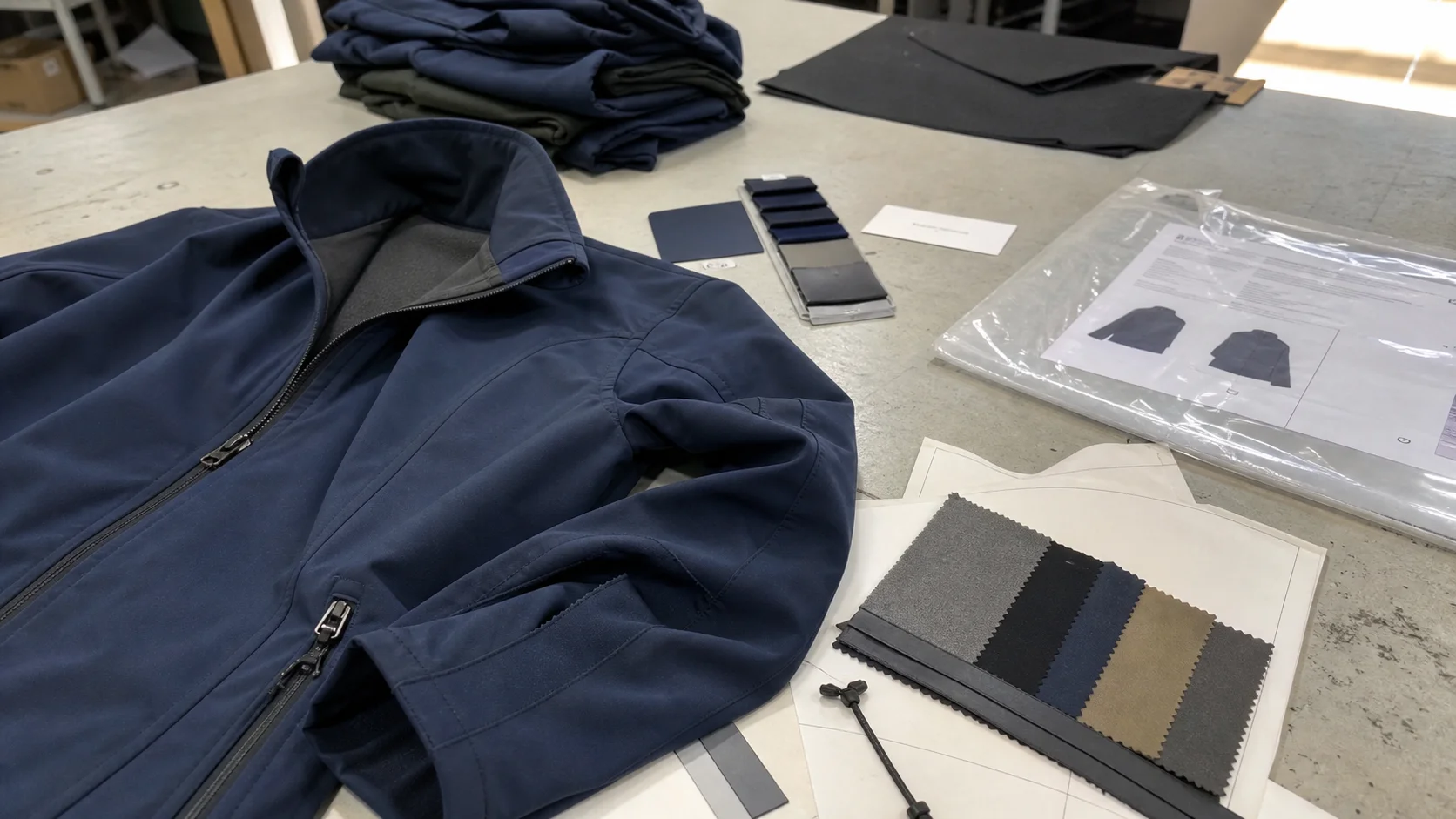
A sourcing-focused outline for transport hub buyers reviewing softshell jacket supplier size grading, fit consistency, sample audits, cost impacts, and MOQ...
Softshell Jacket Size Grading Review for Buyers - MOQ, Cost & Sourcing manufacturing guide
Transport hub buyers source softshell jackets under conditions that are less forgiving than standard corporate uniform programs. Airport ground handlers, rail station crews, port supervisors, parking teams, shuttle staff, courier coordinators, and maintenance contractors all need outerwear that fits a wide range of body types while allowing movement, layering, visibility, and repeated laundering. Size grading is not a cosmetic detail in this category. It affects staff acceptance, re-order accuracy, return rates, inventory waste, and the final landed cost of the program.
For buyers reviewing a softshell jacket supplier, the main question is not simply whether the supplier can provide sizes S to 5XL. The better question is whether the supplier can control the measurement progression from size to size, explain the garment fit, support fit samples before bulk production, and hold tolerances during cutting, sewing, finishing, and packing. A weak size grading system can make a technically acceptable jacket fail at rollout because sleeves are too long on smaller sizes, chest width is too tight after layering, or larger sizes are scaled without enough shoulder and hem adjustment.
This review covers how transport hub buyers should assess size grading before placing a softshell jacket order. It focuses on MOQ, cost, and sourcing decisions, with practical checkpoints for supplier selection, sample approval, specification control, and inspection risk.
Softshell jackets used in transport hubs are work garments, not fashion-only outerwear. Staff may wear them over polo shirts, fleece layers, high-visibility vests, radios, harnesses, ID lanyards, and utility belts. The jacket must allow walking, reaching, lifting, bending, and outdoor exposure. When grading is poor, the wearer feels the problem immediately.
A size chart can look complete on paper while still being unsuitable for operational use. A supplier may offer XS to 6XL, but if the chest grows too slowly between sizes, larger wearers cannot layer comfortably. If the sleeve length grows too quickly, smaller staff may have cuffs covering their hands. If the hem is narrow, the jacket rides up when workers bend or climb into vehicles. These issues usually appear after delivery, when corrections are expensive.
Transport hub buyers also deal with large and mixed workforces. A corporate buyer may order a few hundred jackets across five sizes. A transport operation may need men’s, women’s, and unisex fits across many sizes, with replenishment orders throughout the year. The size grading system must be stable enough for repeat orders, seasonal staff, subcontractor teams, and replacement stock.
Good size grading reduces operational friction. It does not only make the first order fit better; it also makes future replenishment easier to forecast and cheaper to manage.
From a sourcing standpoint, size grading should be reviewed before price negotiation is finalized. A supplier that quotes aggressively but cannot provide a reliable graded spec may create hidden costs through rejects, size exchanges, slow approvals, and inventory imbalance.
Transport hub buyers usually need a practical fit rather than a slim retail fit. A softshell jacket for airport apron staff, logistics coordinators, rail station teams, or terminal security support should give enough ease across the chest, shoulder, upper arm, and hem. The wearer may need to add a mid-layer during colder shifts. The jacket should still look uniform and professional, but it should not restrict movement.
The most common fit routes are unisex regular fit, men’s fit plus women’s fit, or a simplified occupational fit developed from the buyer’s workforce measurements. Each route has tradeoffs.
For transport hub buyers with broad staffing needs, unisex fit can be acceptable when the garment has enough chest ease, adjustable cuffs, a practical hem, and a clear try-on process. For passenger-facing roles where appearance matters, separate men’s and women’s patterns often produce a cleaner fit. For heavy operational roles, movement and layering should take priority over a narrow silhouette.
Buyers should ask suppliers to define the intended wearing condition. A jacket measured over a T-shirt may not work over a fleece or sweatshirt. A supplier should state whether the finished garment measurements include room for layering. If the answer is vague, the sample stage needs to be more rigorous.
A supplier size chart should include finished garment measurements, not only body measurements. Body measurements help with wearer selection, but finished garment measurements are what inspectors can verify in production. For softshell jackets, buyers should request a full graded measurement chart before approving the order.
At minimum, the chart should include chest width, bottom width, shoulder width or across shoulder, sleeve length, back length, armhole, bicep, cuff opening, neck width, and front zipper length. For women’s styles, waist position and hip width may also be important. For longer commuter or outdoor styles, front length and back drop should be reviewed.
Measurement Point Why It Matters Typical Review Risk Chest width Controls layering comfort and core fit Too slim for fleece or uniform shirts Bottom width Affects sitting, bending, and movement Hem too narrow on larger sizes Sleeve length Controls hand clearance and arm coverage Over-graded in big sizes or too long in small sizes Across shoulder Affects reach and posture comfort Too tight for operational movement Bicep Important when worn over layers Upper sleeve not graded enough Back length Controls coverage while bending or climbing Short back exposes lower body during work Cuff opening Affects glove use and wrist comfort Too tight with watches or glovesBuyers should check whether the supplier uses consistent increments. For example, chest width may increase by about 4 cm in total circumference between standard adult sizes, though the exact rule depends on market, fit, and garment type. Larger sizes may need a different progression, especially from 3XL upward. Sleeve length should not increase at the same rate as chest width. Human bodies do not scale evenly in every direction.
A practical review method is to compare the middle size, usually M or L, with the smallest and largest sizes. If the largest size looks like a simple mathematical enlargement without enough bicep, hem, or shoulder correction, the pattern may not work in real use. Ask the supplier to provide graded pattern logic or at least explain the size increments clearly.
If your organization needs support structuring a sourcing brief, the service overview at fabrikn.com/services/ can help buyers frame garment requirements before approaching suppliers.
Size grading is the method used to increase or decrease a base pattern into other sizes. In softshell jackets, the base size is often M, L, or a regional equivalent. The supplier grades the pattern up and down based on chest, length, sleeve, shoulder, and other measurement rules.
Transport hub buyers do not need to become pattern technicians, but they should understand the commercial risks of grading shortcuts. The most common shortcut is proportional scaling. It is fast, but it may create awkward results at the edge sizes. Small sizes can become too long, while large sizes can remain tight in the armhole or hem.
Chest width is usually the first number buyers review, but hem width can be just as important. Many transport workers carry radios, keys, phones, tools, or belt equipment. A jacket that fits at the chest but grips at the hem will ride up. For larger sizes, hem grading should not be ignored.
Softshell fabric has some stretch, but stretch is not a substitute for a correct pattern. Staff may lift baggage, signal vehicles, push carts, inspect platforms, or handle barriers. If the armhole is too low, movement feels bulky. If it is too tight, the jacket pulls across the back. Buyers should evaluate both standing fit and movement fit during sample trials.
Sleeve length is often a problem in extended sizes. Larger chest sizes do not always require much longer sleeves. If a supplier applies aggressive sleeve increases from XL to 5XL, cuffs may cover the hands. Adjustable cuffs help, but they do not fully solve a bad sleeve grade.
If the program includes women’s jackets, a men’s pattern reduced and relabeled is not a proper women’s fit. Women’s grading may need different chest, waist, hip, and sleeve balance. For a transport hub, the aim is not fashion tailoring; the aim is practical fit, professional appearance, and movement.
Size labels vary by market. A European L, US L, UK L, and Asian L may not match. Suppliers should provide finished measurements in centimeters or inches and not rely only on letter sizes. For multinational transport groups, body measurement guidance should be localized for staff ordering portals or uniform issue sheets.
MOQ is one of the first commercial constraints in softshell jacket sourcing. Typical supplier MOQ ranges vary widely depending on whether the jacket is stock, semi-custom, or fully custom.
Sourcing Route Typical MOQ Range Size Grading Flexibility Buyer Tradeoff Stock softshell jacket with logo 50–300 pieces per color/style Limited to existing supplier chart Fast and lower risk, but less control over fit Semi-custom softshell jacket 300–800 pieces per color/style Some adjustment possible Balanced option for mid-size programs Fully custom softshell jacket 800–1,500+ pieces per color/style Strongest control if supplier is capable Higher development time and stronger planning neededThese ranges are general market references, not guarantees. MOQ depends on fabric availability, color, membrane type, trims, factory loading, printing or embroidery requirements, and the number of sizes ordered. A supplier may accept a low total MOQ but require minimum cutting quantities per size. Small sizes and very large sizes often create leftover fabric and cutting inefficiency.
Extended sizes can increase MOQ pressure. If a buyer needs XS to 6XL across men’s and women’s fits, the number of SKUs grows quickly. A 1,000-piece order spread across 18 size-and-fit combinations may be less efficient than the same order across 7 sizes. Suppliers may charge surcharges for low-quantity edge sizes or request minimum quantities for 4XL, 5XL, and 6XL.
Buyers should avoid placing equal quantities across all sizes unless workforce data supports it. A better approach is to collect past uniform issue records, HR size declarations, trial fitting results, or distribution history. If no data exists, use a conservative size curve and hold a small reserve in common sizes for exchanges.
For transport hub operations, size forecasting is not a one-time exercise. Staff turnover, seasonal hiring, subcontractor changes, and weather patterns all affect replenishment. A supplier that can support repeat orders with stable size specs may be worth a higher unit price than a supplier that treats each order as a one-off production run.
Size grading affects cost in several ways. The most obvious is fabric consumption. Larger sizes use more shell fabric, lining if applicable, zipper length, seam tape if used, drawcord, and packaging volume. The less obvious cost is operational inefficiency: more pattern work, more size sets, more inspection points, and more exchange management after delivery.
Many suppliers quote one price across all sizes up to a certain point, then apply surcharges for larger sizes. A common structure is one price for XS to XL, a small surcharge for 2XL to 3XL, and a higher surcharge for 4XL and above. The exact approach depends on supplier policy and fabric cost. Buyers should ask whether the quotation includes all sizes or whether extended sizes are priced separately.
Cost Driver Why It Changes Price Buyer Review Point Fabric consumption Larger patterns require more material Ask if size surcharges apply from 2XL upward Custom grading Pattern development and checking take time Clarify if grading is included in development fee Low size quantities Small cutting lots reduce efficiency Negotiate edge-size handling before order confirmation Separate men’s and women’s fits Requires more patterns and size sets Confirm MOQ per fit, not just total MOQ Inspection complexity More sizes require more measurement checks Build measurement inspection into the quality planThe lowest jacket price is not always the lowest program cost. A poorly graded jacket may create high exchange rates. If 15% of the workforce requests a replacement size, the buyer may lose any initial savings through extra freight, admin time, urgent reorders, and dissatisfied staff. For transport hubs with fixed rollout dates, late corrections can be especially expensive.
Buyers should request a price breakdown that separates garment cost, logo application, development samples, size-set samples, bulk freight, and any surcharge for extended sizes. This makes supplier comparison cleaner. It also prevents a situation where a supplier wins on headline price but later charges for grading work that should have been discussed at the start.
Softshell jacket sampling should be structured. A single salesman sample in size L is not enough for a transport hub program. Buyers should build approval in stages and link each stage to clear measurements and use conditions.
The base sample confirms style, fabric handfeel, construction, branding position, zipper function, pocket layout, cuff design, and general fit. The buyer should measure it against the supplier’s spec and note any deviation. If the base sample is already outside tolerance, the supplier’s production control may need closer review.
Before size-set sampling, the buyer and supplier should freeze the points of measure. The document should define exactly how each measurement is taken. For example, chest width should state whether the jacket is measured 2.5 cm below the armhole, straight across, with zipper closed and garment laid flat. Ambiguity at this stage causes disputes during inspection.
For custom orders, buyers should request size-set samples across the full range or at least key sizes such as S, L, 2XL, and 5XL. If the order includes women’s fit, size-set review should be separate. For lower MOQ programs, the supplier may resist a full size set, but at minimum the buyer should approve the smallest, base, and largest sizes before bulk cutting.
Fit trials should involve actual or representative wearers, not only office review. Test with typical underlayers. Ask wearers to raise arms, bend, sit, zip the jacket fully, use pockets, wear gloves if relevant, and move as they would during a shift. Record feedback by size and body type. Do not rely only on comments such as “fits fine.”
The pre-production sample should reflect final fabric, trims, branding, color, construction, and measurements. This sample becomes the reference for bulk production. The approved size chart should be attached to the purchase order or technical pack.
Finished garments should be inspected by size. Softshell jackets commonly need measurement tolerances such as plus or minus 1 cm for smaller points and plus or minus 1.5 cm to 2 cm for larger widths, depending on the point of measure and buyer standard. Tolerances should be agreed before production, not after defects are found.
Buyers who want a conversation about setting up a supplier brief can use fabrikn.com/contact-us/ to discuss requirements, timelines, and sourcing scope.
Size grading cannot be reviewed separately from fabric and trim specifications. Softshell fabric behavior affects how a jacket fits, stretches, recovers, and feels during work. A correct measurement chart may still perform poorly if the fabric is too stiff, too light, too stretchy, or unstable after washing.
Common softshell fabrics include polyester outer face with spandex or elastane, bonded fleece backing, and sometimes a TPU or PU membrane for wind and water resistance. Fabric weights often range from about 250 gsm to 350 gsm for many workwear softshells, though lighter or heavier options exist. Transport hub buyers should choose based on climate, role, layering system, and durability expectations.
Specification Typical Buyer Question Fit and Grading Impact Fabric weight Is it suitable for the working climate? Heavier fabric may need more ease for movement Stretch content Does the fabric stretch and recover? Good stretch can improve comfort, but grading still matters Bonded backing Is the inner fleece bulky? Bulk affects sleeve, armhole, and chest comfort Membrane Is wind or water resistance required? Some membranes reduce drape and flexibility Zipper quality Will it survive daily use? Stiff zippers can affect front length and wearing comfort Cuffs and hem adjusters Are they easy to use with gloves? Adjustability can help fit, but cannot fix poor gradingTrim selection matters for transport hub uniforms. Zippers should be durable and easy to operate. Pocket openings should fit radios, phones, or job-specific items if required. Reflective trims may be needed depending on visibility requirements, but they must be placed without restricting stretch or creating seam puckering. Drawcords should be reviewed for safety if staff work near machinery or moving vehicles.
Branding also affects fit and comfort. Large embroidery can stiffen the chest or back. Heat transfers may crack if applied to high-stretch zones. Bad placement can irritate wearers under backpack straps, harnesses, or radio equipment. Buyers should review logo technique as part of the sample approval process, especially for transport roles where uniforms are worn for long shifts.
Fabric shrinkage is another important point. Many synthetic softshell fabrics have limited shrinkage compared with cotton garments, but bonded fabrics can still show dimensional change after washing or heat exposure. Buyers should ask for test data where relevant and confirm care labels. If the jacket is industrially laundered, that must be disclosed before fabric approval. Domestic wash approval does not automatically mean the jacket will survive commercial laundering.
Measurement inspection is where many size grading problems become visible. A buyer may approve a good sample, then receive bulk goods with inconsistent sleeves, twisted panels, uneven hems, or size labels that do not match measurements. Softshell jackets are more complex than simple T-shirts because bonded fabric, zippers, pockets, topstitching, cuffs, and hem adjustments all influence finished measurements.
Inspection should include both workmanship and measurement checks. The measurement sample size should cover key sizes, not only the most common size. If the shipment includes 5XL garments, those garments should be measured. Edge sizes are often where grading and cutting errors appear.
Buyers should define acceptable quality levels and measurement tolerances before production. If a third-party inspection is used, the inspector needs the approved sample, size chart, packing list, artwork, and measurement method. Without these documents, inspection becomes subjective.
For transport hub buyers, carton packing also deserves attention. Goods should be packed by style, color, size, and sometimes department or location. Poor packing creates delays during rollout. If the jackets are being distributed to multiple terminals, stations, depots, or contractors, the packing plan should be aligned with the buyer’s issue process.
A pre-shipment inspection is useful, but it is late in the process. For larger orders or new suppliers, buyers may also consider inline checks after cutting and during sewing. This helps catch wrong graded patterns before all units are completed. The cost of an inline check is often lower than the cost of rejecting a full shipment.
A supplier’s size grading capability can be assessed through direct questions. Strong suppliers usually answer with documents, samples, and clear limitations. Weak suppliers often answer with general assurances such as “standard size” or “we can make all sizes.” Those answers are not enough for transport hub programs.
Question Good Supplier Response Warning Sign Can you provide finished garment measurements for all sizes? Provides full graded chart with points of measure Only provides S, M, L body chart What is your base size? Clearly states base size and grading approach Cannot identify base pattern Can we approve size-set samples? Confirms timing, sample cost, and sizes available Pushes directly to bulk production What tolerance do you hold in production? Provides realistic tolerance by measurement point Says all pieces will be exactly the same Do larger sizes carry surcharges? Discloses price structure before order Mentions surcharges only after quotation approval Can you repeat the same size spec next season? Maintains technical file and approved pattern reference Treats repeat order as a new style without controlsBuyers should also ask how the supplier manages fabric lots, graded markers, cutting records, and size labels. These are production control details, but they influence the final delivery. A supplier that cannot explain these basics may struggle with extended sizing.
Company background also matters. Buyers can review a sourcing partner’s positioning and operating model through pages such as fabrikn.com/about-us/ before starting a more detailed discussion.
Lead time for softshell jacket sourcing depends on fabric availability, sample rounds, trims, branding, order quantity, testing, and production capacity. Size grading adds time when the buyer requests custom measurements, extended sizes, or separate men’s and women’s fits.
For stock jackets with logo decoration, lead time may be a few weeks if inventory is available. For semi-custom jackets, buyers should often plan around 6 to 10 weeks after approvals, depending on fabric and decoration. For fully custom softshell jackets, 10 to 16 weeks or more can be realistic, especially if fabric must be dyed, laminated, tested, or imported. These are broad planning ranges and should be confirmed with the supplier for each project.
Stage Typical Time Consideration Main Risk Brief and quotation Several days to 2 weeks Incomplete size and fabric requirements Base sample 1 to 3 weeks if materials are available Wrong fit direction or trim substitution Size-set samples 1 to 3 weeks after base approval Edge sizes not reviewed before bulk Fabric and trim procurement 2 to 6 weeks or longer Custom color or membrane delays Bulk production 4 to 8 weeks depending on quantity Capacity pressure and measurement drift Inspection and shipping 1 to 6 weeks depending on route Late defects or distribution delaysBuyers should not compress the sample stage to recover time lost during procurement. Fit errors created at the beginning usually become larger and more expensive at the end. If rollout timing is fixed, simplify the garment rather than skipping size-set approval. For example, choosing a proven stock or semi-custom fit may be wiser than developing a new pattern under an unrealistic deadline.
Every buyer wants a jacket that fits everyone well, costs less, ships quickly, and requires no extra stock. In practice, tradeoffs are unavoidable. A highly customized size range improves fit but increases development time and SKU complexity. A stock size chart reduces lead time and cost but may increase wearer dissatisfaction. Separate male and female fits improve appearance but increase MOQ pressure. Extended sizes support workforce inclusion but may require surcharges and careful forecasting.
The right sourcing decision depends on order size and operational risk. For a small transport contractor, a stock jacket with a clear size chart and try-on samples may be enough. For a major hub operator ordering thousands of units, custom grading and a formal size trial are usually worth the effort. For a multi-site buyer, consistency across repeat orders may matter more than shaving a small amount from the first order price.
Buyers should classify the order before choosing the sourcing route:
A practical buyer does not over-engineer every order. The grading review should match the scale of risk. If the order is small and urgent, spend time checking the supplier’s existing fit and availability. If the order is large and visible, invest in technical control before committing to bulk.
Before placing a softshell jacket order, transport hub buyers should confirm the commercial and technical details together. Price, MOQ, and delivery date mean little if the size chart is not fit for the workforce.
This checklist is especially important when sourcing from a new supplier. A repeat supplier with proven patterns still needs review if the buyer changes fabric, fit, size range, or branding placement. Even a small material change can affect how the jacket wears.
For transport hub buyers, the best softshell jacket supplier is not always the one offering the widest size range or the lowest MOQ. The stronger supplier is the one that can show a controlled graded spec, support realistic sample approval, explain production tolerances, and repeat the same fit for replenishment orders.
If the order is urgent and small, stock jackets with try-on samples may be the safest commercial route. If the order is large, visible, or long-term, custom grading review is worth the added time. Buyers should be cautious with suppliers that avoid size-set samples, refuse to provide finished measurements, or promise exact production measurements with no tolerance. Apparel production always has tolerances. Serious suppliers manage them; weak suppliers deny them.
A good sourcing decision balances fit, MOQ, cost, and lead time. Softshell jackets in transport hubs need to perform across real bodies, real shifts, and real weather. Size grading is where that performance begins.
Get a free quote from Fabrikn — your trusted B2B clothing manufacturer with 10+ years of experience. MOQ as low as 200 pieces.
Get a Free Quote →Size grading is the process of increasing or decreasing a base jacket pattern to create other sizes. For buyers, it controls how chest, hem, sleeve, shoulder, bicep, and length measurements change across the size range.
Typical MOQs can range from about 300 to 800 pieces for semi-custom jackets and 800 to 1,500 or more for fully custom jackets. Stock jackets with logo decoration may start lower, often around 50 to 300 pieces, depending on supplier inventory and decoration requirements.
Unisex fit is simpler and often cheaper to manage, especially for lower-volume orders. Separate men’s and women’s fits usually improve wearer satisfaction and appearance, but they increase SKU count, MOQ pressure, and sample requirements.
Chest width, bottom width, sleeve length, shoulder width, bicep, armhole, back length, and cuff opening are key points. For women’s styles, waist and hip measurements should also be reviewed.
Larger sizes use more fabric and trims and may reduce cutting efficiency when quantities are low. Some suppliers quote one price up to XL or 2XL, then apply surcharges for extended sizes.
For large or custom transport hub orders, size-set samples are strongly recommended. At minimum, buyers should review the smallest, base, and largest sizes before bulk production.
Tolerances vary by buyer standard and point of measure. Many programs use smaller tolerances for narrow points and larger tolerances for chest, hem, and length measurements. The tolerance should be agreed in writing before production.
Fabric weight, stretch, bonded backing, and membrane structure all affect comfort and movement. A heavier or stiffer fabric may require more ease than a lighter stretch fabric.
The biggest risk is that bulk production does not match the approved graded size chart. Edge sizes, sleeve length, chest width, size labels, and logo placement should be checked carefully.
Use finished garment measurements, approve size-set samples, run wearer trials with real underlayers, and forecast quantities from workforce data. Holding reserve stock in common sizes also helps manage exchanges without urgent reorders.