
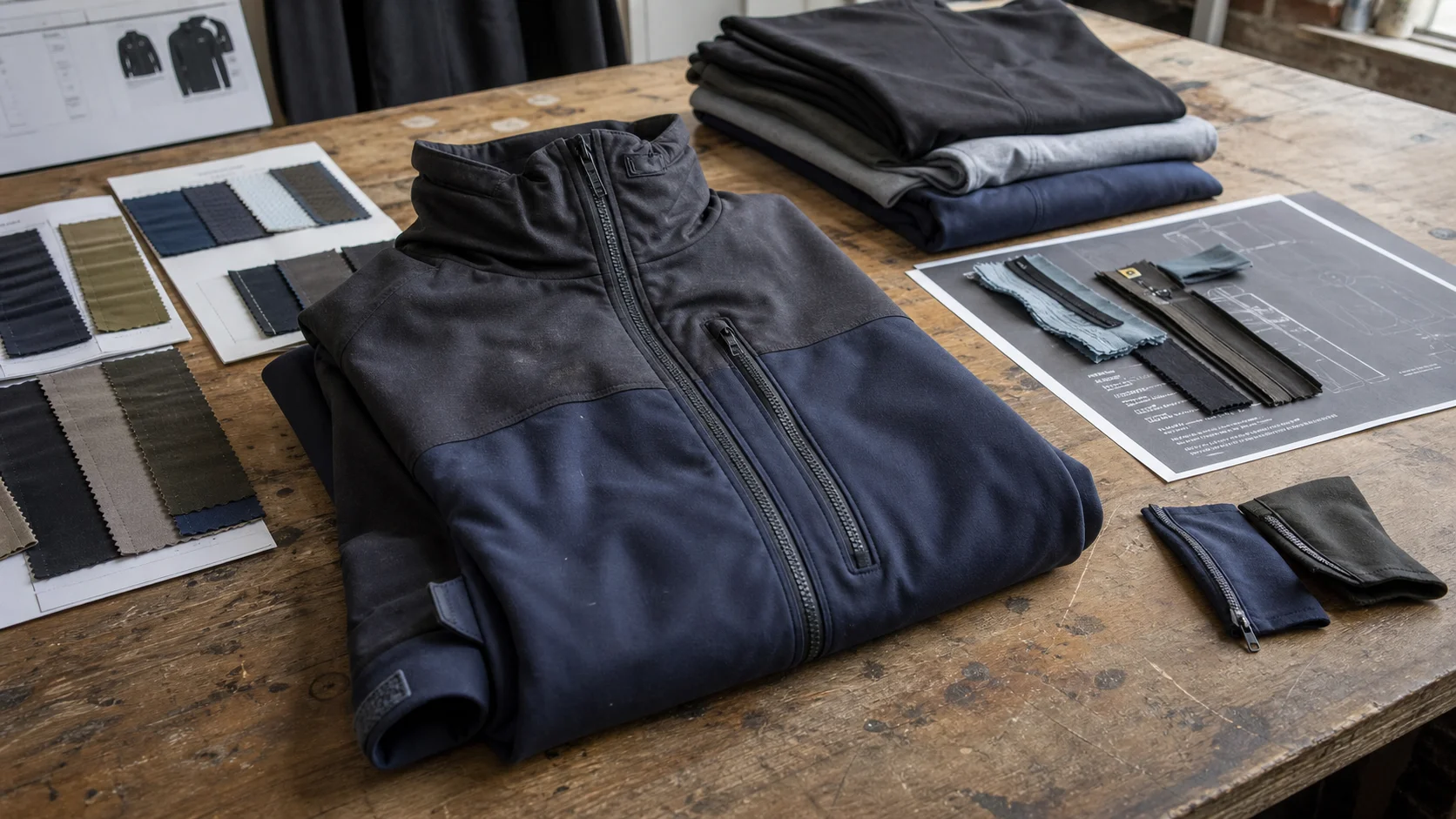
A quality and inspection-focused outline for fitness club buyers sourcing branded softshell jackets, covering fabric performance, decoration readiness,...
Softshell Jacket Compliance Checklist for Buyers - Quality & Inspection manufacturing guide
Fitness club buyers source softshell jackets for a very specific environment. The garment must look sharp at reception, move comfortably during outdoor training, tolerate repeated washing, and carry club branding without cracking, peeling, or distorting the fabric. A basic product photo is not enough. Before placing a purchase order, buyers need a compliance checklist that covers fabric performance, construction, labeling, decoration, packaging, inspection, and supplier readiness.
This guide is written for gym chains, boutique fitness studios, wellness clubs, outdoor training programs, corporate fitness teams, and merchandise buyers who need a practical softshell jacket supplier compliance checklist. It focuses on the quality and inspection decisions that reduce returns, late deliveries, inconsistent sizing, and brand complaints.
Buying judgment: a low unit price is rarely the best deal if the supplier cannot control fabric weight, color consistency, seam strength, branding placement, and final inspection. For fitness club uniforms, visible inconsistency across staff members is the problem buyers notice first.
Softshell jackets sit between sportswear and outerwear. They are usually expected to offer stretch, wind resistance, light water resistance, warmth, and a clean professional appearance. For fitness clubs, that combination is useful for front-desk staff, trainers, outdoor class instructors, event teams, and retail merchandise programs.
The compliance challenge is that softshell jackets are more complex than basic T-shirts or hoodies. The fabric may include bonded layers, TPU film, fleece backing, elastane, water-repellent finishing, zipper systems, adjustable hems, cuffs, pocket bags, and heat-transfer branding. Each component affects comfort, durability, cost, and inspection risk.
Fitness club buyers should treat softshell jackets as a controlled uniform program, not a casual merchandise item. Even when the order volume is modest, the product has enough technical details to justify written specifications and staged approvals.
A strong checklist does not remove every risk, but it makes problems easier to identify before bulk production is complete.
Before discussing price, buyers should confirm whether the supplier can actually manage softshell jacket production. A supplier that is comfortable with basic knitwear may not have the same control over laminated fabrics, outerwear trims, pocket construction, and seam bulk.
Buyers looking for a structured manufacturing partner can review apparel production support options through Fabrikn services. A clear service scope helps prevent misunderstandings around product development, sampling, production follow-up, and inspection responsibilities.
Softshell fabric is the core compliance area. Buyers should not rely on broad terms such as “premium softshell” or “waterproof jacket” without measurable details. Many softshell jackets are water resistant, not fully waterproof. The distinction matters because clubs may use them for outdoor boot camps, commuting staff, and event teams, but not necessarily for heavy rain protection.
For fitness club buyers, the best choice depends on use. A receptionist commuting between sites may need a warmer fleece-backed option. A trainer leading outdoor mobility sessions may prefer lighter stretch fabric with less bulk. Retail merchandise buyers may prioritize clean hand feel, logo appearance, and a flattering fit.
Buying judgment: do not pay for a membrane or “waterproof” claim unless the club actually needs it. For many fitness club uniforms, a reliable DWR finish, comfortable stretch, stable color, and strong logo application are more commercially important.
Construction quality determines whether the jacket still looks professional after staff wear it every week. Softshell jackets need more attention than basic fleece because the fabric can be thicker, seams can become bulky, and topstitching defects are highly visible.
For fitness club buyers, seam comfort matters. Staff may wear jackets over polo shirts, sports bras, hoodies, or base layers. Bulky seams at the shoulder or underarm can feel uncomfortable during movement and may lead to staff avoiding the garment.
Small trims create large complaints when they fail. A zipper that breaks on a staff uniform creates an immediate operational issue, while a loose cord lock makes the product feel cheap. Buyers should approve trims physically, not only through photos.
Fit is one of the most common reasons uniform programs disappoint staff. A softshell jacket can meet fabric and workmanship standards but still fail if trainers cannot move comfortably or if front-desk teams feel the silhouette is unflattering.
Unisex sizing can reduce inventory complexity, but it often creates fit compromises. Women may find the shoulders too wide or the body too boxy. Men may find smaller sizes tight across the chest or short in the sleeve. For staff uniforms, a unisex style may be acceptable if the club prioritizes operational simplicity. For retail merchandise, separate men’s and women’s fits often sell better.
Wear testing does not need to be complicated. A short structured check can reveal issues that a flat measurement table will miss. If the order is for a larger club group, buyers should test at least one middle size and one edge size before bulk approval.
Branding is a major reason fitness clubs order custom softshell jackets. The logo must look consistent across staff uniforms and retail pieces. Poor decoration can ruin an otherwise acceptable jacket.
Softshell fabric with water-repellent finishing can create adhesion challenges for heat transfers and prints. Buyers should never assume that decoration used on cotton hoodies will perform the same on softshell jackets. The supplier should test the actual logo method on the actual bulk fabric.
Buying judgment: embroidery often feels more durable and premium, but it can pucker on stretch softshell. Heat transfer can look cleaner, but only if the supplier proves adhesion on the selected fabric.
Labeling is not just a compliance formality. It affects customs clearance, retail presentation, wearer care, and reorder control. Fitness club buyers should define labeling requirements before sample approval so the supplier can build them into the production plan.
Care labels should match the tested garment, not a generic template. If the jacket uses heat-transfer logos, reflective trims, membrane fabric, or special coatings, the care instructions should protect those features. Overly aggressive wash or tumble-dry instructions can shorten product life and increase complaints.
For retail sales inside a club, presentation matters more than many buyers expect. A jacket that arrives crushed, mislabeled, or mixed by size creates extra labor for the receiving team. Clean packing improves stock handling and reduces launch delays.
Sampling should move in stages. Skipping sample approvals can save a few days early in the process but create expensive corrections during bulk production. A disciplined sample route is especially important when the order includes custom colors, custom trims, or club-specific branding.
Not every order needs every stage. A repeat order of a stock style with the same logo may only need a logo strike-off and pre-production confirmation. A new custom style should go through a more complete approval route.
Written approvals protect both sides. They reduce arguments about whether a supplier followed instructions and help buyers maintain a clear record for reorders.
Minimum order quantity and lead time vary by supplier, style complexity, fabric availability, trim customization, and decoration method. Buyers should ask for MOQ by style, color, and size rather than relying on a single headline number.
These ranges are typical market reference points, not fixed rules. Some suppliers may accept lower MOQs at higher unit prices, especially for stock styles. Custom fabric, dyed-to-match trims, and private-label packaging usually increase MOQ pressure.
Lead time depends heavily on when approvals are completed. Delayed artwork approval, late size breakdowns, trim changes, and repeated fit corrections can push the schedule. Buyers should not judge lead time from production days alone. The full calendar includes sampling, approval, material booking, production, inspection, packing, and transit.
For buyers planning a new club opening, staff rollout, or seasonal outdoor training launch, softshell jackets should be sourced earlier than basic tees. The fabric and trim dependencies justify a longer planning window.
Final inspection should be based on the approved pre-production sample, measurement table, defect classification, packing instructions, and purchase order. The goal is to confirm that bulk goods match what was approved before the jackets leave the supplier.
AQL standards may be used for larger orders, but the buyer should define acceptable quality limits before inspection. For small orders, a full or higher-percentage inspection may be more practical, especially when the jackets are for a visible staff launch.
Not every small measurement deviation requires rejection. A chest measurement outside tolerance is more serious than a minor label placement variation. Buyers should apply judgment based on wear impact, brand visibility, and the likelihood of customer complaints.
Functional failures are often more important than cosmetic defects. A small thread end can be trimmed. A zipper that jams or a logo that peels after light handling is a stronger rejection reason.
A supplier scorecard helps buyers compare options beyond price. Fitness clubs often order apparel repeatedly, so supplier consistency matters. A slightly higher-priced supplier may be the better choice if they reduce sampling rounds, hit delivery windows, and maintain size consistency.
Buyers should not score suppliers only after bulk production. The sampling stage already reveals important behavior. Slow responses, vague fabric claims, missing trim details, and repeated misunderstanding of logo placement are early warnings.
For buyers who want to discuss product development and sourcing expectations before committing to a supplier, the Fabrikn contact page is a practical next step. Supplier alignment is easier before the purchase order than after production starts.
The checklist below can be used as a working buyer tool before issuing a purchase order.
Compliance Area Buyer Check Status Supplier capability Supplier has relevant softshell or outerwear production experience. To confirm Fabric specification Weight, composition, backing, stretch, finish, and color are documented. To confirm Performance testing Shrinkage, pilling, colorfastness, and water resistance are reviewed. To confirm Fit approval Fit sample and wear test are approved before bulk cutting. To confirm Size set Grading is checked across ordered sizes. To confirm Trim approval Zippers, pullers, labels, cords, snaps, and bindings are approved. To confirm Logo approval Decoration strike-off is approved for placement, color, and durability. To confirm Care labeling Labels match the actual fabric, trims, and decoration method. To confirm Packaging Fold method, polybag, barcode, carton marks, and size sorting are agreed. To confirm Inspection plan Defect standards, measurement tolerances, and inspection timing are agreed. To confirm Lead time Sampling, material booking, production, inspection, and transit dates are scheduled. To confirm Reorder control Approved sample, fabric records, and color standards are retained. To confirmFor fitness club buyers, the safest softshell jacket sourcing route is not always the most customized route. If the order is small, a stock softshell jacket with approved branding may offer better speed, lower MOQ, and fewer fit risks. If the jacket is part of a major brand refresh or retail program, custom development may be worth the extra sampling time and higher MOQ.
The right choice depends on volume, launch date, brand expectations, and staff use. A club ordering 80 jackets for trainers has different priorities from a national fitness chain rolling out 5,000 jackets across multiple locations. Small buyers should focus on fabric comfort, logo quality, and reliable delivery. Larger buyers should add stronger controls for color continuity, size grading, inspection data, and reorder consistency.
Buyers can also learn more about apparel manufacturing background and sourcing perspective through Fabrikn about us. Supplier selection works best when expectations are documented early and checked at each stage.
Practical conclusion: approve the fabric, fit, trims, branding, labels, and packing before bulk production. Inspect the final goods against those approvals. This is the simplest way to reduce softshell jacket compliance risk for fitness club orders.
Get a free quote from Fabrikn — your trusted B2B clothing manufacturer with 10+ years of experience. MOQ as low as 200 pieces.
Get a Free Quote →Start with the intended use. A jacket for outdoor trainers needs better mobility and weather resistance than a reception uniform. After that, confirm fabric weight, stretch, fit, branding method, MOQ, lead time, and inspection requirements.
Typical MOQs range from around 50-200 pieces for stock jackets with logo decoration, 300-800 pieces for custom colors or trims, and 500-1,500 pieces for fully custom softshell jackets. The exact MOQ depends on fabric sourcing, trim requirements, supplier capacity, and decoration method.
Stock styles with simple branding may take around 2-5 weeks after approval. Custom softshell jackets often require 6-10 weeks for bulk production after sample approval and material readiness. Sampling, inspection, and shipping time should be added to the calendar.
Embroidery can look premium and durable, but it may pucker on stretch softshell fabric if not handled correctly. Heat transfer can look clean and sporty, but adhesion must be tested on the actual softshell fabric. The better option depends on fabric surface, logo size, wash expectations, and brand style.
Many softshell jackets are water resistant rather than fully waterproof. Some three-layer softshells with membranes offer stronger protection, but buyers should confirm the test method and performance target. For most fitness club uniforms, light rain resistance and comfort are often more practical than full waterproofing.
Broken zippers, fabric delamination, open seams, incorrect logos, wrong size labels, major color variation, and poor logo adhesion are serious defects. These issues affect usability, brand appearance, or product durability.
Yes, especially for custom orders or multi-size uniform programs. A size set helps confirm grading across sizes and reduces the risk of jackets fitting well in one size but poorly in others.
Many fitness club softshell jackets fall around 250-350 gsm. Lighter fabrics are better for movement and layering, while heavier fleece-backed options provide more warmth. Buyers should choose based on climate, wearer activity, and uniform style.
A practical supplier should provide a product specification sheet, fabric details, trim details, sample measurement report, production schedule, packing information, and final inspection support. Test reports are useful when performance claims are important.
Keep the approved pre-production sample, fabric swatch, trim records, logo strike-off, size chart, and packaging details. Reorders should be checked against the original standards because fabric shade, trim availability, and supplier materials can change over time.