
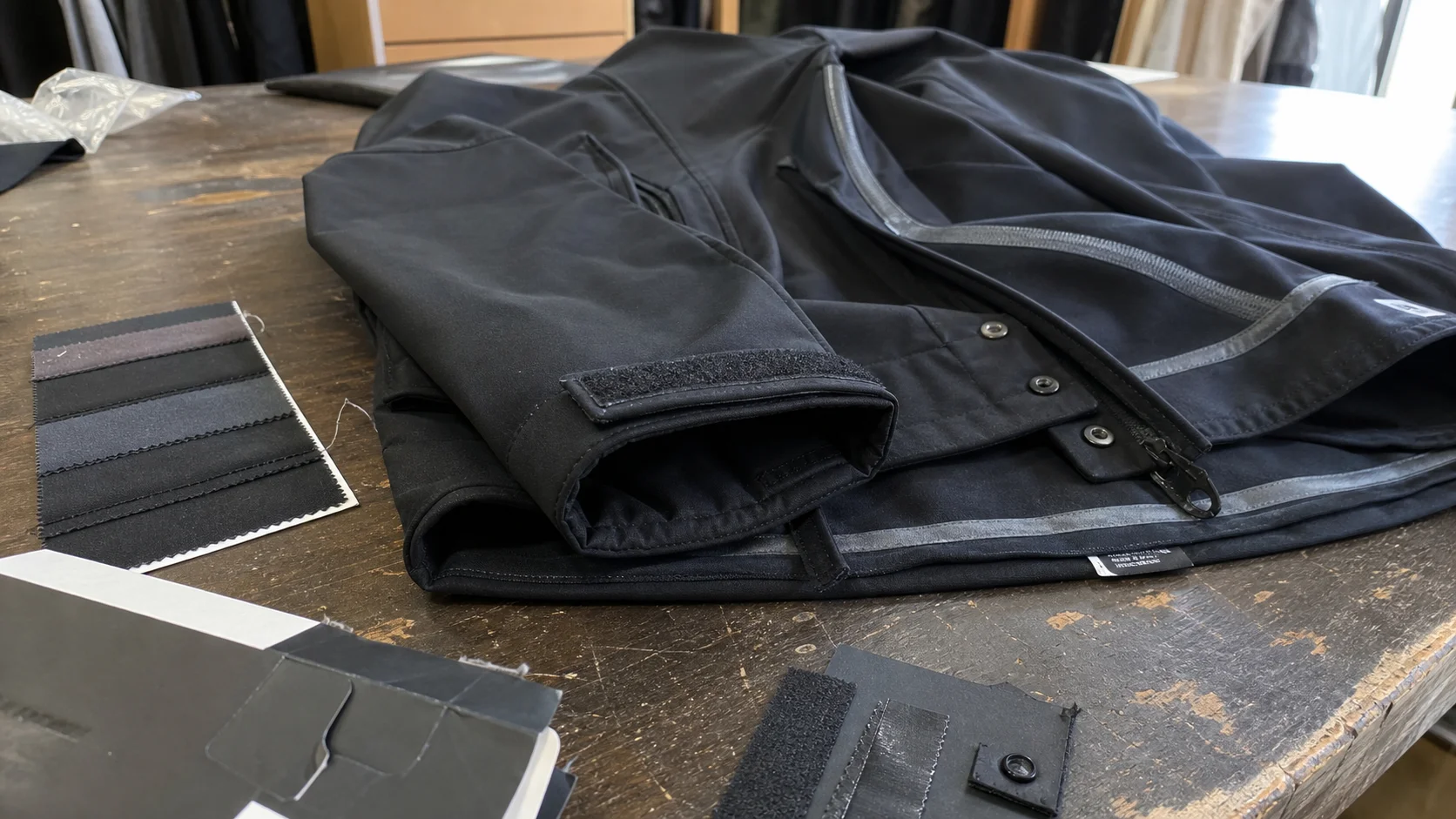
A quality-focused outline for restaurant group buyers reviewing zippers, pulls, snaps, cuffs, labels, and reflective trim on branded softshell jackets...
Softshell Jacket Trim Review for Restaurant Buyers - Quality & Inspection manufacturing guide
Softshell jackets are often bought as uniform outerwear, but the trim package usually decides whether the program feels professional after three months of use. A restaurant group may focus first on fabric weight, color, logo placement, and unit cost. Those are important. The zipper, puller, cuff adjuster, drawcord, pocket opening, label, snap, and packaging details are what staff touch every shift.
Trim failure is also more visible than fabric fatigue. A broken front zipper makes the jacket unusable. A peeling logo puller makes the brand look cheap. A rough zipper tape can snag aprons, shirts, or lining. Weak pocket zippers frustrate managers who carry keys, order devices, and small tools. Loose hook-and-loop tabs catch on knit uniforms and create a worn look quickly.
For restaurant groups, trim sourcing is not a decoration exercise. It is a durability, safety, brand-control, and replacement-cost issue. The right review should compare trims against the actual working environment: cold storage, back doors, patios, delivery routes, wet weather, repeated washing, grease exposure, and high employee turnover.
Buyers working on a multi-location uniform program should treat trim as a bill-of-materials decision, not an afterthought. A well-built trim specification reduces sampling loops, keeps factories from substituting cheaper components, and gives inspectors measurable points to check. If the sourcing process needs outside support, buyers can review production and inspection options through Fabrikn services before committing to a bulk order.
A softshell jacket for restaurant use sits between corporate apparel and workwear. It needs to look clean enough for front-of-house or curbside pickup, but it also has to handle movement, spills, weather, and frequent laundering. This mix creates trim requirements that are different from promotional outerwear.
Restaurant teams use jackets in several ways. Managers wear them while moving between dining rooms, patios, storage areas, and parking lots. Delivery staff may wear them in wind, drizzle, and low-light conditions. Hosts and curbside teams need pockets that are easy to open while holding bags, tablets, scanners, or receipts. Kitchen-adjacent staff may expose trims to steam, oil mist, cleaning chemicals, and repeated abrasion against counters or shelves.
The trim package should be reviewed against these conditions before price negotiation. Low-cost trims can pass a showroom review and fail in use. A zipper that feels acceptable on a sample may become stiff when staff are wearing gloves. A narrow pocket opening may look neat on a size medium but feel impractical on larger sizes. A plastic cord stopper may crack in cold conditions if the grade is too brittle.
Purchasing judgment: restaurant buyers should not buy the cheapest trim package available unless the jacket is intended for a short seasonal promotion. For core uniform programs, spend the budget on the center-front zipper, pocket closures, cuffs, and labels before adding decorative branding trims.
A complete softshell jacket trim review should start with a trim card and a bill of materials. The trim card should show physical examples of every component used in bulk production. The bill of materials should list size, material, color, finish, placement, supplier reference, and tolerance where possible.
Trim Component Common Specification Points Restaurant Buyer Risk Center-front zipper Coil or molded tooth, size #5 or #8, auto-lock slider, tape color, puller type Failure makes the jacket unwearable Pocket zippers Coil zipper, reverse coil option, welt or exposed design, puller length Snagging, poor access, lost items Cuff tabs Hook-and-loop grade, rubber tab, molded tab, stitch reinforcement Lint collection, peeling, weak closure Drawcords and stoppers Elastic cord, flat cord, cord lock material, end tips Choking risk, breakage, uneven hem adjustment Labels Main label, size label, care label, country of origin, fiber content Compliance issues and staff discomfort Logo trims Embroidery, heat transfer, patch, zipper pull branding Brand inconsistency, peeling, color mismatch Reflective tape Width, reflectivity grade, wash rating, placement Low visibility and poor wash durabilityRestaurant buyers should ask the supplier to separate standard trims from custom trims. Standard trims usually have better availability, lower minimums, and faster replacement options. Custom trims improve brand presentation but can extend lead times and raise MOQ. For a chain rolling out jackets across many locations, a balanced approach often works best: standard performance trims with controlled brand details such as embroidery, woven labels, or a modest branded puller.
The center-front zipper deserves the most scrutiny. For most restaurant softshell jackets, a #5 coil zipper is common because it is flexible, reasonably durable, and cost-effective. A #8 zipper may be considered for heavier jackets, delivery outerwear, or workwear-style programs. Molded tooth zippers can look rugged, but they are less flexible and can feel bulky on lighter softshell fabrics.
Reverse coil zippers are popular because they provide a cleaner exterior. They also reduce the visual shine of the zipper teeth, which can help the jacket look more uniform. The tradeoff is that reverse coil zippers may feel slightly less smooth if the zipper quality is weak or if sewing tension causes distortion along the tape.
Auto-lock sliders are usually preferred for restaurant uniforms because they reduce zipper drift during movement. Non-lock sliders may be cheaper, but they can slide down when staff bend, lift, or walk quickly. For delivery staff, a zipper garage at the collar can reduce chin irritation. For front-of-house jackets, a neat zipper garage also improves appearance.
Buyers should be careful with “equivalent” zipper substitutions. A factory may quote using a known zipper brand during sampling, then switch to a lower-cost zipper in bulk unless the approved item is locked in the bill of materials. If the brand name is not commercially necessary, specify the performance and keep a sealed trim sample as the control reference.
Zipper pullers are small, but they carry a lot of user experience. Restaurant staff often zip jackets while carrying food bags, using tablets, wearing gloves, or moving between indoor and outdoor zones. A tiny metal pull may look clean but be frustrating in daily use. A long cord pull is easier to use but can look too sporty or catch on aprons and shelving.
Branded pullers are tempting for restaurant groups because they create a custom uniform feel. The tradeoff is cost, MOQ, lead time, and replacement complexity. Custom molded rubber pullers may require tooling and color approval. Typical custom trim MOQs can start around 1,000 to 3,000 pieces per color and design, while some suppliers may require 5,000 pieces or more. Tooling fees and strike-off samples should be confirmed before purchase order release.
For multi-location buyers, a practical option is to use standard zipper sliders and add brand identity through embroidery, heat transfer, woven patches, or main labels. Custom pullers make more sense when the order volume is stable, reorders are predictable, and the brand has a clear uniform standard across locations.
Cuff trims can make or break staff acceptance. Adjustable cuffs are useful for outdoor work and delivery, but hook-and-loop closures can collect lint, scratch skin, and damage knit garments if poorly placed. A restaurant jacket with a clean elastic cuff may be easier to launder and maintain, but it offers less adjustability.
Hook-and-loop quality varies widely. Strong hook can damage nearby fabric and collect debris. Weak hook loses grip quickly. The stitching around the tab matters as much as the material itself. A cuff tab should be reinforced at stress points, especially if staff frequently tighten and loosen the cuff.
Snaps are less common on softshell jackets but may appear on storm flaps, cuffs, or pockets. Metal snaps should be checked for rust resistance, plating quality, and attachment strength. Plastic snaps reduce corrosion risk but can crack if the resin is poor or if cold temperatures are common.
Elastic drawcords at the hem can improve fit and wind protection. They also introduce safety and compliance questions, especially if cords hang loosely. Cord ends should be secured, and cord locks should be positioned so they do not swing into equipment or food-service tasks. Some buyers prefer an internal hem adjustment to keep the exterior cleaner and reduce snag risk.
Adjustment Method Best Use Tradeoff Elastic cuff Simple staff jacket, easy laundering Less fit control Hook-and-loop cuff tab Outdoor and delivery use Can collect lint and snag knits Hem drawcord Wind protection and adjustable fit Needs secure cord management Snap closure Storm flap or structured cuff Attachment failure can be difficult to repairRestaurant groups with delivery, curbside pickup, drive-through support, or parking-lot runners should review visibility trims carefully. Reflective piping, heat-transfer reflective tape, or segmented reflective trim can improve low-light visibility. The right choice depends on brand appearance, wash requirements, and garment flexibility.
Reflective tape should not be treated as a generic silver strip. Buyers should confirm width, reflectivity level, wash rating, placement, and compatibility with the softshell surface. Heat-applied reflective trims may peel if the softshell face fabric has a water-repellent finish, heavy texture, or incompatible stretch. Sewn reflective tape can be more secure but may reduce stretch and create seam leakage points.
Placement matters. A tiny reflective logo on the chest is not a substitute for functional visibility. For delivery jackets, reflective elements on the back, sleeves, and side body are more useful. For restaurant managers, a subtler reflective piping detail may be enough if the jacket is not intended for roadside use.
Safety requirements vary by market and job function. Buyers should avoid implying compliance with high-visibility standards unless the jacket is designed, tested, and labeled accordingly. If the garment must meet a specific safety standard, that requirement belongs in the purchase order and technical pack from the beginning.
Labels are trim, and they deserve the same attention as zippers. A restaurant uniform jacket needs accurate fiber content, care instructions, size marking, country of origin where required, and brand labeling. Incorrect labels can create compliance risk, rework cost, and customs delays.
Main labels can be woven, printed satin, heat transfer, or tagless. Woven labels feel premium but can irritate the neck if the edge is rough. Printed labels are softer and faster to produce, but print durability should be checked after wash. Heat-transfer neck labels offer comfort and a clean look, but they may crack or peel if the application is not compatible with the softshell backing or inner fleece.
Packaging trim includes hangtags, polybags, size stickers, carton labels, barcode labels, and spare trim packs if needed. Restaurant groups distributing jackets to many branches need packaging that supports allocation. A jacket packed without visible size marking can create warehouse delays. A carton label that only lists total quantity without size breakdown can cause receiving errors.
Buyers planning a first program can use Fabrikn contact options to clarify sourcing, inspection, and supplier communication needs before locking the packaging standard.
Softshell fabric is not one material. It may be two-layer or three-layer, bonded with fleece, laminated for water resistance, or finished with durable water repellent. Trim selection must match the fabric structure. A heavy zipper can distort a lightweight bonded softshell. A heat-transfer logo can peel from a textured face. A stiff reflective tape can restrict stretch across the shoulder or sleeve.
Common restaurant softshell fabrics range from roughly 280 gsm to 350 gsm for general uniform use. Lighter options can work for indoor-outdoor staff and mild climates. Heavier options are better for delivery teams and colder markets but may feel too warm for managers who move between kitchen, dining room, and office areas.
Typical fabric compositions include polyester with spandex or elastane, polyester bonded to microfleece, or polyester mechanical-stretch softshell. Water resistance may be described through a membrane rating, coating, or DWR finish. Buyers should ask whether the jacket is only water repellent or actually laminated for higher water resistance. The distinction affects cost, comfort, and heat transfer compatibility.
Fabric Feature Trim Impact Buyer Question Stretch face fabric Rigid trims may restrict movement Does the trim stretch or flex with the garment? Fleece backing Heat labels may need adjusted pressure and temperature Has the label been wash-tested on this exact fabric? DWR finish Heat transfers and reflective trims may have adhesion issues Is a pre-treatment or alternate branding method needed? Heavy GSM Small zippers may look weak or operate poorly Should the center zipper be upgraded? Bonded membrane Needle holes and seam construction affect weather resistance Are seam areas acceptable for the intended use?One common mistake is approving trims separately from the garment. A zipper can look good on a trim card and still perform poorly when sewn into a curved pocket. A heat transfer can pass a flat-panel test and fail near a seam or stretch zone. Buyers should approve trims on actual garment samples, not only on loose swatches.
MOQ depends on whether the buyer selects stock trims, custom colors, custom branding, or special performance components. For standard softshell jackets using available fabric and stock trims, typical garment MOQs may range from 300 to 800 pieces per color, depending on the supplier and fabric availability. Some factories may accept 100 to 300 pieces for simple styles, but unit costs usually rise and trim choices narrow.
Custom trim MOQs can be higher than garment MOQs. A restaurant group may order 600 jackets, but a custom zipper puller supplier may require 2,000 pieces. A custom dyed zipper tape may need 1,000 to 3,000 yards. A custom woven label may be easy at 1,000 pieces, while molded rubber patches may require tooling and larger minimums.
The practical purchasing question is whether the trim MOQ supports the reorder plan. If the first order is 500 jackets but the group expects quarterly replenishment, buying extra custom trim inventory may be acceptable. If the order is a one-time rollout, stock trim is safer. Unused custom trims can become dead inventory if the brand updates colors, logos, or uniform rules.
A buyer should not evaluate trim cost only by line item. A cheaper zipper that causes returns, replacements, and staff complaints is not cheaper at program level. At the same time, over-specifying custom trims for a small restaurant group can create avoidable cost and slow replenishment. The best trim package is usually the one that protects daily function while keeping future orders simple.
Softshell jacket sampling should move in controlled stages. Rushing from a photo sample to bulk production is risky when trims are custom, safety-related, or critical to use. A restaurant group does not need an overly complicated development process, but it does need clear approvals.
Sample Stage Purpose Trim Review Focus Proto sample Confirm style, fit direction, and basic construction Temporary trims may be acceptable if clearly marked Fit sample Confirm size, movement, and garment balance Check pocket access, cuff comfort, zipper length Salesman or approval sample Confirm appearance for stakeholder approval Use closest possible bulk trims and brand details Pre-production sample Lock bulk materials before production Must use approved bulk trims, labels, and packaging Size set Review grading across size range Confirm trim placement and function on small and large sizes Top-of-production sample Check first bulk output Confirm no trim substitution or sewing distortionThe pre-production sample is the critical control point. It should not be approved if the zipper, pullers, labels, reflective trims, or branding trims are “pending.” If a factory needs approval to start cutting fabric before all trims arrive, the buyer should understand the risk. Cutting early can save time, but it can also lock the buyer into a garment body before trim compatibility has been proven.
Sample review should include wear simulation. Staff or fit reviewers should zip and unzip the jacket repeatedly, access pockets while standing and bending, test cuffs over uniform sleeves, and check whether the collar irritates the chin. For delivery use, reviewers should test movement with gloves and bags. Small handling problems become large complaints when multiplied across hundreds or thousands of employees.
Lead time for softshell jackets depends on fabric availability, trim sourcing, approval speed, factory capacity, and shipping method. A basic program using stock fabric and stock trims may be ready faster than a custom-branded program with special zippers, reflective details, and location-specific packaging.
Typical development and production timing varies by supplier, but buyers can use cautious planning ranges. Sampling may take 2 to 4 weeks if materials are available. Custom trims may add 2 to 6 weeks depending on tooling, dyeing, strike-off approval, and supplier queue. Bulk garment production may take 4 to 8 weeks after all materials and approvals are ready. Ocean freight, customs, and domestic distribution add more time. Air freight can protect a launch date, but it can erase savings quickly on bulky outerwear.
Restaurant groups should build a calendar backward from the date jackets must reach locations, not from the date the head office wants to approve the design. If stores need jackets by early autumn, the trim decisions should not be left until late summer. Seasonal demand for outerwear can tighten factory capacity and zipper availability.
Good buyers ask for a trim status report before bulk production starts. The report should show which trims are in-house, which are in transit, which are approved, and which remain open. A factory production plan is only as strong as the slowest approved trim.
Inspection for softshell jacket trim should be specific. A general visual check is not enough. Inspectors need an approved sample, trim card, bill of materials, measurement chart, packing instructions, and defect classification guide. Without those controls, trim issues become subjective and hard to dispute.
Major trim risks include zipper malfunction, incorrect slider type, color mismatch, weak puller attachment, loose cuff tabs, peeling heat transfers, crooked reflective tape, missing labels, wrong care content, inconsistent logo placement, and poor carton marking. Some issues are cosmetic. Others affect use, compliance, or safety.
Zipper testing should include smooth operation, slider lock function, bottom stop strength, top stop security, tape alignment, and seam puckering. Pocket zippers should be checked with hands inside the pocket to confirm access and snag risk. Drawcords should be checked for equal length, secure end finishing, and stopper function. Hook-and-loop tabs should be opened and closed repeatedly during inspection to identify weak attachment.
Branding trims need their own checks. Embroidery should be reviewed for thread breaks, puckering, backing irritation, and color consistency. Heat transfers should be checked for edge lift, cracking, shine marks, and placement. Patches should be checked for alignment, edge adhesion, and stitch security. Reflective trims should be checked for continuity and obvious surface damage, with lab testing used where a performance claim is required.
Inspection Point Check Method Common Defect Center-front zipper Open and close multiple times Sticking, waviness, slider drift Pocket zipper Operate while hand is inside pocket Snagging, rough tape edge, tight opening Cuff tab Pull test by hand and check stitch security Loose stitching, weak grip, lint buildup Heat-transfer logo Visual edge check and wash test reference Peeling, cracking, incorrect placement Reflective trim Check placement, continuity, and surface damage Crooked application, delamination Labels Compare against approved label copy Wrong size, fiber content, or care instruction Packaging Verify SKU, size, color, carton breakdown Allocation errors and receiving delaysInspection should happen before shipment, not after jackets arrive at the distribution center. Once goods are packed and shipped, repair options become expensive. A third-party final inspection is especially useful when the order includes custom trims, multiple sizes, or direct-to-location packing. Buyers can learn more about sourcing background and company approach through Fabrikn about us.
A practical trim review can be reduced to a disciplined checklist. The goal is not to make the jacket complicated. The goal is to remove avoidable ambiguity before bulk production.
The strongest purchasing position comes from clear specifications and realistic tradeoffs. A restaurant buyer does not need the most expensive trim package. The buyer needs a trim package that matches staff use, supports brand standards, can be reordered, and can be inspected objectively.
Get a free quote from Fabrikn — your trusted B2B clothing manufacturer with 10+ years of experience. MOQ as low as 200 pieces.
Get a Free Quote →A #5 reverse coil zipper with an auto-lock slider is a common practical choice for midweight restaurant softshell jackets. Heavier delivery jackets may justify a stronger zipper, but the fabric weight and jacket design should guide the decision.
Custom trims often start around 1,000 to 3,000 pieces per design or color, though some items may require 5,000 pieces or more. Garment MOQs for standard programs may range from 300 to 800 pieces per color, depending on supplier, fabric, and trim availability.
Custom zipper pullers make sense for stable, repeatable uniform programs with enough volume to absorb tooling and MOQ. For smaller or one-time orders, standard pullers with branded embroidery or labels are usually safer and faster.
Reflective trims are useful for delivery staff, curbside pickup teams, and employees working near traffic or parking areas. They may not be necessary for manager jackets used mostly indoors. Performance claims should be supported by proper testing and labeling if safety compliance is required.
Broken or rough zippers, loose cuff tabs, peeling heat transfers, incorrect labels, weak drawcord stoppers, and wrong packaging labels are serious because they affect function, compliance, or distribution accuracy. Cosmetic trim issues can also matter if they damage brand presentation across locations.
Heat-transfer logos can work, but they must be tested on the exact softshell fabric and finish. DWR coatings, stretch, texture, and fleece backing can affect adhesion. Wash testing and edge-lift checks should be completed before bulk approval.
Buyers should lock the trim bill of materials, approve a pre-production sample using actual bulk trims, keep a sealed control sample, and require written approval for any substitution. Final inspection should compare bulk goods against the approved trim card and sample.
The most common mistake is approving the jacket based on appearance without testing daily handling. Restaurant staff use zippers, pockets, cuffs, and labels constantly. A good trim review checks function, wash durability, brand consistency, and reorder practicality before production starts.