
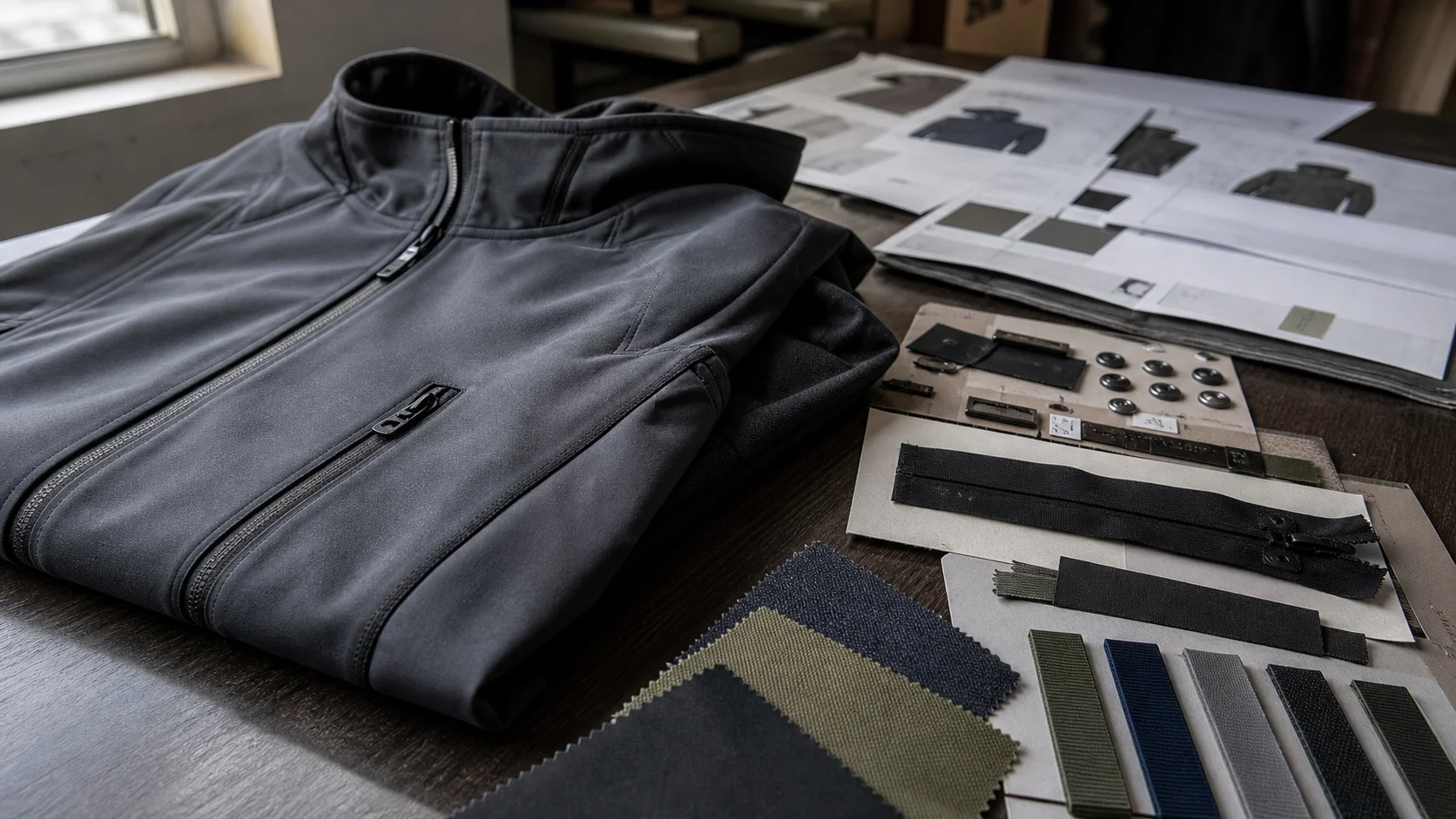
A product-specific outline for security contractors evaluating softshell jacket trim sourcing, from zipper systems and reflective details to badge access,...
Softshell Jacket Trim Sourcing Review for Buyers - Outerwear & Jackets manufacturing guide
For security contractors, a softshell jacket is not just a branded outerwear item. It is part of the working uniform, often worn during patrol, access control, event security, transport supervision, and outdoor response duties. The jacket has to look professional, move comfortably, resist light weather, carry equipment, and survive repeated washing and daily wear. Fabric gets much of the attention during sourcing, but trim sourcing is where many production problems start.
This review focuses on softshell jacket supplier trim sourcing for security contractors. The goal is practical: help buyers check zippers, pullers, hook-and-loop, snaps, labels, reflective details, cord systems, pocket parts, reinforcement tapes, and packaging before committing to bulk production. Trim decisions affect cost, lead time, wearer safety, repair rates, and brand consistency. A low-cost zipper can erase any saving if guards start reporting broken sliders after one month of use.
Security contractors usually buy jackets for performance, uniformity, and controlled replacement cycles. The wearer may need easy access to radios, ID cards, gloves, torches, notebooks, and keys. The garment may also need reflective visibility, detachable badges, concealed branding, or low-profile styling depending on contract requirements. Trims support all of these functions.
A softshell jacket can use a laminated polyester or nylon face fabric, a TPU or PU membrane, and a fleece or grid-fleece backing. That main fabric may pass the buyer’s hand-feel and water-resistance check, but the jacket can still fail in service if the trims are not aligned with the job. Weak hook-and-loop closures stop holding name patches. Cheap pocket zippers snag when used with gloves. Reflective transfers crack after laundering. Metal snaps corrode in wet conditions. Drawcords can become safety hazards if placed poorly.
For buyers, trim sourcing review should happen before price negotiation is closed. It is difficult to control trim quality after the supplier has already quoted based on generic local-market components. A factory may assume standard nylon coil zippers, basic rubber pullers, domestic hook-and-loop, and non-branded elastic cord unless the buyer specifies otherwise. Those choices may be acceptable for promotional jackets, but they are often risky for security uniforms.
Purchasing judgment: for security contractor softshell jackets, trims should be treated as functional parts, not decorative extras. The jacket is handled, opened, pulled, clipped, and washed many more times than a casual outerwear garment.
If the jacket is issued across several sites, trim consistency also matters. Different zipper tape shades, mismatched puller shapes, or inconsistent badge panel sizes can make a uniform program look poorly controlled. Security clients often care about a disciplined appearance. A trim sourcing review protects that image and reduces the need for costly rework.
The main front zipper is one of the highest-risk components. Security staff use it repeatedly throughout shifts, often while wearing gloves or holding equipment. For most softshell jackets, buyers choose between nylon coil zippers, molded plastic zippers, or water-resistant coated zippers. Metal zippers are less common on technical softshells because they add weight and can feel cold, though they may be used for fashion-driven outerwear.
Nylon coil zippers are flexible and suitable for softshell construction. They work well on curved seams and lighter jackets. Molded plastic zippers look more robust and can suit tactical styling, but they are less flexible and can feel bulky. Water-resistant coated zippers improve appearance and reduce water entry, but they cost more and can feel stiffer. They are not fully waterproof unless the entire jacket construction supports that claim.
Security contractor buyers should specify zipper size, tape color, slider type, puller style, top stop, bottom stop, and whether the zipper is auto-lock or non-lock. A size 5 zipper is common for the front opening of midweight softshell jackets. Heavy-duty applications may use size 6 or size 8, depending on design and supplier availability. Pocket zippers are often size 3 or size 5.
Pocket trims should be reviewed based on actual use. A jacket for event security may need large hand pockets and a secure chest pocket for credentials. A jacket for mobile patrol may need inner pockets for documents and devices. If pocket openings are too small or sliders are too delicate, wearers will force them, which increases breakage.
Pullers should be easy to grip. Molded rubber, TPU, cord, or webbing pullers are common. For security uniforms, oversized fashion pullers can catch on equipment, while tiny metal pullers can be difficult with gloves. A moderate-length puller with a firm grip is usually the safer option. If the jacket is used around machinery, doors, vehicle interiors, or crowd-control barriers, avoid loose trim that can snag.
Hook-and-loop is widely used for detachable badges, name tapes, rank panels, and sleeve patches. Buyers should specify panel size, shape, color, location, stitch pattern, and edge finishing. Domestic hook-and-loop can be economical, but holding strength and wash durability vary widely.
Security contractors should ask for peel strength and shear strength expectations, especially when badges are removed frequently. The loop side on the garment should not pill excessively or lose grip after washing. Edges should be cleanly cut and securely stitched, with no sharp corners that lift after wear. Common badge panel sizes vary by market, so buyers should confirm compatibility with existing badges before bulk cutting.
Reflective details are often required for outdoor patrol, traffic direction, parking control, logistics sites, and night work. The buyer needs to decide whether the jacket requires certified high-visibility performance or only decorative visibility. This distinction is important. A reflective logo or small piping detail does not make a garment compliant with high-visibility standards.
Reflective trims can include sew-on tape, heat-transfer film, reflective piping, segmented tape, and reflective print. Sew-on tape is durable but can affect stretch and seam comfort. Heat-transfer reflective film gives a clean look but depends heavily on correct application temperature, pressure, dwell time, and fabric compatibility. Reflective piping adds visibility at seam lines but provides limited surface area.
For security contractors, reflective placement should support visibility without compromising professional appearance. Buyers should check wash durability, cracking risk, edge lifting, and whether the reflective trim is suitable for softshell fabrics with membrane layers.
Hem adjustment is common on softshell jackets. Elastic cords and cord stoppers help seal out wind and improve fit. These trims must be reviewed carefully for safety and durability. Loose cords can snag on vehicle doors, barriers, and equipment. Some markets also restrict drawcord placement on certain garments, especially children’s wear, though security contractor jackets are usually adult workwear.
For adult security uniforms, internal hem adjustment is generally cleaner and safer than long external cords. Cord ends should be capped or bar-tacked. Cord stoppers should hold firmly after repeated compression. Low-grade stoppers can crack, lose spring tension, or slip under stress.
Softshell jacket cuffs may use simple binding, elasticated cuffs, hook-and-loop cuff tabs, snap tabs, or internal storm cuffs. Security contractors often prefer adjustable cuffs because the wearer may need to seal out wind or fit the sleeve over gloves. The tradeoff is that cuff tabs add stitching points and wear risk.
If hook-and-loop cuff tabs are used, buyers should confirm the hook side does not abrade the jacket body or catch on knit gloves. Rubber cuff tabs should be tested for cracking. Plastic injected tabs can look neat but may require higher MOQ and tooling if custom shapes are used.
Branding trims include woven labels, printed neck labels, size labels, care labels, silicone badges, rubber patches, embroidery badges, zipper pull logos, and hangtags. Security contractors may require discreet branding or no visible manufacturer branding at all. Contract uniforms may also need wearer ID systems or department coding.
Labels should be practical. Neck labels must not scratch. Care labels should include correct fiber content, wash instructions, country-of-origin marking where required, and any safety or performance claims that the buyer is prepared to support. If the jacket uses a laminated softshell fabric, the care label should avoid instructions that damage the membrane, seam bonding, reflective transfers, or coating.
Thread is often overlooked because it is not visible as a separate trim, but it affects seam strength and appearance. Polyester thread is common for softshell jackets. Buyers should specify thread color matching, strength expectations, and whether contrast stitching is required. Poor thread color matching can be obvious on black, navy, charcoal, and tactical green outerwear.
Internal seam tapes, zipper garage pieces, pocket bags, binding tape, hanger loops, back-neck tape, and reinforcement patches also need attention. A security jacket may carry heavier pocket contents than a retail jacket. Pocket bag fabric should not be too thin, and stress points should be reinforced with bar-tacks or suitable stitching.
A supplier’s trim sourcing capability is not only about finding low prices. It is about controlling consistency, replacements, documentation, testing, and production timing. Buyers should ask how the supplier selects trim vendors, whether trims are purchased through approved channels, and how shade, strength, and compatibility are checked before bulk sewing.
A serious softshell jacket supplier should be able to provide a trim card during development. This card should include physical examples of zipper tape, sliders, pullers, hook-and-loop, reflective tape, labels, cords, stoppers, thread, snaps, packaging materials, and any branded trim. The trim card should match the salesman sample and pre-production sample. If bulk production uses substitutes, the buyer should approve them in writing.
For B2B uniform programs, trim continuity is important. If the first order uses one zipper supplier and the repeat order uses another, the jackets may look different even when the fabric is the same. Buyers should ask whether trims can be reserved or nominated for repeat production. Nominated branded trims usually cost more and may raise MOQ, but they reduce uncertainty.
It is also worth checking whether the supplier can support documentation. For some security contractor tenders, the buyer may need test reports, restricted substance declarations, care label confirmation, or reflective trim performance data. Not every apparel factory manages this well. Some can sew the jacket but cannot provide reliable trim traceability.
Buyers comparing factories can review broader sourcing support through pages such as Fabrikn services, especially when trim coordination, sampling, and production follow-up need to be handled across multiple garment categories.
MOQ depends on the supplier, trim type, fabric availability, branding level, color count, and whether components are stock or custom. For standard softshell jackets using available fabric and local trims, many factories may quote around 300 to 800 pieces per color. Some may accept 100 to 300 pieces for sample-heavy or premium orders, but unit prices usually rise. Larger factories may prefer 1,000 pieces or more per color for efficient production.
Trim MOQ can be separate from garment MOQ. Stock zippers, cords, and labels are easier to source in smaller quantities. Custom zipper pullers, silicone badges, jacquard elastic, special reflective tape, or dyed-to-match trims may require 1,000 to 5,000 pieces, sometimes more. Custom molded rubber pullers may also involve mold fees and longer sampling time.
Buyers should not only ask, “What is your jacket MOQ?” They should ask, “Which trims are stock, which are custom, and which trims create separate MOQ exposure?” This question often reveals hidden costs early.
A disciplined sample process reduces the chance of trim disputes during inspection. The process usually includes the following stages:
The pre-production sample is the key control point. It should use the same zipper supplier, zipper tape shade, puller, hook-and-loop quality, reflective trim, label content, and packaging method planned for bulk. If substitute trims are still being discussed at that stage, the order is not fully ready for production.
Softshell jacket lead time often ranges from 45 to 90 days after sample approval and deposit, depending on fabric availability, trim complexity, factory capacity, order size, and season. Stock fabric and stock trims shorten the timeline. Custom colors, branded trims, lab testing, reflective certification, and tender documentation can extend it.
Trim lead time can become the bottleneck. Standard zippers may be available within days or one to two weeks. Dyed-to-match zipper tape may need more time. Custom pullers, silicone badges, woven patches, and reflective transfers may take two to five weeks depending on artwork approval and supplier workload. If the garment factory waits until after fabric approval to start trim sourcing, the production schedule can slip.
Buyers should request a critical path showing fabric booking, trim booking, lab dips, strike-offs, sample making, bulk cutting, sewing, finishing, inspection, and shipment. This does not need to be complicated, but it should show which materials are on the longest lead time.
For programs that require schedule coordination or buyer-side support, it can be useful to contact a sourcing partner early through Fabrikn contact rather than waiting until sample delays affect the delivery window.
Zipper issues are among the most common inspection findings in outerwear. Inspectors should check smooth opening and closing, slider locking, bottom stop strength, tape twisting, missing teeth, uneven zipper length, and wavy installation. On water-resistant zippers, they should check coating scratches and puckering along the seam.
A front zipper that looks slightly wavy on the hanger may become more visible when worn. Softshell fabric has body and stretch, so zipper insertion must be controlled. If sewing tension is wrong, the front panel can ripple. This is both a visual problem and a sign of poor process control.
Hook-and-loop panels should be aligned, flat, securely stitched, and positioned correctly. Common defects include crooked panels, skipped stitches, weak edge sewing, poor color match, and wrong dimensions. If detachable badges are part of the uniform system, even a small size error can create field complaints.
Buyers should also check whether the hook side damages nearby fabric during packing or wearing. If hook components are exposed, they can abrade softshell face fabric or fleece lining.
Reflective trims require close inspection because some defects appear after washing rather than at shipment. Edge lifting, adhesive marks, cracking, uneven heat application, dull reflection, and misalignment are all concerns. Inspectors should compare placement against the approved sample and spec sheet.
If a jacket is sold as high-visibility or safety outerwear, inspection should be supported by the relevant standard and test data. A buyer should avoid vague claims such as “safety reflective” unless the performance level is defined.
Label mistakes can block shipment or create compliance risk. Care labels should match the actual garment composition and trim limitations. A jacket with reflective transfer may require lower washing temperature or no tumble drying. A laminated softshell may need instructions that protect the membrane and bonding.
Packaging should also be reviewed. Security contractors may need size stickers, department coding, polybag warnings, carton markings, barcode labels, or individual issue packs. Incorrect size ratios or carton labels can cause distribution problems even when the jackets themselves are acceptable.
Softshell jackets for security contractors may carry heavier loading at pockets and seams. Inspectors should check bar-tacks at pocket openings, zipper ends, hanger loops, side seams, cuff tabs, and badge panels. Weak reinforcement is not always visible at first glance. Pull testing, seam strength testing, and wear simulation are useful when the program has high service demands.
Buyers should set acceptance criteria before inspection. If requirements are not defined, disputes become subjective. A clear tech pack, approved sample, measurement chart, trim card, and inspection checklist give both buyer and supplier a fair reference.
Trim sourcing decisions should be judged by use case, not by the cheapest line item. Security contractor jackets sit between corporate uniforms and technical workwear. They must look controlled, support movement, and tolerate daily handling. Spending more on the right trims can be justified when the garment is issued for repeated professional use.
The best purchasing decision is not always the premium trim package. A security contractor supplying short-term event staff may need a different jacket than a contractor issuing durable outerwear to full-time mobile patrol teams. For temporary or seasonal use, a mid-grade zipper and stock trims may be adequate. For long-term uniform programs, stronger trims and better documentation reduce replacement risk.
Buyers should also consider repeat-order availability. A custom zipper puller may look distinctive, but if the MOQ is high and the second order is small, replacement production can become expensive. A stock puller with a branded woven label may be more practical.
Before confirming a softshell jacket order for security contractors, buyers should review the trim package as carefully as the fabric and fit. A supplier that cannot give clear answers on trims may still make samples, but bulk consistency can become difficult.
Supplier selection should include communication discipline. The buyer needs timely warnings when a trim is unavailable, delayed, or substituted. Silent substitution is a major sourcing risk. It can cause shade differences, performance changes, and disputes during final inspection.
For companies reviewing supplier fit beyond one product, background on sourcing approach and business positioning can be checked through Fabrikn about us. This is useful when the buyer wants a partner that understands uniform supply, not only one-off apparel production.
A softshell jacket tech pack should include more than a front and back sketch. Trim control needs clear data. Buyers should include a bill of materials with supplier name or nominated grade where applicable, color reference, size, placement, quantity per garment, artwork, and testing requirement. If the exact supplier is not nominated, the approved sample and trim card become even more important.
Each trim should be linked to a construction note. For example, a pocket zipper should state opening length, zipper direction, puller type, top and bottom reinforcement, and whether a zipper garage is required. A hook-and-loop sleeve panel should state dimensions, corner shape, stitch margin, and placement from sleeve seam or shoulder point.
Color references are also important. Black trims can vary from deep black to brownish black or bluish black. Navy is even more sensitive. If the shell fabric is dark navy and zipper tape is a different navy, the jacket can look cheap. Buyers should approve trims under daylight or controlled light, not only through photos.
For branded trims, artwork files should be final before sampling. Logo changes after trim mold or label production can delay the entire order. Buyers should confirm Pantone references, logo size, embossing or debossing depth, label fold type, and text legibility. Small text on rubber patches and zipper pullers can become unreadable if not designed for the production method.
Softshell fabrics vary in stretch, thickness, lamination, and surface finish. A trim that works on one fabric may not work on another. Water-resistant zipper tape can feel too stiff on a lightweight stretch softshell. Heat-transfer reflective film may not bond well to certain durable water repellent finishes. Heavy silicone badges can pull on thinner panels. Hook-and-loop can distort stretch fabric if the panel is too large and rigid.
Buyers should ask the supplier to test trims on the actual bulk fabric, not only on a sampling substitute. This is especially important when the fabric has mechanical stretch or spandex content. Stitching can restrict stretch, causing puckering around pockets, badge panels, and reflective tape. Bonded trims and transfers need compatibility checks for adhesion and appearance after laundering.
Membrane-backed softshells require care during heat application. Excess heat can affect lamination or leave press marks. If reflective transfer or heat-sealed badges are required, the supplier should run application trials and provide samples for buyer approval. A clean sample is not enough if the bulk process cannot repeat the result consistently.
Testing requirements depend on budget, tender terms, and end use. Not every order needs a full laboratory program, but security contractor jackets should have enough checks to support the claims being made. Common tests may include colorfastness to washing, colorfastness to rubbing, seam strength, dimensional stability, pilling, zipper strength, puller attachment strength, and reflective trim wash performance.
For softshell fabric, buyers may also review water resistance, water repellency, breathability, and wind resistance. These are fabric or garment performance points, but trims can affect them. A poorly installed zipper or pocket opening can reduce weather protection. A reflective tape seam can restrict stretch. A wrong care label can damage performance after laundering.
If the garment is intended for high-visibility use, the buyer should confirm applicable standards in the sales market. Requirements vary by jurisdiction and job type. A factory statement is not enough if the contractor must submit documentation to a client or public-sector tender.
A softshell jacket supplier trim sourcing review should be completed before final price approval, not after bulk production starts. Trims shape the real working value of the jacket. They influence how the garment opens, closes, adjusts, identifies the wearer, reflects light, carries items, washes, and presents the contractor’s image.
For security contractors, the safest sourcing route is a balanced trim package: reliable zippers, functional pullers, durable hook-and-loop, clearly specified reflective elements, safe cord systems, accurate labels, and reinforced stress points. Buyers do not need to over-engineer every jacket, but they should not accept vague trim descriptions such as “good quality zipper” or “standard Velcro.” Those phrases are not specifications.
The stronger approach is to request a trim card, approve a pre-production sample, define inspection criteria, and understand which trims affect MOQ and lead time. This protects both sides. The supplier knows what to buy and sew. The buyer knows what will arrive. In security uniform programs, that clarity is worth more than a small saving on unverified trims.
Get a free quote from Fabrikn — your trusted B2B clothing manufacturer with 10+ years of experience. MOQ as low as 200 pieces.
Get a Free Quote →A size 5 nylon coil zipper is a common practical choice for many softshell jackets because it is flexible and reasonably durable. Molded plastic or larger zippers can suit heavier tactical styles. Water-resistant coated zippers improve appearance and reduce water entry, but they add cost and stiffness.
Standard stock trims may fit garment MOQs around 300 to 800 pieces per color, depending on the supplier. Custom zipper pullers, silicone badges, special labels, and dyed-to-match trims may require 1,000 to 5,000 pieces or more. Buyers should check trim MOQ separately from jacket MOQ.
No. Small reflective trims, piping, or logos do not automatically make a jacket compliant high-visibility workwear. Buyers need to confirm the required standard, reflective surface area, fabric color, placement, and test documentation for the target market.
Security jackets often use hook-and-loop panels for badges, names, and rank identifiers. Poor-quality hook-and-loop can lose grip, curl at the edges, or damage nearby fabric. Buyers should confirm panel size, stitch quality, holding strength, and compatibility with existing badges.
Typical production may take 45 to 90 days after sample approval and deposit. Timelines depend on fabric booking, trim availability, order size, testing, factory capacity, and shipment method. Custom trims can add several weeks if artwork, molds, or special dyeing are required.
A trim card should include physical examples of zippers, sliders, pullers, hook-and-loop, reflective tape, cords, stoppers, labels, thread, snaps, binding, packaging materials, and any branded trims. It should match the approved pre-production sample.
Nominated branded trims can improve consistency and reduce performance uncertainty, especially for zippers and reflective components. The tradeoff is higher cost, higher MOQ, and sometimes longer lead time. For long-term uniform programs, the control may be worth it.
The main risks are zipper failure, crooked trim placement, weak hook-and-loop stitching, reflective peeling, wrong label content, poor pocket reinforcement, drawcord safety issues, and trim shade mismatch. Buyers should define inspection criteria before production starts.