
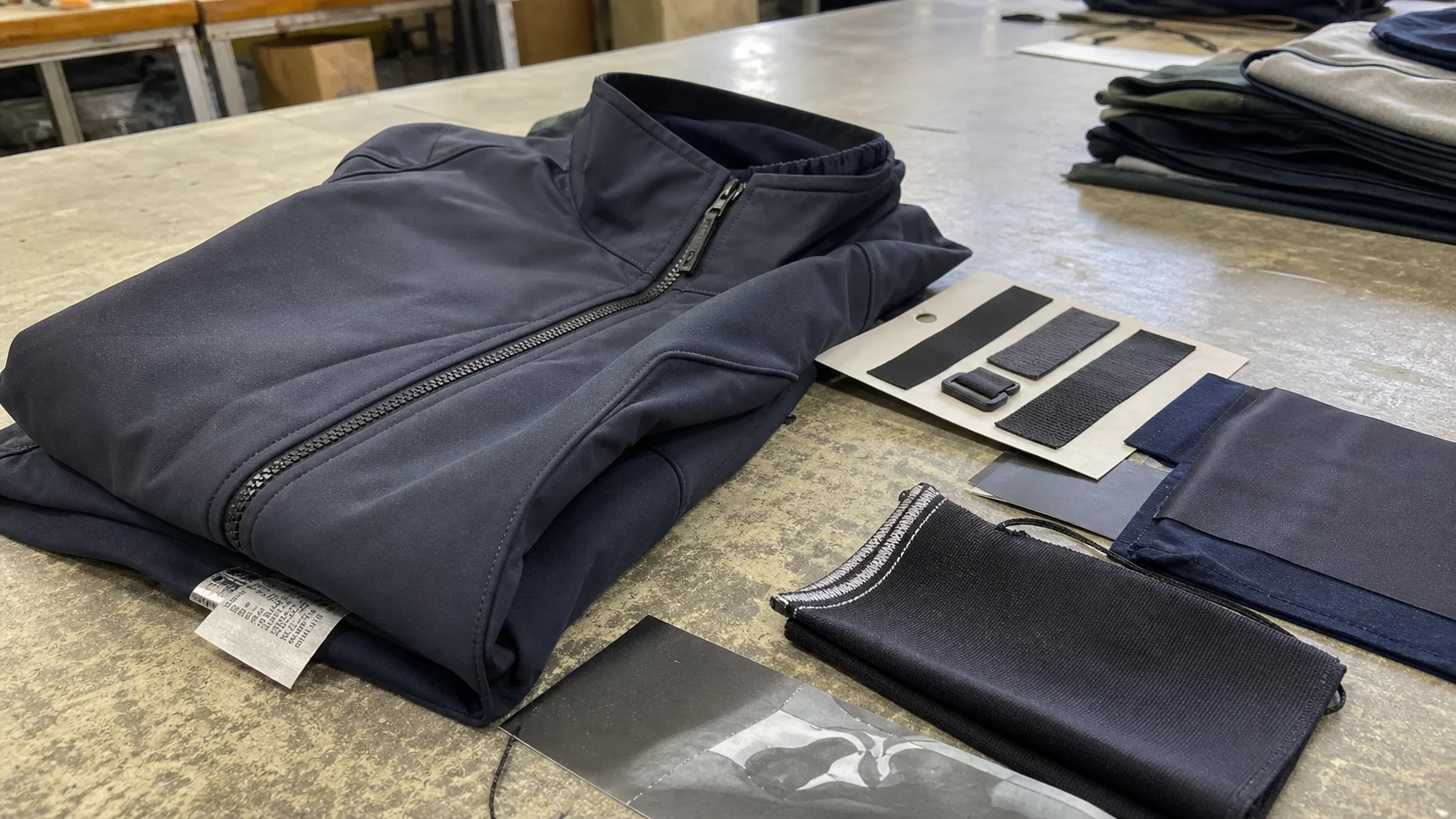
A product-specific sourcing outline for transport hub buyers reviewing softshell jacket trims, MOQ tradeoffs, cost drivers, and manufacturer readiness...
Softshell Jacket Trim Sourcing for Transport Buyers - Fabrikn production reference
Softshell jacket trim sourcing is not a secondary detail for transport hub buyers. It controls how the garment opens, closes, adjusts, identifies the wearer, withstands repeated laundering, and performs during long shifts in exposed terminals, depots, loading bays, ports, rail yards, airports, and logistics centers.
A softshell jacket manufacturer can cut and sew a neat shell, but poor trim choices will still cause returns. Zippers jam. Reflective tape cracks. Hook-and-loop catches lint. Elastic cord loses recovery. Pullers break off in gloves. Logo badges peel after washing. These are not cosmetic issues when the wearer is operating in a timed, safety-sensitive transport environment.
For buyers sourcing uniforms for transport hubs, the trim review should start before the first sample. Too many programs approve a fabric swatch and color card, then treat trims as a factory default. That approach may work for a low-cost promotional jacket, but it is risky for daily uniform wear. Transport teams need repeatable fit, visibility, pocket security, durable closures, and clear identification across multiple departments and seasons.
The practical sourcing point is simple: trim decisions affect MOQ, cost, lead time, inspection workload, and reorder consistency. A low-price quote can become expensive if the zipper brand changes mid-production, the reflective tape supplier runs short, or the cord stopper color is unavailable at the confirmed quantity.
Purchasing judgment: lock the trim package early, not after the fit sample. A softshell jacket is only as reliable as the closure, adjustment, and identification components attached to it.
Transport hub buyers usually source softshell jackets for practical uniform use rather than fashion retail. The product has to support movement, layering, visibility, and brand control. It also has to survive frequent wear by teams working across different shifts and weather conditions.
Typical users may include baggage handlers, warehouse coordinators, delivery supervisors, vehicle marshals, rail platform teams, port operations staff, dispatch teams, shuttle crews, cargo handlers, maintenance support workers, and security-adjacent personnel. Each group may need the same base jacket with different logo placement, color blocking, reflective treatment, or pocket configuration.
This is where trim sourcing becomes more complex. A manufacturer may quote one base style, but the buyer may need several trim variants. For example, a night operations team may need segmented reflective tape, while administrative supervisors may prefer a cleaner low-reflective version. A maintenance group may require stronger pocket zippers, while a customer-facing transport team may prioritize branded zipper pullers and neat embroidery.
Before selecting trims, buyers should define the use case in sourcing language:
Buyers comparing softshell jacket manufacturers can review general production and sourcing capabilities through pages such as Fabrikn services, then use the trim package as a practical test of whether the supplier understands uniform-grade manufacturing rather than only garment assembly.
A trim sourcing review should list every component attached to the shell. Small parts often create the biggest production delays because they are ordered late, customized separately, or missed in the bill of materials.
Trim Category Common Options Main Buying Risk Best Practice Main closure Coil zipper, molded zipper, waterproof zipper Jamming, color mismatch, weak slider Confirm zipper type, gauge, length, slider, puller, and top/bottom finish Pocket closures Invisible zipper, reverse coil zipper, welt pocket zip Pocket distortion and poor hand access Approve pocket function on a worn fit sample Adjusters Elastic cord, cord stopper, hem toggle, cuff tab Breakage or uncomfortable pressure points Test with gloves and repeated pulling Visibility trims Reflective tape, reflective piping, heat-transfer reflective logo Cracking, peeling, wrong placement Confirm wash rating, width, placement, and compliance needs Brand trims Embroidery, woven badge, rubber patch, heat transfer, zipper pull branding Inconsistent shade or poor adhesion Approve artwork, size, color, and application method before bulk Labels Main label, size label, care label, barcode label, RFID label Regulatory or warehouse sorting errors Check care instructions against all fabric and trim limitsThe trim map should be included in the tech pack and quotation request. It is not enough to state “matching zipper” or “standard cord stopper.” Those terms allow the supplier to choose the cheapest available option, which can create differences between samples and bulk production.
Zippers are usually the highest-risk trim on a softshell jacket. They are visible, functional, and frequently used. In transport settings, they may be operated dozens of times per shift, sometimes with cold hands or gloves.
The main front zipper should be selected based on usage, fabric weight, styling, and budget. Coil zippers are common for softshell jackets because they are flexible and relatively lightweight. Molded zippers can look more rugged and may suit workwear styling, though they can add stiffness. Waterproof or water-resistant zippers improve the technical appearance but add cost and can feel harder to pull if the slider and tape quality are not well matched.
Typical specifications to confirm include:
A two-way zipper may be useful for drivers or workers who sit for long periods, because it reduces hem pressure when seated. It also increases cost and introduces more risk if users are not familiar with aligning the bottom pin correctly. For large uniform programs, a simple one-way open-end #5 zipper is often the safer choice unless the job role clearly needs two-way access.
Pocket zippers need careful review because pocket function is often more important than styling for transport workers. Staff may carry ID cards, small tools, scanners, radios, gloves, keys, and personal items. A pocket that looks clean but is hard to access with gloves will create user complaints.
Buyers should check pocket zipper length, opening angle, slider size, and whether the pocket bag is deep enough for the intended use. Waterproof zippers on pockets can look technical, but they are usually stiffer. A reverse coil zipper with a neat garage may be a better cost-performance balance for many transport uniform programs.
Some buyers specify a named zipper brand for performance consistency. Others accept “brand equivalent” to control price. Both approaches can work, but the decision should be documented.
Zipper Strategy Advantages Tradeoffs Suitable For Named premium zipper Consistent quality, stronger buyer confidence, easier repeat orders Higher cost and possible longer lead time Critical uniforms, high-wear roles, premium corporate outerwear Approved equivalent zipper Lower cost, more sourcing flexibility Requires stricter testing and sample comparison Mid-range uniform programs with clear inspection standards Factory standard zipper Lowest price and easy availability Higher inconsistency risk between lots Short-term promotions or low-use jacketsPurchasing judgment: for transport hub buyers, the cheapest zipper is rarely the best value. A zipper failure usually means the entire jacket is rejected by the wearer, even if the fabric and stitching are acceptable.
Softshell jackets often include small adjusters that improve comfort and weather protection. These parts should be reviewed with the same discipline as fabric and stitching because they affect daily usability.
Hem adjustment helps block wind and improve fit. A common construction is elastic shock cord with plastic cord stoppers at the side seam, front hem, or inside hem. For transport hub workwear, hidden adjusters may reduce snag risk compared with exposed toggles.
Key specifications include cord diameter, elasticity, color, stopper material, spring strength, and end finish. Cord ends should be secured with knots, plastic tips, heat sealing, or bartacks depending on construction. Loose cord ends can become a snagging risk around conveyors, vehicle interiors, luggage equipment, or warehouse fixtures.
Adjustable cuffs are useful when workers need to seal sleeves over gloves. Hook-and-loop tabs are common, but buyers should be realistic about lint accumulation and edge curling. Molded rubber cuff tabs can look cleaner and last longer, though they add cost.
If the jacket is intended for high-frequency use, request a sample with repeated open-close testing on cuff tabs. Cheap hook-and-loop loses grip quickly and can damage knit layers or softshell surfaces when it catches during washing.
Transport workers may use jackets while wearing handling gloves, cold-weather gloves, or safety gloves. Small metal zipper tabs are often inconvenient. Cord pullers, rubber pull extensions, or molded branded pullers are easier to use.
Branded zipper pullers can improve uniform identity, but they increase MOQ and tooling complexity. A stock black cord puller may be a better choice for lower-volume orders. If branding matters, consider branding the chest logo and sleeve badge first, then add custom zipper pullers only when order volume supports the cost.
Softshell jackets may use snaps on storm flaps, detachable hoods, cuff tabs, or pocket flaps. Snaps should be tested on the actual fabric layers because softshell laminates can stretch or delaminate if the pressure is wrong. Reinforcement patches may be needed at stress points.
Metal trims should be reviewed for rust resistance, nickel concerns, and finish consistency. Plastic trims should be checked for brittleness in cold conditions. The right answer depends on the operating environment and expected garment life.
Transport hubs often operate in mixed lighting: early mornings, night shifts, vehicle yards, interior corridors, loading docks, aircraft stands, bus bays, rail platforms, and rain-darkened service roads. Visibility trims are therefore more than decorative details.
Reflective trim can be applied as tape, piping, heat transfer, or segmented film. Tape width, placement, and wash durability should be confirmed before sampling. If a buyer has a formal high-visibility requirement, the manufacturer needs the exact standard and garment classification target. General reflective accents are not the same as certified high-visibility workwear.
Common sourcing questions include:
Segmented reflective tape is more flexible and may suit stretch softshell fabric better than solid tape. It usually costs more. Solid reflective tape can be economical and visible, but it may restrict stretch or create puckering if applied poorly.
Branding trims must match the uniform’s use and wash conditions. Embroidery is durable and familiar, but dense embroidery can restrict stretch and may allow water to enter through needle holes. Heat transfers provide a smooth modern appearance, though adhesion depends on fabric face, lamination, temperature, pressure, and washing. Woven or rubber badges look premium but add MOQ, development time, and placement complexity.
For transport hub buyers, the most practical branding solution is often a left chest logo plus an optional back print or sleeve mark. Department badges can be added when role identification is necessary. Name badges should be planned carefully because individualized trims complicate packing, allocation, and returns.
If the buyer is still defining supplier capabilities and uniform options, it is reasonable to speak with a manufacturer through a page such as Fabrikn contact before finalizing brand trims. Early clarification can prevent costly artwork revisions after samples are already made.
Care labels are small, but they carry risk. The care instruction must reflect the weakest component in the garment, not only the shell fabric. A softshell fabric may tolerate a certain wash temperature, while reflective trim, bonded logos, zipper coatings, or rubber badges may require gentler care.
Transport hub buyers may also need barcode labels, SKU stickers, size tabs, department labels, or RFID integration for uniform inventory control. These should be included in the trim bill, not added at packing stage as an afterthought.
MOQ is one of the main reasons trim sourcing becomes difficult. A manufacturer may accept a jacket order at a certain garment MOQ, but individual trims may have their own minimums. Buyers should separate garment MOQ from fabric MOQ, trim MOQ, color MOQ, logo MOQ, and size assortment requirements.
Typical MOQ ranges vary by country, supplier type, customization level, and material availability. The following ranges are practical planning references, not fixed promises:
Component Typical MOQ Range Notes for Transport Buyers Basic softshell jacket style 300-800 pieces per style Lower quantities may use stock fabric and stock trims Custom fabric color 800-1,500+ pieces per color Dyed-to-match fabric can drive the real MOQ Stock zipper color 300-500 pieces Black, navy, and common colors are easier Dyed-to-match zipper tape 500-1,000+ pieces Lab dip approval may be needed Custom zipper puller 1,000-3,000+ pieces Tooling or mold cost may apply Custom rubber badge 500-2,000+ pieces MOQ depends on size, colors, mold, and backing Reflective tape Roll-based MOQ, often 100-500 meters Yield depends on placement and size range Heat transfer logo 100-500 pieces per artwork Low MOQ is possible, but unit cost rises Woven label 1,000-5,000 pieces Can be carried across multiple styles if genericThe key issue is alignment. A buyer may want 400 jackets in three department colors with custom pullers, reflective tape, and separate sleeve badges. The garment quantity may be acceptable, but the trim MOQs may push cost up sharply. A better plan may be one base shell color, shared trims, and department identification through patches or heat transfers.
Purchasing judgment: small programs should use stock trims where possible. Spend customization budget on the elements that users and supervisors actually notice: fit, zipper reliability, visibility, and clear branding.
Softshell jacket trim costs can look minor line by line, but the total impact is significant. A few cents per zipper pull, stopper, label, or reflective strip becomes material when multiplied across sizes and reorders. Cost also includes development, testing, rejection risk, and delayed shipment risk.
Spend first on the trims that protect garment function: main zipper, pocket zippers, reflective elements if safety visibility is required, and durable adjustment parts. These directly affect wearer satisfaction and operational risk.
Spend second on brand presentation. A transport hub uniform still needs to look organized and professional, but a premium badge does not compensate for a zipper that fails or reflective tape that peels.
Spend cautiously on novelty. Custom pullers, contrast trims, unusual zipper colors, and complex badges may help differentiate the garment, but they increase reorder risk. If the buyer expects a multi-year uniform program, standardization is more valuable than a one-season design detail.
Cost savings are usually safest when they reduce unnecessary customization rather than reduce durability. Use stock zipper tape colors if they coordinate with the fabric. Use a standard woven main label across multiple uniform styles. Use one reflective tape specification across jackets, vests, and rainwear if it meets policy. Use heat transfer logos for small runs where embroidery setup, badge MOQ, or individual stitching time becomes inefficient.
A manufacturer with broad sourcing ability can help compare these choices. Buyers reviewing supplier background may find pages such as Fabrikn about us useful when assessing whether a partner is set up for program sourcing rather than one-off sample making.
Softshell jacket trim sourcing should follow a controlled sample approval workflow. Skipping steps may save a week during development but often creates expensive confusion during bulk production.
The buyer should provide a trim brief with reference images, color standards, logo files, size range, expected use, wash requirements, visibility needs, and any prohibited materials. The manufacturer should convert this into a bill of materials with specific trim descriptions.
A useful trim line item includes trim name, supplier or quality level, color, size, placement, application method, approved reference, and testing requirement. “Black zipper” is weak sourcing language. “#5 reverse coil open-end zipper, black tape, auto-lock slider, black cord puller, zipper garage at neck” is much better.
Before the first garment sample, request physical or photographed swatches of zipper tape, pullers, reflective trim, logo method, cord, stopper, hook-and-loop, labels, and patches. Digital photos are useful for speed, but color and handfeel should be checked physically when the order is important.
The proto sample checks construction concept, trim placement, pocket access, adjuster function, and overall appearance. It is normal for the proto sample to use available trims if final trims are still under development, but substitutes must be clearly marked. Never approve a proto sample as bulk reference if the trims are not final.
The fit sample should include trims that affect wearing comfort. Main zipper length, pocket placement, cuff adjusters, hem cord position, and hood attachments can change fit perception. A jacket can measure correctly on a table and still feel awkward when the zipper, collar, or pocket opening is wrong.
The pre-production sample should use actual bulk trims or confirmed production-equivalent trims. This is the sample that should be signed off for bulk production. Buyers should inspect stitching around trims, zipper smoothness, reflective tape alignment, logo placement, label content, and packaging labels.
Transport uniform programs often cover a wide size range. Trims must scale correctly across sizes. Pocket zippers that look fine on size L may be too long on size XS. Reflective tape layout may need adjustment on larger sizes. Hem cord access should remain consistent.
A practical wash test is recommended before bulk approval, especially when using heat transfers, reflective trims, bonded badges, coated zippers, or hook-and-loop closures. The test should follow the expected care method. A home wash test is not enough if the garment will face industrial laundering.
Approval rule: the bulk standard should be the pre-production sample with actual trims, approved measurements, confirmed logo artwork, and signed care label content.
Lead time depends on more than sewing capacity. Trim sourcing can control the production schedule, especially when custom colors, logos, reflective materials, or imported components are involved.
Typical planning ranges may look like this:
Stage Typical Timing What Can Delay It Trim sourcing and quotation 3-10 business days Unclear tech pack, missing artwork, unusual trim requirements Custom logo or badge development 7-20 business days Mold making, artwork revisions, color matching Proto sample 7-15 business days after materials are ready Fabric unavailability, trim substitutions, pattern revisions Pre-production sample 10-20 business days Waiting for actual bulk trims or revised branding Bulk trim procurement 10-30 business days Dyed-to-match zippers, reflective tape shortage, label revisions Bulk production 30-60 days after approvals Order size, factory capacity, trim arrival, inspection failuresThese ranges are only planning references. A simple stock-trim order can move faster. A complex multi-department transport program with reflective compliance, custom labels, and several logo placements can take longer.
Buyers should also consider seasonal demand. Softshell jackets are often ordered ahead of autumn and winter. If the buyer waits until the weather changes, the manufacturer may face capacity pressure, zipper shortages, or longer fabric lead times. Reorder planning should begin before inventory reaches a critical level.
Transport hub buyers often need phased delivery by site or department. In that case, trims should be ordered with the total program in mind, not only the first delivery. Running out of matching zipper tape or reflective material halfway through a rollout can create visible lot differences.
Inspection should cover trim function as well as garment appearance. A softshell jacket can pass a quick visual review and still fail in use. Transport hub buyers should give inspectors a checklist that reflects operational needs.
Inspection risk rises when the order includes many variants. A single style with one logo and one trim package is easier to control. A program with five departments, three reflective layouts, two logo methods, and individualized labels requires stricter carton marking and final audit procedures.
A softshell jacket manufacturer’s answers to trim questions often reveal how organized the production team is. Buyers do not need technical jargon for its own sake, but they do need clear accountability.
Buyers should request direct answers and written confirmations. Vague responses such as “we will use good quality” or “standard trims are okay” are not enough for a transport uniform program. The supplier should show the trim card, bill of materials, sample comments, and production approval record.
For most transport hub buyers, the strongest sourcing approach is not maximum customization. It is controlled standardization. Use a durable softshell fabric, a reliable zipper package, practical pocket access, approved reflective treatment, and consistent branding. Then create department differences through controlled logo color, sleeve badge, or packing allocation rather than rebuilding the entire trim package for each team.
This approach supports lower risk and better repeatability. It also helps with MOQ. Shared trims across multiple departments increase buying volume for zippers, labels, cords, and reflective tape. The manufacturer can plan procurement more efficiently, and the buyer can reduce the chance of mismatched reorders.
A practical trim sourcing sequence for transport buyers is:
The best softshell jacket manufacturer for this category is not simply the lowest quote. It is the supplier that can explain trim options, flag MOQ conflicts, manage sample approvals, and keep production consistent across future orders.
Softshell jacket trim sourcing for transport hub buyers should be treated as a controlled purchasing decision, not a design afterthought. Trims affect user acceptance, safety visibility, garment lifespan, lead time, and reorder stability.
If the order is small, reduce customization. If the order is large or recurring, invest in stronger trim standards and keep approved references. If the jacket is used in exposed operations, prioritize zippers, reflective trim, adjusters, and wash durability before decorative upgrades. If multiple departments need different looks, build from one shared trim platform wherever possible.
The right trim package will not always be the most expensive. It will be the one that matches the user’s job, the buyer’s MOQ, the manufacturer’s sourcing capability, and the expected service life of the uniform program.
Get a free quote from Fabrikn — your trusted B2B clothing manufacturer with 10+ years of experience. MOQ as low as 200 pieces.
Get a Free Quote →Start with the main zipper, pocket zippers, reflective trim, logo method, hem adjusters, cuff closures, labels, and any department identification trims. These components have the highest impact on function, appearance, lead time, and inspection risk.
A typical custom softshell jacket MOQ may range from 300 to 800 pieces per style when using available fabrics and stock trims. Custom fabric colors, dyed-to-match zippers, molded pullers, special badges, or multiple department versions can push the practical MOQ above 1,000 pieces.
Stock trims are often the best choice for small and mid-size uniform programs. They reduce MOQ, cost, and lead time. The buyer should still approve the exact trim quality, color, size, and function before bulk production.
A premium zipper is useful for high-wear uniforms, long-term programs, and jackets expected to last through heavy daily use. An approved equivalent can be acceptable if the manufacturer provides samples and the buyer tests zipper smoothness, strength, and consistency.
Not always. Some transport roles require certified high-visibility garments, while others only need reflective accents for added visibility. Buyers should define the safety requirement before development because certified visibility and decorative reflective detailing are not the same.
Commonly missed details include zipper gauge, slider type, puller style, cord diameter, stopper quality, reflective tape width, logo placement tolerance, care label wording, barcode labels, and department-specific packing requirements.
Use stock zipper colors, standard pullers, shared labels, common reflective tape, and one base trim package across departments. Avoid reducing quality on the main zipper, pocket closures, or safety-related trims because failures there affect the entire garment.
Trim testing should happen before bulk approval. At minimum, buyers should review a trim card, pre-production sample, zipper function, logo adhesion, reflective placement, and wash behavior. More demanding programs may need formal lab testing or industrial laundry trials.
Yes, one base style can often serve multiple departments if the trim package is standardized. Department differences can be managed through logo color, sleeve badges, back print, name labels, or packing allocation rather than changing every trim component.
The biggest mistake is approving the garment style without locking the actual trims. A sample made with substitute zippers, temporary logos, or available reflective tape does not protect the buyer unless the final trim package is confirmed before production.