
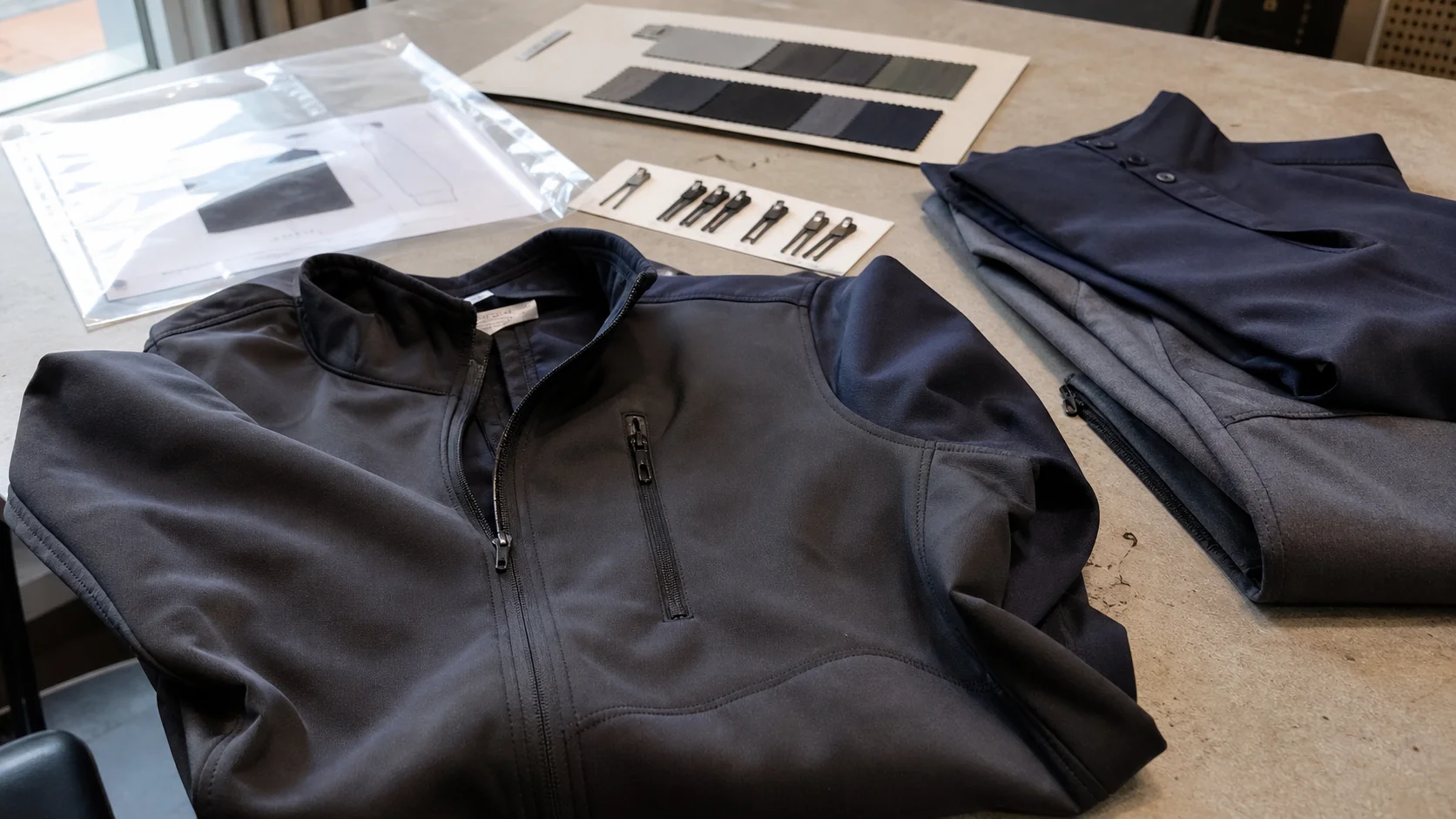
A quality-and-inspection breakdown of how wholesale softshell jackets hold up after repeated laundering, with practical checks for restaurant groups...
Restaurant groups buy softshell jackets for one reason: the garment has to look clean, wear well, and survive repeated laundering without becoming bulky, shiny, warped, or poorly fitted across a team. A wash test review is the fastest way to judge whether a wholesale softshell jacket is suitable for front-of-house, kitchen-adjacent, catering, or outdoor service use. It is not a paperwork exercise. It is a practical check on whether the fabric, bonding, trims, prints, and construction can hold up to the way restaurant staff actually work.
This review focuses on wholesale softshell jacket wash test criteria for restaurant groups, with an emphasis on sourcing decisions, sample approval, and the risks that show up after repeated wash cycles. The standard is not the same as for fashion outerwear. Restaurant programs need consistency, easy care, predictable sizing, and acceptable appearance after multiple washes.
Softshell Jacket Wash Test Review for Restaurant Groups - Quality & Inspection manufacturing guide
Softshell jackets sit in a difficult category. They are expected to look more polished than a fleece, resist wind better than a knit layer, and remain comfortable across long shifts. In restaurant operations, that also means exposure to frequent laundering, food odors, spills, grease mist, sanitizer residue, and rough handling during service and storage.
A jacket that looks acceptable on arrival can fail quickly after washing. Common problems include seam puckering, zipper ripple, delamination, shrinking in the body or sleeves, peeling logos, and color loss that makes a uniform program look inconsistent across locations. For restaurant groups, the hidden cost is not just replacement. It is brand dilution, uneven employee appearance, and extra time spent sorting out complaints by location.
Wash testing gives the buyer a clearer view of lifecycle value. A lower unit price is not a good deal if the jacket changes shape after five washes. A slightly higher unit price can be justified if the fabric keeps its handfeel, the trims remain stable, and the garment stays presentable through a realistic service life.
If the program is being developed with a sourcing partner, it helps to align the testing plan early. A manufacturing and inspection team can define wash cycles, acceptable tolerances, and hold points before bulk production starts. For teams that need this kind of support, the service scope is usually easier to manage when the supplier has a defined process, such as the one outlined on fabrikn.com/services/.
A softshell jacket is typically made from a bonded or laminated fabric system that combines a woven face, a membrane or film layer, and often a brushed or knit backer. That structure is what gives it stretch, wind resistance, and a cleaner finish than many casual outerwear styles. It also creates wash sensitivity that buyers need to understand.
The fabric may be composed of polyester, polyester-spandex blends, or hybrid constructions with TPU or similar films. Once a bonded structure is involved, repeated washing can expose weak points in adhesion, stitch balance, and trim compatibility. Heat can change the behavior of laminated layers. Aggressive detergent chemistry can affect water repellency. Drying conditions can alter the recovery of stretch content.
For restaurant groups, this matters because the garment has to be practical. Staff may wash at home, facilities may use commercial laundry, or the operation may use outsourced uniform services. Each scenario creates different stress. A softshell that performs well under gentle home laundering may not hold up in a warmer commercial cycle with frequent tumble drying. That is why wash test review should match the intended laundering environment, not a generic standard pulled from a spec sheet.
The most useful wash test review does not stop at pass/fail. It tracks appearance, fit, physical integrity, and decoration performance across multiple cycles. For restaurant groups, the practical review usually includes the following areas.
Test Area What to Check Why It Matters Dimensional stability Body and sleeve shrinkage, twist, skew Unstable sizing creates uniform inconsistency Appearance retention Wrinkling, pilling, shine, surface fuzz Affects front-of-house presentation Bonding integrity Delamination, bubbling, edge lift Critical for softshell performance Trim stability Zippers, snaps, pulls, cords, labels Trims are frequent failure points after washing Decoration durability Embroidery, heat transfer, print cracking or lift Restaurant branding has to survive laundering Water resistance DWR performance after wash and dry Softshell utility drops if repellency disappears Colorfastness Shade change, crocking, shade variation across lots Uniform programs need visual consistencyThe buyer should ask for wash data under the planned care method. If the jacket is intended for 30 or 40 degree laundering, do not accept test results from a much gentler process and assume the outcome will hold. The same applies to drying. Line drying and tumble drying do not produce the same outcome, and restaurant teams may not follow a single method consistently.
A useful review compares the pre-wash sample against washed samples after 1, 5, and 10 cycles. For higher-risk programs, some buyers extend the check to 15 or 20 cycles, especially when a jacket will be reissued, shared, or used in high-turnover hospitality operations. The goal is not to chase a laboratory-perfect result. The goal is to identify when the garment stops looking acceptable in a real working environment.
If these failure modes appear early, the jacket may still be usable, but it is no longer a strong uniform choice for a restaurant group seeking a polished look across multiple sites.
A proper sample approval process is the best defense against expensive bulk mistakes. For wholesale softshell jacket programs, the buyer should not approve based on a single pre-production sample alone. At minimum, the process should include fabric hand strike, size set or fit samples, decoration strike-offs, and a washed sample review.
The most practical sequence is straightforward. First, confirm the garment spec: fabric composition, weight, bonded structure, seam construction, zipper type, and decoration method. Next, approve the visual sample. After that, request washed samples using the actual care method expected in service. Only then should the program move into bulk production.
Buyers often underestimate the value of a pre-wash and post-wash comparison sheet. A side-by-side review makes small problems visible. Sleeve length may look acceptable before washing but shorten enough to affect movement after drying. A jacket that feels roomy in the chest may tighten slightly after several cycles if the fabric and construction are not balanced for shrinkage.
Restaurant groups with multiple locations should also request size grading confirmation. A softshell that fits well in medium may not grade proportionally through XXL if the pattern is not controlled. That creates uneven employee comfort and unnecessary exchange requests. For procurement teams that need help defining these checkpoints before bulk order release, it is reasonable to start the conversation through fabrikn.com/contact-us/.
A sample that looks good on a hanger is not enough. For restaurant uniform programs, the washed sample is the real approval sample.
Wholesale softshell jacket programs usually involve moderate minimum order quantities. A common MOQ range is 300 to 1,000 pieces per color or style, although some suppliers can offer lower quantities for simple programs and higher quantities for custom branding or special fabric requirements. The exact MOQ depends on fabric availability, trim sourcing, print or embroidery setup, and whether the style uses stock materials or a custom construction.
Lead time is influenced by more than sewing capacity. Fabric production, membrane lamination, dyeing, lab testing, strike-offs, and logo approval all add time. A realistic total lead time for a custom softshell program is often 45 to 90 days after sample approval, with longer timelines when custom colors, imported fabrics, or detailed decoration are involved. Peak season, holiday ordering, and multiple approval rounds can stretch that further.
Cost drivers are usually predictable. Heavier fabrics, higher-quality zippers, bonded seams, better water repellency, and more complex decoration all raise the price. So does tighter wash performance. A jacket that needs to hold up after repeated laundering will generally require better raw materials and more careful construction than a promotional outerwear piece.
Restaurant buyers should frame the cost decision as a lifecycle question. A cheaper jacket that fails after a short service life may cost more per wear than a better-built jacket with a higher initial price. That calculation becomes even more important when the same jacket is used across front-of-house, management, and outdoor delivery teams.
Softshell performance starts with fabric selection. The outer face should resist abrasion and color loss. The backer should remain comfortable and not pill excessively. Stretch content should be enough for mobility, but not so high that recovery becomes unstable after washing. A stable fabric weight also helps the jacket keep its shape in service.
Recommended spec elements to review:
Thread choice is often ignored, but it matters. Threads that shrink differently from the base fabric can cause seam puckering. Likewise, poor needle selection or overly dense embroidery can create visible distortion after laundering. If a restaurant group wants a clean, premium appearance, decoration should be treated as part of the garment system, not an afterthought.
Trim selection also affects serviceability. Zipper garages, pull tabs, chin guards, and pocket bag fabrics should all be checked for wash durability. Even a good face fabric can be undermined by a cheap zipper that starts to wave or fail after repeated washing.
Inspection should not be limited to the first sample. Repeated washing changes the garment in ways that are easy to miss if the review is too superficial. A jacket can retain basic function while still becoming unsuitable for a restaurant brand program.
The main inspection risks include:
Restaurant groups should also watch for odor retention. Softshell surfaces can hold odors more than smooth woven shells if laundering is inconsistent. That is a practical problem in kitchens, open-air patios, and catering work. A jacket that is technically intact but smells stale is not acceptable in many hospitality environments.
Another point to watch is batch consistency. One lot may pass while a later lot shows changes in fabric finish or zipper sourcing. If a uniform program spans several branches, the inspection plan should cover all incoming lots, not just the first order. A small variation in shade or trim can be very visible when staff stand side by side.
Not every restaurant group needs the same softshell jacket. A quick-service brand with outdoor team members has different needs from a fine dining group with limited guest-facing outerwear. The jacket should match the role, climate, and laundry model.
For front-of-house teams, appearance often comes first. The garment should look structured, clean, and quiet in motion. A slimmer profile may be preferred, but not at the expense of comfort or wash stability. For outdoor and delivery staff, the balance shifts toward weather resistance, stretch, and durability. For managers or catering staff, a more versatile jacket with neutral branding can work better across multiple settings.
There is always a tradeoff between softness, structure, and wash durability. A very soft brushed backer may feel good but can show wear faster. A stiffer face fabric may hold shape better, but can feel less comfortable during long shifts. A stronger water-repellent finish may improve performance, but some finishes lose effectiveness over time if not maintained correctly.
Uniform buyers should choose based on actual use, not assumptions. If staff will wear the jacket indoors most of the day, breathability matters more than heavy weather protection. If the jacket is going to be used in mixed indoor and outdoor service, a balanced fabric is usually the safer purchase. The most expensive option is not always the best. The cheapest option is rarely the best once repeated washing is included in the equation.
Before placing a wholesale order, ask direct questions and require direct answers. Vague language is a risk, especially when a jacket is expected to support a branded restaurant program.
If the supplier cannot answer these questions clearly, the program is not ready for bulk approval. A reliable factory or sourcing partner should be able to explain the construction, care assumptions, and quality checks in plain terms. For a broader look at sourcing and development support, review the background information on fabrikn.com/about-us/.
For restaurant groups, quality control should be structured around use, not just garment specs. A sensible framework includes lab testing, sample approval, in-process inspection, and final inspection. Each stage catches a different type of risk.
Lab testing is where you verify the technical claims: shrinkage, colorfastness, seam strength, and fabric stability. Sample approval confirms the jacket looks and feels right. In-process inspection checks cutting consistency, stitch quality, zipper alignment, and decoration placement. Final inspection verifies size distribution, packaging, and batch consistency before shipment.
Inspection standards should be tied to the program’s priorities. A premium guest-facing jacket may require tighter limits on color deviation and appearance defects. A back-of-house jacket may tolerate minor visual variation if durability is strong. The key is to define the acceptable range before production starts, not after a problem surfaces in distribution.
It also helps to keep washing instructions realistic. If a jacket requires special care to preserve its finish, the restaurant group has to decide whether that care will actually happen. Uniform programs fail when care instructions are theoretical. A practical wash and care plan should match the way staff and laundry vendors operate.
Get a free quote from Fabrikn — your trusted B2B clothing manufacturer with 10+ years of experience. MOQ as low as 200 pieces.
Get a Free Quote →For a restaurant group, a 5- to 10-cycle review is a practical baseline, with more cycles if the jackets will be washed frequently or reused across multiple locations. The right number depends on the expected laundering method and how visible the jacket is in service.
Delamination, logo lift, and seam distortion are common. Color fade and zipper wave can also show up early if the fabric or trims are not suitable for repeated laundering.
Embroidery is usually more durable, but it can affect fabric drape and comfort on lighter softshells. Heat transfer can look cleaner and flatter, though it needs careful testing because some adhesives do not hold up well in repeated washing. The better choice depends on the fabric weight and wash method.
A common MOQ is 300 to 1,000 pieces per style or color, although simpler stock programs may be lower and custom programs may be higher. Decoration requirements, fabric sourcing, and trim selection all influence MOQ.
Some can, but not all are built for it. Commercial laundry adds heat, chemistry, and mechanical stress that can expose laminate weakness or trim failure. The supplier should confirm whether the jacket is suitable for that environment before bulk ordering.
Check shrinkage, fit, sleeve length, color change, handfeel, zipper behavior, seam appearance, logo integrity, and water repellency. A quick visual check is not enough. Measure and compare the garment before and after washing.
It can be, if the garment is used lightly and the brand does not require a high-end appearance. The buying decision should still account for wash life, replacement frequency, and how consistent the jacket looks across the team. In many cases, the lower unit price disappears once replacements are counted.
For restaurant groups sourcing wholesale softshell jackets, the wash test review is the decision point that separates a workable uniform from a short-lived purchase. The garment has to survive repeated laundering, preserve its shape, and keep the brand presentation intact. If the supplier cannot prove that with real samples and clear testing, the safest move is to keep looking.