
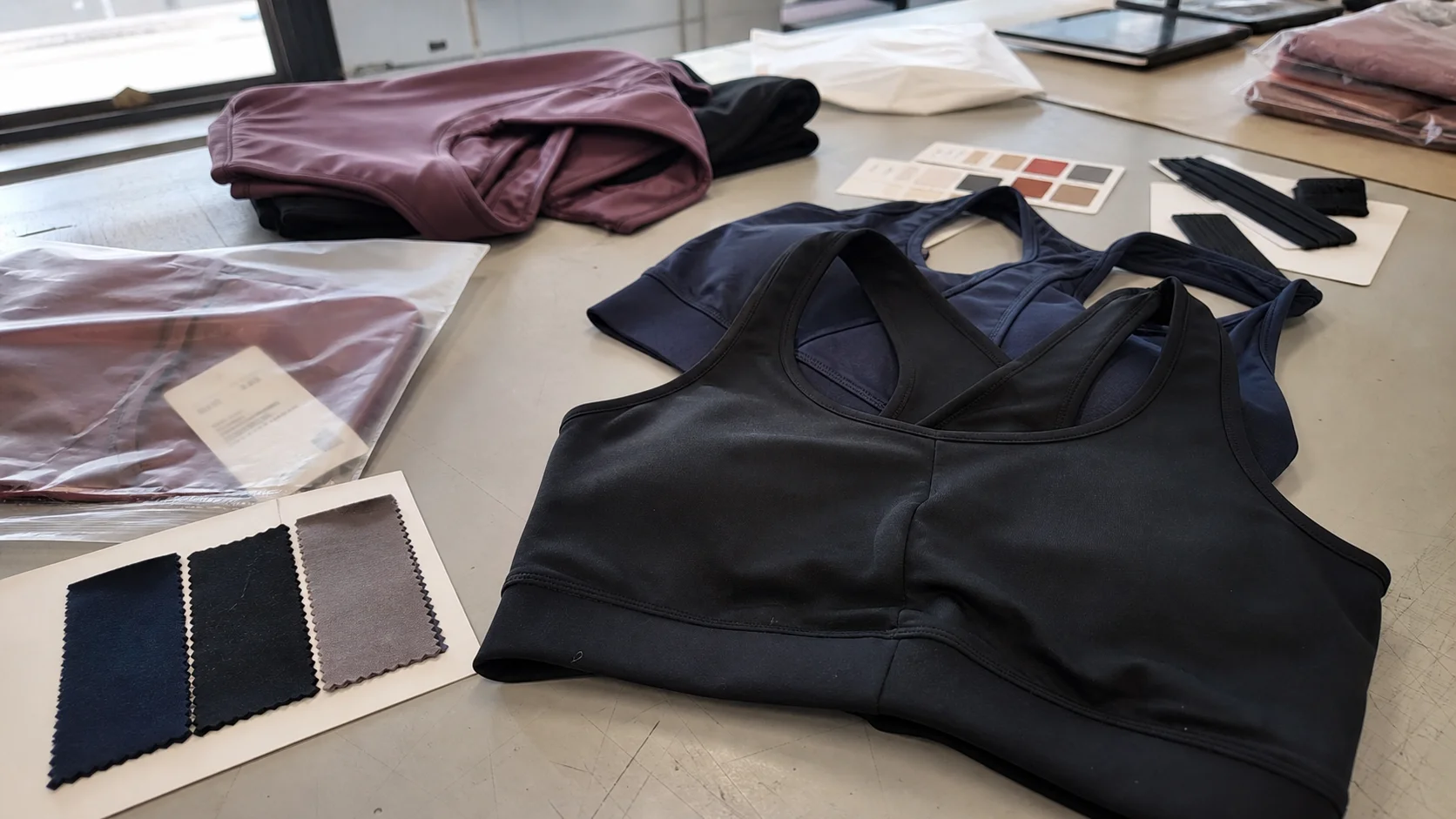
A retail operations outline for classifying, isolating, and reporting sports bra defects at receiving, DC, and store level so teams can reduce returns,...
Retail buyers who source sports bras need a defect sorting process that is stricter than a general garment inspection. Support garments fail for reasons that are easy to miss in a quick pass: stretched elastic, weak recovery, torque in the straps, cup imbalance, poor seam flatness, lining shift, and inconsistencies in compression. A sports bra can look acceptable on a hanger and still be a return risk after one wash or one training session.
This guide is written for activewear and teamwear operations teams that need a practical sports bra supplier defect sorting guide for retail operations. The goal is simple: catch the defects that hurt fit, support, comfort, and sell-through before product reaches stores or fulfillment centers. That means sorting by critical, major, and minor defects, setting clear sampling rules, and tying approval to measurable construction standards instead of subjective “looks good” checks.
If you are building or tightening your sourcing process, use this alongside your supplier qualification and quality control workflow. Fabrikn’s services page is a useful starting point for broader production support, and the about us page can help you understand the company’s operating approach. For a direct conversation about sampling, quality checkpoints, or bulk order coordination, use the contact us page.
Sports Bra Defect Sorting Checklist for Retail Buyers - Activewear & Teamwear manufacturing guide
Sports bras are not ordinary tops. The product has to control motion, sit flat under tension, retain shape after repeated wear, and remain comfortable against sweat and friction. Small defects become customer complaints fast. A twisted strap may not block a shipment, but a distorted underbust band, poor recovery, or seam breakage can lead to returns, chargebacks, and reputation damage.
Retail operations teams also have to think beyond garment appearance. Many sports bras ship in multi-size runs, and buyers often compare the same style across multiple colorways or fabric lots. A style that passes visual review can still fail because the elastic shrinkage differs from batch to batch, the pads shift in transit, or the dyeing process changes hand feel and stretch.
The practical approach is to sort defects by business impact.
The challenge is not defining categories. The challenge is forcing the factory, the QC team, and the buyer to use the same definitions every time.
These are the defects that should trigger automatic rejection or quarantine until reviewed. In sports bras, critical issues usually sit in high-stress construction points or affect the product’s ability to perform its core function.
Major defects usually do not make the garment unsafe, but they make it unacceptable for retail sale at normal price. This is the category that creates the most friction between buyers and suppliers because it sits between “technically usable” and “commercially acceptable.”
Minor defects are still worth tracking because repeated minor failures often signal weak process control. Retail teams should not dismiss them as harmless if they cluster in the same factory line or style family.
Most defect sorting failures begin before the first bulk piece is cut. If the approved sample is weak, the quality team ends up policing symptoms instead of process. Retail buyers should insist on a structured pre-production signoff, especially for new styles, new suppliers, or material changes.
Sports bra sampling usually moves through several stages: proto sample, fit sample, sales sample, size set sample, and pre-production sample. The last one matters most for defect sorting because it reflects the actual bulk fabric, trims, and production line settings. A buyer should not accept “sample looks close enough” when the style depends on elastic tension, pad pocket construction, or bonded seams.
Sample approval should cover:
Buyers should request a clear spec sheet that defines tolerances for measurements and construction. Typical sports bra MOQ ranges vary by supplier capability and customization level. Basic cut-and-sew programs may start around 300 to 500 pieces per color, while custom fabric, specialty elastic, or molded inserts can push the MOQ higher. Retail teams should treat very low MOQ offers carefully if the factory lacks controlled finishing, testing, or size consistency.
Lead time also depends on material readiness. A simple repeat order with in-stock fabric may move faster than a first order using custom-dyed fabric, custom elastic, or specialty trims. Production calendars should leave room for fabric lab dip approval, strike-off approval for logos, and bulk test results before cutting starts.
Sports bras fail in predictable places. Defect sorting is more effective when it follows construction logic rather than only visual appearance. Buyers should inspect the product from the inside out.
Trims deserve the same discipline as fabric. Poor trims often cost less upfront and create more downstream loss.
The following checklist can be used at in-line inspection, final inspection, or warehouse receiving, depending on how your operation is structured. The same logic should guide each stage, even if the acceptance threshold changes.
Inspection Area What to Check Common Defect Risk to Retail Body panel Symmetry, stretch recovery, opacity Panel distortion, shade mismatch Fit inconsistency, visual rejection Underbust band Elastic width, tension, seam security Rolling, overstretch, seam break Support failure, returns Shoulder straps Length, alignment, attachment strength Twist, unequal length, weak stitching Poor fit, breakage Cup or pad area Shape, insertion, pocket stability Pad shift, asymmetry, visible outline Appearance defect, comfort issue Labels and branding Placement, content, durability Crooked label, wrong size code Compliance risk, customer confusion Packaging Folding method, count accuracy, protection Wrong assortment, contamination Receiving delays, damage claimsSome defects are not worth debating. They should be pulled, documented, and escalated right away.
Many retail teams use AQL-based inspection, which is useful, but AQL alone does not solve the sports bra problem. The inspection plan must prioritize functional defects and capture style-specific risks. A low cosmetic defect count does not offset a high rate of elastic or seam failures.
Buyers should define defect severity in advance and align the supplier on the rejection logic. That means agreeing on the exact measurement tolerances, acceptable shade variation, stitch density, and recovery thresholds before bulk shipment. The factory should not learn the standard only when cartons are opened.
One common failure mode is approving a sample with small defects because “the market will accept it.” That line of thinking usually creates an operational exception that repeats itself at scale. A better approach is to decide which defects are acceptable, which are reworkable, and which are absolute rejects. That decision needs to be visible in the product file and shared with the supplier before production starts.
Sports bra quality is not won by broad promises. It is won by clear tolerances, repeatable sampling, and the willingness to reject styles that cannot hold shape under load.
Not every sports bra fails in the same way. The defect sorting checklist should reflect the construction method.
Compression styles rely on fabric tension and pattern accuracy. Risk concentrates around stretch recovery, panel symmetry, and band stability. A small cutting error can make the whole style feel off-balance.
Encapsulation styles depend on cup shape and internal support. Defects often show up as asymmetry, pad migration, or seam bulk at the cup transition. The product may pass a flat inspection and still perform poorly on body.
Hybrid styles introduce more components and more failure points. Adjusters, hooks, sliders, and detachable pads create inventory complexity. Buyers should expect a higher defect sorting burden and should price that into the sourcing decision.
Physical inspection is only part of the job. Good documentation keeps the supplier from reinterpreting standards after the fact and gives retail operations teams leverage when a shipment misses the mark.
Buyers should keep a record of defects by style, color, size, and production lot. That data helps identify patterns. If the same seam issue appears repeatedly in one factory line, the real problem is process control, not isolated rejection.
A clear supplier relationship reduces friction during defect sorting. The strongest sourcing teams do not wait until shipment to explain what went wrong. They define the problem early, provide evidence, and tie corrective action to the next production stage.
Do not tell a supplier that the product “looks poor.” That is too vague to correct. Say that the underbust band is rolling after stretch, that the left and right cup pockets are mismatched, or that the elastic recovery is outside tolerance. Specificity improves response quality and reduces back-and-forth.
Not every defect should trigger a production stop. That said, retail buyers should avoid normalizing repeated major defects in exchange for speed. A cheap shipment that generates returns is expensive inventory. A slightly longer lead time with stronger process control is often the better tradeoff for sports bras, especially in core programs and repeat styles.
For suppliers that need structured support, a clear services framework helps align expectations. Fabrikn’s services page is a logical reference point when the buying team wants to map sampling, production, and quality review into one workflow.
Get a free quote from Fabrikn — your trusted B2B clothing manufacturer with 10+ years of experience. MOQ as low as 200 pieces.
Get a Free Quote →Elastic failure and seam distortion are among the most common. They affect support, recovery, and wear comfort, which makes them far more serious than cosmetic issues.
Typical MOQ ranges vary by supplier and construction. Basic custom styles may start around 300 to 500 pieces per color, while more complex designs can require higher minimums because of fabric, trim, or finishing constraints.
Only if the deviation is within a documented tolerance. Sports bras are fit-sensitive products, so small measurement errors can create real support issues once the garment is worn and washed.
At minimum, buyers should check body panels, underbust band, straps, pad pockets or cups, labels, and packaging. Styles with hardware or removable components need additional checks.
Shade disputes usually come from dye lot variation, different fabric rolls, poor light conditions during approval, or mixed inventory from separate production runs. Buyers should compare under controlled lighting and keep sample records.
AQL is useful, but it is not enough on its own. The defect checklist must also focus on functional problems such as stretch recovery, support balance, seam integrity, and pad stability.
Open seams, wrong size labels, contamination, severe shade inconsistency, missing components, and elastic failure should trigger rejection or quarantine until the supplier provides a credible corrective plan.
Sports bra defect sorting is a retail control task, not a cosmetic review. Buyers who tighten the process before bulk production, inspect with construction logic, and document defect patterns will reduce returns and protect shelf performance. If you want to discuss production support, QC coordination, or a sourcing workflow for activewear and teamwear, use the contact us page.