
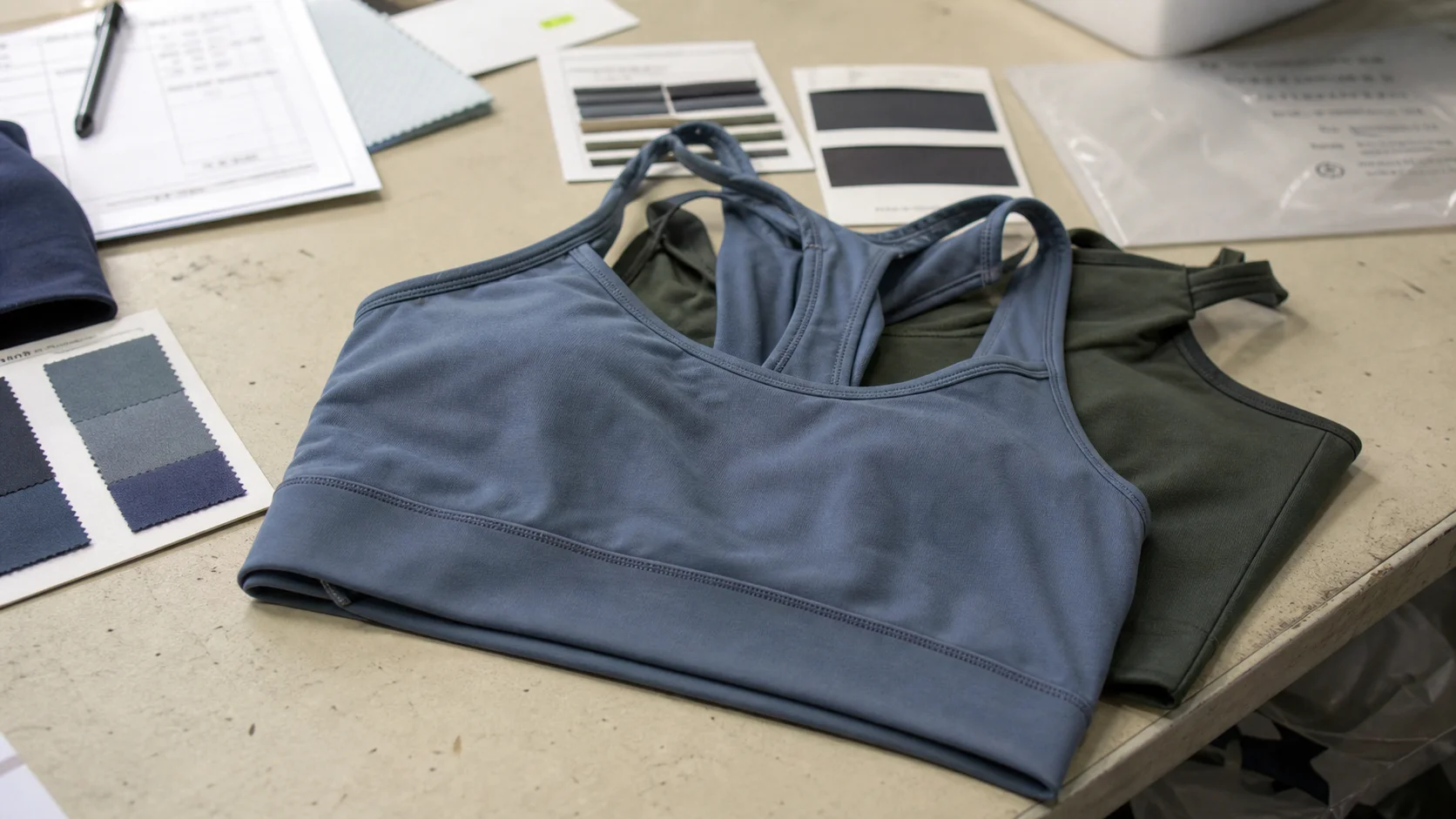
A 2500-word SEO outline for retail operations teams evaluating sports bra MOQ pricing, cost drivers, size-curve risk, decoration impacts, and production...
Sports Bra MOQ Pricing Review for Retail Ops - Activewear & Teamwear manufacturing guide
Retail operations teams reviewing sports bra MOQ pricing have a different job from design, merchandising, or marketing. The question is not only “What is the unit cost?” The better question is “Can this minimum order quantity support sell-through, size coverage, replenishment, and margin without tying up cash in slow-moving stock?”
Sports bras are operationally demanding products. They carry fit risk, fabric performance risk, size-curve complexity, and trim dependency. A low unit price can look attractive on a quote sheet, but if the MOQ forces too many colors, weak size allocation, or excess inventory, the real cost can be much higher. Retail ops teams need to compare MOQ pricing against demand forecasts, purchase order timing, carton flow, warehouse capacity, and return exposure.
This review is written for buyers, sourcing managers, retail planners, and operations teams assessing sports bra production for private label, teamwear, and activewear assortments. It covers realistic MOQ ranges, cost drivers, sampling steps, lead-time dependencies, fabric and trim specifications, inspection risks, and the purchasing tradeoffs that matter before placing a production order.
MOQ, or minimum order quantity, is often treated as a sourcing constraint. For retail operations, it is also an inventory and margin control point. A sports bra MOQ determines how many units must be bought before a factory will open production. That quantity affects cash flow, warehousing, inbound freight, markdown exposure, and replenishment flexibility.
A sports bra is rarely a single-SKU decision. One style may include multiple sizes, colorways, cup coverage options, strap configurations, or compression levels. A factory may quote MOQ by style, color, fabric dye lot, size set, or total order. The difference matters. A 1,000-piece MOQ by style is manageable for many retail programs. A 1,000-piece MOQ per color can become difficult if the assortment includes six colors and eight sizes.
Retail ops teams should push for clarity at the quote stage. Ask whether the MOQ is based on cutting efficiency, fabric mill minimums, elastic minimums, dyeing requirements, or factory line setup. The answer helps determine whether the MOQ can be negotiated or whether the quantity is tied to a hard production constraint.
A lower unit price is not always a better buy. If the MOQ creates excess depth in weak sizes or unproven colors, the order can lose margin through markdowns, storage costs, and returns.
Sports bra MOQ pricing should be reviewed against total commercial performance. That includes gross margin, landed cost, size availability, replenishment risk, and the probability of selling through the full order within the planned retail window.
MOQ ranges vary by factory, fabric type, construction complexity, and whether the order uses stock materials or custom-developed components. The ranges below are typical planning references, not fixed rules. Retail teams should confirm every MOQ directly with the manufacturer before committing to a launch calendar.
Production Type Typical MOQ Range Best Use Case Key Tradeoff Stock fabric, simple sports bra 300-800 pieces per style/color Small retail drops, test orders, teamwear programs Limited color, fabric, and trim customization Custom color with stock fabric base 800-1,500 pieces per color Seasonal activewear collections Dye lot minimums and lab dip approval add time Custom fabric or performance finish 1,500-3,000 pieces per style or fabric lot Established retail programs with forecast confidence Higher development cost and longer lead time Seamless or engineered knit sports bra 1,000-3,000 pieces per style/color Compression styles and body-mapped activewear Machine programming, yarn minimums, and fit iteration High-support sports bra with molded cups 1,000-5,000 pieces depending on components Performance retail, gym, running, and training categories Cup molds, hardware, elastic, and grading riskFor new retail programs, 300-800 pieces per style/color may sound attractive, but this usually works only when the factory can use existing fabrics, existing elastic widths, standard pads, and simple packaging. The unit price may be higher because the factory has less cutting efficiency and fewer economies of scale.
For mature retail operations, larger MOQs can reduce unit cost. The tradeoff is inventory commitment. A 2,000-piece order may secure better pricing, but the team must have enough sales confidence to support the depth across sizes and colors. If the purchase order is built around an untested silhouette, the risk rises quickly.
Sports bra pricing is shaped by more than fabric consumption. Construction, labor minutes, fabric recovery, trims, testing, packaging, and quality standards all affect the quote. Retail ops teams should request a cost breakdown or at least a line-by-line explanation of major cost factors.
Fabric is usually one of the largest cost inputs. Common sports bra fabrics include nylon-spandex, polyester-spandex, recycled polyester-spandex, cotton-spandex blends, and seamless knit yarns. Nylon-spandex often provides a smooth hand feel and strong stretch recovery, while polyester-spandex can be cost-efficient and suitable for printed programs. Recycled fibers may increase cost depending on certification, supply availability, and testing requirements.
Fabric weight can also change pricing. A light 180 gsm fabric may be suitable for low-impact lounge or yoga bras, while a 250-320 gsm fabric may be needed for stronger compression and opacity. Heavier fabric increases material cost and may affect sewing performance.
A simple pullover sports bra with a racerback and encased elastic is usually cheaper than a high-support style with adjustable straps, hook-and-eye closure, power mesh panels, bonded seams, removable pads, and multiple fabric layers. Each feature adds labor minutes and inspection points.
Retail teams should not remove support features only to chase a lower quote. If the product is marketed for training, running, or team performance, weak support can create returns and poor reviews. Cost savings must be balanced against fit and function.
Underband elastic, binding, strap elastic, sliders, rings, hooks, labels, pads, and logo applications can all influence MOQ and price. Elastic often has its own color and width minimums. A custom jacquard underband with branding may raise MOQ substantially compared with plain stock elastic.
Removable pads are another common cost variable. Pad shape, thickness, perforation, edge finish, and size grading can affect both price and fit. Cheap pads may crease, shift, or show through the fabric. That can damage the product experience even if the garment itself is well sewn.
Sports bras may use heat transfer logos, silicone prints, woven labels, printed care labels, embroidery, or jacquard elastic branding. Heat transfers are common, but they must be tested for stretch, wash durability, and placement accuracy. Embroidery is less common on high-stretch compression zones because it can distort or irritate the wearer.
Branding choices should be reviewed early. A low MOQ garment can become a high MOQ order if the branding trim requires custom tooling or large material minimums.
Retail-ready packaging can add cost and complexity. Hangtags, belly bands, size stickers, polybags, barcodes, carton labels, and folding standards should be confirmed before the final quote. Operations teams should check whether the supplier can meet warehouse routing requirements and retailer compliance rules.
Packaging mistakes create downstream cost. Incorrect barcodes, mixed sizes, unreadable carton marks, and wrong fold dimensions can delay receiving and allocation.
Sports bra specifications need more detail than a basic top or promotional garment. A tech pack should define fabric performance, construction standards, trims, measurements, and packaging. Ambiguity at this stage often leads to sample delays or production disputes.
Specification Area What to Confirm Why It Matters Main fabric Fiber content, gsm, width, stretch direction, color, finish Controls hand feel, coverage, recovery, and cost Lining Power mesh, self-fabric, brushed lining, or compression lining Affects support, opacity, and comfort Elastic Width, modulus, color, branding, placement, shrinkage Controls underband stability and fit consistency Pads Removable or fixed, thickness, size grading, edge quality Impacts shape, coverage, and consumer complaints Seams Flatlock, overlock, coverstitch, bonded, bartack points Affects durability, comfort, and labor cost Labels Printed care label, woven label, tearaway, heat transfer Reduces irritation and supports complianceRetail ops teams should ask sourcing and product teams to confirm stretch and recovery targets. A fabric may stretch well during fitting but fail after repeated wear if recovery is poor. Shrinkage should also be tested because sports bras depend on close body fit. Even small dimensional changes can affect comfort and support.
Colorfastness is another practical issue. Activewear may be exposed to sweat, deodorant, friction, and frequent washing. Dark shades and bright neons require careful testing. If the style includes contrast binding or light mesh panels, migration risk should be checked before bulk cutting.
For broader apparel development support, teams can review manufacturing service options at Fabrikn services. The key is to align material selection with the intended retail price point, support level, and production quantity before confirming MOQ.
Skipping sample discipline to meet a launch date is risky with sports bras. Fit, compression, seam comfort, and pad behavior cannot be judged from a flat sketch. Retail operations should understand the sample path because approval delays often affect purchase order timing and delivery windows.
The development sample checks the first interpretation of the tech pack. It may use substitute fabric or available trims, so it should not be judged as final production quality unless all materials are confirmed. The purpose is to evaluate silhouette, construction, seam placement, and initial fit direction.
The fit sample should use fabric close to the intended bulk quality. Sports bras depend on stretch and recovery, so fit decisions made in the wrong fabric can mislead the team. Review underband tension, armhole comfort, strap angle, bust coverage, neckline security, and movement stability.
A size set checks grading across the full size range. This step is especially important for sports bras because compression and support must scale correctly. A medium sample may fit well while XS feels too tight and XL lacks support. Retail teams should not assume one approved base size proves the entire range.
The pre-production sample should represent final approved fabric, trims, color, labels, logo placement, stitching, and packaging. This is the sample that operations, quality, and merchandising teams should treat as the production benchmark. Bulk should not begin until the pre-production sample is approved in writing.
Top-of-production samples are pulled from the first production output. They confirm that bulk sewing matches the approved pre-production sample. If TOP review finds issues in seam tension, elastic placement, pad pockets, or logo adhesion, production may need correction before the full order is completed.
The most expensive sample is the one skipped too early. A poor pre-production approval can move fit and construction problems into thousands of finished units.
Sports bra lead time is not only factory sewing time. It depends on fabric booking, lab dips, trim procurement, sample revisions, testing, production capacity, inspection scheduling, and freight. A typical bulk production timeline may range from 45 to 90 days after all approvals, but complex styles or custom materials can run longer.
Stage Typical Timing Dependency Tech pack and quote review 3-10 business days Complete specs, size range, and packaging details Development and fit samples 10-25 business days per round Material availability and pattern complexity Lab dips or color approval 7-21 business days Fabric type, dye process, and approval speed Bulk fabric and trim procurement 15-45 days Mill MOQ, elastic, pads, hardware, and labels Cutting and sewing 20-45 days Order size, line capacity, and construction complexity Inspection and packing 3-10 business days AQL plan, rework needs, carton labeling Freight and receiving Varies widely Shipping mode, customs, routing, and warehouse capacityRetail ops should ask whether quoted lead time starts from purchase order date, deposit date, material approval date, or pre-production sample approval. Many delays happen because teams assume the clock starts at PO issue, while the factory starts counting only after sample, fabric, trim, and payment conditions are complete.
Lead time also changes with seasonality. Activewear demand, holiday shipping peaks, mill capacity, and regional holidays can all affect delivery. Teams buying for back-to-school, spring fitness campaigns, or teamwear seasons should build in calendar buffer.
MOQ pricing must be reviewed against SKU count. A sports bra style with six sizes and four colors creates 24 SKUs. If the MOQ is 1,200 pieces per color, each color must be split across sizes. The size curve then determines whether core sizes receive enough depth and edge sizes remain commercially reasonable.
Retail planners should avoid equal size allocation unless there is a specific reason. Sports bra demand usually concentrates in core sizes, but the exact curve depends on customer base, brand positioning, support level, and regional market. Teamwear programs may need broader size coverage, while fashion activewear drops may focus more heavily on core retail sizes.
Color planning is equally important. Black, navy, grey, and core neutrals often carry lower demand risk than seasonal fashion shades. Bright or trend-led colors may perform well in marketing but can become markdown exposure if overbought. A practical approach is to place MOQ depth behind proven core colors and use smaller test quantities for seasonal colors when the supplier structure allows it.
Retail ops teams should ask these questions before confirming the order:
If the MOQ is too high for the expected sell-through, the team should consider reducing color count, simplifying trims, using stock fabric, or moving the style into a broader coordinated activewear program. Spreading one fabric across multiple styles can improve fabric utilization, but it also increases exposure if the fabric choice underperforms.
Sports bras should be inspected with performance and fit in mind, not only visual appearance. A garment can pass a basic visual check and still fail commercially if the underband rolls, pads shift, straps twist, or seams irritate the wearer.
Measurements must be checked against the approved spec and tolerance. Key points include underband width, body length, strap length, front neckline, armhole, side seam height, and back opening. Since stretch garments are sensitive, measurement method should be standardized. Pulling too hard or too lightly during inspection can distort results.
Elastic is one of the most common failure points. Underband tension should be consistent across sizes and production lots. If elastic is too tight, customers may reject the fit. If it is too loose, the sports bra may lack support. Twisted elastic, uneven joining, and poor bartacking can also cause returns.
Removable pads can create several inspection risks: uneven pad shape, visible pad edges, shifting during wear, difficult insertion, or mismatched left and right cups. If pads are size-graded, the packing team must not mix pad sizes across garments.
Seam stretch is critical. Broken stitches, skipped stitches, tight thread tension, and seam grin can appear when the garment is stretched. Inspectors should check stress points such as strap joins, side seams, underband joins, and pad pocket openings.
Shade variation can happen between fabric rolls, trim lots, elastic, and lining. A black sports bra with mismatched elastic may look low quality even if the sewing is acceptable. Contrast styles should be reviewed carefully because mismatched components are more visible.
Heat transfer logos and printed branding should be checked for placement, adhesion, cracking, and wash resistance. A logo that looks clean at packing may fail after stretch or laundering if the application method is not compatible with the fabric.
Retail operations should define inspection standards before production starts. Acceptable quality level, measurement tolerances, defect classification, packaging requirements, and carton labeling rules should be written into the purchase order or quality manual.
A useful sports bra MOQ pricing review compares the quoted unit cost with operational exposure. The lowest quote should not automatically win. Retail teams should review cost, MOQ, quality risk, replenishment ability, and supplier responsiveness together.
Review Area Operational Question Buying Judgment MOQ structure Is the minimum by style, color, size, or fabric lot? Prefer flexible MOQ if assortment testing is needed Unit price Does the price include all trims, labels, packaging, and testing? Compare complete landed assumptions, not garment-only cost Fabric risk Is the fabric proven, available, and suitable for support level? Avoid custom fabric on untested silhouettes unless volume supports it Size allocation Does MOQ create too much stock in edge sizes? Negotiate size flexibility or reduce color count Sampling Are fit, size set, and pre-production samples included in the timeline? Do not approve bulk before final materials are reviewed Inspection Are stretch, seam, elastic, and pad issues covered? Use a sports-bra-specific inspection checklist Replenishment Can the supplier repeat the style quickly if it sells? Higher first MOQ may be acceptable for proven replenishable basicsRetail ops teams should also calculate the cost of slow stock. If a factory offers a lower price at 3,000 pieces but demand supports only 1,500 pieces in the selling window, the apparent saving may disappear through markdowns. A higher unit cost at a lower MOQ can be the better commercial decision for new styles.
For teams evaluating supplier setup or production planning, Fabrikn’s company information can help frame the type of apparel manufacturing support available. The practical goal is not simply to source a sports bra. It is to build a production model that supports retail operations without creating avoidable inventory problems.
MOQ negotiation is rarely about asking for a lower number in isolation. Factories set minimums because they must cover fabric purchases, cutting setup, sewing line efficiency, trim procurement, and overhead. A buyer can often improve flexibility by changing the product or order structure.
A higher MOQ can make sense when the style is a proven core item, the size curve is supported by sales history, the fabric is used across multiple products, and replenishment demand is likely. In this case, better unit pricing may support margin, and deeper inventory may reduce stockouts.
Higher MOQ can also work for black or neutral sports bras that form part of a recurring activewear program. If the same body is sold season after season, the operational risk is lower than with a trend-led color or new support construction.
A lower MOQ is often better for a new silhouette, new customer segment, seasonal color, limited teamwear program, or uncertain support level. Paying a higher unit cost can be sensible if it protects cash and reduces markdown risk. Retail ops should think of the extra unit cost as a test premium.
Lower MOQ is also useful when the team needs market feedback before committing to a broader program. A first drop can validate fit, return rates, customer reviews, and size demand. Once the data is stronger, the next order can move to a more efficient production quantity.
If MOQ pricing is too high, simplify before cutting quality-critical features. Reduce color count, use stock elastic, choose existing pads, remove custom hardware, or share fabric with matching leggings. Do not remove lining, support panels, or durable stitching if those features are necessary for the product promise.
Retail teams should be cautious with over-customization. A custom underband, custom pad, custom print, and custom color can turn a manageable order into a high-risk MOQ. Customization should earn its place through brand value, customer demand, or margin improvement.
Some quotes are not operationally suitable. If the supplier cannot explain MOQ structure, refuses sample approval checkpoints, gives vague fabric information, or treats inspection requirements as optional, the order carries elevated risk. A cheap quote without process control is not a reliable sourcing win.
Retail operations should also walk away from MOQ terms that force unrealistic size depth. If the order cannot be allocated sensibly across sizes and colors, the issue is not just price. It is a mismatch between supplier model and retail demand.
A disciplined review protects both margin and customer experience. Sports bras are intimate, performance-sensitive garments. Buyers should expect more development work than a basic tee or hoodie. That work is justified when the product must deliver comfort, support, and repeat purchase potential.
Sports bra MOQ pricing review should be treated as a retail operations decision, not just a sourcing negotiation. The best order quantity is the one that supports the forecast, protects fit quality, allows workable size allocation, and keeps inventory risk within the business plan.
For new styles, lower MOQ with higher unit cost may be the better first buy. For proven core programs, larger MOQ can improve margin and supply continuity. The practical answer depends on fabric certainty, trim requirements, size curve confidence, inspection readiness, and the team’s ability to sell through the order without heavy markdowns.
Teams preparing an activewear or teamwear production brief can discuss requirements through Fabrikn’s contact page. A clear brief should include target MOQ, expected retail price, size range, support level, fabric direction, packaging needs, and delivery window. Better information at the beginning usually leads to cleaner pricing and fewer operational surprises.
Get a free quote from Fabrikn — your trusted B2B clothing manufacturer with 10+ years of experience. MOQ as low as 200 pieces.
Get a Free Quote →A typical sports bra MOQ may range from 300 to 800 pieces per style/color for simple stock-fabric programs. Custom colors, custom fabrics, seamless knitting, molded cups, or branded trims can push MOQ into the 1,000 to 5,000 piece range depending on supplier and material requirements.
No. A lower MOQ reduces inventory exposure but usually increases unit cost. It is useful for testing new styles, colors, or customer segments. A higher MOQ can be better for proven core products where sales history supports deeper inventory and stronger margin.
Sports bras use performance fabrics, elastic, pads, linings, and more technical construction. Fit and support are sensitive to material quality and sewing accuracy. Fabric mills and trim suppliers may also impose their own minimums, which increases the factory’s required production quantity.
Retail ops should confirm final fabric, trims, measurements, size grading, pad quality, logo placement, packaging, carton labeling, and inspection standards. Fit sample, size set sample, and pre-production sample approvals should be completed before bulk cutting begins.
MOQ determines how many total units must be divided across sizes. If the MOQ is high and the size range is broad, weak size planning can create too much inventory in low-demand sizes. Retail teams should use historical sales data where possible and avoid equal allocation unless it is commercially justified.
Sometimes. MOQ may be flexible if the factory can use stock fabric, existing trims, shared materials, or combine production with related styles. It is harder to reduce MOQ when custom dyeing, custom elastic, seamless programming, or special pads are involved.
Common inspection issues include uneven elastic tension, skipped stitches, shade variation, poor logo adhesion, shifting pads, inaccurate measurements, twisted straps, and weak bartacks. Inspection should include stretch and seam checks, not only visual review.
Compare total landed assumptions, not only unit price. Review MOQ structure, fabric quality, trim inclusion, sample process, lead time, packaging, inspection readiness, replenishment options, and markdown exposure. The better quote is the one that supports the retail plan with acceptable risk.