
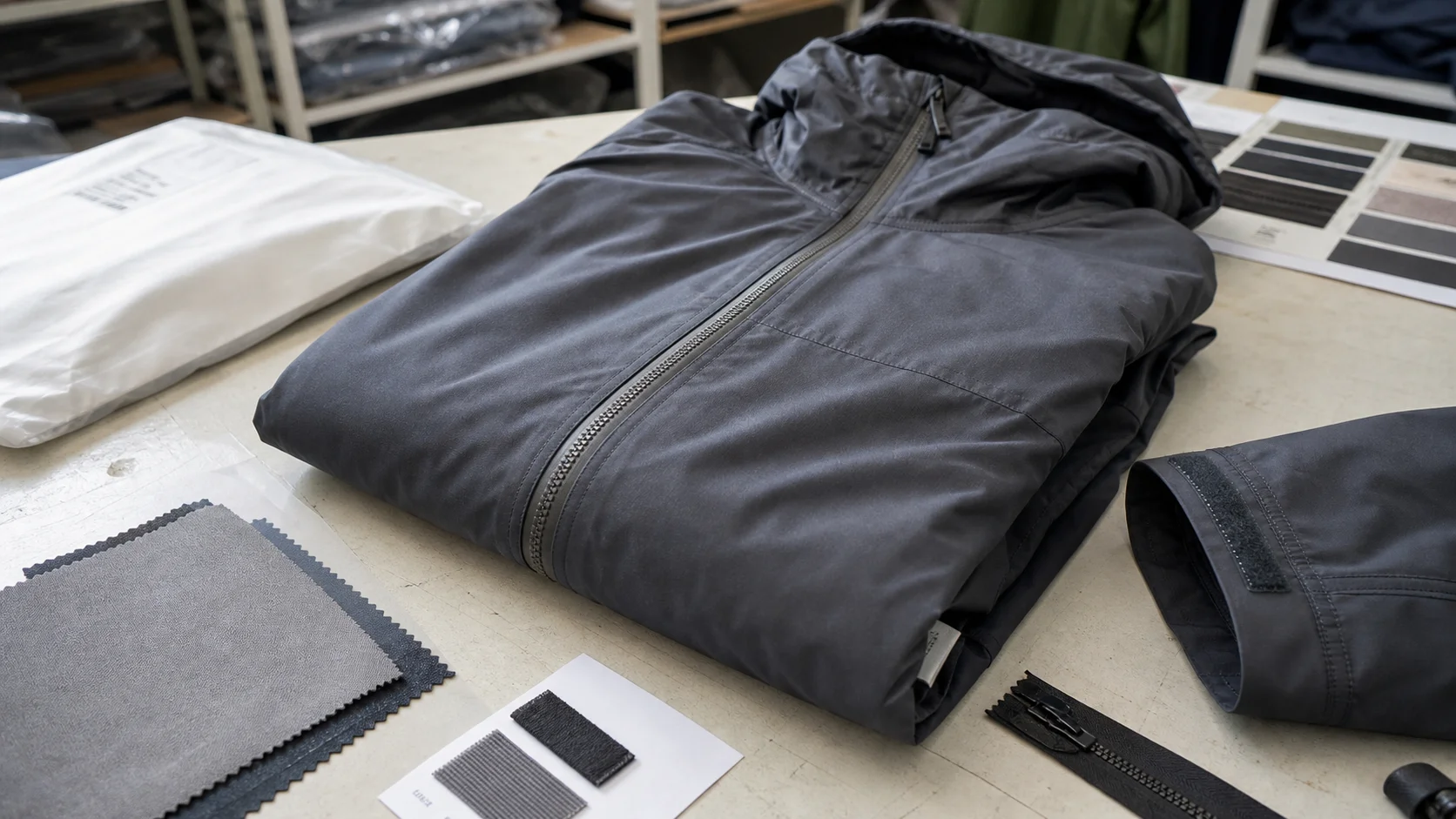
A practical SEO outline for outdoor school buyers comparing storm jacket landed costs, including shell fabric specs, seam sealing, trims, testing, freight,...
Storm Jacket Landed Cost Guide for School Buyers - Outerwear & Jackets manufacturing guide
Buying storm jackets for schools is not the same as buying standard retail outerwear. A school buyer has to balance weather protection, student comfort, uniform rules, safety expectations, budget control, decoration requirements, and delivery timing before the cold or wet season starts. The quoted factory price is only one part of the decision. The real purchasing number is landed cost: the total cost of getting approved jackets from a storm jacket manufacturer into the school’s warehouse, uniform shop, distributor, or campus delivery point.
This guide is written for outdoor school buyers, uniform program managers, education procurement teams, and apparel distributors supplying schools. It explains how landed cost is built, where costs often move, and how to compare factory quotes more accurately before issuing a purchase order.
Landed cost is the total cost of a finished jacket after production, packing, inland transport, export handling, international freight, import duty, customs clearance, insurance, domestic delivery, and any local handling are included. For school outerwear, it should also account for decoration, labeling, size distribution, packaging, and quality inspection. A low unit price can become expensive if the freight method is wrong, the jackets are overbuilt for the use case, or the order requires multiple rounds of corrections.
School buyers often compare quotations using only FOB unit price. FOB can be useful, but it does not show the full delivered cost. A storm jacket manufacturer may quote a competitive garment price, while another supplier includes better trims, stronger fabric, improved packing, or more realistic delivery planning. The buyer’s task is to normalize those offers into a like-for-like landed cost.
A practical buying rule: do not approve a storm jacket quote until the fabric, membrane or coating, seam treatment, lining, trims, decoration method, packing, Incoterm, inspection plan, and delivery route are all clear.
For school programs, landed cost also affects retail pricing if the jackets are sold through a uniform shop. It affects parent affordability, annual budget planning, and repeat-order stability. If landed cost is calculated too tightly, the program may have no margin for size exchanges, replacement units, freight volatility, or late-season reorders.
A storm jacket usually has more cost layers than a fleece, hoodie, or basic shell. Weather protection depends on materials and construction, and those choices directly affect manufacturing time and price.
Cost Component What It Includes Why It Matters for Schools Fabric Shell fabric, coating or membrane, lining, interlining Controls warmth, waterproofing, breathability, durability, and appearance Trims Zippers, snaps, drawcords, toggles, hook-and-loop, elastic, reflective tape Impacts safety, longevity, repair risk, and compliance with school requirements Labor Cutting, sewing, seam sealing, quilting, pressing, packing Complex jackets need more sewing operations and tighter workmanship control Decoration Embroidery, woven badge, heat transfer, print, reflective logo School branding must withstand rain, washing, and student use Testing Water resistance, colorfastness, seam strength, shrinkage, trim performance Reduces complaints and protects the buyer from unsuitable goods Packing Polybag, size sticker, carton, carton markings, assortment packing Supports easy distribution by class, house, campus, or uniform shop Logistics Export handling, freight, insurance, clearance, inland delivery Often determines whether the jacket arrives before the school seasonThe highest-risk area is incomplete specification. If a buyer asks for a “waterproof school storm jacket” without defining the fabric, test method, seam sealing, and lining, suppliers will quote different products. One jacket may be a lightweight water-resistant shell. Another may be a taped-seam waterproof jacket with mesh lining and branded zippers. The price difference can be large, and both suppliers may believe they quoted correctly.
Storm jacket pricing begins with the technical pack. If the school already has an existing jacket, the best starting point is a physical sample plus a clear specification sheet. If the school is developing a new program, the buyer should define performance requirements before asking for final prices.
Common shell options include polyester pongee, polyester taslon, nylon taslon, recycled polyester, and softshell-style woven fabrics. Polyester is often more cost-stable and suitable for school uniform programs. Nylon can provide a premium hand feel and abrasion resistance, but it may raise cost and color control requirements.
Typical school storm jacket shell weights may range from around 90 gsm to 180 gsm, depending on whether the product is a lightweight rain shell, a lined school jacket, or a heavier winter-ready outer layer. Heavier fabric is not automatically better. It can improve durability and structure, but it can also reduce packability, increase freight weight, and feel too warm for active students.
School buyers should separate water-resistant, waterproof-coated, and waterproof-breathable jackets. A simple water-resistant finish may be adequate for light rain during commuting. A waterproof coating with taped critical seams may suit outdoor school trips and wet playground duty. A waterproof-breathable membrane with fully taped seams is stronger for prolonged exposure, but it costs more and needs better production control.
Waterproof ratings are often quoted in millimeters, such as 3,000 mm, 5,000 mm, or 10,000 mm. Breathability may be quoted as g/m²/24h. These figures are only useful when the test standard and fabric construction are clear. A school does not always need the highest rating. The better purchasing question is: how long will students be exposed to rain, and how much movement and heat buildup will the jacket need to manage?
A storm jacket can be unlined, mesh-lined, taffeta-lined, fleece-lined, quilted, or padded. Each choice changes cost and use case. Mesh lining improves comfort and breathability in a rain shell. Taffeta lining slides more easily over uniforms. Fleece lining adds warmth but may hold moisture if the shell performance is poor. Padding raises warmth and perceived value, yet it adds bulk, carton volume, and freight cost.
For many school programs, a lined waterproof shell is more versatile than a heavy padded jacket. Students can layer a sweater or fleece underneath. In colder regions, a 3-in-1 jacket may be attractive, but the landed cost, production complexity, and size-fit risk are higher.
Zippers are a common failure point in school outerwear. Low-cost zippers can reduce the quote, but they may create complaints after repeated use by students. Buyers should define zipper type, gauge, puller style, color, and whether the front zipper requires a storm flap. Reverse coil zippers can look cleaner and resist light rain when paired with a flap or garage, but they are not a substitute for proper waterproof construction.
Drawcords need careful review for children’s apparel. Some markets restrict or discourage drawcords in certain locations on children’s garments. For younger students, elastic binding, adjustable cuffs, or safer closure options may be preferable. Reflective trims may be useful for visibility during dark commuting hours, but placement and durability should be agreed before sampling.
Decoration is not just an artwork issue. It affects waterproofing, production sequence, and inspection. Embroidery can look premium, but needle holes can compromise water resistance if placed on exposed shell panels. Heat transfers and badges may be better for waterproof shells, provided adhesive strength and wash durability are tested. Woven badges are common for traditional school styling, yet they require edge quality, color matching, and secure attachment.
Buyers preparing a school outerwear program can review broader production support options through Fabrikn’s services page when planning specification, sourcing, and manufacturing coordination.
Minimum order quantity is one of the first commercial points to check with a storm jacket manufacturer. MOQs vary by factory setup, fabric availability, dyeing requirements, trim customization, and decoration complexity. For school buyers, the real issue is rarely total units alone. It is the spread across sizes, colors, campuses, and gender fits.
Typical MOQ ranges for custom storm jackets may look like this:
Program Type Typical MOQ Range Buyer Notes Stock fabric, custom logo 100–300 pieces Best for smaller schools or urgent orders, but color and fabric choices are limited Custom color, standard trims 300–600 pieces Common for school uniform programs with one main color Custom fabric, custom trims 500–1,000 pieces Better brand control, but longer lead time and higher development risk Multi-color or house system jackets 600–1,500 pieces Cost depends on color split, fabric dye lots, and decoration variationThese are typical planning ranges, not fixed rules. A manufacturer may accept a lower MOQ if fabric is available and the design is simple. Another may require higher volume if fabric must be dyed, laminated, or tested specifically for the order.
Size mix is where school orders become difficult. A 500-piece order spread across youth sizes, adult sizes, plus short or long fit requests can become inefficient. Factories may apply surcharges for very small size quantities. The buyer should ask for the minimum per size and per color, not only the total MOQ.
For annual school programs, a higher first order can reduce unit cost and stabilize supply. The tradeoff is inventory risk. If the jacket design, logo, or school color changes, leftover stock becomes difficult to sell. Buyers should check whether the manufacturer can hold approved fabric or trims for repeat orders, but they should avoid assuming availability unless it is confirmed in writing.
Sampling protects the buyer from expensive mistakes. It also adds time and cost. For storm jackets, skipping sample discipline is risky because performance depends on details that are hard to judge from a flat quotation.
A sample cost may be free, charged at cost, or charged at a premium and later deducted from the bulk order. For custom storm jackets, sample fees can vary widely depending on fabric and trim availability. A simple logo sample may be modest. A fully custom waterproof jacket sample with special fabric, taped seams, and branded trims can cost significantly more.
School buyers should allow enough time for corrections. One sample round is possible when the product is based on an existing pattern and stock materials. Two or three rounds may be needed for new designs, fit changes, custom colors, or technical seam construction. Rushing approval often moves risk into bulk production.
Approval should be written, dated, and linked to the exact sample version. If multiple people approve the jacket, one person should control final signoff. Conflicting feedback from procurement, sports staff, uniform shop staff, and school leadership can delay production if it arrives after materials are ordered.
Lead time is not only sewing time. It includes quotation, sample development, material booking, lab dips, bulk fabric production, trim production, cutting, sewing, seam sealing, inspection, packing, export handling, freight, customs, and domestic delivery. School buyers should work backward from the in-hand date, not from the desired ship date.
A practical lead-time range for custom storm jackets may be:
For school-season launches, buyers should avoid placing the first custom storm jacket order too close to term start. A realistic calendar often needs 90–150 days from specification confirmation to delivered goods for custom production. More time is needed for new fabric development, multi-campus programs, or a full tender process.
Lead time can change for several reasons. Custom color fabric needs lab dip approval. Waterproof coatings may need curing and testing. Seam tape must match fabric construction. Branded zipper pullers or custom snaps can extend trim lead time. Public holidays, port congestion, and peak outerwear season can also affect schedules. None of these issues should be treated as unusual. They are normal planning risks in outerwear sourcing.
For school buyers evaluating a supplier’s capability and process fit, Fabrikn’s about page can be used as a starting point to understand the company background before opening a sourcing discussion.
Freight can change the landed cost sharply, especially for padded or bulky jackets. A storm jacket may be quoted at a reasonable factory price, then become expensive if shipped by air because the cartons cube out by volume weight. Lightweight shells are easier to airfreight. Insulated jackets, 3-in-1 systems, and heavy lined jackets are less forgiving.
Common Incoterms include EXW, FOB, CIF, DAP, and DDP. Each one shifts cost and responsibility between buyer and seller. School buyers should not compare an EXW quote with a DDP quote as if they are the same.
Incoterm Meaning for Buyer Purchasing Judgment EXW Buyer handles pickup from factory and nearly all logistics Useful for experienced importers, risky for schools without freight support FOB Supplier delivers goods to export port or vessel as agreed Good comparison basis when buyer controls freight and import CIF Supplier includes cost, insurance, and freight to destination port Check local charges carefully; port-to-door cost is still buyer’s issue DAP Supplier delivers to named place, buyer usually handles duties and taxes Convenient if import process is clear DDP Supplier includes delivery with duty paid, where legally and practically available Simple for budgeting, but buyer should verify what is truly includedDDP can be attractive for schools because it gives a clearer delivered figure. The tradeoff is visibility. Buyers should confirm whether customs duty, taxes, delivery appointment fees, remote area charges, and unloading are included. If the supplier cannot explain the basis of the DDP quote, the simplicity may not be dependable.
Import duty depends on product classification, fiber content, country of origin, destination country, and trade agreements. A polyester waterproof jacket may fall under a different classification than a padded jacket or coated garment. Small construction differences can affect duty treatment. Buyers should ask their broker or logistics partner to confirm classification rather than relying only on a supplier’s informal estimate.
Country of origin documentation, commercial invoice accuracy, packing lists, and material descriptions matter. A school buyer may not manage customs directly, but incorrect documents can delay delivery and create unexpected charges. If delivery timing is tied to a school launch or outdoor education trip, clearance delay becomes more than an accounting issue.
Carton size affects freight cost and warehouse handling. Jackets should not be packed so tightly that insulation is crushed, coatings are creased, or decorations are damaged. At the same time, excessive carton volume raises shipping cost. A balanced carton plan should show units per carton, carton dimensions, gross weight, net weight, and size assortment.
For school distribution, carton ratios should match the receiving process. A uniform shop may prefer size-specific cartons. A multi-campus school group may need cartons marked by campus, class, or delivery location. These choices may add handling time at the factory, but they can reduce receiving errors and labor after arrival.
Storm jackets need stronger inspection than basic apparel because defects can affect function, not only appearance. A skipped seam tape, weak zipper, leaking embroidery placement, or poor hood fit can create immediate complaints in wet weather.
A pre-shipment inspection should compare bulk goods against the sealed sample, approved measurements, bill of materials, artwork, packing instructions, and workmanship standard. For technical jackets, inspection may also include simple on-site water spray checks, although lab testing is more reliable for formal performance claims.
Buyers should decide acceptable quality limits before production. Many apparel inspections use AQL methods, but the chosen level should reflect the order value and risk. Critical defects, such as unsafe trims or wrong school logo, should not be treated like minor thread ends. Waterproofing failures also need clear handling rules because they may not be visible during a standard visual inspection.
Testing may include colorfastness to washing and rubbing, dimensional stability, seam strength, tear strength, pilling for lining or fleece components, water repellency, hydrostatic pressure, and decoration durability. Not every school order needs every test. The correct test package depends on claims made to parents, intended use, fabric type, and destination market requirements.
If the jacket is sold as waterproof, the buyer should be prepared to support that claim with appropriate testing. If the product is only water-resistant, the marketing language should stay modest. Overstating performance creates parent dissatisfaction and potential compliance exposure.
The following example is for planning only. Actual numbers will vary by country, season, freight market, duty rate, quantity, and specification. The point is to show how a school buyer can structure the calculation.
Cost Line Example Cost Per Jacket Notes FOB garment price $24.00 Polyester shell, PU coating, mesh lining, school logo badge Sample and development allocation $0.60 Spread across 500 pieces Testing allocation $0.45 Basic fabric and decoration tests Inspection allocation $0.35 Pre-shipment inspection cost divided by order quantity International freight $2.80 Depends heavily on carton volume and shipping method Insurance and export documents $0.20 Varies by logistics arrangement Duty and customs charges $2.10 Must be confirmed by classification and destination Domestic delivery and handling $0.90 Warehouse, school, or uniform shop delivery Estimated landed cost $31.40 Before margin, tax treatment, or retail markupIn this example, the FOB price is $24.00, but the estimated landed cost is $31.40. That is a meaningful difference. If the school buyer sets the budget using the factory price alone, the program will be underfunded before the jackets arrive.
The same jacket shipped by urgent air freight could cost much more. A larger order shipped by sea may reduce freight per unit, but it requires earlier approval and more inventory commitment. A lower-priced jacket with weak zippers or poor seam tape may save a few dollars on paper, then cost more in returns and reputational damage.
A good comparison table prevents misleading price decisions. Buyers should ask each storm jacket manufacturer to quote against the same specification and identify exclusions clearly.
Two quotes that look similar may not be equivalent. One may include fabric testing, sealed samples, and carton assortment packing. Another may exclude all of these. A school buyer should push for clarity before negotiating price. Price negotiation without specification control usually removes quality before it removes waste.
For buyers ready to discuss a school storm jacket requirement, the next practical step is to send a clear brief through Fabrikn’s contact page with target quantity, delivery market, required date, size range, logo details, and any existing sample photos.
The best storm jacket program is not always the highest-specification program. Schools need dependable, wearable jackets that match the climate, budget, uniform policy, and distribution model. Overengineering can make the jacket too expensive for parents. Underengineering can create complaints as soon as bad weather arrives.
A simpler water-resistant or lightly waterproof jacket may be the right choice when students mainly need protection for short commutes, playground breaks, and occasional outdoor activity. It can reduce cost, shorten lead time, and simplify repeat orders. The buyer should avoid marketing it as a serious technical storm jacket if the construction does not support that claim.
Higher waterproof ratings, seam sealing, stronger zippers, and better hood design are worth considering when the jacket is used for outdoor education, sports travel, wet climates, or boarding school daily wear. Better trims and construction can reduce replacement complaints. The investment makes more sense when the school expects the jacket to last more than one season or pass between siblings.
Custom color blocking, multiple logos, contrast zippers, branded pullers, special linings, and house-color variants can make a jacket more distinctive. They also raise MOQ pressure, sampling time, and inventory risk. A school with uncertain demand should keep the first program disciplined: one core color, one logo position, a controlled size range, and a clear reorder path.
Holding stock helps schools handle late enrollments, lost jackets, size exchanges, and mid-season weather changes. The tradeoff is cash tied up in inventory. Buyers should use previous uniform sales data where available. If no data exists, start with conservative extras in the most common sizes rather than equal overstock across every size.
Air freight is a tool, not a normal cost base for bulky outerwear. It may be justified for launch deadlines, sample delays, or a partial shipment of core sizes. Sea freight or consolidated freight is usually more economical for planned programs. A split shipment can be sensible: urgent sizes by air, remaining stock by sea. The buyer should calculate the blended landed cost before agreeing.
A structured process reduces cost surprises. The buyer should start with the use case, then move into specification, sampling, quotation, landed cost calculation, and production control.
The strongest school outerwear programs are usually built on repeatability. Once a jacket is approved and proven in use, the buyer can improve cost control through better forecasting, earlier material booking, and stable specifications. Changing the design every year may look fresh, but it can reset sampling, increase leftover stock, and weaken supplier learning.
A storm jacket manufacturer landed cost guide is useful because it forces the buyer to look beyond the quoted garment price. For outdoor school buyers, the real cost sits in the total program: specification, fit, weather performance, decoration, testing, freight, duty, delivery, and after-arrival handling. The cheapest quote is rarely the safest choice if it leaves out seam sealing, reliable trims, inspection, or realistic logistics.
The best purchasing decision is a controlled one. Define the jacket honestly, match performance to the school’s climate and use case, keep customization manageable, approve samples carefully, and calculate landed cost before committing. That approach gives schools a better chance of receiving jackets that arrive on time, fit students properly, perform in wet weather, and stay within budget.
Get a free quote from Fabrikn — your trusted B2B clothing manufacturer with 10+ years of experience. MOQ as low as 200 pieces.
Get a Free Quote →Landed cost is the total cost of getting the jacket from the manufacturer to the final delivery point. It usually includes garment price, sample allocation, testing, inspection, export handling, freight, insurance, duty, customs clearance, and domestic delivery.
Typical custom storm jacket MOQs range from about 100–300 pieces for stock fabric with a logo, 300–600 pieces for custom color programs, and 500–1,000 pieces or more for custom fabric, trims, or complex designs. The exact MOQ depends on fabric, trims, size spread, and supplier capacity.
A practical planning range is 90–150 days from confirmed specification to delivered goods for a custom school program. Simpler stock-fabric orders can be faster, while custom fabric, special trims, multiple samples, or sea freight can extend the timeline.
Water-resistant jackets can work for light rain and short commutes. Waterproof jackets with seam treatment are better for wet climates, outdoor education, and longer exposure. The decision should match the real use case and the claims made to parents.
Embroidery can be used, but it may create needle holes in the shell fabric. For exposed waterproof panels, buyers should consider placement carefully or use badges and heat transfers where suitable. Decoration durability and water impact should be checked during sampling.
Quotes often differ because the specifications are not identical. Fabric weight, coating, seam sealing, lining, zipper quality, decoration, testing, packing, Incoterm, and freight inclusion can all change the price. Buyers should compare quotes using the same technical brief.
Common risks include leaking seams, weak zippers, poor logo placement, incorrect sizing, color variation, unsafe trims, missing labels, and packing errors. A sealed sample and pre-shipment inspection help control these risks before goods leave the factory.
Keep the design simple, limit colorways, use available fabric where suitable, avoid unnecessary custom trims, order early enough for economical freight, and concentrate volume in core sizes. Cutting zipper quality, seam treatment, or inspection is usually a poor saving.