
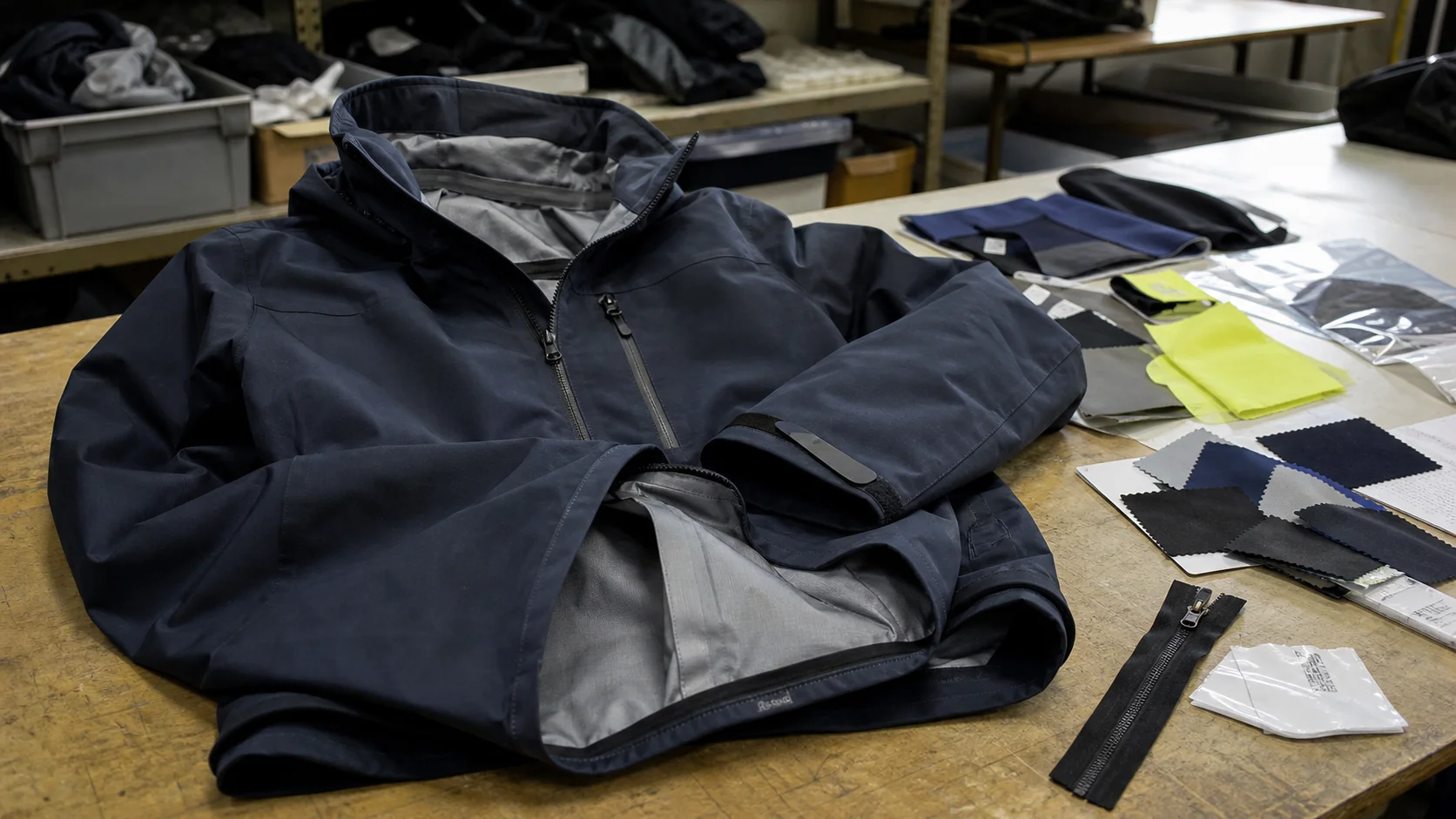
A product-specific SEO outline for buyers comparing storm jacket supplier MOQ, pricing, fabric specs, decoration costs, and production terms for cleaning...
Storm Jacket MOQ Pricing Review for Cleaning Crews - Outerwear & Jackets manufacturing guide
Storm jackets are a practical outerwear category for cleaning crews working around loading bays, car parks, exterior windows, waste areas, early-morning site access, and wet-weather facility maintenance. For procurement teams, the buying question is not only “Which jacket is waterproof?” It is also “What minimum order quantity makes commercial sense, what does the unit price include, and what risks appear after production starts?”
This storm jacket supplier MOQ pricing review for cleaning crews is written for buyers comparing factories, trading companies, and private-label outerwear programs. It covers realistic MOQ ranges, price drivers, fabric and trim specifications, sampling steps, lead-time dependencies, branding options, and inspection risks. The focus is B2B purchasing judgment: what to accept, what to negotiate, and where low pricing can create long-term problems.
Cleaning crews often work across mixed environments. A single shift may include indoor floor care, outdoor bin movement, pressure washing, loading dock cleaning, and access between buildings in rain or wind. A basic fleece or softshell is not enough for wet-weather exposure. A heavy industrial raincoat may be too bulky for fast movement. A storm jacket sits between these categories.
For cleaning businesses, the best storm jacket is usually lightweight, waterproof or highly water-resistant, easy to layer, durable enough for repeated laundering, and simple to brand. It should protect staff without slowing them down. It also needs to look consistent across crews, because outerwear is often the most visible part of the uniform in public spaces.
The purchasing tradeoff is straightforward. A cheaper jacket can meet a short-term tender budget, but it may fail at seams, zippers, coating, or reflective tape after repeated use. A premium jacket improves comfort and service life, but it can create cash-flow pressure if the supplier requires a high MOQ. Cleaning companies and uniform distributors need to balance unit cost, replacement cycles, and order flexibility.
MOQ is one of the first commercial filters when reviewing storm jacket suppliers. Minimum order quantities vary by supplier type, fabric availability, color, construction complexity, and branding method. Buyers should treat any MOQ quote as conditional until fabric, trims, size range, logo placement, packaging, and testing requirements are confirmed.
Supplier Type Typical MOQ Range Best For Common Limitation Stock jacket supplier 10–100 pieces Small cleaning crews, urgent replenishment, basic branding Limited colors, fixed fit, fewer fabric choices Semi-custom supplier 100–300 pieces per style/color Growing cleaning companies and regional uniform programs Some design restrictions, limited trim changes Full custom manufacturer 300–1,000 pieces per style/color Private-label uniforms, larger contractors, distributors Longer development cycle and higher sampling commitment Technical outerwear factory 500–2,000 pieces per style/color High-performance waterproof jackets with taped seams Higher MOQ, stricter material ordering requirementsFor cleaning crews, a practical MOQ often sits between 100 and 500 pieces if the jacket is semi-custom. This usually allows a branded product, controlled color, basic trim selection, and size distribution without pushing the buyer into a fully engineered outdoor performance garment.
Very low MOQ sounds attractive, especially for a small crew or pilot program. The limitation is that the product may come from stock inventory with decoration added afterward. That can work well if the goal is fast deployment. It is less suitable when the buyer needs exact company colors, custom reflective placements, special pocketing, or a long-term repeatable uniform standard.
Purchasing judgment: If the crew size is below 50 people, stock or semi-custom jackets are usually more sensible than full custom manufacturing. If the buyer needs repeat orders for multiple sites, a custom or semi-custom program can be worth the higher MOQ.
Storm jacket pricing depends heavily on fabric, seam sealing, lining, zipper grade, reflective material, and order quantity. Buyers should avoid comparing only the first quoted unit price. A proper pricing review checks what is included in the jacket and what will be charged separately.
Jacket Level Indicative B2B Unit Price Range Typical Features Buyer Risk Basic water-resistant shell Lower-cost range Polyester shell, PU coating, mesh or no lining, simple hood May not withstand prolonged rain or frequent washing Mid-range storm jacket Moderate range Waterproof coating or membrane, partial seam sealing, better zippers, adjustable cuffs Performance varies by seam construction and coating quality High-performance waterproof jacket Higher range Waterproof breathable fabric, fully taped seams, storm flap, technical hood, branded trims Higher MOQ and longer production lead timeFor cleaning crews, the mid-range storm jacket often offers the best cost-to-function balance. The jacket does not need to compete with mountaineering outerwear, but it must handle wet shifts, repeated movement, and daily wear. A very cheap shell may look acceptable at delivery but can lose water resistance quickly if the coating is thin or the seams are poorly finished.
Unit pricing normally falls as order volume increases. A supplier may quote one price at 100 pieces, a better price at 300 pieces, and a stronger price at 500 pieces. Buyers should still calculate the total landed cost, including sampling, logo setup, packaging, freight, duties, testing, and replacement allowance for defects.
Several cost items are commonly missed during early quotation:
A low EXW or FOB price may become less attractive after these items are added. Procurement teams should request a clear quote sheet that lists garment cost, decoration cost, sample cost, production MOQ, payment terms, lead time, packing method, and incoterm.
The fabric specification is the main technical driver in storm jacket pricing. Cleaning crews do not always need the highest outdoor performance fabric, but the jacket should be suitable for wet conditions and physical work. A thin promotional shell is rarely the right choice for crews who are outdoors every week.
Suppliers may quote waterproof performance as a hydrostatic head rating, such as 3,000mm, 5,000mm, or 10,000mm. For many cleaning crews, a 3,000mm to 5,000mm rating can be adequate if exposure is moderate and seams are protected. More demanding outdoor use may justify 8,000mm to 10,000mm. Buyers should not rely on fabric rating alone. Water can enter through seams, zippers, pocket openings, and hood construction.
Breathability matters because cleaning work can involve constant movement. A fully waterproof but non-breathable jacket may trap sweat, making workers uncomfortable. Breathability is usually quoted as g/m²/24h. A modest breathable coating may be enough for routine crew use, while high-output outdoor cleaning may require better performance. Higher breathability generally increases cost.
Lining affects comfort, warmth, and price. Mesh lining is common for lightweight storm jackets and helps reduce cling. Taffeta lining is smoother and easier to layer over uniforms. Fleece lining adds warmth but increases bulk and cost. For cleaning crews, mesh or taffeta lining is often more flexible because staff can layer underneath depending on season.
Fabric weight also matters. A very light shell is easy to carry but may feel flimsy. A heavier oxford fabric improves durability but may be warmer and less packable. For all-season cleaning contracts, a medium-weight shell with room for layering is often the safest specification.
Trim choices are a common source of hidden cost and quality variation. Two jackets may look similar in photos while using very different zippers, drawcords, snaps, seam tape, and reflective materials.
Front zippers should be smooth, durable, and protected by a storm flap if the jacket is expected to resist rain. Budget coil zippers may be acceptable for light use, but weak sliders and poor stitching can create complaints quickly. For cleaning crews, a zipper that can be operated with gloves is useful. Pullers should not be so large that they catch on equipment.
Seam construction determines whether the jacket performs in real rain. A water-resistant fabric without taped seams can still leak. Fully taped seams add cost and require proper factory capability. Partial seam sealing, usually at shoulders and upper body, may be a cost-effective compromise for moderate exposure.
A fixed hood is cheaper and harder to lose. A detachable hood improves versatility but adds snaps, zippers, and possible leakage points. A packable hood is neat for uniform presentation but may be less comfortable. Cleaning crews working outdoors in wet weather generally benefit from an adjustable fixed hood with a small brim.
Elastic cuffs are economical, while hook-and-loop adjustable cuffs provide better control. Drawcord hems improve fit but need safe cord management. For workwear, loose cords can be a snag risk. Buyers should consider whether a simple adjustable system is safer than a highly technical outdoor design.
Cleaning crews may need pockets for keys, access cards, gloves, small tools, or job sheets. Pocket openings should be protected from rain. Zippered hand pockets are better than open pockets, but every zipper adds cost. An internal chest pocket can be useful for supervisors. Too many pockets can complicate production and increase QC risk.
Reflective piping, tape, or prints can improve visibility in car parks and service yards. If the jacket must meet a specific high-visibility standard, that requirement needs to be stated before quotation. Decorative reflective trim is not the same as certified high-visibility workwear. Buyers should request test reports or certification details where compliance is required.
Storm jackets are often used as a mobile brand surface. Logos may be placed on the left chest, back, sleeve, or hood. The correct method depends on fabric type, waterproof construction, order quantity, and budget.
Branding Method Best Use Advantages Limitations Embroidery Chest logos on non-critical waterproof areas Professional look, durable Needle holes can reduce water resistance unless backed or positioned carefully Heat transfer Chest, back, sleeve logos Clean finish, good for waterproof shells Requires correct temperature and pressure; may peel if poorly applied Screen print Larger simple logos Cost-effective at volume Less flexible for small multi-color runs Woven patch Uniform branding with premium feel Consistent appearance, removable design option Sewing can create water-entry points Rubber or silicone badge Private-label outerwear Modern look, durable Mold cost and MOQ may be higherFor waterproof storm jackets, heat transfer branding is often the safest choice. Embroidery can look better on a corporate uniform, but buyers should ask how the supplier protects the back of the embroidery from moisture. For small cleaning crews, stock jackets with heat-applied logos may be the most efficient route.
Brand color accuracy should also be managed. If the logo must match exact corporate colors, request a digital proof and physical strike-off before bulk production. A screen color or PDF proof is not enough for final approval.
A disciplined sample approval process reduces production disputes. Storm jackets have more technical variables than basic T-shirts or polos, so buyers should not skip pre-production checks. Even when MOQ is small, one approved sample can prevent costly misunderstandings.
Cleaning companies often need inclusive sizing. That can affect pattern grading and fabric consumption. A supplier may quote a base price for regular sizes and charge extra for 3XL, 4XL, or 5XL. This is normal in outerwear, but it should be agreed before purchase order confirmation.
Fit should allow movement. Cleaning staff may lift equipment, bend, reach overhead, and wear layers underneath. A slim retail fit may look sharp but perform poorly on site. Buyers should ask for garment measurements and tolerance standards rather than relying on size names.
If the supplier offers only a single sample and no size set, the buyer should treat the order as higher risk. That may still be acceptable for a basic stock jacket, but it is weak control for custom storm jacket production.
Lead time depends on whether the jacket is stock, semi-custom, or fully custom. A buyer who needs jackets for a contract start date should work backward from delivery, not from production completion. Freight, customs, decoration, inspection, and packing can all shift the schedule.
Order Type Typical Lead Time Main Dependencies Stock jackets with logo 1–3 weeks Stock availability, logo approval, decoration capacity Semi-custom jackets 4–8 weeks Fabric availability, trim sourcing, sample approval, branding method Full custom jackets 8–14 weeks or more Material production, pattern development, seam sealing, testing, bulk production Technical waterproof jackets 10–16 weeks or more Special fabric, taped seams, lab testing, factory capacity, freight modeSeasonality is important. Outerwear factories can become busier before autumn and winter delivery windows. Buyers ordering storm jackets for a wet season should not wait until the weather changes. Late orders often lead to rushed sampling, limited fabric choices, and higher freight costs.
Approval delays are another common cause of missed delivery dates. If the buyer takes two weeks to approve a logo strike-off or fit sample, the production lead time shifts accordingly. Suppliers usually count bulk lead time from final approval and deposit, not from the first inquiry.
Freight mode changes the timeline and cost. Air freight may solve a late delivery problem but can damage the landed-cost calculation. Sea freight is more economical at volume but requires earlier planning. For cleaning companies with recurring uniform needs, forecasting and scheduled replenishment are better than emergency ordering.
Storm jackets require inspection beyond visual appearance. A jacket can look clean on a hanger but still fail in rain, washing, or daily use. Buyers should define inspection criteria before production starts.
For waterproof jackets, seam tape is a major risk. Factories need proper equipment, controlled temperature, and trained operators. Poor seam taping may not be obvious until the jacket is worn in rain. Buyers requesting fully taped seams should confirm that the supplier regularly produces this construction, not just that they can quote it.
Color shade variation is another risk, especially when orders use multiple fabric lots. If cleaning crews must present a consistent uniform image across sites, buyers should request shade band approval and keep repeat orders tied to confirmed fabric references.
Measurement tolerance should be realistic. Outerwear cannot be controlled like precision hardware, but large variation across sizes will cause fit complaints. A tolerance chart should be part of the tech pack or purchase order. Critical points include chest width, sleeve length, body length, shoulder width, and hood fit.
A storm jacket supplier MOQ pricing review for cleaning crews should compare more than the headline price. The right supplier depends on order volume, quality expectations, replenishment needs, and brand control.
Buyers should be cautious with vague answers. If the supplier cannot define fabric weight, coating type, seam treatment, zipper specification, and decoration method, the quotation is not complete. A low price based on unclear specifications is not a reliable buying basis.
For companies building a uniform program across many cleaning teams, supplier continuity matters. The first order may be easy, but the second and third orders reveal whether the supplier can maintain color, fit, trims, and labeling. Reorders should be discussed before the initial purchase order.
Businesses looking for broader apparel manufacturing support can review Fabrikn’s services to understand how sourcing, development, and production support may be structured. For company background, the about page provides context on the platform and approach. Buyers ready to discuss an outerwear project can use the contact page to start a sourcing conversation.
Not every cleaning company should buy storm jackets in the same way. Crew size, contract structure, staff turnover, and branding requirements all affect the best MOQ strategy.
Small teams should usually avoid full custom production unless they have a strong brand requirement and stable sizing data. Stock jackets with logo decoration are often enough. MOQ may be low, delivery is faster, and the buyer avoids holding excess inventory. The tradeoff is limited design control.
A smart approach is to choose a supplier with a stock jacket that can be reordered. Buyers should ask whether the style is seasonal or core inventory. If the jacket disappears after one season, replacement uniforms may not match.
Medium-sized cleaning companies can consider semi-custom storm jackets. This may allow company colors, improved pocketing, reflective trim, and better branding. MOQ may sit around 100–300 pieces, depending on supplier and fabric.
This group should build a size curve from actual staff data. Ordering equal quantities of each size is rarely efficient. Larger sizes may be more common in outerwear because staff wear layers underneath. A small reserve stock is useful for new hires and replacements.
Larger contractors can justify custom storm jackets if the garment supports a long-term uniform standard. Higher MOQ can reduce unit price and improve control over fabric, trims, fit, and branding. The buyer should build in replenishment planning, because one large order may not solve ongoing staff changes.
For multi-site cleaning operations, packing becomes important. Site-wise cartons, employee packs, size labels, and barcode systems reduce distribution errors. These services may add cost, but they can save time during rollout.
A practical mid-range storm jacket specification for cleaning crews might include the following elements:
This specification is not the cheapest option. It is a balanced starting point for crews that face regular wet-weather exposure. Buyers can reduce cost by choosing stock colors, limiting pocket complexity, using partial seam sealing, or simplifying branding. They can increase performance by upgrading fabric rating, adding full seam tape, improving zippers, or using certified reflective materials.
Payment terms vary by supplier, order size, and relationship. A common structure in apparel manufacturing is a deposit before production and balance before shipment or after inspection. Buyers should confirm payment milestones in writing.
Commercial documents should include style number, fabric specification, approved sample reference, size breakdown, unit price, logo details, packaging instructions, delivery terms, inspection requirements, and defect handling process. A purchase order that only says “storm jacket with logo” leaves too much room for interpretation.
For first orders, buyers should avoid paying the full balance before any inspection evidence is provided. Photos are useful but limited. For larger orders, third-party or buyer-appointed inspection may be appropriate. The cost is small compared with the disruption of receiving leaking jackets, incorrect sizes, or misplaced logos.
Storm jacket pricing is full of tradeoffs. The lowest-price product is not automatically bad, but it usually removes something from the specification. Buyers should know what they are giving up.
The best choice depends on how the jackets will be used. A crew that only walks between indoor buildings may not need high waterproof performance. A team cleaning outdoor retail parks before opening hours needs more protection. A contractor bidding on a public-facing facility may need better branding and visibility features.
For most cleaning crews, the best storm jacket purchase is a semi-custom mid-range waterproof shell with controlled branding, reliable trims, and realistic MOQ. Buyers should not over-specify technical outdoor features unless the work environment requires them. They should also avoid ultra-cheap promotional rain shells for crews that regularly work outdoors.
A good target is often 100–300 pieces for a semi-custom program or 300–500 pieces for stronger price negotiation and better design control. Smaller teams should use stock jackets and focus on logo quality, reorder availability, and fit. Larger contractors should invest in a proper tech pack, sample approval, inspection plan, and replenishment strategy.
The supplier should be judged on clarity, not just cost. A strong supplier can explain MOQ by fabric and color, confirm trim specifications, provide sample steps, identify lead-time dependencies, and discuss inspection risks before production. Weak suppliers keep the quote vague and push for fast deposit approval.
Final purchasing view: Choose the lowest price only if the specification is clear and the use case is light-duty. For cleaning crews exposed to rain, wind, and daily movement, a slightly higher unit cost usually buys fewer complaints, better uniform consistency, and longer service life.
Get a free quote from Fabrikn — your trusted B2B clothing manufacturer with 10+ years of experience. MOQ as low as 200 pieces.
Get a Free Quote →Typical MOQ ranges from 10–100 pieces for stock jackets, 100–300 pieces for semi-custom jackets, and 300–1,000 pieces or more for full custom production. Technical waterproof jackets with special fabric or fully taped seams may require higher MOQ.
Stock storm jackets can be suitable for small crews, urgent orders, or basic uniform programs. They are faster and require lower MOQ. The limitation is reduced control over color, fit, fabric, and long-term availability.
Many cleaning crews can use jackets in the 3,000mm to 5,000mm waterproof range if exposure is moderate. Heavier outdoor work may justify higher ratings. Seam construction, zipper protection, and hood design are just as important as the fabric rating.
Full seam taping is best for stronger rain protection, but it increases cost and production complexity. Partial seam taping may be acceptable for moderate weather exposure. Jackets without seam taping may leak during prolonged rain even if the fabric is waterproof.
Heat transfer branding is often practical for waterproof shells because it avoids needle holes. Embroidery can look premium but may reduce water resistance if not managed correctly. Buyers should request a logo strike-off before bulk production.
Stock jackets with logos may take 1–3 weeks. Semi-custom jackets often take 4–8 weeks. Full custom or technical waterproof jackets may take 8–16 weeks depending on fabric, trims, sampling, testing, production capacity, and freight method.
Inspection should check fabric defects, seam tape, stitching, zipper function, logo placement, measurements, reflective trim, pocket construction, hood fit, labeling, and packing. Waterproof-related details need closer attention than normal visual inspection.
Yes. Outerwear in 3XL, 4XL, 5XL, and above may carry extra charges because of higher fabric consumption and pattern adjustments. Buyers should confirm larger-size pricing before approving the purchase order.
Buyers can reduce cost by using stock colors, limiting pocket complexity, choosing partial seam taping where appropriate, simplifying branding, consolidating order volume, and planning early to avoid air freight. Cutting fabric quality or zipper quality too aggressively often creates field complaints.
Small crews should usually buy stock jackets with reliable decoration. Medium crews can benefit from semi-custom production at 100–300 pieces. Larger contractors should consider custom production with a clear tech pack, approved samples, inspection criteria, and planned replenishment.