
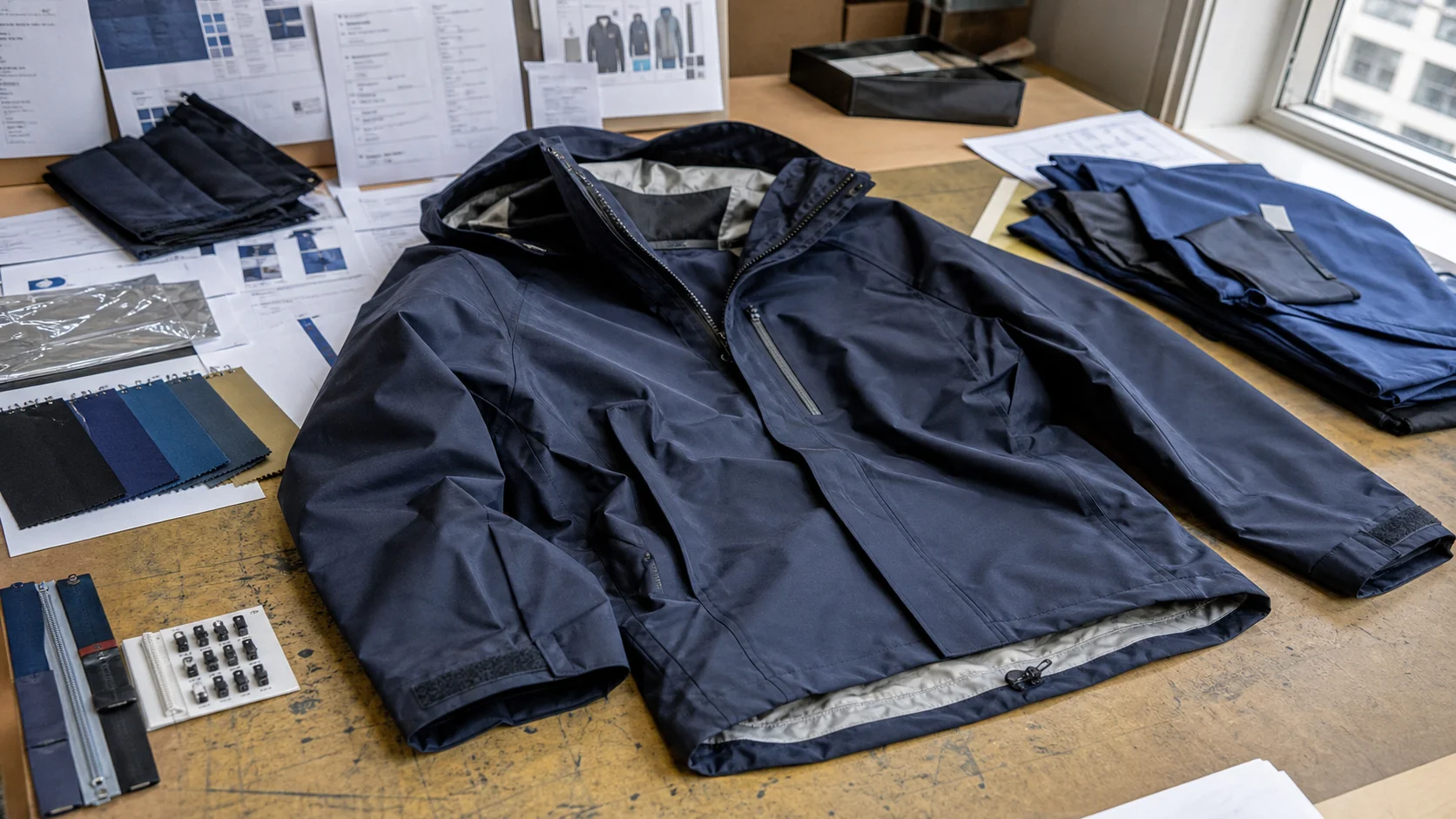
A product-specific outline for outdoor school buyers evaluating storm jacket size grading, fit consistency, measurement specs, layering allowances, and...
Storm Jacket Size Grading Review for School Buyers - Outerwear & Jackets manufacturing guide
Storm jacket size grading is one of the most overlooked cost and quality checkpoints in school outerwear procurement. Buyers often focus on waterproof ratings, color matching, logo placement, and landed price, yet the size scale decides whether the jacket actually works across a real student population. A jacket that fits well in one sample size can still fail in production if the grading rules are too narrow, too long in the sleeve, too tight across the chest, or poorly adapted between youth and adult sizes.
For outdoor school buyers, the stakes are practical. Storm jackets are not fashion capsules with short selling windows. They are worn on wet commutes, field trips, playground duty, outdoor learning programs, sports sidelines, and residential trips. A poor size grade creates avoidable returns, parent complaints, uneven uniforms, and stock imbalances that sit in storage for years.
This review explains how school procurement teams should assess storm jacket size grading before placing bulk orders. It covers measurement points, youth-to-adult transitions, fit allowances, size-set sampling, fabric and trim considerations, MOQ realities, lead-time risks, and inspection controls. The aim is not to over-engineer a basic school jacket. The aim is to prevent the common sizing failures that turn a sensible outerwear purchase into a long-term inventory problem.
Size grading is the method used to increase or decrease garment measurements across a size range. For storm jackets, it is not just a matter of making each size slightly bigger. Chest width, sleeve length, shoulder width, back length, hood opening, cuff circumference, hem sweep, and armhole depth all need controlled grade rules. If the grading is wrong, the jacket may look acceptable on a hanger but perform badly on the wearer.
School buyers usually purchase for mixed body types, fast-growing students, and multiple use cases. One student may wear a blazer underneath. Another may wear a fleece. Younger pupils may need room for growth, while older students may reject a jacket that looks oversized. Staff sizes may be included in the same order, creating another fit challenge. That makes size grading a procurement issue, not only a technical design issue.
The main risk is assuming a supplier’s standard youth or adult size chart is suitable without review. Many factories use generic blocks developed for retail, workwear, sportswear, or regional markets. Those blocks may not match the school’s student profile. A slim European retail block, a broad workwear block, and an Asian-market youth block can produce very different results even if all are labeled “size 12” or “medium.”
Direct buying judgment: do not approve a storm jacket order from one middle-size sample only. A size medium sample can hide grading faults that only appear at the smallest and largest sizes.
Outdoor school buyers should treat grading as part of risk control. The jacket must fit over layers, allow movement, maintain weather protection, and remain acceptable across the full ordered size range. This is especially important when the order includes branded trims, embroidered logos, reflective tape, or custom colors, because these details reduce flexibility if stock has to be replaced or reordered later.
A storm jacket size scale for schools should balance coverage, comfort, durability, appearance, and stock efficiency. The most technically accurate size chart is not always the most practical one. A school may need fewer sizes with wider fit tolerance, or it may need a broader range because the student body includes very young pupils and adult staff. The right approach depends on how the jacket will be issued and worn.
Before confirming a size chart, buyers should define the jacket’s role. A lightweight shell for occasional rain cover can use a different fit standard from an insulated storm jacket used for daily winter wear. A jacket intended to cover a blazer needs more body length and chest ease. A jacket used for outdoor education may need better arm mobility, adjustable cuffs, a shaped hood, and a hem that does not ride up when carrying a backpack.
Common objectives include:
Size grading also affects parent perception. A jacket that is too tight is seen as poor value because it may not last through the school year. A jacket that is too large may look untidy and uncomfortable. The school buyer needs a fit that is forgiving but not sloppy. That often means a moderate relaxed fit, rather than a slim retail fit or a bulky workwear fit.
Schools that need help aligning product development, specifications, and supplier communication can review apparel manufacturing support options through Fabrikn services. A clear technical pack and size specification reduce ambiguity before bulk production starts.
A size grading review should start with the measurement points that directly affect comfort and weather performance. For storm jackets, chest width and back length are not enough. The buyer should ask for a full graded specification sheet, including tolerances, for every size being ordered.
Measurement Point Why It Matters Common Risk Chest width Controls layering room and general comfort. Too narrow in larger youth sizes or too wide in adult sizes. Back length Protects uniform layers and improves rain coverage. Too short over blazers or too long for younger pupils. Sleeve length Affects movement, cuff function, and appearance. Over-grading creates sleeves that cover the hands. Across shoulder Impacts comfort when worn over shirts, jumpers, and blazers. Too tight across the upper body, restricting arm lift. Armhole depth Determines mobility and layering capacity. Low armholes make the jacket ride up during activity. Hood opening Affects weather protection and comfort. Too small over hair or hats; too loose in wind. Cuff opening Controls water entry and sleeve adjustability. Loose cuffs reduce protection; tight cuffs restrict wear. Hem sweep Supports comfort when sitting, walking, and layering. Too narrow over uniforms or too wide in small sizes.Buyers should request both flat garment measurements and the supplier’s grade rule. A size chart tells the buyer what each size should measure. The grade rule shows how the measurements change between sizes. This is useful because small errors compound across a long size range. For example, an extra 1 cm grade in sleeve length over several size jumps can create sleeves that are visibly too long at the upper end.
Typical tolerance ranges for woven storm jackets are often around plus or minus 1 cm for smaller points and plus or minus 1.5 cm to 2 cm for larger body measurements. These are only general references. The final tolerance should reflect fabric type, seam construction, quilting if present, and factory capability. Tight tolerances may look reassuring on paper, but they are not useful if the construction cannot realistically hold them in production.
The transition from youth sizes to adult sizes is a common failure point in school storm jacket programs. Many schools need sizes that run from small children through older students and staff. Suppliers may combine a children’s block and an adult block without smoothing the transition. The result can be a sudden jump in chest, sleeve length, body length, or shoulder width.
This matters because older students do not all fit neatly into adult small or medium. Some need adult chest room but shorter sleeves. Others need extra length but not much width. Staff may need a separate adult fit. If the same size run is expected to cover all groups, the buyer should check the bridge sizes carefully.
Key questions include:
One practical approach is to create a blended school fit scale rather than simply adopting standard retail youth and adult charts. This can reduce confusion during ordering and simplify stock planning. It may also require more sample review. The extra work is usually worthwhile when the order volume is high or the school expects repeat purchases over multiple years.
Purchasing judgment: if the supplier cannot explain how youth and adult grades connect, require a size-set sample before confirming the full order. The cost of sample review is lower than the cost of unusable outer sizes.
Storm jackets for schools rarely sit directly over a T-shirt. They may be worn over shirts, jumpers, blazers, fleece mid-layers, hoodies, sports kits, or light insulation. The fit allowance must reflect the real wearing situation. A sample that looks neat over a thin top may be too tight for daily school use.
For outdoor school buyers, a relaxed fit is usually safer than a slim fit. That does not mean oversized. It means enough chest and armhole room to layer without pulling across the upper body. The jacket should allow a student to raise both arms, carry a backpack, sit on transport, and run briefly without the hem lifting excessively.
Useful fit checks include:
Mobility is often affected by sleeve pitch and armhole shape, not just size. A jacket can have enough chest width but still restrict movement if the armhole is too low or the sleeve is poorly balanced. Raglan sleeves may improve movement and simplify grading in some school jackets, while set-in sleeves can look smarter but require closer shoulder and armhole control. There is no universal best choice. The decision should match the school’s appearance standards and activity level.
Length also needs judgment. Longer storm jackets provide better rain coverage over uniforms, but they may be less comfortable for active younger pupils. Shorter jackets are easier for movement and storage but may expose blazers or jumpers. Many school buyers settle on a mid-hip length for general use, then specify a longer version for staff or outdoor education programs if needed.
Size grading cannot be reviewed separately from fabric and trim choices. Different materials behave differently in cutting, sewing, pressing, packing, and wear. A storm jacket made from a stiff laminated shell will fit differently from one made from a softer coated polyester. Insulation, lining, seam taping, and elastic trims also change the fit.
Common fabric specifications for school storm jackets include polyester or nylon shell fabrics with a water-resistant coating or waterproof membrane. Buyers may see waterproof ratings such as 3,000 mm, 5,000 mm, or 10,000 mm, and breathability claims stated in grams. These numbers are useful, but they should be treated cautiously unless supported by test reports and matched to the intended use. A higher waterproof rating may increase cost and stiffness, while a basic coated fabric may be adequate for short school commutes but less suitable for prolonged outdoor exposure.
Fabric and trim details that can affect grading include:
Trim choices can create sizing issues. A non-adjustable elastic cuff may be neat and low cost, but it must work across different wrist sizes. Hook-and-loop cuffs offer better adjustment but add cost and can snag knitwear. A fixed hood is harder to lose than a detachable hood, but hood size and face opening must be graded properly. Drawcords may be restricted or avoided in children’s products depending on market regulations and school policy.
Buyers should ask the supplier to confirm whether the size-set samples are made in bulk fabric and trims. Proto samples made in substitute fabric are useful for silhouette review, but they cannot fully confirm final fit. Laminated fabric, quilted lining, taped seams, and heavy zips can all change how the jacket sits on the body.
A disciplined sample approval process is the best defense against size grading problems. The process does not need to be complicated, but it must be structured. Relying on photos or a single sales sample is not enough for a school storm jacket program.
A typical approval path may include:
For budget or time reasons, buyers may not review every size. In that case, choose risk sizes rather than only the most common size. A practical size-set review might include the smallest youth size, one mid-youth size, the youth-to-adult transition size, adult medium, and the largest adult size. This gives a better view of the grade than reviewing three middle sizes.
Measurement comments should be specific. “Sleeves too long” is less useful than “reduce sleeve length by 2 cm on youth sizes 8 to 12 and keep adult sleeve grade unchanged.” The supplier should respond with a revised measurement chart, not just a verbal confirmation. Written approvals matter because production, quality control, and sales teams may not all interpret comments the same way.
When branding is included, logo size and position should be reviewed across sizes. A chest logo that looks balanced on adult medium may look too large on small youth sizes. Embroidery can stiffen lightweight fabrics and affect drape. Heat transfers need compatibility testing with coated or laminated shells. Reflective school marks must be placed without distorting seams or restricting movement.
For buyers preparing a custom school outerwear brief, Fabrikn’s background and sourcing approach can be reviewed at Fabrikn about us. Supplier alignment is easier when design, technical, and commercial expectations are set before sampling begins.
Minimum order quantity and lead time shape what is realistic in storm jacket size grading. School buyers often want many sizes, low quantities per size, custom colors, and branded trims. Factories usually prefer fewer sizes, higher quantities per color, and stable repeat orders. The negotiation sits between those two positions.
Typical MOQ ranges vary by supplier, fabric availability, customization level, and production country. As a cautious guide, plain or lightly customized school storm jackets may start around 300 to 500 pieces per style or color with some suppliers. More custom programs often sit closer to 800 to 1,500 pieces. Fully bespoke fabric colors, special trims, seam-taped waterproof construction, or complex branding can push practical MOQs higher. Small test orders may be possible, but unit costs and sampling charges usually rise.
Size grading affects MOQ because each size requires marker planning, cutting control, bundling, and measurement inspection. A broad size range with very low quantities in each size is less efficient. Buyers should avoid creating too many marginal sizes unless they have demand data. The aim is to cover the population, not to offer a retail-style size menu that creates dead stock.
Useful size split planning inputs include:
Lead times also depend on the fabric and trim route. If the supplier uses stock fabric and standard trims, production may be faster. Custom-dyed fabric, branded zip pullers, special reflective tape, waterproof seam taping, and lab testing can extend the schedule. A cautious bulk lead-time estimate for customized school storm jackets is often 8 to 14 weeks after final approval, though this can change with seasonality, raw material availability, factory capacity, and shipping method.
Sampling can add several weeks before that clock starts. Buyers should not treat sampling time as a minor admin step. If the size set fails and needs revision, the calendar moves. This is why schools should start outerwear development well before the wet or cold season. Late orders force compromises, and sizing review is often the first step that gets cut.
Tradeoff: a narrower size range can improve MOQ efficiency and reduce inventory risk, but it may increase fit complaints. A broader range improves coverage, but only if demand data supports the extra sizes.
Final inspection should verify that production matches the approved graded specification. For storm jackets, inspection needs to cover measurements, workmanship, weather-related construction, branding, packing, and labeling. Size grading errors can appear even after good samples if cutting, bundling, or sewing controls are weak.
Common inspection risks include:
Measurement inspection should use an agreed method. Different inspectors can measure the same jacket differently if the garment is not laid flat consistently. The technical pack should define whether measurements are taken from edge to edge, seam to seam, folded or opened, relaxed or extended for elastic points, and before or after any finishing process.
Storm jackets also require weather-function checks. A size-correct jacket can still fail if seams leak, coating is damaged, or storm flaps are poorly constructed. Buyers should define acceptable testing based on the product level. Not every school jacket needs high-performance outdoor certification, but waterproof claims should be realistic and controlled. If the product is sold as waterproof, seam construction and testing expectations need to match that claim.
Packaging inspection matters for schools because distribution often happens by size. Carton markings should be clear, size ratios should match the purchase order, and polybag labels should be readable. Errors in size labeling create unnecessary handling work and parent dissatisfaction even if the garments themselves are acceptable.
A good storm jacket size grading review is not about chasing perfect measurements. It is about reducing the most expensive and most likely fit failures. School buyers should apply commercial judgment at every stage. Some compromises are acceptable. Others create long-term problems.
The first judgment is whether to use an existing supplier block or develop a custom school fit. An existing block can reduce sampling time and cost, especially if the supplier has made similar school outerwear before. A custom fit gives better control but needs more development work. For small orders, adjusting an existing block may be the only realistic option. For repeat programs, a custom graded spec can pay for itself by improving consistency over multiple seasons.
The second judgment is how much growth room to build in. Parents may prefer a jacket that lasts longer, but excessive growth allowance makes the current fit poor. Younger students may need more room than older students. One practical solution is to keep the body fit relaxed while controlling sleeve length with adjustable cuffs. This improves usability without making the jacket look too oversized.
The third judgment is how to handle gender fit. Many school programs use unisex jackets for simplicity. This is efficient and often appropriate for outerwear, but it may not fit all older students equally well. If the school has strong fit expectations at senior levels, separate fit options may be considered. That choice increases SKU complexity and stock risk, so it should be based on clear demand rather than preference alone.
The fourth judgment is whether to prioritize waterproof performance or everyday comfort. Higher waterproof specifications, seam taping, and heavier shell fabrics can improve weather protection, but they may also increase stiffness, noise, cost, and lead time. A moderate waterproof shell with good fit, reliable trims, and clear care instructions may be the better school-buying decision for general use. For outdoor education or expedition programs, higher protection may be justified.
The fifth judgment is reorder stability. If the jacket will become part of a long-term uniform range, the buyer should lock the size chart, fabric reference, trims, color standard, and logo placement. A supplier changing the block between orders can create visible inconsistency. Repeat-order specifications should include the approved graded measurements and a requirement that any change be submitted for approval before production.
Schools can discuss custom outerwear requirements, specification control, and supplier coordination through Fabrikn contact us. Early technical review is especially useful when the size range is broad or the product includes waterproof construction and branding.
Before confirming a school storm jacket order, buyers should complete a practical checklist. This keeps the process focused and helps avoid late changes after production has started.
Review Area Buyer Checkpoint Decision Risk if Skipped Use case Confirm whether the jacket is for commute, playground, sports, outdoor learning, or staff use. Fit and fabric may not match actual wear conditions. Size range Confirm smallest, largest, and transition sizes. Outer sizes may be unusable or overstocked. Graded spec Review all key measurements and grade rules. Middle sample may pass while full range fails. Layering Fit test over the thickest expected school layer. Jacket may be too tight in real use. Fabric Confirm shell, lining, insulation, coating, and waterproof claim. Final garment may fit differently from sample. Trims Check cuffs, hood, zips, adjusters, reflective details, and safety rules. Comfort, compliance, or durability issues may appear. Branding Review logo size and placement across sizes. Branding may look inconsistent or distort panels. Inspection Agree measurement method, tolerances, and AQL expectations. Disputes may arise after shipment.The checklist should be used before purchase order confirmation and again before pre-production approval. It is easier to change the size chart at the sampling stage than after fabric has been cut. Once production begins, changes can trigger delays, extra cost, or compromise repairs.
Supplier size charts can look professional while still being unsuitable for school use. Buyers should look beyond formatting and check whether the numbers make practical sense. A good chart should show consistent logic across sizes, realistic tolerances, and clear measurement descriptions.
Red flags include:
None of these red flags automatically disqualifies a supplier. They do require follow-up. A capable supplier should be able to revise the spec, provide size-set samples, explain construction limits, and document changes. A supplier that treats size grading as an afterthought may still deliver garments, but the buyer carries more risk.
For outdoor school buyers, the strongest storm jacket purchase is usually a controlled, moderately relaxed fit with confirmed grading across the full size range. The jacket should allow layering, protect against rain, support movement, and remain consistent across repeat orders. Price matters, but a cheap jacket with poor size grading is rarely a saving once returns, complaints, and leftover stock are counted.
The safest procurement route is to approve the base design first, then review the graded specification, then check risk sizes in sample form, then approve a pre-production sample in bulk fabric and trims. This sequence reduces guesswork. It also gives the supplier clear written instructions before cutting begins.
Buyers should be especially cautious with youth-to-adult transitions, sleeve length grading, hood fit, cuff adjustability, and logo placement. These areas cause frequent problems because they are easy to overlook in a single-size sample. A storm jacket is a functional garment. If the fit does not work in bad weather, the product has failed regardless of how good it looks in a catalog.
The final decision should reflect the school’s actual use case, not a generic outerwear chart. A commuter rain shell, a playground duty jacket, an outdoor education jacket, and a staff storm coat may all need different grading choices. Clear specifications, sensible sample review, and realistic production planning give school buyers the best chance of receiving outerwear that works across the whole community.
Get a free quote from Fabrikn — your trusted B2B clothing manufacturer with 10+ years of experience. MOQ as low as 200 pieces.
Get a Free Quote →Storm jacket size grading is the process of adjusting garment measurements across different sizes. It controls how chest width, sleeve length, body length, hood size, cuffs, shoulders, and other points change from the smallest to largest size.
School storm jackets must fit many body types and usually need to be worn over uniforms or layers. Poor grading can cause tight chests, long sleeves, short bodies, uncomfortable hoods, and inconsistent branding across sizes.
No. One sample size is not enough for a reliable storm jacket program. Buyers should review at least the smallest size, a middle size, the youth-to-adult transition size, and the largest size when order value and timing allow.
Typical MOQs may start around 300 to 500 pieces for simpler customized styles, while more bespoke programs often require 800 to 1,500 pieces or more. Fabric type, color, trims, waterproof construction, and branding all affect MOQ.
Customized storm jackets often take around 8 to 14 weeks after final sample approval, depending on fabric availability, trims, factory capacity, testing, and shipping. Sampling and size-set approval can add several weeks before bulk production starts.
Chest width, back length, sleeve length, shoulder width, armhole depth, hood opening, cuff opening, and hem sweep are all important. Buyers should request a full graded specification rather than relying on basic body size labels.
The jacket should close comfortably over the thickest expected school layer without pulling across the chest or restricting arm movement. A moderate relaxed fit is usually safer than a slim fit for school outerwear.
A unisex chart can work for many school programs, especially when the jacket is worn as outerwear. Senior students, staff, or specialist outdoor programs may need extra review because body proportions and fit expectations vary more widely.
Common risks include incorrect size labels, sleeve length variation, chest measurements outside tolerance, inconsistent hood grading, uneven cuffs, poor logo placement, zip puckering, seam taping distortion, and unclear carton size markings.
The best approach is to define the use case, approve a graded measurement chart, review risk-size samples, test fit over real school layers, confirm bulk fabric and trims, and document all approvals before production starts.