
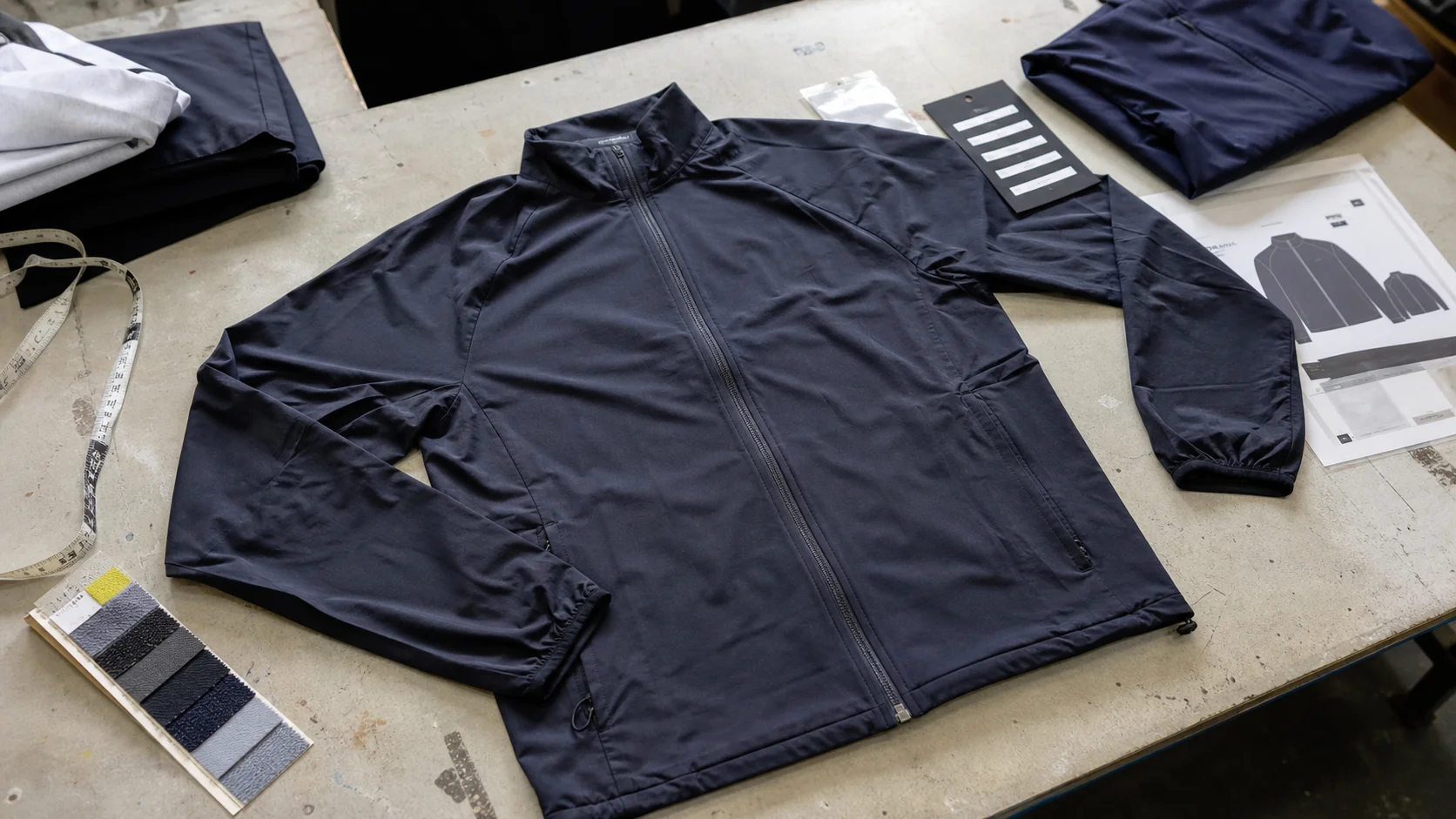
A buyer-focused outline for fitness clubs evaluating reorder risks on stretch wind jackets, from fabric continuity and fit drift to decoration...
Fitness club buyers do not usually lose time on the first stretch wind jacket order. The real pressure shows up on the reorder. Once members have worn the jacket, once team staff have started asking for matching sizes, and once the program needs a second season run, any weak point in fabric sourcing, trim continuity, or color consistency becomes a business problem. A reorder risk review is not about style preference. It is about whether the same jacket can be made again at the same quality, at the same cost range, and within a lead time that still fits the club calendar.
For clubs, the stretch wind jacket sits between performance outerwear and branded uniform. It has to move well, resist light wind, layer over training gear, and still look clean enough for front-of-house staff, coaches, and team travel. That mixed use makes reorder planning more sensitive than a standard tee or hoodie order. The buyer is often balancing member expectations, staff wear requirements, and the supplier’s willingness to hold the same fabric, elastics, zipper tape, and color standards from one season to the next.
This review looks at the parts of a stretch wind jacket program that create reorder risk, the checks that should happen before the first bulk buy, and the practical signs that a repeat order is likely to stay stable. It is written for sourcing teams, merchandising leads, and club operators who need a clear view of what can change, what should be locked, and where the tradeoffs usually sit.
Stretch Wind Jacket Reorder Risk Review for Clubs - Activewear & Teamwear manufacturing guide
The reorder risk is highest when the product depends on components that are not universally available. A stretch wind jacket often uses a woven shell with mechanical stretch or spandex content, a water-repellent finish, bonded or mesh linings, elastic binding, cuff tape, reverse coil zippers, and screen-print or heat-transfer branding. Each of those pieces can become a point of variation. If the original production relied on a specific mill run, a special zipper color, or a proprietary finish, the supplier may be able to reproduce it only with extra lead time or a higher minimum order quantity.
Clubs should expect the following reorder risks:
The best way to think about reorder risk is simple: the more the jacket depends on controlled inputs, the less safe a blind repeat order becomes. A jacket built from common 100 percent polyester woven shell, standard zipper tapes, and stock bindings is easier to repeat than one built from a custom-dyed stretch nylon blend with contrast elastic and special reflective tape.
A repeat order is safest when the tech pack locks the fabric composition, fabric weight, finishing standard, trim codes, artwork scale, and measurement tolerances before the first bulk approval.
Fitness clubs buy stretch wind jackets for different reasons, and each use case creates a different reorder pattern. Front desk and coaching staff usually need a clean, presentable layer that can be worn often and washed frequently. Trainers and class leaders may need a jacket that has better stretch and mobility for warm-up, travel, or outdoor sessions. Member retail programs care more about style, color options, and size depth, which increases the chance that a reorder will need more SKU coverage.
When a club uses the jacket as staff uniform, the reorder decision is usually less forgiving. Even a small change in fit across sizes can create complaints, and staff often notice zipper quality, cuff retention, and pocket construction faster than retail customers do. When the jacket is sold as merchandise, the buyer must also manage forecast risk. If the first drop sold through quickly, the reorder has to arrive before demand cools, or the club loses the momentum of a season launch.
That is why clubs should separate the question of product approval from the question of replenishment. A jacket can be acceptable for first use and still be a poor repeat candidate if the supply chain depends on unstable inputs. A practical sourcing team should assess both.
Fabric control is the first line of defense. For stretch wind jackets, the shell fabric should be defined by fiber content, construction, weight, stretch percentage, finish, and shade standard. A vague description like “lightweight stretch woven” is not enough for a repeat order. The buyer should ask for a written fabric spec that includes composition, grams per square meter, stretch direction, and any coating or DWR finish.
Good control points include:
Trim control matters just as much. Zippers are a common reorder problem because many factories can source a similar-looking item that does not behave the same way under repeated use. Puller shape, coil size, tape color, and slider quality should be fixed by code or supplier reference. Elastic cuffs and hems need special attention if the jacket is meant to retain shape through regular wear. If reflective tape, heat-seal film, or printed branding is involved, the buyer should require a clear approved sample and note whether the same vendor must be used again.
If the club expects future reorders, it is worth insisting on an approved trim card and a production record that ties the jacket to named component references. That document makes later conversation with the factory much simpler. It also reduces the risk of silent substitutions.
Sample approval should not be treated as a formality. A weak approval process usually creates the exact reorder issues buyers later blame on the factory. For stretch wind jackets, a disciplined approval path typically includes a prototype, a fit sample, a size-set check, and a pre-production sample. Some programs also need a wash or wear test before bulk signoff, especially when the garment is expected to hold shape after repeated laundering.
A useful approval sequence looks like this:
Clubs should resist the temptation to approve a sample just because it looks close. A repeat order will only be as reliable as the weakest detail that was allowed to pass. If the zipper color is slightly off, if the sleeve length is short on one size, or if the hem elastic feels weak, those issues usually return in bulk unless they are corrected in the sample stage.
For club buyers, one practical step is to request a sealed approved sample or a digital approval record with photos, measurement sheet, and trim references. That record helps if a reorder is placed months later under a different buying team or through a new procurement contact.
MOQ and lead time are closely linked in outerwear. A stretch wind jacket is usually more complicated than a basic knit top, so factories often require a larger minimum order or a longer production window. In many sourcing situations, a simple club program may sit around 300 to 500 pieces per color or style for a workable MOQ, while more customized versions can require 500 to 1,000 pieces or more depending on fabric sourcing, trim import needs, and decoration complexity. Those are typical ranges, not guarantees. The actual threshold depends on the factory’s line setup and the fabric mill’s willingness to reserve stock.
Lead time is also not a single number. It depends on whether the fabric is ready, whether the factory has in-stock trim, and whether print or embroidery is part of the order. A simple repeat using held fabric might move faster than the first order, but that only happens when the original production was planned with replenishment in mind. If the shell fabric must be re-dyed, if the DWR finish needs to be re-applied, or if the zipper must be specially ordered, the second order can take almost as long as the first.
Buyers should ask four direct questions before assuming a reorder will be fast:
If the answer to any of those is unclear, the reorder should be treated as a new development cycle rather than a simple repeat.
Inspection risk on a reorder often comes from complacency. Buyers and factories both assume that because the first run passed, the second run will behave the same way. That assumption is unsafe. Repeat orders can fail on a different defect mix, even when the product looks familiar. New risks can appear in seam slippage, puckering around stretch panels, uneven elastic tension, poor zipper insertion, or size inconsistency from one production lot to another.
A practical inspection plan for a stretch wind jacket should pay attention to these areas:
Special attention is needed if the club uses multiple size runs for staff or members. A repeat order can pass on medium and large while drifting on extra-small or extra-extra-large because grading is less stable at the ends of the curve. The same issue can appear in sleeve balance and jacket length. Clubs that expect broad size coverage should ask for size-set approval and not rely on a single fit sample.
Risk Factor What to Verify Reorder Impact Fabric substitution Composition, GSM, stretch, finish, shade Fit, appearance, and hand feel may change Trim replacement Zipper code, elastic spec, thread type, label stock Durability and visual consistency may drop Pattern update Block version, grading table, seam allowance Size balance and wearer comfort may shift Decoration change Logo size, placement, print method, thread color Brand presentation may no longer match approval Finish variation DWR standard, wash performance, surface texture Weather resistance and look can changeThe right supplier for a stretch wind jacket reorder is not always the cheapest bidder. Clubs need a vendor that understands repeat production discipline. The factory should be able to explain how it stores approved specs, how it controls bulk fabric references, and how it manages substitution requests. A supplier that treats every reorder like a fresh design development usually creates hidden risk, even if the first shipment looked acceptable.
When evaluating a supplier, buyers should look for evidence of process control, not just promises. Useful indicators include:
For clubs that need a broader sourcing relationship, it can help to review the supplier’s general service structure at Fabrikn services and company background at about us. A repeatable reorder process depends on a supplier that is organized enough to keep production records usable months later. If the order is complex or the calendar is tight, the buyer should use contact us early rather than waiting until the line is already committed.
The best suppliers usually do one simple thing well: they tell the buyer what cannot be repeated exactly and what needs a fresh approval. That honesty is worth more than a low quote that later turns into substitutions.
A club should decide on a stretch wind jacket reorder by combining product stability, supply stability, and demand certainty. If all three are strong, the reorder is relatively low risk. If even one is weak, the buyer should slow down and verify the details before issuing a repeat PO.
Use this practical rule set:
There is also a tradeoff between perfection and continuity. For some club programs, a small variation in fabric hand feel is acceptable if the jacket still functions well and the branding is consistent. For other programs, especially member retail or public-facing staff wear, a visible change in gloss, shade, or trim quality can damage the program’s perceived value. The buyer should define that threshold in advance. Without that line, every reorder becomes a judgment call under time pressure.
One of the most practical things a club can do is keep the first order documents complete. That means signed tech pack, approved sample photos, measurement sheet, label artwork, packaging instructions, and any comments on acceptable variation. If the reorder comes later, those records are the fastest way to tell whether the second run is still on target.
A stretch wind jacket can be a strong club product when the fit is correct, the fabric moves well, and the branding is clean. The reorder is where the product either proves itself or exposes weak sourcing control. Clubs should treat the second order as a controlled repeat, not an assumption. The most reliable programs are the ones that lock the fabric spec, trim references, sample approvals, and inspection criteria before bulk production starts.
If the jacket is for a recurring staff uniform program, the priority should be consistency. If it is for member retail, the priority is consistency plus lead-time confidence and enough size depth to protect sell-through. In both cases, the best risk reduction comes from clear approvals, stable material sourcing, and a supplier that can support repeat production without improvisation.
Get a free quote from Fabrikn — your trusted B2B clothing manufacturer with 10+ years of experience. MOQ as low as 200 pieces.
Get a Free Quote →The main risk is material drift. Fabric shade, stretch recovery, zipper quality, and trim substitutions can all change between runs if the original spec was not tightly controlled.
Typical MOQs often fall around 300 to 500 pieces per style or color for simpler programs. Customized fabric, special trims, or complex decoration can push that higher, sometimes into the 500 to 1,000 piece range.
The buyer should confirm the original tech pack, approved sample, measurement sheet, color reference, fabric specification, trim codes, and decoration details before issuing a repeat order.
Standard polyester or nylon woven shells with modest stretch and common trims are usually easier to repeat than custom-dyed blends or specialty finishes that depend on limited supply.
Keep the approved sample and production record on file, ask the supplier whether fabric and trims are still available, and confirm the lead time before the season starts or the event date gets close.
That depends on the program. A small variation may be acceptable for internal use, but it is harder to accept on member retail or front-facing staff wear where visual consistency matters more.
Measurement accuracy, zipper function, seam quality, stretch recovery, logo placement, and color consistency are the key checks. Repeat orders can fail even when the first run passed if those points are not rechecked.