
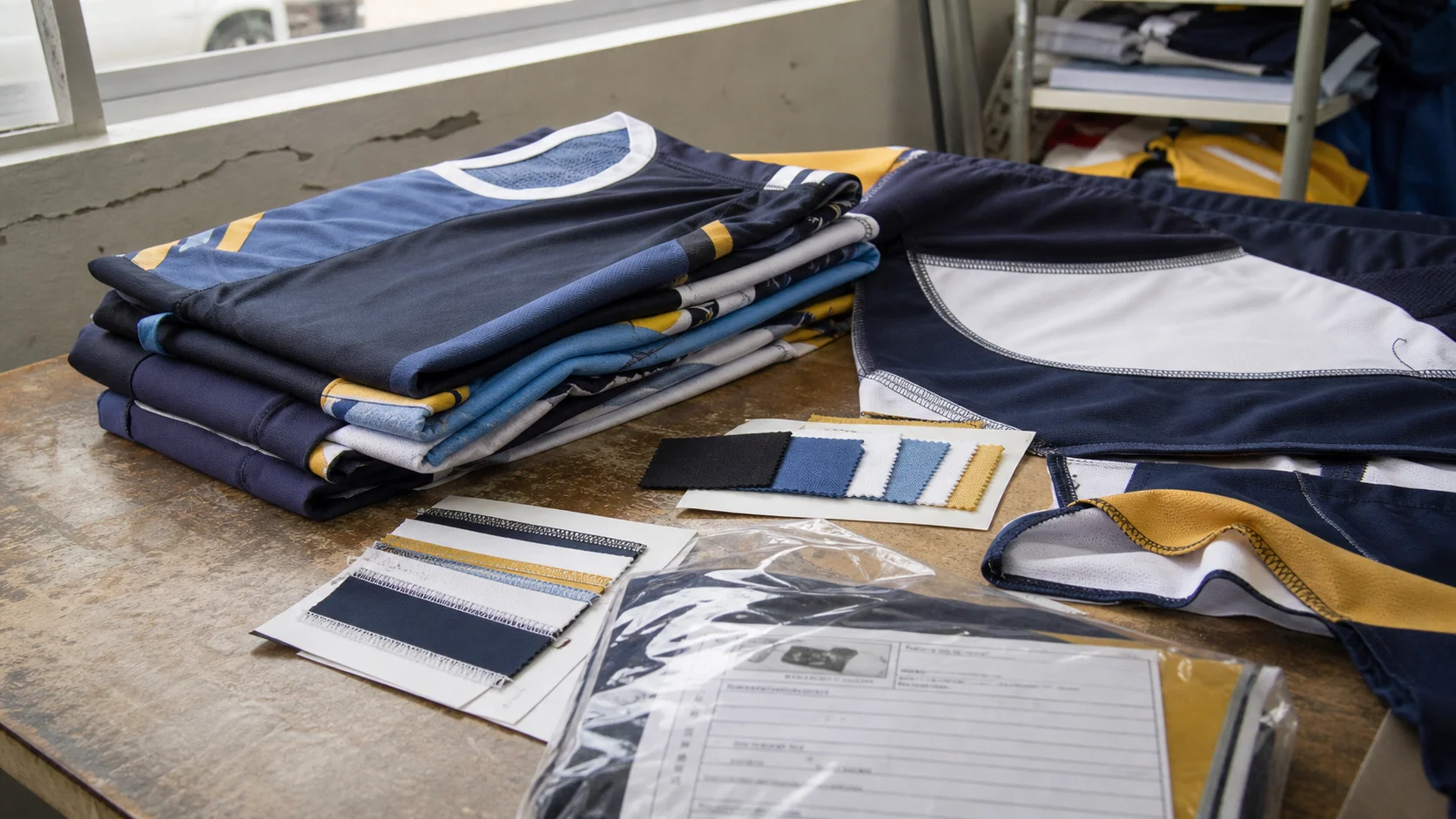
A practical compliance checklist for outdoor school buyers reviewing wholesale sublimated teamwear panels, covering artwork, fabric performance,...
Wholesale sublimated teamwear panel compliance matters most when the garments are going to outdoor school buyers who need repeatable quality, consistent branding, and predictable delivery. A school order is rarely just about graphics. It is about fit, durability, wash performance, color control, visibility, and whether the finished garment matches the approved artwork after the panels are cut, printed, sewn, and packed.
This checklist is written for buyers, merchandisers, and sourcing teams evaluating wholesale sublimated teamwear panel compliance checklist for outdoor school buyers. The goal is simple: reduce avoidable risk before production starts. The best time to catch panel issues is at quoting and sampling, not after the first bulk carton arrives.
If you are comparing suppliers, a practical starting point is to review the production capability on the services page, then confirm order intake on the contact-us page, and use the about-us page to check how the team positions its development and quality process.
Sublimated Panel Compliance Checklist for Schools - Decoration & Printing manufacturing guide
In school teamwear, panel compliance means the printed garment matches the agreed specification across design, construction, labeling, sizing, and performance. For sublimated products, the panel print is not a decorative layer added at the end. It is built into the fabric before cut-and-sew. That changes the risk profile.
A panel can be visually correct and still fail the order if the seams drift, the fabric stretches too much, the print loses contrast, the logo sits too close to a stitch line, or the color shifts from the approved strike-off. For outdoor school use, buyers should care about sunlight exposure, sweat, repeated washing, abrasion, and changing weather conditions. The decoration has to stay legible and the garment still has to feel fit for play.
Compliance also means the supplier can prove what was approved. A reliable file set usually includes the tech pack, panel map, size spec, color references, approved sample photos, and final packing list. Missing paperwork is not a minor issue. It becomes a dispute when a school rejects an order and asks for proof of what was signed off.
Outdoor school programs put teamwear through more stress than a casual retail garment. Students use the clothing in sports days, training sessions, inter-school events, and travel. That means the order has to hold up under movement, repeated washing, and mixed-size wearers who may not handle garments gently.
Sublimated panel teamwear is attractive because it allows full-coverage graphics, school colors, and repeating patterns without the cracking associated with some print methods. The tradeoff is that quality control becomes more technical. Color placement, seam matching, fabric recovery, and panel alignment all matter more than they do on a plain tee.
School buyers should also think about consistency across future reorder cycles. If the first delivery looks sharp but the second run shifts in shade, the school ends up with mismatched squads. A strong compliance checklist protects repeat business and keeps replacement stock usable across seasons.
Do not approve a teamwear panel from a sales mockup alone. Ask for production artwork with exact panel dimensions, seam allowances, bleed zones, and logo clear space. A mockup may look fine on screen and still fail when panel pieces are cut and joined. School buyers should insist on final art in a format the factory can actually use, not just a visual sample.
Each front, back, sleeve, yoke, side body, and collar piece should be identified in a panel map. The map should indicate print orientation, grain direction if relevant, and whether the graphic continues across a seam. If a stripe or crest crosses multiple panels, the cut plan needs to match the art plan. Loose interpretation at this stage causes the most visible defects in bulk.
School colors are often not forgiving. Maroon, navy, gold, green, and black all present different challenges under sublimation. Buyers should request a color reference that is tied to an agreed standard, then check it against the strike-off in daylight and indoors. If the supplier cannot explain how the color reference is being managed, expect drift between runs.
A design that looks balanced on a medium may crowd the chest on a youth size or sit awkwardly on a 3XL. Grade the artwork with the size curve in mind. The school logo, player number, and sponsor marks should remain readable across the full size range. This is a frequent miss when suppliers copy one master layout across all sizes without resizing the art properly.
Decoration compliance is not only about print quality. School buyers should ask how labels will be applied, whether private labeling is available, and whether packing will separate sizes cleanly. A well-made shirt can still become an operational problem if cartons are mixed or care instructions are omitted.
Sublimated panel garments depend on registration. That means the printed artwork has to line up with the cut pattern in a controlled way. For outdoor school teamwear, common problem areas are shoulder curves, raglan seams, side panels, and sleeve joins. These areas move during sewing, which means a design that looks centered on a flat template can drift on the finished garment.
Buyers should ask for a “sewn mockup” or sample garment, not just a flat print proof. A sewn sample shows how lines, logos, gradients, and panel repeats behave when the garment takes shape. That step is especially useful if the design uses chevrons, pinstripes, camo, gradients, or repeated school crests.
It is worth checking seam allowance early. If a crest is placed too close to a seam, the finished edge can cut through the artwork or leave a cropped logo. The same issue appears with player names and numbers on back panels. A practical rule is to maintain a clear zone around major marks, then confirm that the print stays inside that safe area after sewing tolerances are applied.
A good sublimated panel layout does not just look correct in a mockup. It survives sewing variance, size grading, and repeat production without losing the school identity.
The fabric base influences almost every quality outcome. School buyers usually see polyester meshes, interlock, birdseye, or performance knits used in sublimated teamwear. The right choice depends on climate, sport type, and budget. Outdoor use favors fabrics with stable dimensional control, good moisture management, and enough opacity for active wear.
Fabric weight should be stated clearly. Light fabrics can feel breathable, but they may show more print-through, become translucent when stretched, or lose structure during wear. Heavier fabrics can improve body and coverage, yet they may hold more heat and cost more to ship. There is no single correct answer. The buyer needs a balanced choice based on use case and school expectations.
Trims also affect compliance. Neck rib, cuffs, piping, zippers, and hem reinforcement should all be specified with color and performance tolerances. A low-grade zipper or poor elastic can make an otherwise acceptable garment fail in use. If the design includes contrast trim, ask for shrinkage and colorfastness confirmation so the trim does not react differently from the body fabric after washing.
For outdoor school buyers, UV exposure can matter even when the garment is not sold as sun-protective apparel. Ask the supplier what testing, if any, has been done on color retention or fabric stability under frequent sunlight. Do not assume sublimation alone guarantees fade resistance. It improves durability, but fabric choice and ink control still determine the result.
Sample approval should happen in stages. A rushed approval process creates the kind of order that looks fine in the showroom and fails in bulk. The better sequence is simple: artwork confirmation, strike-off or print proof, sewn sample, fit approval, then pre-production sample if the order is large or the design is complex.
For small repeat items, some buyers accept a combined fit and decoration sample. For larger school programs, that is often too risky. A sewn sample verifies more than the print. It reveals how the garment sits on the body, whether the panels twist after assembly, and whether logos land where the school expects them.
Sample comments should be written in plain language. Avoid vague notes such as “make it better” or “adjust color.” State what is wrong, where it appears, and what must change. If the school wants a crest 20 mm lower or a stripe aligned with the shoulder seam, write that into the approval record. That paper trail becomes important if the bulk order repeats the sample exactly but still does not meet the buyer’s intent.
Approved samples should be retained. Keep one with the buyer file and one with the factory reference if possible. On reorder business, the sample is often more useful than a spec sheet because it shows how the garment was actually interpreted.
Wholesale sublimated teamwear usually comes with moderate minimum order quantity expectations. For custom school programs, MOQ can vary widely by supplier and style, but a common working range is around 50 to 100 pieces per design for highly customized runs, with some factories asking for more when multiple panels, logos, or trim variations are involved. Smaller quantities may be possible, yet the unit cost usually rises fast.
Lead time depends on several moving parts: artwork approval, fabric availability, print queue, cutting, sewing, finishing, inspection, and shipping method. A straightforward run can move in a few weeks after sample approval. A complicated or heavily customized school order can take longer, especially if the color standard is strict or the buyer requests multiple size packs and private labeling.
Do not ignore dependency risk. A factory may quote a short lead time while assuming the buyer has already approved artwork and paid for sampling. If the file set is not clean, the schedule slips before production starts. Sublimation is efficient once the process is stable. The delay usually comes from front-end clarification, not the printing stage itself.
School buyers should also ask whether the quoted lead time includes final inspection and carton readiness or only sewing completion. That distinction matters when the order has a fixed delivery date tied to term start, tournament registration, or uniform handout day.
Bulk inspection for sublimated panel teamwear should focus on consistency, not just defect counts. A school can tolerate a minor cosmetic issue on one unit if the overall lot is clean, but it will not tolerate a design drift across the order. That means the quality plan needs to look at color matching, seam symmetry, print placement, measurements, and packing accuracy together.
Common inspection risks include panel mismatch, incorrect neck shape, uneven sleeve length, misaligned numbers, and shade variation between cartons. Another frequent problem is size inconsistency caused by cutting drift or sewing tolerance variation. In youth programs, even small size errors create complaints because fit expectations vary sharply by age group.
If possible, ask for an inline or pre-final inspection photo set. That is not a substitute for a real inspection, but it can reveal obvious issues early. For larger orders, third-party inspection can be justified. It adds cost, yet it can be cheaper than reworking a failed school delivery or replacing an entire class set.
Pack-out accuracy deserves its own check. School buyers often receive multiple sizes in one order, and a carton mix-up can cause distribution chaos. Confirm whether cartons are labeled by style, colorway, size run, and quantity. That detail saves time when the school office or sports coordinator is sorting the delivery.
Good sourcing is not about demanding every possible control at the lowest possible price. It is about choosing the controls that protect the order. For outdoor school buyers, the highest-value controls are usually artwork approval, color reference control, fit sample approval, and carton accuracy. Those items should be non-negotiable.
There are places to flex. If the supplier offers a slightly different fabric blend with better availability, that may be acceptable if the feel, opacity, and wash stability remain suitable. A small variation in internal packaging may also be fine if the school does its own distribution. Cutting corners on print proofing or size grading is harder to justify because the risk lands directly with the buyer.
Price comparisons should be normalized. A cheap quote that excludes strike-off, private labels, or final inspection may not be cheaper at all once those services are added back in. Buyers should compare on the same basis: garment spec, decoration coverage, sample process, delivery terms, and support for reorder consistency.
Before placing the order, ask three simple questions. Can the supplier reproduce the same panel layout on the reorder? Can the colors be matched consistently across seasons? Can the team explain what happens if the sample and bulk differ? If the answers are vague, the quote is not ready for approval.
For buyers building a longer-term supply relationship, the right next step is usually a capabilities review, then a development sample. The services page should show whether the supplier handles cut-and-sew sublimation, custom artwork support, and quality control in a way that fits school program buying. If the process looks suitable, use the contact-us page to request a spec discussion before artwork is finalized.
For schools that need a supplier background check before moving ahead, the about-us page is useful for seeing how the business presents its production focus and service scope. That does not replace due diligence, but it helps buyers decide whether the supplier is built for repeat custom work or only for one-off orders.
Get a free quote from Fabrikn — your trusted B2B clothing manufacturer with 10+ years of experience. MOQ as low as 200 pieces.
Get a Free Quote →It is a sourcing checklist used to verify that a custom sublimated teamwear order meets the school’s approved artwork, fit, fabric, labeling, and quality expectations before bulk production moves too far.
Outdoor use adds exposure to sun, sweat, movement, and repeated washing. Those conditions make color control, seam placement, and fabric stability more important than they would be on low-activity garments.
MOQ varies by supplier and design complexity, but a practical working range is often 50 to 100 pieces per design. More complex panel builds, multiple trim options, or small-size splits can push that higher.
One strike-off and one sewn sample may be enough for a simple design. Complex school kits often need an additional correction round if the color, panel alignment, or fit needs adjustment.
The biggest risk is usually not print quality alone. It is mismatch between artwork, panel cutting, sewing tolerance, and size grading. A design can look correct in proof form and still fail in bulk if those elements are not controlled together.
For larger orders or tight delivery windows, yes, it can be a sensible cost. Third-party inspection helps catch measurement drift, print placement problems, and packing errors before shipment leaves the factory.
Usually yes, if the supplier keeps the approved sample, panel map, and artwork files on record. Even then, buyers should expect a reorder check because dye lots, trim stock, and fabric supply can change over time.
School buyers do best when they treat sublimated panel teamwear as a managed specification, not a generic print job. The order becomes easier to control once artwork, fabric, sample approval, and inspection are handled as separate checkpoints rather than one loose approval step.