
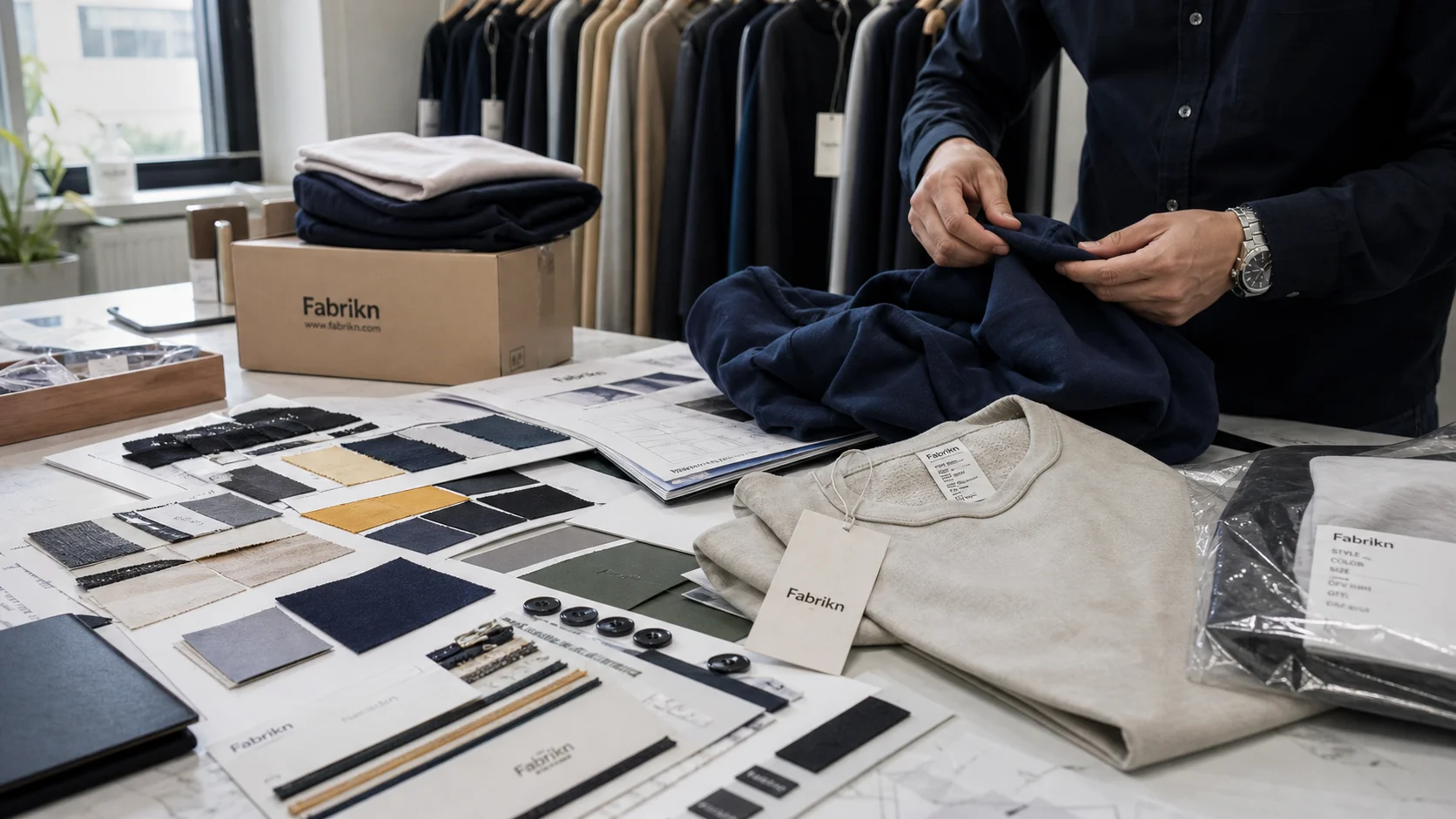
Tech Pack Development for Clothing Manufacturing with checks for samples, fit, MOQ, QC evidence, pricing terms, and delivery risk.
Fast answer: Tech Pack Development for Clothing Manufacturing should be judged by production evidence, not by a generic sourcing promise. The buyer needs sample proof, cost breakdowns, QC checkpoints, and delivery buffers in writing.
Ask for recent sample photos, measurement tolerances, fabric or print test assumptions, decoration test notes, packing examples, and a named inspection checkpoint. These details show whether the team can repeat an approved sample at bulk volume.
Separate garment cost, decoration, labels, packaging, sampling, testing, freight, and rush charges. When every cost line is visible, it becomes easier to reduce colorways, adjust size depth, or reserve more time for sampling.
Tech Pack Development for Clothing Manufacturing - Clothing Manufacturer manufacturing guide
Tech pack development for clothing manufacturing is where a product stops being an idea and starts becoming something a factory can cut, sew, and ship without guessing. In my experience, the best garments rarely begin on the sewing line. They begin in a disciplined tech pack: clear sketches, exact measurements, construction notes, fabric specs, trims, labeling, packaging, and quality standards that leave as little as possible to interpretation. A good pack can be detailed enough for a factory in Guangzhou, Dhaka, or Ho Chi Minh City to quote the same style within a few dollars of each other, instead of treating it like a blank page.
That sounds dry. It is not. A strong tech pack can save weeks of sampling, reduce costly corrections, and keep production on schedule. A weak one can turn even a simple t-shirt into a mess of back-and-forth emails, delayed approvals, and rework. I have seen brands lose an entire production slot because they approved a sample with missing stitching details, no tolerance on the chest measurement, and an unclear label callout. The factory was not being difficult. The instructions were incomplete. On a basic tee, that can be the difference between a $2.50-4.00 per unit quote at 500 MOQ and a quote that drifts upward after every clarification call.
If you are building a new collection or improving your existing production process, this guide breaks down how tech pack development works, what should be included, what it usually costs, and how to use it effectively with a clothing manufacturer. If you need a production partner, you can also explore our services, learn more about us, or reach out through contact-us.
A tech pack is the master instruction file for a garment. It tells the factory exactly how to make the product. Think of it as the bridge between design and production. A sketch alone is not enough. A beautiful mood board is not enough. Even a detailed sample on its own is not enough unless the factory can measure, replicate, and scale it correctly across sizes from XS to XXL, often with a 1/2 inch tolerance on body length and a 1/4 inch tolerance on key width points.
A complete tech pack usually includes flat sketches, a bill of materials, measurement specs, construction details, stitch types, color references, artwork placement, labels, packaging requirements, and comments for development. Some brands call it a specification sheet. Others call it a production package. The name changes. The job does not. In a working factory, this document often gets checked alongside the CAD marker plan, the trim card, and the approved lab dip record before cutting begins.
For smaller labels, tech pack development is often handled by a freelance fashion designer, a technical designer, or the manufacturer’s in-house development team. In larger operations, it may be split across design, pattern making, and product development. A good factory will review it line by line before sampling begins. A bad factory will skim it and hope for the best. That hope gets expensive fast, especially when the line is running on Juki DDL-9000C single-needle machines, Kansai flatlock units, and Brother bartack machines that do exactly what the document tells them to do.
Garment production is full of variables. Fabric shrinks. Stitch tension changes. Trims arrive in the wrong shade. A collar looks perfect on a size small and awkward on a size large. A tech pack reduces those risks because it gives everyone the same reference point. In a knit program, for example, the difference between 180 gsm combed cotton jersey and 220 gsm ring-spun cotton can change the drape, the shrinkage behavior, and even the needle choice on the sewing line.
It also creates accountability. When the sample comes back wrong, the team can check the document and see whether the issue came from the factory or from unclear instructions. That matters more than many new brands realize. Clear tech packs protect both sides. I have seen a factory in Ho Chi Minh City reproduce a style perfectly on the second sample because the pack specified a 3/8 inch topstitch, a 12 mm neck rib, and a 1.5 cm sleeve hem instead of just saying "clean finish."
There is another reason. Cost control. Every unclear detail tends to create a hidden cost: an extra sample, a wasted marker, a delayed order, an air shipment, a rushed trim purchase, a fit correction, a last-minute approval call at 11 p.m. The garment is not just being built. It is being negotiated. A clean tech pack reduces the negotiation. On a 1,000-piece run, one missed trim approval can add $0.18 to $0.35 per unit, which is enough to erase margin on a low-priced item.
I have always believed a solid tech pack is not a luxury item. It is basic factory hygiene. A brand can survive a modest fabric mistake. It usually cannot survive repeated sampling mistakes across an entire season. The best development teams treat the tech pack the same way a cutting room treats the marker: if it is not exact, everything downstream gets more expensive.
A serious tech pack should be detailed enough that a factory can quote accurately and sample with confidence. The exact format can vary by product and manufacturer, but these are the core sections I expect to see. If the product is complex, I also expect a development note on machine type, seam allowance, and any special process such as garment washing, enzyme wash, silicone softening, or heat transfer curing at a defined temperature and dwell time.
Use technical flats, not fashion illustrations. Front and back views are the minimum. Side views help on complex products such as outerwear, trousers with paneling, or dresses with asymmetrical construction. Every seam, pocket, panel, pleat, cuff, dart, and closure should be shown clearly. On outerwear, I like to see callouts for storm flap width, snap spacing, zipper gauge, and whether the placket is sewn with 301 lockstitch or reinforced with 401 chainstitch in high-stress areas.
The BOM lists every fabric, lining, thread, label, zipper, button, snap, elastic, drawcord, and hangtag. It should include composition, weight, width, supplier reference, and color code when available. A factory can source faster when the BOM is precise. A vague BOM invites substitutions. For example, "cotton rib" is not enough when one mill is quoting 1x1 rib at 320 gsm and another is quoting 2x2 rib at 280 gsm. The difference changes stretch recovery, shrinkage, and the final neck opening.
Measurements should be listed at each key point of measure, often called POMs. Chest width, body length, shoulder width, sleeve length, waist, hip, rise, inseam, and leg opening are common examples. Tolerance levels matter too. If you do not define tolerance, the factory will define it for you. A common production tolerance on basics is +/- 1/2 inch at the chest and body length, while premium tailoring may run tighter at +/- 1/4 inch on critical fit points.
This section explains how the garment is assembled. It should cover seam type, stitch count, topstitch spacing, binding, hemming, fusing, pocket attachment, reinforcement, and any special sewing requirements. A simple tee may only need standard overlock and coverstitch notes. A jacket may need fused panels, bar tacks, seam tape, and lining attachment details. If the factory uses a Juki overlock, Yamato coverstitch, or Pegasus 5-thread safety stitch, that process should match the garment category and fabric weight.
Print size, embroidery position, label location, heat transfer placement, care label wording, and logo alignment should all be documented. A 2 cm shift on a chest print can be the difference between premium and sloppy. For embroidery, specify stitch density, backing type, and whether the file is satin stitch or fill stitch. If the logo is a woven patch, state the border width and whether the merrow edge should be 3 mm or 5 mm.
Use Pantone codes where possible, or at least provide physical strike-offs and approved lab dips. Fabric color can drift more than many new brands expect, especially across different mills or dye lots. In practice, a dye house may target a Delta E tolerance under 1.0 for premium programs and under 1.5 for mass-market basics, so the approval standard should be written into the tech pack rather than assumed.
Polybag size, folding method, size sticker placement, carton marking, hanger requirements, tissue paper, and moisture protection should all be specified. If you export to different regions, carton labeling becomes even more important. A factory packing for the U.S. retail channel may need master carton barcode placement, suffocation warning text, and a fold size that fits a 14 x 18 inch polybag without compressing the collar.
Define what counts as acceptable, minor, or major defect. A factory with a proper QC team will use these standards during inline inspection and final inspection. Without them, quality becomes subjective. Subjective quality is expensive. I would rather see a simple defect chart than a page of vague language, and I always like to see whether the factory works to AQL 2.5 or AQL 4.0 during final inspection.
Tech pack development is not just document creation. It is a development process that usually moves through several stages. The best results come when design, product development, and manufacturing stay aligned from day one. For a basic cut-and-sew tee, that process may move quickly; for a tailored jacket with bonded seams and printed lining, it can involve multiple rounds of pattern corrections, lab dips, and trim approvals.
Stage What Happens Typical Timeline Typical Cost Concept review Design direction, target fit, fabric ideas, and product purpose are clarified 1 to 3 days Often included or $50 to $150 Tech pack drafting Flats, BOM, measurements, construction notes, and branding details are built 2 to 7 days $75 to $300 for simple styles; $300 to $900 for complex outerwear Factory review Manufacturer checks feasibility, cost, and sourcing availability 1 to 5 days Usually included in development quote Sample making Pattern, cut, sew, trim, and fit sample are produced 7 to 21 days $40 to $250 per sample Revisions Fit comments, construction changes, and spec updates are applied 3 to 10 days per round Varies by complexity Production approval Final tech pack, graded specs, and approved sample lock the order 1 to 3 days Usually no extra feeThe process starts with a clear product brief. What is the garment? Who will wear it? What price point is it targeting? Is the product meant to feel premium, streetwear, workwear, activewear, or basics? A factory can only engineer the right garment if it understands the market position. A $12 wholesale hoodie and a $38 premium hoodie are not built the same way. The first one may use a 260 gsm brushed fleece and standard rib; the second may use 380 gsm organic cotton fleece, double-needle topstitching, and a higher-end drawcord tipped with metal aglets.
Fabric choice changes everything. Weight, drape, shrinkage, handfeel, and production yield all depend on the material. A 320 gsm brushed fleece hoodie, for example, behaves very differently from a 240 gsm loopback fleece. The same is true for woven shirts, denim, and active knits. I usually advise brands to lock the main fabric early, then build trims around it. If the factory is sourcing from a mill in Dhaka or a knit supplier near Guangzhou, ask for the actual test reports, not just a swatch card.
At this stage, the technical designer or manufacturer compiles all product details into a working tech pack. This is where accuracy matters most. One missing label callout or one unclear seam allowance can create confusion in the sampling room. Good factories often build the first proto using CAD pattern software such as Gerber AccuMark or Lectra Modaris, then cut the sample on a plotter before it ever reaches a Juki DDL-8700 sewing machine. That workflow catches fit issues earlier and reduces wasted fabric.
The factory should check whether the garment can be made at scale. This is where production reality enters the conversation. A design that looks simple on paper may require special attachments, a different needle system, or a new operation sequence on the line. If a style needs bonded seams, laser-cut edges, or all-over print alignment, the factory may need additional setup time and a higher minimum order quantity. In many cases, a factory in Ho Chi Minh City will be faster on knit basics, while a larger operation in Guangzhou may be better equipped for trim-heavy development, and Dhaka often has strong woven capacity at competitive prices.
Sampling is where the tech pack gets tested. The first sample is usually not the final sample, and that is normal. What matters is whether the comments are specific enough to improve the next round. I have seen brands save a full sampling cycle by marking the exact point of correction on the spec sheet instead of writing "make it better." For a clean development process, the first round sample should usually arrive within 18-22 business days if the fabric and trims are already in stock.
Tech pack and sample costs vary by product complexity, material choice, and factory location. A basic jersey tee developed in Ho Chi Minh City may come in lower than a fully structured jacket produced in Guangzhou, while a compliance-heavy order in Dhaka may cost more if the factory is WRAP- or BSCI-audited and the program requires testing for OEKO-TEX Standard 100. The numbers below are common real-world ranges, not theoretical ones.
Item Typical Range Notes Basic tech pack drafting $75 to $300 T-shirts, hoodies, simple woven shirts Complex tech pack drafting $300 to $900 Outerwear, tailored pieces, technical sportswear First sample $40 to $250 per piece Higher if custom trims, wash, or embroidery are involved Production sample / PPS $60 to $300 per piece Often required before bulk approval Basic knit garment at 500 MOQ $2.50 to $4.00 per unit Common for 180 to 220 gsm tees depending on print and trims Midweight hoodie at 500 MOQ $8.50 to $16.00 per unit Depends on fleece weight, rib quality, and decoration Typical first-sample lead time 18 to 22 business days Shorter if the factory already has fabric in hand Bulk production lead time 30 to 60 days Longer if fabric dyeing, printing, or washing is requiredFor certification-sensitive programs, add time for testing. An OEKO-TEX Standard 100 lab test can take several business days depending on the lab queue, while GOTS certification work may require additional documentation on fiber origin, chemical input approvals, and transaction certificates. If the factory also holds WRAP or BSCI certification, you still need to verify the current audit date and scope, because a certificate does not automatically cover every product line.
Brands often assume they are only paying for paper work, but most of the cost sits in skilled labor: technical design, pattern drafting, marker planning, sample sewing, and communication. A solid development room uses a CAD workstation, a digitizer, a plotter, and specialized machines on the sample floor. If a sample includes a collar stand, zipper garage, or hidden placket, the factory may spend more time on the first sample than on the bulk units later. That is normal and should be priced into the quote.
One of the biggest mistakes is treating the tech pack like a formality. It is not. It is the production contract in practical terms, even if it is not the legal contract. I have seen brands send a mood board, three reference photos, and a handwritten note, then wonder why the sample came back wrong. If the factory has to guess the finish, stitch type, or measurement target, it will guess based on convenience, not brand intent.
Another mistake is mixing marketing language with technical language. "Relaxed but tailored" is not a measurement. "Premium handfeel" is not a fabric spec. "High quality zipper" is not a hardware callout. Use actual terms: YKK coil zipper, 5 mm teeth, nickel-free puller, 1x1 rib cuff, 280 gsm French terry, 40 singles combed cotton, or 100 percent recycled polyester interlock.
The third mistake is ignoring factory capability. Not every factory is right for every product. A cut-and-sew tee factory in Dhaka may be excellent for volume basics but not ideal for a multi-panel technical jacket. A boutique development team in Guangzhou may do better with complex construction, while a factory in Ho Chi Minh City may be highly efficient on knit programs with fast sampling. Matching the product to the right factory matters as much as the pack itself.
The best factory relationships are collaborative, not adversarial. When a factory receives a clear tech pack, it can tell you quickly whether the idea is feasible, what it will cost, and which details may need adjustment. That saves time for both sides. A good production partner will also suggest practical changes, such as moving a pocket 1 cm for better balance, switching from a decorative stitch to a cleaner coverstitch, or changing a heat transfer to embroidery if wash durability is a concern.
If you are sourcing globally, factory location matters. Guangzhou is often strong for speed, trims, and a wide supplier network. Dhaka is widely used for cost-efficient knit and woven production at scale, especially when MOQ and labor cost matter. Ho Chi Minh City is often favored for balanced quality, responsive sampling, and tighter development on contemporary basics. None of these locations is automatically better. The right one depends on product type, target margin, and timeline.
Compliance also matters. If your brand sells to major retailers or premium wholesale accounts, ask whether the factory holds GOTS for organic fiber programs, OEKO-TEX Standard 100 for chemical safety, WRAP for social compliance, or BSCI audit coverage for supplier standards. Certifications do not replace good product development, but they do help prove the factory has systems in place. Always verify the current scope certificate, not just the logo on a website.
Before bulk, ask for a pre-production sample, a size set if grading is critical, and a trimmed production file that includes the approved BOM, final spec sheet, and signed approval comments. If the factory uses inline QC, ask how often it checks seams, measurements, and shade continuity. A factory that can explain its inspection routine in plain numbers, such as every 50 pieces or every hour on the line, usually has a stronger control process than one that says "we check everything" without specifics.
Not every garment needs the same level of documentation. A single jersey t-shirt is much simpler than a lined blazer, but both still need precision. The difference is in where the precision goes. For a tee, the important details are neck rib recovery, shoulder seam stability, body length, and shrinkage after wash. For a blazer, the important details are lapel roll, fusing type, shoulder shape, sleeve head, and lining turnback construction.
For knits, I like to see knit structure, GSM, yarn count, and whether the fabric is open-end cotton, combed cotton, ring-spun cotton, or recycled polyester blend. For wovens, I want weave type, yarn-dyed or piece-dyed status, and wash finish. For denim, the pack should specify warp and weft composition, indigo shade, rinse type, and whether the garment will be enzyme washed, stone washed, or ozone washed. Each of those choices affects handfeel, shrinkage, and final shade.
Technical sportswear needs even more detail. If the product includes bonded seams, laser-cut ventilation, reflective tape, or welded pockets, the tech pack should identify the process clearly and state the machine or equipment class when relevant. A factory may use ultrasonic welding for certain lightweight applications, while another relies on heat-seal tape and a fusing press. If you do not specify, the factory may select the cheapest workable method, not the best one for the product.
Luxury or tailored garments require tighter measurements and more construction notes. A blazer may need a shoulder pad spec, canvas type, roll line reference, and sleeve pitch note. A trouser may need a front rise balance point, waistband extension detail, and pocket bag fabric spec. These are not optional refinements. They are the difference between a garment that looks designed and one that looks assembled.
Get a free quote from Fabrikn — your trusted B2B clothing manufacturer with 10+ years of experience. MOQ as low as 200 pieces.
Get a Free Quote →How detailed should a tech pack be? Detailed enough that a factory can quote, sample, and bulk produce with minimal interpretation. For a basic tee, that may be 6 to 10 pages. For technical outerwear, it can easily be 15 to 30 pages with construction callouts and trim sheets.
Can a factory make a garment without a tech pack? Yes, but it increases risk. Most factories can work from sketches or samples, but they will still need a written spec before bulk. Without it, fit issues and construction disputes are much more likely.
What is a normal MOQ? For many cut-and-sew basics, 300 to 500 pieces per style is common, though some factories will do 100 to 200 pieces at a higher unit cost. Complex styles with custom fabric or trims may require 1,000 pieces or more.
How long does tech pack development take? A simple style may take 3 to 7 days to draft and 18 to 22 business days for the first sample if materials are ready. More complex garments usually take longer because fit, trims, and construction need more back-and-forth.
Do certifications matter in development? Yes. GOTS matters for organic programs, OEKO-TEX Standard 100 matters for chemical safety, and WRAP or BSCI matter for compliance expectations. If your customer or retailer asks for proof, the factory should be able to provide current documentation.
What is the biggest mistake brands make? Using vague language. "Good quality," "premium feel," and "make it like the sample" are not production instructions. Exact fabric, exact measurement, exact stitch, exact label placement.