
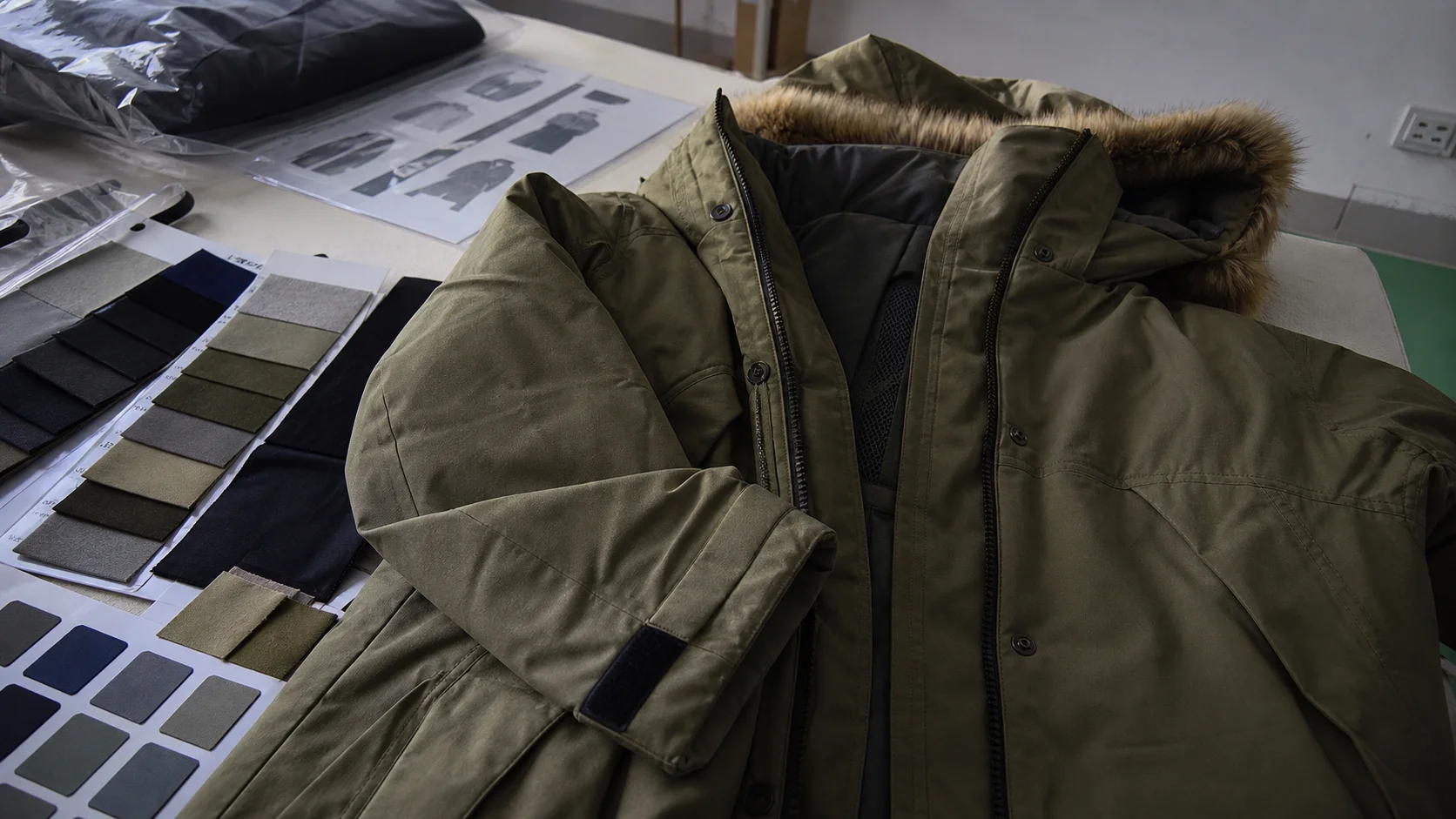
A practical SEO outline for retail operations teams auditing thermal parka colorfastness before launch, replenishment, and customer-facing rollout decisions.
Thermal Parka Colorfastness Audit for Retail Teams - Outerwear & Jackets manufacturing guide
Thermal parkas carry more colorfastness risk than many lighter outerwear styles because they combine dyed shell fabric, insulation, lining, rib trims, zipper tapes, coated parts, drawcords, labels, and sometimes faux fur or reflective details. A retail operations team may see the garment as one SKU family, but the customer experiences it as a full system: a navy shell rubbing onto a cream scarf, a black cuff staining hands, a red lining bleeding after wet snow, or a garment panel fading unevenly after store lighting and normal wear.
A thermal parka colorfastness audit gives retail teams a practical way to reduce these problems before bulk goods reach stores, marketplaces, or wholesale accounts. The audit should not be treated as a paperwork exercise. It is a commercial risk screen that connects lab testing, supplier controls, inspection checkpoints, care label claims, returns analysis, and vendor accountability.
This guide is written for retail operations, sourcing, quality assurance, production, and merchandising teams managing thermal parka programs. It focuses on what to check, when to check it, what specifications to request, and how to make practical purchasing decisions without slowing the calendar more than necessary.
Colorfastness is the ability of a material to retain its color and avoid staining adjacent materials when exposed to rubbing, washing, perspiration, water, light, dry cleaning, heat, or other conditions. In thermal parkas, the risk is higher because the garment is often worn in wet, cold, abrasive, and layered conditions. A customer may wear the parka over knitwear, uniforms, scarves, backpacks, gloves, or light-colored interiors in a vehicle. Any color transfer becomes visible quickly.
Retail teams usually feel the impact after the product has already shipped. Returns rise, customer service receives complaints, marketplace reviews mention staining, and stores may need to quarantine inventory. The direct cost includes markdowns, reverse logistics, replacement units, and vendor debit notes. The indirect cost can be larger: a colorfastness failure can weaken trust in a core winter category that should be dependable.
Thermal parkas also sit at a higher retail price point than basic jackets. Customers expect durable performance. If a parka is promoted as weather-resistant, insulated, premium, commuter-ready, or expedition-inspired, the color standard must match that promise. A colorfastness audit protects the claim architecture as much as the garment.
Purchasing judgment: a low-cost parka shell that barely passes dry crocking but fails wet crocking is not a bargain. It is a deferred returns problem, especially in dark colors, brushed surfaces, and wet-weather markets.
A useful thermal parka colorfastness audit should cover more than the main shell fabric. The audit must include every component that can bleed, migrate, fade, or stain. Retail teams should require the supplier to submit a complete bill of materials with color references, material composition, coating details, finish descriptions, and nominated test standards.
The audit scope should include shell fabric, contrast panels, lining, pocketing, insulation containment layers, seam tape if used, zipper tape, snaps, hook-and-loop tape, drawcords, cord stoppers, rib cuffs, labels, reflective prints, heat transfers, embroidery thread, faux fur trims, real leather patches if present, and any coated or laminated surface. Dark components attached to light shells need special attention, as do bright linings inside pale outer shells.
Retail operations teams should align the audit with the actual selling environment. A parka sold mainly through cold-weather stores may face snow, road salt, condensation, car seats, and backpacks. A fashion parka sold online may face more return scrutiny due to customer expectations on color accuracy. A uniform parka may face repeated laundering and abrasion. The testing plan should reflect the use case.
Teams that need help organizing supplier documentation, quality gates, and production follow-up can review the apparel support structure on Fabrikn’s services page. The value is not only in ordering tests; it is in connecting test results to practical buying decisions.
A risk map helps retail teams prioritize testing budget and inspection time. Not every component carries equal risk. A black brushed shell, a red lining, and a dark rib cuff deserve more scrutiny than a white polyester care label. The goal is to rank risk based on customer exposure, material behavior, color depth, and failure consequences.
Component Typical Risk Main Failure Mode Audit Priority Dark polyester or nylon shell Medium to high Wet crocking, light fading, shade variation High Cotton-rich or brushed shell High Dry and wet rubbing, surface color loss High Contrast lining Medium to high Bleeding onto inner layers or insulation bags High Rib cuffs and hem ribs High Perspiration staining, wet transfer, pilling-related color loss High Zipper tape and drawcords Medium Dye migration onto shell or lining Medium Printed logo or heat transfer Medium Cracking, peeling, color migration, staining Medium Faux fur trim Medium Color shedding, rubbing, moisture transfer Medium Leather or PU patch Medium to high Bleeding, oil transfer, coating breakdown High when placed on light fabricThe highest-risk parkas are usually dark, heavily finished, multi-material styles with light contrast details. A black parka with black trims may hide some staining, but it can still transfer dye to customer clothing. A cream or pale grey parka with dark zipper tapes, dark labels, and dark inner fleece creates a different problem: staining becomes visible on the garment itself.
Colorfastness control starts with specifications. Retail operations teams should not accept vague descriptions such as “100% polyester shell, waterproof coating” as a complete technical record. A sourcing file should identify the exact fabric construction, fiber content, yarn type where relevant, finish, coating, lamination, color standard, approved lab dips, and performance requirements.
For thermal parkas, common shell fabrics include polyester pongee, nylon taslan, polyester oxford, nylon twill, cotton-nylon blends, polyester-cotton blends, and recycled polyester constructions. Each behaves differently. Nylon can have strong performance but may be sensitive to certain dye and finishing controls. Polyester often has good wash stability but can still show crocking or sublimation issues depending on dye class, finish, and heat exposure. Cotton-rich blends can feel better but often carry higher rubbing and fading risk.
Many thermal parkas use polyester taffeta, pongee, fleece, sherpa, quilted lining, or brushed knit panels. The lining touches customer clothing, which makes it commercially sensitive. A red, black, or deep green lining can look attractive at point of sale but creates a transfer risk if the dyeing and finishing are weak.
Insulation is usually less visible, but it can be affected by bleeding from adjacent layers. Down-proof or fiber-proof coatings may also influence heat and moisture behavior. If a lining bleeds during garment washing or wet exposure, staining can appear through quilting seams or at pressure points.
Trim colorfastness is frequently under-controlled. Zipper tapes, elastic cords, drawcords, hook-and-loop tape, grosgrain tabs, rib cuffs, labels, badges, and faux fur trims may be sourced from different suppliers. Each supplier may use a different dyeing process. Retail teams should require trim cards for approval and bulk trim testing for high-risk colors.
Dark rib cuffs deserve special attention because they sit against skin and gloves, absorb moisture, and rub frequently. A cuff can pass a visual review and still fail perspiration or wet crocking. Faux leather patches and coated labels should be tested for migration, especially on pale shells or light linings.
Purchasing judgment: trims are often treated as minor cost items, but trim failure can make a finished parka unsellable. If a supplier resists trim testing on dark components, treat that as a risk signal.
The testing plan should match the garment’s price tier, market, care instructions, and color risk. Retail teams do not need to over-test every low-risk component, but they should avoid under-testing dark, saturated, brushed, or coated materials. Testing should be completed before bulk fabric cutting whenever possible.
Retail specifications often use a grey scale rating system for color change and staining. Many buyers target grade 4 or above for core fastness areas, with grade 3-4 sometimes accepted depending on product type, color, and market positioning. Premium winter parkas should generally be held to stricter expectations than entry-level promotional outerwear. A grade that is technically acceptable in a lab may still be commercially risky if the garment is a dark color worn over light clothing.
Black, navy, charcoal, dark olive, burgundy, red, cobalt, and saturated fashion colors should be tested more aggressively than pale neutrals. Pale shades need different checks: staining from dark trims, yellowing, shade continuity, and light exposure. White and cream parkas are not automatically low risk because they often include dark zippers, dark labels, or contrast linings.
Materials with water-repellent finishes, coatings, laminated membranes, or brushed surfaces may show different results before and after finishing. Test reports should identify whether the submitted specimen is bulk production quality, lab dip fabric, pre-production fabric, or final garment material. A passing lab dip is useful, but it is not the same as a passing bulk lot after coating and finishing.
The care label must match real performance. If the label says machine wash, the garment should pass relevant wash fastness and appearance tests. If the parka includes down, faux fur, coated shell fabric, taped seams, or mixed trims, the care label must be reviewed carefully. A restrictive care label may reduce testing burden, but it may also increase customer dissatisfaction if the instruction is unrealistic.
A practical retail team should challenge care instructions that seem designed only to protect the supplier. “Spot clean only” on a mass-market winter parka can be difficult for customers. If the target customer expects washable outerwear, build the product and testing plan around that expectation.
Colorfastness cannot be controlled by final inspection alone. By the time finished parkas are packed, most failures are expensive to correct. Retail operations teams should build colorfastness review into the sample approval process from development through shipment.
Before sample making, review the color palette, material mix, trim placement, and care claim. Flag any dark-to-light contact areas. A dark leather patch on a cream shell, a red lining under a white outer, or black rib cuffs on a pale sleeve should trigger early testing. At this stage, the team can still change materials with limited cost impact.
Approve lab dips against the selected color standard under controlled light conditions. Ask suppliers to submit multiple options when color depth may affect fastness. A slightly adjusted shade can sometimes improve performance without changing the commercial look. For printed, coated, or transfer details, approve strike-offs and request fastness results for the actual process.
Use the prototype to review component interaction. The proto does not always use final bulk materials, so it should not be treated as proof of colorfastness. It is useful for identifying contact points: hood lining against shell, collar against face fabric, cuff against sleeve, zipper tape against placket, and labels against lining.
Salesman samples may drive wholesale or internal buying decisions, but they are sometimes made from available materials. Retail operations teams should record whether sample materials are final or substitute. If a photo sample uses a substitute trim, the final trim must still be tested and approved before bulk.
The pre-production sample should be made with actual bulk fabric, bulk trims, approved lining, approved insulation, and final construction. This is the key checkpoint for colorfastness confirmation. Request test reports from a recognized lab or agreed testing facility before cutting bulk, especially for high-risk colors.
Size sets verify construction and grading, while top of production samples verify actual production execution. Colorfastness issues can enter at this stage if the factory switches trim lots, uses different fabric rolls, changes heat press settings, or receives late replacement materials. Keep approved standards physically or digitally available for comparison.
Retain sealed shipment samples by color and production lot. If customer complaints arise, these samples help separate production defects from isolated misuse, distribution damage, or later handling issues. Retention samples are also useful for vendor scorecards and future seasonal development.
Final inspection cannot replace lab testing, but it can catch visible warning signs. Inspectors should be briefed to look for shade variation, staining, trim bleeding, rubbing marks, poor curing of prints, dirty handling, migration under folded areas, and inconsistent components between sizes or lots.
AQL inspection plans typically focus on workmanship, measurements, packing, labeling, and visible defects. Colorfastness is harder because failures may only appear after rubbing, moisture, light, or laundering. Retail teams should add simple on-site checks where appropriate, while remembering that these are screening tools rather than formal lab substitutes.
Inspection teams should document any suspected color transfer with photos, carton numbers, size, color, production date where available, and component location. If the issue appears in multiple cartons, hold shipment until the supplier provides a root-cause review and corrective action. A small number of isolated stains may be a handling issue, but repeated staining near the same trim or panel usually points to a material or process failure.
Purchasing judgment: do not approve shipment based only on supplier reassurance if wet rubbing or migration is visible during inspection. Ask for retained sample comparison, recent test reports, and a containment plan before release.
Minimum order quantity and lead time directly affect colorfastness control. Small test orders can be useful, but they may rely on stock fabric or substitute trims. Large programs may justify custom dyeing and stronger control, but they also increase exposure if a failure is missed.
MOQ ranges vary by supplier, fabric mill, trim complexity, and customization level. For thermal parkas, retail teams often see approximate MOQs such as 300 to 800 pieces per color for simpler stock-fabric programs, 800 to 1,500 pieces per color for custom shell colors or branded trims, and 1,500 to 3,000 pieces or more for fully customized fabric, lining, insulation, trims, and performance finishes. These ranges are not fixed rules. A supplier may offer lower MOQs with surcharges, limited color options, or longer lead times.
Lower MOQs can be attractive for testing demand, but they may limit control over dye lots and trim matching. Stock fabric can shorten the calendar, yet it may come with incomplete test history or inconsistent availability. Custom dyeing gives more control over color and performance, but it requires earlier lab dip approval, bulk testing, and stronger calendar discipline.
Thermal parka lead times depend on fabric availability, dyeing, coating, lamination, quilting, insulation sourcing, trim development, sample approval, lab testing, production capacity, inspection, and shipping method. A basic stock-fabric parka may move faster, while a custom insulated parka with waterproof coating, branded trims, and multiple colors requires more time.
Typical development and production timelines may include 7 to 15 days for lab dips, 10 to 20 days for proto samples depending on materials, 5 to 10 days for lab testing after specimens are ready, 15 to 35 days for bulk fabric dyeing and finishing, and 35 to 60 days for cut-and-sew production depending on complexity and capacity. Shipping adds further time. These are planning ranges, not guarantees.
Testing can create calendar pressure if it is treated as a final step. The better approach is to test high-risk materials before bulk cutting and reserve final garment tests for confirmation. If a failed colorfastness result arrives after production is complete, the team may face rework, discounting, or cancellation discussions.
Decision Faster Option Stronger Control Option Tradeoff Fabric source Stock fabric Custom dyed bulk fabric Stock is quicker but may offer weaker color control records Color palette Core black and navy only Multiple seasonal colors More colors increase testing cost and dye-lot risk Trim sourcing Available standard trims Approved custom trims Custom trims improve brand match but add approval steps Testing timing Final garment testing only Material testing before cutting plus garment confirmation Early testing costs time upfront but reduces shipment riskA colorfastness audit only matters if the results drive action. Retail operations teams should classify findings into clear release decisions: approved, approved with caution, hold for corrective action, or reject. The decision should consider lab results, product tier, market expectations, complaint history, and available delivery time.
For example, a slight color change after washing may be acceptable for a garment labeled dry clean only, but not for a washable school or commuter parka. A marginal wet crocking result on a black shell may be more serious if the product is marketed for rain and snow. A dark lining that stains adjacent fabric should be treated as high risk, even if the outer shell looks acceptable.
Retail teams should avoid vague approvals. If a deviation is accepted, record who approved it, why it was accepted, which lots are affected, and what monitoring is required after launch. This protects the business if returns rise and helps sourcing teams negotiate corrective action with suppliers.
Support teams can also prepare customer service guidance when a controlled risk is accepted. Care instructions, stain disclaimers, and product page notes should be accurate, not defensive. A customer should not discover a dye-transfer limitation only after purchase.
Colorfastness performance should be part of the supplier scorecard for outerwear vendors. A supplier that consistently submits complete test reports, flags risks early, controls trim lots, and reacts quickly to failures is more valuable than a supplier that only offers a lower FOB price. Winter outerwear failures are costly because the selling window is short.
Corrective action should address the root cause. Rewashing, extra finishing, improved dye fixation, trim replacement, supplier change, revised care label, altered color depth, or changed material construction may be needed. Retesting should confirm the fix. A supplier should not simply resubmit a better-looking sample without explaining what changed.
When the audit reveals repeated problems, retail teams should review whether the product design is pushing beyond the supplier’s capability. Some suppliers are strong in basic padded jackets but weaker in high-performance parkas with coated shells, complex trims, and strict colorfastness demands. Vendor allocation should reflect technical fit, not only price.
The following checklist can be used before purchase order placement, before bulk cutting, during production, and before shipment. It is intentionally practical. A retail team does not need a long theoretical document; it needs a repeatable control point that prevents avoidable failures.
Stage Action Owner Decision Point Development Review color/material risk map Merchandising, sourcing, QA Change risky combinations early Lab dip Approve shade and request fastness data Design, QA Approve, revise, or reject shade Trim approval Test dark trims and high-contact components Sourcing, QA Approve trim supplier and lot Pre-production Test actual bulk materials and garment sample QA, supplier Release bulk cutting only after approval Production Monitor shade, lots, and component substitutions Factory, inspector, sourcing Hold if unapproved materials appear Final inspection Check visible staining, rubbing risk, packing migration Inspector, QA Approve, hold, sort, or reject Post-launch Track returns and customer complaints by color Retail operations, customer service Update vendor scorecard and next-season specsThe most common mistake is testing only the main shell fabric and assuming the full garment is safe. A thermal parka is an assembly of materials, and any one component can create a staining complaint. Another mistake is accepting test reports that do not match the actual production lot. Reports should clearly identify material, color, supplier, date, and test method.
Teams also make mistakes when they approve marginal results without documenting the commercial reason. If a test result is below target, the decision should not be hidden in an email chain. It should be recorded in the quality file with an agreed risk owner. This is especially important for dark colors, children’s outerwear, uniform programs, and premium parkas.
A third mistake is compressing the test calendar. Late testing encourages pressure approvals. If the shipment date is close and goods are already packed, the team may feel forced to accept risk. Early testing gives buyers real options: adjust shade, change trim, switch lining, delay cutting, or renegotiate delivery.
Retail operations teams should connect colorfastness audits to post-season returns analysis. Complaint data should be coded by style, color, size, market, component, and reported issue. “Defective” is too broad. More useful categories include dye transfer, fading, lining bleed, trim staining, wash-related color change, light discoloration, and unknown staining.
Customer photos can help identify patterns, but they should be reviewed cautiously. A stain on a garment does not automatically prove a production defect. It may come from external exposure, other garments, detergents, or handling. Repeated complaints in the same location, color, and production lot are more meaningful. Retained shipment samples and supplier records are essential for comparison.
Return findings should feed the next development cycle. If black cuffs caused repeated complaints, raise the cuff testing requirement or change the material. If a red lining created staining risk, reconsider the color placement or use a more stable lining. If a coated shell showed uneven fading, review the finish and lightfastness requirement before repeating the fabric.
Every retail team balances cost, speed, and risk. Stronger colorfastness controls add testing cost and may extend development time. At the same time, a failed winter parka program can be far more expensive than the tests that could have prevented it. The right decision depends on order size, price tier, sales channel, brand promise, and customer use.
For a small fashion drop with limited units and a short life cycle, teams may prioritize targeted testing on the riskiest components. For a core annual parka program, full material and garment-level colorfastness controls are justified. For uniforms, school programs, or workwear-inspired parkas, repeated wear and cleaning make stronger requirements necessary.
Buying teams should be careful with last-minute color additions. A late burgundy, forest green, or cobalt option may look commercially strong, but it still needs colorfastness validation. Reusing the same fabric quality does not guarantee the same result in a different color. Dye chemistry and depth matter.
If a supplier offers a lower price by switching to available fabric, ask for test reports and confirm whether the fabric is from the same mill, same construction, same finish, and same performance standard. The price saving may be valid, but the risk must be visible.
Retail teams should escalate when a parka has multiple risk factors: dark shell, light contrast trim, brushed surface, coated fabric, washable care claim, premium price point, large order volume, or previous complaint history. Escalation may include third-party lab testing, technical review of material specifications, factory corrective action, or tighter inspection plans.
A specialist review is also useful when internal teams disagree. Merchandising may want a bold lining color, sourcing may be protecting lead time, and QA may see a risk. A documented audit gives the team a common basis for decision-making. It does not remove commercial judgment, but it makes the tradeoff explicit.
Retailers planning new outerwear programs or reviewing existing vendor controls can learn more about company background at Fabrikn’s about page. For specific questions about parka sourcing, quality checkpoints, and supplier follow-up, use the Fabrikn contact page to start a discussion.
A thermal parka colorfastness audit is a retail operations tool, not just a lab form. It protects customers, margins, store teams, and the brand’s outerwear credibility. The best audits start early, cover all materials, test the right risks, document release decisions, and connect results to supplier scorecards.
The strongest purchasing approach is straightforward: identify high-risk colors and components before ordering, test actual bulk materials before cutting, inspect for visible migration before shipment, and use post-launch data to improve the next season. That discipline gives retail teams better control over winter outerwear performance without relying on hope at final inspection.
Get a free quote from Fabrikn — your trusted B2B clothing manufacturer with 10+ years of experience. MOQ as low as 200 pieces.
Get a Free Quote →A thermal parka colorfastness audit is a structured review of shell fabric, lining, insulation layers, trims, labels, prints, and finished garments to assess the risk of fading, bleeding, rubbing, or staining. It combines material specifications, lab tests, sample approvals, production checks, and inspection findings.
Crocking, water fastness, perspiration fastness, wash fastness, light fastness, and dry-cleaning fastness are commonly relevant. Heat migration or sublimation testing may also be needed for polyester fabrics, heat transfers, printed logos, and packed garments exposed to heat.
Dark parkas are higher risk for dye transfer, especially black, navy, burgundy, red, and dark green. Risk depends on fiber type, dye process, finish, coating, rubbing exposure, and wet-use conditions. A dark parka can look visually acceptable while still staining light clothing during wear.
Yes. Zipper tapes, drawcords, rib cuffs, hook-and-loop tape, labels, patches, faux fur, and heat transfers can fail even when the main shell passes. Dark trims on light garments and high-contact trims such as cuffs and collars deserve separate attention.
High-risk materials should be tested before bulk cutting. Pre-production samples made with actual bulk materials should be checked before production release. Final garment testing and inspection can confirm compliance, but they should not be the first control point.
Typical ranges may run from 300 to 800 pieces per color for simpler stock-fabric programs, 800 to 1,500 pieces per color for custom colors or trims, and 1,500 to 3,000 pieces or more for fully customized parka programs. Actual MOQ depends on supplier, fabric mill, trim requirements, and performance specifications.
Final inspection can catch visible staining, shade variation, rubbing marks, trim inconsistency, and packing migration. It cannot fully replace lab testing because many failures appear only after controlled exposure to rubbing, water, perspiration, light, washing, or dry cleaning.
The team should hold release, identify the affected component and lot, request supplier root-cause analysis, review corrective options, retest corrected materials, and document the decision. Shipment approval should depend on customer risk, product claim, order value, and the severity of the failure.
No. A passing shell fabric test is useful, but the full garment includes linings, trims, labels, prints, coatings, and construction details. Garment-level review is needed when components interact, especially in dark-to-light combinations or washable products.
Returns should be coded by style, color, component, issue type, and production lot when possible. Repeated complaints help teams adjust specifications, change materials, strengthen testing, or reconsider supplier allocation for the next season.