
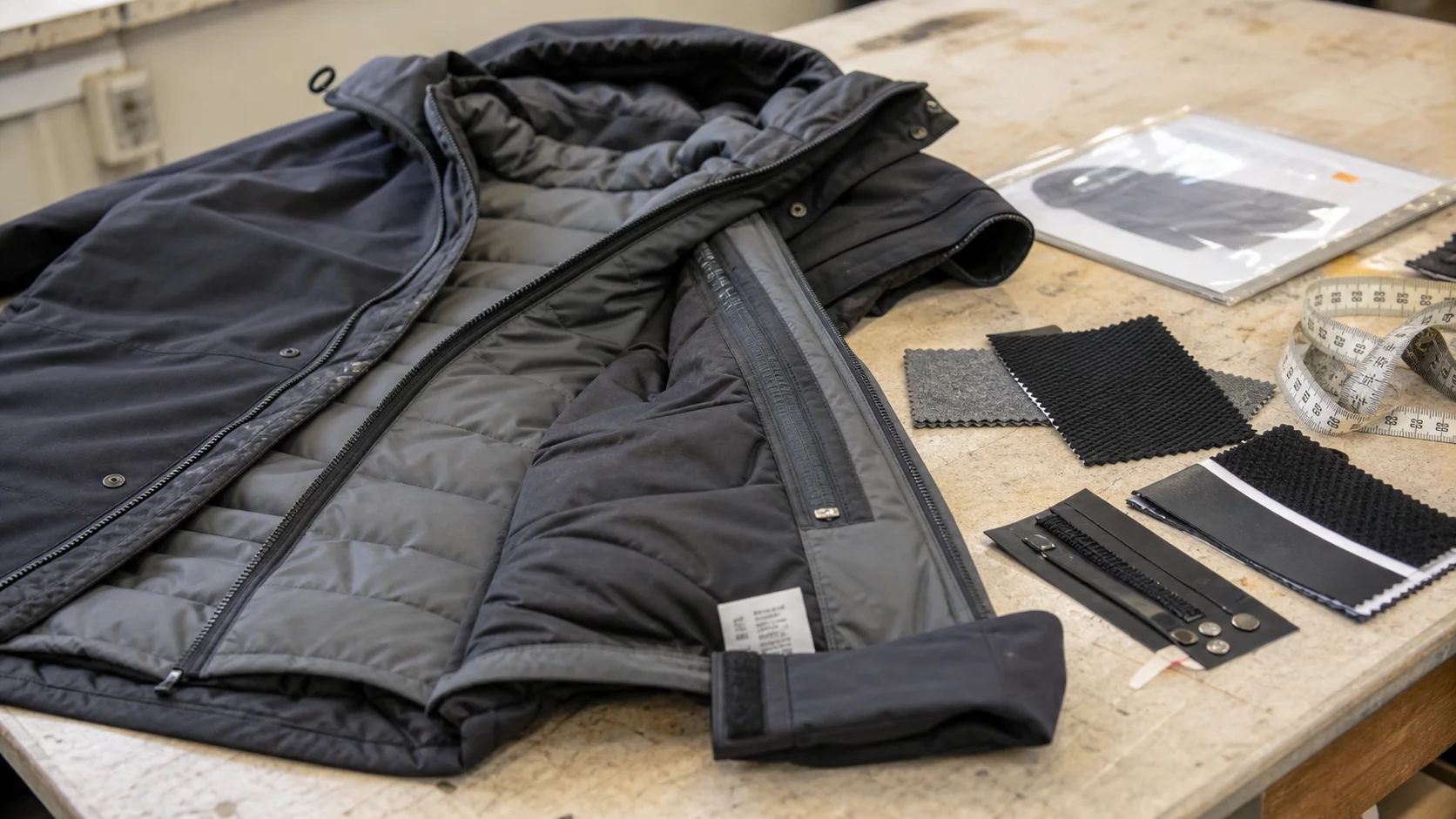
A buyer-focused compliance checklist for thermal parka sourcing in gym programs, covering safety, performance, labeling, testing, and factory documentation...
Thermal Parka Compliance Checklist for Gym Buyers - Quality & Inspection manufacturing guide
If you are sourcing thermal parkas for a gym program, compliance is not a side issue. It is the difference between a clean seasonal rollout and a batch of outerwear that arrives late, fails inspection, or creates avoidable liability. Gym buyers usually want warmth, durability, a sharp branded look, and reliable repeatability. Those goals are compatible, but only if the sourcing brief is controlled from the start.
A thermal parka looks simple on the surface. In practice, it combines shell fabric, insulation, lining, trims, branding, packaging, and performance claims that all need to line up. A buyer who skips specification control may still get a jacket, but not necessarily one that passes internal quality review, merchandising standards, or customer expectations. That is why a compliance checklist matters before you approve artwork, place a deposit, or confirm a production window.
This article focuses on the checks gym program buyers should use when evaluating a thermal parka manufacturer compliance checklist. It is written for sourcing teams, merchandising managers, and procurement leads who need a practical working tool rather than a theory lesson. If you are comparing suppliers, it also helps to review a manufacturer’s broader capability on about-us, the services they offer on services, and the fastest way to start a conversation through contact-us.
Compliance starts with a clear program definition. Buyers often focus on color and logo placement first, then discover later that the insulation weight, waterproofing expectation, or cold-weather rating was never formally agreed. That is a common source of dispute. A manufacturer cannot reliably quote or test against an unclear brief.
For gym use, decide whether the parka is meant for staff uniforms, member retail, outdoor training, event wear, or travel merchandise. Each use case pushes the specification in a different direction. Staff parkas may need stronger wash durability and consistent size runs. Retail parkas may need better handfeel, cleaner finishing, and broader color options. Event parkas may prioritize volume, speed, and simple branding. A buyer should not expect one style to satisfy every scenario without compromise.
The program scope should define the following points in writing:
MOQ expectations vary by factory and construction complexity. A basic polyester insulated parka may start around 300 to 500 pieces per color if the supplier already has suitable materials. A more complex insulated parka with custom shell, laminated fabric, multiple trims, or special trims can move into 500 to 1,000 pieces or more. Buyers should treat unusually low MOQ claims with caution unless the supplier can show how they handle component sourcing and production consistency at that level.
Outerwear compliance is built on the fabric and trims list. The shell fabric must match the intended performance and appearance, and the insulation must support the warmth claim without creating excess bulk or weak stitching performance. A gym buyer should not approve a sample only because it looks attractive on a hanger. The real question is whether the material stack meets the program brief.
Confirm the fiber content, construction, weight, finish, and functional coating or membrane. Typical shell choices include polyester, nylon, or blended fabrics with a DWR finish. If the buyer expects weather resistance, the supplier should specify whether the fabric is water-repellent, water-resistant, or waterproof. These are not interchangeable terms, and the inspection risk rises when marketing language is used instead of measurable fabric data.
Ask for the fabric specification sheet, color standards, and lab test report where relevant. Watch for shade variation across production lots, especially on dark tones and heathered looks. A fabric that passes a visual sample stage can still create shade inconsistency when bulk dye lots arrive.
Thermal performance depends on insulation type, fill weight, and construction method. Common options include polyester batting, recycled fill, or down-alternative insulation. Buyers should ask for the GSM or fill weight and understand the tradeoff between warmth and bulk. A thicker fill may improve perceived warmth, but it can also affect pattern fit, mobility, and stitching consistency.
The lining should be smooth enough for layering, stable enough for repeated wear, and compatible with the shell and insulation. If the lining is too slippery or weak, seam slippage and comfort complaints become more likely. If the lining fabric is too light, it may tear near stress points or zippers during use.
Zippers, snaps, drawcords, labels, heat transfers, and sewing thread all count as compliance items. A poor-quality zipper can compromise the entire garment, even when the fabric is acceptable. Gym buyers should request trim specifications with brand, gauge, material, color code, and placement. If the manufacturer proposes equivalent trims, require written approval before bulk production.
Pay close attention to drawcord safety, zipper pull durability, and snap strength. For some markets, cord and toggle design may need to follow specific safety expectations. Buyers should not assume the factory will self-police this area unless the requirement is stated clearly in the tech pack or purchase order.
Outerwear construction issues are often invisible in photos but obvious in wear. Buyers should check stitch density, seam alignment, reinforcement at stress points, and consistency of topstitching. Poor construction can show up as puckering near the zipper, uneven quilting, loose thread ends, or weak attachment of pockets and cuffs. These defects are common inspection failures because they are easy to spot and expensive to rework.
Pattern balance matters as much as fabric quality. A parka can use good materials and still fit badly if the grading is off. For gym wear, buyers usually want enough room for movement without making the garment look oversized. That balance should be tested in size set samples, not assumed from a base size sample alone.
Labeling is part of compliance, not decoration. The buyer should confirm care label content, fiber content, country-of-origin requirements, size labeling, brand marks, and any legal symbol usage before bulk printing. One common mistake is approving the garment sample and leaving labeling details until later. By then, the supplier may have already ordered labels based on incomplete information.
The approval sequence should usually follow this order:
Documentation should include a clear product specification sheet, measurement chart, artwork files, approved swatches, and sample comments log. Buyers who maintain a single, version-controlled document package reduce the risk of production drift. Once the manufacturer starts cutting bulk fabric, late changes become costly and can affect the delivery schedule.
Testing is where confidence becomes evidence. A thermal parka buyer should not depend on visual inspection alone. The required tests depend on market expectations, fabric claims, and program risk, but a sensible checklist usually includes colorfastness, seam strength, pilling resistance, zipper function, dimensional stability, and, where relevant, water repellency or thermal performance testing.
The exact test plan should be agreed before production. If the supplier only discovers the test requirement after bulk completion, delays are likely. Some factories can source compliant materials quickly. Others need lead time for substitute trims, special fabric lot booking, or repeat test cycles. Buyers should build this into the calendar rather than treat it as contingency noise.
Sample approval deserves discipline. A good sample process includes comments, revision control, and measured confirmation against the spec sheet. Visual approval alone is not enough. The buyer should compare the sample against size tolerances, stitch details, branding placement, and approved material references. If the sample passes visually but deviates in measurement or trim quality, the issue should be corrected before bulk sign-off.
Inspection risks increase when the program uses multiple colorways or staggered size ratios. The first production pieces often look strong, while later pieces reveal inconsistency in padding, stitching, or label application. A mid-production inspection can catch this early. Final random inspection is still necessary, but it should not be the first time someone checks the bulk.
Typical lead times depend on many factors: fabric readiness, lab test requirements, approval speed, trim availability, and production capacity. A basic order may move in 45 to 60 days after approvals if materials are in stock. A more complex parka with custom fabric, special insulation, or branded hardware may need 75 to 120 days or more. Buyers who promise launch dates before confirming material sourcing create pressure that often shows up as shortcuts in quality control.
Factory compliance is not only about certifications. It is about whether the supplier has the systems to produce outerwear consistently at the required quality level. A gym buyer should ask how the factory handles incoming material inspection, line balancing, sewing quality control, and final packing checks. A supplier that cannot explain these controls clearly is not ready for a disciplined retail or uniform program.
Ask for the manufacturer’s documentation on production flow, inspection checkpoints, and handling of nonconforming goods. A practical factory should be able to explain what happens when a fabric roll fails inspection, a zipper batch arrives late, or a sample detail is unclear. The response should be procedural, not vague. That is usually more useful than a polished sales pitch.
Compliance also depends on ethical and operational discipline. Many buyers require social compliance, restricted substance controls, and traceability on key materials. The depth of review will vary by market and program value, but the buyer should at least ask whether the manufacturer tracks supplier declarations and maintains batch records for major components. If a claim is made on recycled content, water resistance, or special performance, supporting documentation should be available.
When comparing suppliers, consider whether they offer full-service support or only cut-and-sew capacity. A factory with broader services may be better suited to help with sourcing, sampling, and packaging coordination. That can reduce coordination burden for the buyer, but only if the supplier is transparent about responsibility boundaries. If you are screening options, the service structure listed on services is the right place to look for that type of support, and the company profile on about-us should help you judge fit.
Good sourcing work is mostly tradeoff management. A gym buyer may want a lower unit cost, faster delivery, richer insulation, and premium branding in the same order. Those goals are not impossible, but one usually gives way to another. Compliance issues often appear when a buyer tries to compress every requirement into the cheapest possible spec.
Higher insulation weight improves warmth, but it can raise cost and make stitching more difficult. Waterproof laminated fabric improves weather protection, but it may increase MOQ and make the garment stiffer. Embroidery can look premium, but heavy logo areas may distort on padded panels. Heat transfer branding is lighter and cleaner, but it may wear differently under abrasion and repeated laundering. Each choice has a direct inspection and durability implication.
Buyers should also think about replacement and replenishment. If the gym program will reorder throughout the season, the original fabric and trim package must be repeatable. A supplier can sometimes duplicate a style once, but not reliably across multiple months if the materials are too niche. In that case, the first order may look strong, while the repeat order drifts in shade, handfeel, or component availability.
A cautious buyer will write a tolerance strategy into the order. That means deciding what is acceptable on measurement variation, shade banding, logo placement, and packaging detail before the factory starts production. Without that clarity, inspection becomes subjective. Subjective inspection leads to arguments. Arguments lead to delays.
A thermal parka order is safest when the buyer treats specification control as the foundation, not the paperwork. The more exact the brief, the fewer surprises in bulk production.
For gym buyers, the best thermal parka is usually not the most technical one. It is the one that balances warmth, durability, repeatability, and cost in a way the program can actually sustain. A high-performance shell means little if the supply chain cannot repeat it. A premium fill means little if the garment fails label review or arrives too late for the season.
If a supplier can show clean sample flow, transparent material sourcing, reasonable MOQ expectations, and disciplined inspection controls, that is a stronger signal than glossy product photos. Buyers should value clarity over promises. When a factory is vague about fabric sourcing, testing, or the approval sequence, the risk is rarely limited to one detail. It usually affects the whole order.
For teams comparing vendors, the most efficient next step is often a structured inquiry with the tech pack, target quantity, and desired delivery window attached. That lets the supplier respond on feasibility rather than generalities. If you are at that stage, using the contact route on contact-us is the cleanest way to start the conversation.
Get a free quote from Fabrikn — your trusted B2B clothing manufacturer with 10+ years of experience. MOQ as low as 200 pieces.
Get a Free Quote →Start with the use case, target climate, quantity, and branding method. Those four items shape the fabric, insulation, MOQ, and lead time more than anything else.
Many factories start around 300 to 500 pieces per color for simpler constructions, while more customized parkas often require 500 to 1,000 pieces or more. The actual MOQ depends on fabric sourcing, trims, and production setup.
Common priorities include seam strength, zipper function, colorfastness, dimensional stability, pilling resistance, and water repellency if the product makes weather claims. The exact test set should match the market and specification.
Lead time often ranges from 45 to 60 days after approvals for simpler orders with available materials. Custom fabrics, special hardware, and extra testing can push the timeline to 75 to 120 days or more.
They lock down the material, fit, construction, and branding details before bulk cutting starts. Once production begins, corrections become slower and more expensive.
The most common mistake is approving style and color before finalizing the full specification package. That usually leads to label errors, measurement drift, or inconsistent bulk quality.