
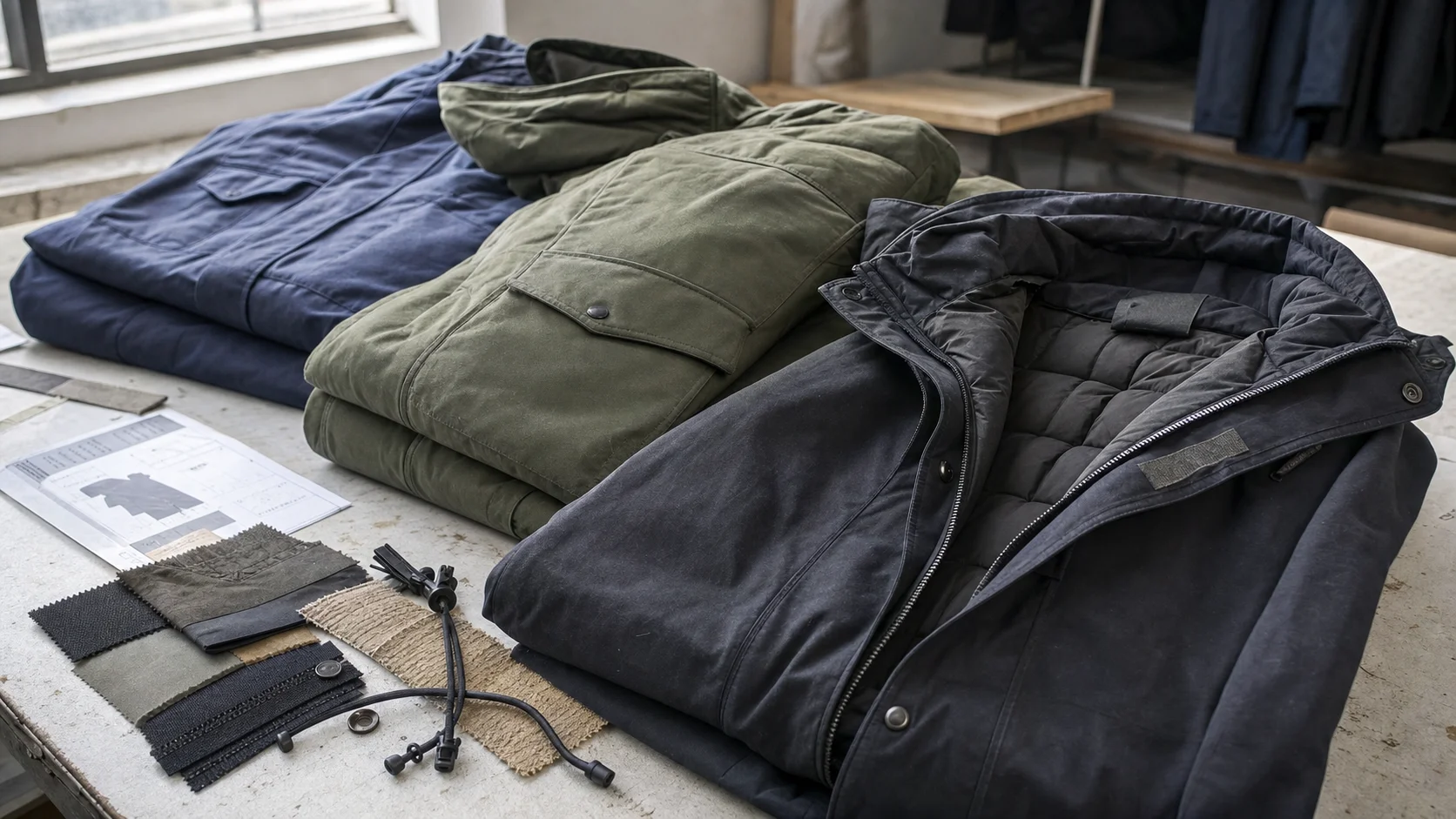
A practical SEO outline for retail operations teams auditing thermal parka manufacturing compliance, inspection records, labeling, safety, packaging, and...
Thermal Parka Compliance Checklist for Retail Teams - Fabrikn production reference
Retail operations teams do not buy thermal parkas on design alone. A parka may look commercially strong in a line review, but it still has to pass fabric testing, trim safety checks, warmth claims, labeling rules, packaging standards, warehouse handling, and final inspection. That is where a clear thermal parka manufacturer compliance checklist becomes useful.
This guide is written for retail teams managing outerwear sourcing, quality assurance, vendor onboarding, production follow-up, and inbound inspection. It focuses on practical controls that reduce claims, late shipments, carton rework, fit complaints, and avoidable chargebacks.
A thermal parka is a high-risk product category because it combines performance fabric, insulation, lining, trims, closures, labeling, and weather-protection claims in one garment. Compliance should be built into development, not left for final inspection.
Thermal parkas carry more compliance exposure than basic fleece, sweatshirts, or lightweight jackets. They are usually higher-ticket garments, often promoted with warmth, cold-weather, water-resistant, or weather-ready language. Buyers, planners, and operations teams must make sure those claims are supported by specifications and testing.
The cost of a failed parka program is not limited to returns. A retail team may face relabeling, repacking, shipment delays, store allocation disruption, markdown pressure, customer complaints, customs issues, or vendor chargebacks. In winter categories, timing matters. A late parka shipment can miss the main selling window.
A good compliance checklist helps align the manufacturer, buying office, QA team, logistics team, and retail operations team before bulk production starts. It also makes supplier conversations more specific. Instead of asking whether the factory can “make good parkas,” the team can verify fabric performance, insulation weight, seam strength, zipper durability, labeling accuracy, and carton compliance.
Retailers that need structured production and inspection support can review apparel manufacturing service options through Fabrikn’s services page. The key is to translate commercial requirements into measurable manufacturing controls.
The first compliance gate is supplier qualification. Thermal parkas should not be assigned to a manufacturer that mainly handles simple cut-and-sew products unless the factory has proven padded outerwear capability. Parkas require bulk handling, insulation control, quilting accuracy, needle control, seam consistency, zipper alignment, and careful finishing.
Retail teams should request evidence, not broad claims. Useful documents include production photos of similar product types, sample test reports, trim supplier declarations, fabric composition certificates, inspection history, and quality manuals. Audits may be required depending on the retailer’s policy, product destination, and risk profile.
Minimum order quantities vary by fabric source, insulation type, trim customization, size range, color count, and factory capacity. For thermal parkas, retail teams should expect higher MOQs than basic knitwear because shell fabric, padding, zippers, snaps, and linings are often purchased from multiple suppliers.
Program Type Typical MOQ Range Key Dependency Purchasing Judgment Stock fabric parka 300-800 pieces per style/color Available shell fabric and standard trims Best for speed, but fewer performance and color options Custom color shell fabric 800-1,500 pieces per color Dye lot minimums and lab dip approval Good for brand control, but color approval can delay production Custom insulation or quilting design 1,000-2,000 pieces per style Padding width, quilting setup, and technical pattern work Worth it for differentiated product, risky for small test orders Private label retail program 500-2,500 pieces per style Labeling, packaging, size range, and delivery split Works when the supplier has strong SKU and carton disciplineVery low MOQs can be possible, but they usually come with tradeoffs: stock fabric, limited colors, higher unit cost, fewer trim options, and less flexibility on delivery splits. A retail team should treat unusually low MOQ promises cautiously unless the supplier can show available materials and realistic production capacity.
A thermal parka specification must be more detailed than a general jacket tech pack. The spec should define the intended performance level, styling details, material construction, measurement tolerances, safety rules, labeling, packaging, and inspection standards.
The spec should avoid vague descriptions such as “warm padding,” “good zipper,” or “waterproof fabric” unless those terms are backed by measurable requirements. If a parka is marketed as waterproof, the team needs hydrostatic pressure targets, seam sealing requirements, and test methods. If the garment is only water-resistant, the packaging and product copy should not imply waterproof protection.
Thermal parkas can fail fit inspections because insulation changes the way a garment sits on the body. Finished measurements must account for padding thickness, lining tension, sleeve rotation, hood volume, and layering space.
Measurement tolerance should be realistic. A common tolerance range for padded outerwear is plus or minus 1 cm for small points and plus or minus 1.5-2 cm for larger body measurements. Tighter tolerances may be possible with stable materials and experienced factories, but overly strict tolerances create inspection disputes without improving sell-through.
Material compliance is the backbone of a thermal parka program. Retail operations teams should verify that each material matches the approved bill of materials and complies with market regulations, retailer standards, and product claims.
Common parka shell fabrics include polyester pongee, polyester taslan, nylon taslan, polyester oxford, recycled polyester, and laminated or coated woven fabrics. The right choice depends on target price, handfeel, durability, printability, weather protection, and brand positioning.
Retail teams should be careful with sustainability claims. Recycled polyester requires documentation such as transaction certificates or supplier declarations depending on the claim and retailer policy. A recycled claim without chain-of-custody documentation can become a compliance issue.
Thermal parkas commonly use polyester padding, synthetic down-like insulation, down, feather blends, or recycled insulation. Each option has commercial and compliance tradeoffs.
Insulation Type Typical Use Compliance Focus Tradeoff Polyester padding Value and mid-market parkas Weight, loft, recovery, migration, and even distribution Cost-effective, but bulky if low-grade padding is used Synthetic down-like fill Lightweight warmth styles Fill weight, leakage, clumping, and wash durability Soft handfeel, but needs tight fabric and proper seams Down or feather blend Premium cold-weather outerwear Fill power, species declaration, cleanliness, odor, and animal welfare documentation High warmth-to-weight, but higher compliance burden Recycled insulation Sustainability-focused programs Recycled content documentation and performance consistency Marketable, but source control is essentialInsulation should be specified by weight, composition, construction, and location. For example, body panels may use a heavier fill than sleeves or hood. A parka spec should not use one generic fill reference if different panels require different insulation levels.
Parkas are trim-heavy garments. Zippers, snaps, toggles, drawcords, elastic cuffs, hook-and-loop tape, buttons, labels, and patches can all create quality or safety failures.
A common purchasing mistake is approving a premium-looking sample with upgraded trims, then allowing bulk production to use cheaper substitutes. The manufacturer should not change zipper brand, snap specification, drawcord diameter, insulation weight, or shell finish without written approval.
Sample approval is where retail teams prevent most production mistakes. A thermal parka should move through controlled sample stages before bulk cutting. Skipping stages may save calendar days early, but it often adds risk at inspection.
Retail teams should keep approval comments specific and dated. “Approved with comments” is dangerous if the comments are not tracked. The supplier should respond with corrected samples, photos, or written confirmation before production release.
Retail teams should require one sealed pre-production sample for the manufacturer, one for the buying office or QA team, and one for inspection reference if the inspection agency is separate. The sample should include final labels and trims, not only the garment shell.
Testing requirements depend on product category, destination market, retailer standards, fiber content, claims, and age group. Adult outerwear and children’s outerwear do not carry the same safety profile. Any parka for children needs special attention to drawcords, small parts, sharp points, flammability, and labeling.
Testing should be ordered early enough to avoid shipment delays. Some tests require production fabric, finished trims, or finished garments. If testing starts only after goods are packed, failures can lead to costly rework or missed delivery windows.
Marketing teams often want strong language: thermal, weatherproof, storm-ready, waterproof, sub-zero, expedition, or insulated. Retail operations teams should check each claim against evidence. A product can be warm without being waterproof. A shell can be water-resistant without sealed seams. A parka can be insulated without being appropriate for extreme cold.
Claim Compliance Check Risk if Unsupported Water-resistant Spray test, DWR performance, or retailer-approved water repellency method Customer complaints if fabric wets out quickly Waterproof Hydrostatic pressure, seam sealing, and construction review Misleading claim if seams are not sealed Thermal Insulation type, fill weight, construction, and warmth test if required Returns due to weak warmth perception Wind-resistant Fabric construction, coating, membrane, or air permeability test Claim may be challenged if fabric is loosely woven Recycled Recycled content documentation and claim wording review Green claim risk without traceabilityThe safest approach is to align product copy with tested performance. If the shell has a basic DWR finish but no membrane or seam sealing, “water-resistant” is usually more defensible than “waterproof.”
Labeling failures are common because many teams treat labels as administrative details. For retail operations, label accuracy directly affects customs clearance, store compliance, customer trust, and returns handling.
Care labels should not be guessed. If the garment cannot tolerate tumble drying, the label should not suggest it. If dry cleaning is not tested, the care instruction should be reviewed carefully. Parkas with synthetic insulation may clump or distort under aggressive washing, and down-filled parkas need specialized care instructions.
Thermal parkas should not be over-compressed to reduce freight cost unless the retailer has approved compression and recovery standards. Compression can flatten insulation, distort quilting, bend zipper teeth, and create a poor unboxing impression.
Retailers planning a new outerwear program can use the Fabrikn contact page to discuss requirements, sourcing structure, and production expectations before committing to a manufacturer.
Thermal parka lead time depends on material availability, lab dip approval, trim sourcing, insulation procurement, sample corrections, testing schedules, production capacity, inspection booking, and shipping method. Retail teams should avoid relying on a single “delivery date” without milestone tracking.
A realistic total timeline for a new custom thermal parka program is often 90-150 days from development kickoff to shipment, depending on complexity and approval speed. Repeat orders using approved materials can be faster. Rush programs usually require stock materials, simplified trims, and quick decision-making.
Retail operations teams should ask for production status reports tied to actual quantities: fabric received, pieces cut, pieces sewn, pieces finished, pieces packed, cartons ready, and inspection date. Percentages alone can hide problems. “80% complete” may mean sewing is nearly done, but trims, labels, or packing are still blocked.
Final inspection should occur when production is complete and most goods are packed. Standard practice is often based on AQL sampling, though the exact level depends on retailer policy, product risk, and order value. Thermal parkas deserve careful inspection because defects may not be visible at a quick glance.
Measurement checks should use the approved size chart and sealed pre-production sample. Inspectors should avoid compressing the garment too aggressively when measuring padded areas. If the measurement method is not consistent, disputes are likely.
Final inspection should not be used as the first serious quality checkpoint. By that stage, repair options are limited and expensive. Strong retail teams use final inspection to verify control, not to discover the whole risk profile.
A clear workflow prevents compliance gaps between buying, sourcing, QA, logistics, and merchandising. Thermal parka programs need structured ownership because decisions are spread across departments.
The best workflow uses gate approvals. Bulk fabric should not be cut before fabric approval. Production should not start before PP sample approval. Shipment should not be released before inspection and document checks. Exceptions may be necessary in urgent situations, but each exception should be documented with a risk owner.
Good document control reduces disputes. If a claim arises, the team can compare the defective garment against approved specifications, test records, and inspection reports.
Retail teams should score thermal parka manufacturers after each season. Outerwear suppliers can perform well on one style and struggle on another if material complexity, order volume, or delivery pressure changes. A scorecard makes supplier decisions less subjective.
A supplier with a slightly higher unit cost may be the better purchasing decision if it reduces inspection failures, air freight, carton rework, and customer returns. Lowest FOB price is not always lowest landed risk.
Retailers evaluating long-term manufacturing partners can review company background and sourcing approach through Fabrikn’s about page.
Thermal parka programs often fail for predictable reasons. Most issues are preventable if retail teams check details early and avoid approving vague substitutions.
Warmth is influenced by insulation type, fill weight, garment length, quilting pattern, lining, wind resistance, hood coverage, cuff closure, and fit. A thin parka with weak closure points should not be marketed as extreme cold protection. If a retailer needs a strong warmth claim, the test plan and product design must support it.
Many parkas use water-repellent shell fabric but do not have sealed seams. That construction may handle light rain or snow, but it should not be described as fully waterproof. The product copy, hangtag, and online listing should match the real construction.
Color, handfeel, coating, weight, and finish can shift between sample yardage and bulk fabric. Retail teams should require bulk fabric approval before cutting, especially for custom colors or coated fabrics.
Loose synthetic fill or down-like insulation can migrate through seams or fabric if the shell and lining are not suitable. Quilting design, stitch density, seam construction, and fabric density all matter. Early wash testing and leakage checks are useful before production scales.
A parka zipper carries heavy stress because the garment is bulky and often worn over layers. Weak sliders, poor tape quality, bad insertion, or misaligned plackets can create high return rates. A smooth sample zipper does not guarantee bulk performance if the trim supplier changes.
Fiber content errors are common when shell, lining, padding, rib, faux fur, and trims have different compositions. Care labels may also be wrong if wash testing happens late. Label artwork should be locked only after the BOM and testing plan are stable.
Bulky outerwear creates packing pressure. When factories rush, mixed sizes, wrong barcodes, and inaccurate carton marks can occur. Retail receiving teams should insist on carton-level accuracy because store allocation depends on it.
The checklist below can be adapted for retail operations, sourcing teams, and QA departments. It is most useful when converted into a shared approval tracker with owners, due dates, and document links.
Checklist Area Required Control Status Supplier capability Confirm padded outerwear experience, equipment, QA process, and production capacity Open / Approved / Rejected MOQ and lead time Confirm MOQ by style, color, fabric, trim, and delivery split Open / Approved / Rejected Tech pack Finalize sketch, BOM, measurements, construction, labels, and packaging Open / Approved / Rejected Shell fabric Approve composition, weight, color, finish, strength, and restricted substance compliance Open / Approved / Rejected Insulation Approve type, weight, panel distribution, loft, recovery, and documentation Open / Approved / Rejected Trims Approve zippers, snaps, drawcords, toggles, elastic, labels, and logo applications Open / Approved / Rejected Samples Approve fit sample, size set, material submits, and PP sample before production Open / Approved / Rejected Testing Complete required lab tests for safety, durability, performance, and claims Open / Approved / Rejected Labeling Verify fiber content, country of origin, care, size, barcode, and hangtag claims Open / Approved / Rejected Production Track material receipt, cutting, sewing, finishing, packing, and issue resolution Open / Approved / Rejected Inspection Conduct inline and final inspection using approved sample and AQL standard Open / Approved / Rejected Shipment Confirm packing list, carton marks, routing guide, documents, and delivery schedule Open / Approved / RejectedA thermal parka compliance checklist should not slow the business unnecessarily. It should help teams decide where speed is acceptable and where control is non-negotiable.
For a small seasonal test, a retailer may choose stock fabric, standard trims, and a simpler silhouette to reduce MOQ and lead time. That is a sensible tradeoff if the product copy is modest and the garment is not positioned as technical outerwear. For a premium program, the team should invest more time in fabric testing, trim approval, fit refinement, and performance validation.
The riskiest route is a complex parka with custom fabric, special insulation, multiple trims, performance claims, low MOQ, and a compressed calendar. That combination creates pressure at every stage. If the delivery window cannot move, the specification may need to be simplified.
Retail operations teams should protect three things: claim accuracy, shipment timing, and customer experience. A parka that arrives late, fits poorly, or underperforms in cold weather will create more cost than a careful compliance process.
Get a free quote from Fabrikn — your trusted B2B clothing manufacturer with 10+ years of experience. MOQ as low as 200 pieces.
Get a Free Quote →Start with supplier capability, product specification, and material compliance. A manufacturer should have proven padded outerwear experience, and the tech pack should define shell fabric, insulation, trims, measurements, labeling, packaging, and testing requirements before bulk production begins.
Typical MOQs often range from 300 to 800 pieces per style/color when stock fabric and standard trims are used. Custom colors, custom insulation, branded trims, or private-label packaging can push MOQs to 800-2,500 pieces or more. Exact quantities depend on fabric mills, trim suppliers, size range, and production capacity.
A new custom program commonly takes 90-150 days from development to shipment. Repeat styles with approved materials may move faster. Lead time depends on sample approval, lab dips, fabric procurement, trim sourcing, testing, production capacity, inspection, and freight.
Common tests include fiber composition, colorfastness, dimensional stability, seam strength, tear strength, zipper durability, snap pull strength, restricted substances, and performance tests for water resistance or waterproofing if claimed. Down-filled parkas require additional fill quality and documentation checks.
Not unless the construction and testing support the waterproof claim. Water-resistant fabric may repel light moisture, but waterproof claims usually require hydrostatic pressure performance and appropriate seam construction, often including seam sealing. Product copy should match tested performance.
Common defects include uneven insulation, skipped stitches, open seams, zipper malfunction, misaligned plackets, twisted lining, poor hood shape, weak snaps, stains, loose threads, wrong labels, barcode errors, and mixed cartons.
That is risky. If timing forces a conditional approval, the risk owner should be documented and production should not ship until critical testing and labeling checks are complete. For performance claims, children’s garments, and regulated markets, testing should be treated as a required gate.
Focus on accurate fit, durable zippers, clear care instructions, realistic warmth claims, correct sizing, strong seam construction, and consistent insulation. Many returns come from practical failures: zipper problems, poor warmth, tight sleeves, bulky fit, or misleading weather-protection claims.
Keep the final purchase order, approved tech pack, BOM, sample approvals, lab test reports, material declarations, factory qualification records, inspection reports, packing list, shipment documents, and claim-support evidence for recycled content, water resistance, or thermal performance.
Final inspection should happen when production is complete and most goods are packed. The inspector should use the approved pre-production sample, tech pack, measurement chart, labeling requirements, packaging instructions, and AQL standard agreed by the retailer.