
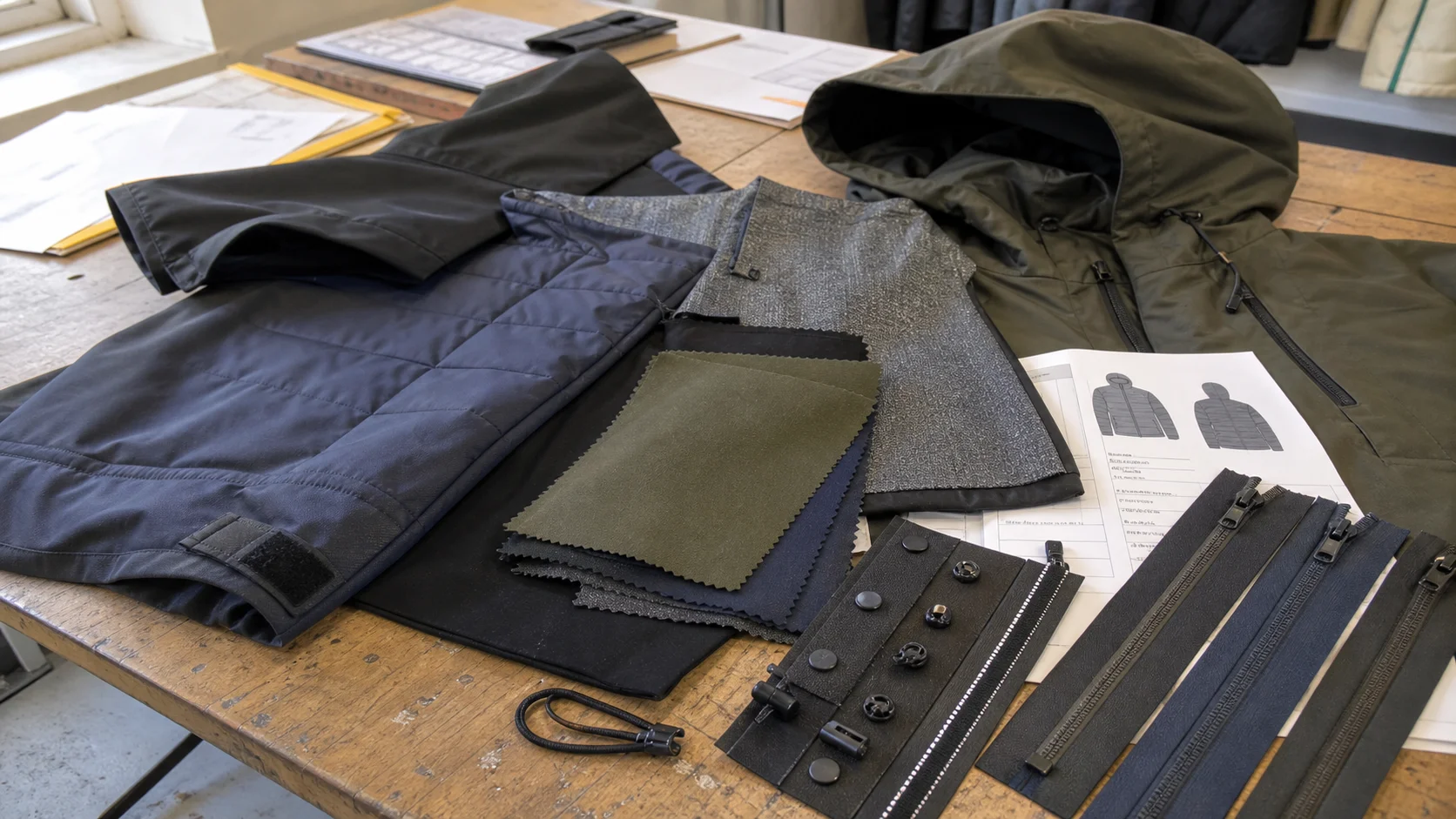
A quality and inspection outline for gym program buyers evaluating thermal parka fabrics, lab tests, production checks, and acceptance criteria before bulk...
Thermal Parka Fabric Testing for Gym Buyers - Fabrikn production reference
Thermal parkas are not standard gym apparel. They sit closer to outerwear, uniform, and teamwear procurement. For gym program buyers, the fabric testing process needs to prove more than warmth. A parka must handle outdoor check-in teams, coaches walking between venues, members arriving before early classes, youth sports tie-ins, and branded staff uniforms used through wet, windy, and cold months.
A weak parka program creates visible quality problems fast. Insulation collapses after wear. Shell fabric wets out. Zippers snag. Seam leakage appears at shoulders. Color lots shift across reorders. The garment looks premium in a showroom but fails when staff wear it daily in bad weather. That is why fabric testing should be treated as a purchasing control, not a technical formality.
The main goal is simple: confirm that the shell, lining, insulation, trims, construction, and finishing match the intended use before bulk production. Buyers do not need to become laboratory technicians, but they do need to know which claims require evidence. “Warm,” “waterproof,” “breathable,” “windproof,” and “heavy duty” are not enough on a purchase order. Each claim should connect to a test method, a measurable result, and an inspection checkpoint.
For gym chains, franchises, school-affiliated gyms, boutique fitness groups, and multi-location programs, this matters even more. A single poor fabric choice can affect hundreds or thousands of garments across locations. Replacement costs are not limited to the unit price. There are freight charges, staff dissatisfaction, member-facing brand damage, and delays during the season when parkas are actually needed.
Practical purchasing judgment: if a thermal parka is part of a visible staff or member program, test the fabric system before chasing the lowest FOB price. Outerwear failures are expensive because they are easy to see and hard to fix after delivery.
Gym buyers usually purchase thermal parkas for one of four use cases. Each use case changes the testing priority.
A gym program buyer should be clear about the garment’s actual environment. A parka used by an indoor spin studio for short commutes does not need the same fabric package as one used by staff supervising outdoor winter training. A product worn for twenty minutes between car and club can use a different testing threshold than a product worn for four hours in cold rain.
The common mistake is over-specifying one area and under-specifying another. Buyers may request a high waterproof rating but accept a weak zipper. They may pay for premium insulation but skip seam testing. They may approve a soft shell fabric without checking abrasion resistance at cuffs, elbows, or pocket edges. Thermal parka quality is a system. The shell, membrane, coating, insulation, lining, seam construction, trims, and care performance must work together.
For sourcing support on specification planning, buyers can review production and development services at Fabrikn services. Early specification alignment is usually cheaper than correcting bulk failures later.
A thermal parka project should start with a written specification sheet. This document does not need to be complicated, but it must be precise enough for factories, fabric mills, trim suppliers, testing labs, and inspection teams to evaluate the same product standard.
The shell fabric carries most of the weather protection and visual value. Gym buyers commonly consider polyester pongee, polyester taslon, nylon taslan, Oxford fabric, recycled polyester, softshell, or laminated woven fabrics. Each option has tradeoffs.
Typical shell fabric weights may range from 80 gsm to 180 gsm for many commercial parkas, though heavier outerwear fabrics can exceed this range. A buyer should not select weight alone. Fiber content, weave density, coating type, lamination, finish, and tear strength all matter.
Insulation determines warmth, bulk, recovery, and laundering performance. Synthetic insulation is common for gym programs because it is easier to manage than down, usually more cost controlled, and less sensitive to moisture.
For many gym staff programs, synthetic insulation between 160 gsm and 240 gsm is a practical starting range. Longer parkas, colder climates, or outdoor-duty garments may require more. High insulation weight can improve warmth but may reduce mobility, increase shipping volume, and create quilting or migration issues.
Lining affects comfort and ease of wear. Polyester taffeta, pongee, brushed tricot, fleece panels, and mesh zones are common. Slick linings help the wearer put the parka on over hoodies or training tops. Brushed linings feel warmer but can grab against sleeves and increase bulk.
Buyers should specify lining fiber content, weight, color, handfeel, and colorfastness requirements. Dark linings can transfer dye to light clothing if poorly dyed. Light linings may show dirt faster in staff programs.
Water resistance and breathability often depend on PU coating, TPU membrane, laminated films, or durable water repellent finishes. Buyers should ask whether the fabric is coated or laminated and whether the finish is fluorine-free if sustainability requirements apply.
A low-cost coated shell can be adequate for light weather exposure. A laminated fabric generally performs better but costs more and may require better seam sealing. DWR finish helps water bead on the surface, but it is not the same as waterproof construction. It can also weaken after washing or abrasion.
Thermal testing is where many parka projects become vague. Buyers often ask whether the parka is “warm enough,” but warmth depends on insulation type, insulation weight, garment coverage, fit, wind resistance, moisture, and user activity level.
Not every buyer needs advanced thermal lab testing for every order. For a basic staff parka, a fabric test report, insulation weight check, sample wear review, and bulk inspection may be enough. For large multi-location programs or claims such as “extreme cold protection,” a more formal thermal resistance test is worth the cost.
The purchasing tradeoff is clear. Higher thermal performance usually increases cost, garment weight, and carton volume. A very warm parka may be overbuilt for gyms in mild climates. A lighter parka may reduce cost and improve comfort but disappoint staff who stand outside for long periods. Buyers should define the temperature range and wear duration before approving insulation.
Thermal parkas are often judged during poor weather. A warm parka that wets out quickly will feel cold. A lightweight shell that allows wind penetration can make insulation underperform. For gym program buyers, the fabric test package should separate water repellency, water resistance, waterproofness, and wind resistance.
Water repellency measures how well water beads and rolls off the fabric surface. Spray rating tests are common. A good DWR finish can make the garment look and feel more weather protective, especially during light rain or snow.
The risk is durability. A fresh fabric may pass a spray test before washing but fail after laundering or abrasion. Buyers should request initial and after-wash performance if the parka is marketed as washable and weather resistant.
Hydrostatic pressure testing measures resistance to water penetration. Results are often reported in millimeters. General commercial parkas may use a wide range of ratings. Light resistance may sit around 1,000 mm to 3,000 mm. More protective outerwear may target 5,000 mm to 10,000 mm or higher, depending on price and claim level.
A buyer should be cautious with high numbers on paper. Fabric waterproof rating does not guarantee garment waterproofness. Needle holes, seam construction, pocket openings, zipper type, hood design, and storm flaps all affect real performance.
If a parka is sold as waterproof, seam sealing becomes important. Critical seams often include shoulders, hood, armholes, and upper body panels. Fully seam-sealed parkas cost more and require stronger factory process control. Poor seam tape application can peel, bubble, crack, or restrict movement.
For many gym programs, a water-resistant parka with a storm flap, strong DWR, and critical seam protection may be a better value than a fully waterproof garment. Buyers should avoid paying for full waterproof claims unless the end use demands it and the supplier can prove consistent seam sealing quality.
Wind resistance is especially important for coaches, front-door staff, and outdoor events. Testing may evaluate air permeability. Lower air permeability generally means better wind blocking, but breathability can decrease.
The tradeoff is comfort. A very windproof and waterproof fabric can trap heat and moisture if breathability is poor. That may be acceptable for low-activity staff but uncomfortable for trainers moving between indoor and outdoor spaces.
Performance Area Common Test Focus Buyer Judgment Water repellency Spray rating, before and after wash Useful for light rain and snow, but not proof of waterproofness Water resistance Hydrostatic pressure Match rating to actual weather exposure and garment construction Wind resistance Air permeability Prioritize for outdoor staff and cold-weather team travel Seam protection Seam leakage and tape adhesion Critical for waterproof claims and shoulder-area durabilityGym parkas are handled roughly. They are thrown into lockers, hung in staff rooms, worn over backpacks, packed into team buses, and washed without much care. Fabric testing should account for real handling, not only showroom appearance.
Abrasion testing helps predict wear at elbows, cuffs, pocket edges, and shoulders. This is important when staff wear radios, bags, lanyards, or backpacks. A smooth lightweight shell may look clean on a sample but polish, pill, or scuff after repeated wear.
Oxford and taslan fabrics often perform better in abrasion than very light plain weaves. Nylon may provide stronger abrasion resistance than polyester in some constructions, though price and color consistency can be more challenging. Buyers should compare actual test results rather than assume one fiber always performs better.
Tear strength matters because parkas catch on doors, lockers, equipment hooks, and bus seats. A small puncture can become a visible tear if the fabric is weak. Tear strength should be tested in both warp and weft directions.
Lightweight coated fabrics can sometimes show reduced tear strength after finishing. A buyer should ask for tear strength data after coating or lamination, not only greige fabric information.
Seam strength is critical at armholes, side seams, pockets, and hood attachment. A parka may use a strong shell fabric but still fail if stitching density, seam allowance, or thread quality is poor. Bulk inspection should include seam pulling checks and review of skipped stitches, broken threads, puckering, and seam slippage.
Pilling is more common on brushed surfaces, fleece linings, rib cuffs, and some blended fabrics. For retail merchandise or premium staff uniforms, surface appearance after wear is important. Pilling tests are useful when the design uses fleece panels, brushed lining, or knit storm cuffs.
Many gym buyers prefer machine-washable outerwear. Washing can affect shrinkage, colorfastness, coating performance, seam tape adhesion, insulation migration, and zipper function. Care label testing should be done before final approval.
A practical test set may include dimensional stability after washing, appearance after washing, colorfastness to washing, and water repellency after washing. If the parka is dry-clean only, that should be decided early because it may reduce user satisfaction for staff programs.
Performance fabrics can still fail commercially if the garment is uncomfortable. Gym staff and members may reject a parka that is stiff, noisy, clammy, too heavy, or restrictive over activewear.
Breathability matters when the wearer moves between warm indoor spaces and cold outdoor environments. A highly coated shell with low breathability can trap moisture, making the wearer feel cold once activity stops. Moisture vapor transmission testing helps compare fabric options, especially for laminated shells.
Gym buyers should not overpay for extreme breathability unless the wearer is active outdoors. For low-activity front-door staff, wind blocking and warmth may matter more. For coaches walking, loading gear, or supervising outdoor training, breathability becomes more valuable.
Some coated fabrics feel plasticky or noisy. This may be acceptable for budget event parkas but not for premium retail or staff programs. Handfeel should be reviewed after coating, lamination, quilting, and washing. A fabric swatch alone is not enough because insulation and lining change the final garment feel.
A heavier parka may feel warmer and more premium, but it can restrict movement. Buyers should assess sleeve reach, shoulder mobility, zipper comfort when seated, hood visibility, and hem length. Gym staff often need to bend, carry boxes, use tablets, and move quickly between spaces.
For large programs, children’s sizing, school partnerships, or regulated markets, chemical compliance matters. Buyers should request applicable restricted substance testing and confirm requirements for the destination market. Common concerns include azo dyes, formaldehyde, heavy metals in trims, phthalates in prints or coatings, and PFAS-related restrictions where relevant.
Testing requirements vary by country, product type, age group, and buyer policy. A cautious buyer should define compliance requirements at quotation stage, not after bulk fabric is purchased.
Trim failure is one of the fastest ways to make a parka feel cheap. A strong fabric package does not save a garment with weak zippers, loose snaps, peeling logos, or drawcord issues.
Thermal parkas usually need heavier zippers than lightweight jackets. Buyers should specify zipper type, size, material, slider quality, puller design, and color. Two-way front zippers may improve comfort when seated but add cost and another failure point.
Testing should include zipper strength, smoothness, colorfastness, and function after washing. During inspection, check for wavy zipper insertion, mismatched zipper tape color, slider snagging, missing top stops, and poor alignment at the hem or collar.
Storm flaps often use snaps or hook-and-loop closures. Snap attachment strength should be tested because weak snaps can pull out and damage shell fabric. Hook-and-loop tape should be checked for stitch security, edge irritation, and lint collection. It can be practical for staff use but may catch on knit cuffs or scarves.
Hood and hem adjusters improve weather protection. Safety requirements become more sensitive for children’s products. For adult gym programs, buyers should still check cord length, stopper strength, and whether toggles scratch the face or interfere with zipping.
Gym programs usually require logos. Embroidery, heat transfer, woven patches, silicone badges, reflective prints, and screen prints all interact differently with parka fabrics.
Logo testing should include adhesion, wash durability, colorfastness, and placement accuracy. Large back logos on insulated parkas can pucker if the application method is not compatible with quilting and padding.
A controlled sample process reduces bulk risk. Skipping steps may save two weeks at the beginning and cost two months later.
The development sample confirms concept, silhouette, fabric direction, trim direction, and construction approach. It may not use final bulk fabric. Buyers should use this sample to review length, hood shape, pocket placement, mobility, branding size, and general styling.
The fit sample should be measured against the size specification. For thermal parkas, fit should be checked over expected base layers such as hoodies, staff uniforms, or training tops. A parka that fits over a T-shirt may feel too tight in real gym use.
Pay close attention to chest, sweep, across shoulder, sleeve length, bicep, armhole, hood opening, and center back length. Sleeve mobility is often more important than a slim appearance for staff uniforms.
Before pre-production, buyers should approve shell fabric, lining, insulation, rib, zipper, snaps, drawcord, labels, packaging, and logo application. Lab dips or color standards should be approved under controlled lighting. Dark colors such as black, navy, charcoal, and forest green can still vary noticeably between lots.
The pre-production sample should use actual bulk fabric, trims, insulation, branding, labels, and construction. This is the most important approval sample. If the PP sample is not correct, bulk production should not start.
Buyers should check all test reports before PP approval or set clear conditional approval points. If waterproofness, shrinkage, or logo adhesion is pending, the factory should not cut bulk fabric without written risk acceptance.
A size set confirms grading across sizes. Parkas often fail in larger sizes because sleeve length, armhole shape, or sweep grading is not balanced. Small sizes may also become too tight once insulation is added.
A top of production sample shows the first output from the production line. This helps catch bulk issues early, such as incorrect padding weight, zipper color mismatch, seam tape defects, or logo placement drift.
Sample Stage Main Purpose Buyer Risk if Skipped Development sample Confirm style and construction direction Design problems discovered too late Fit sample Confirm measurements and mobility Poor comfort across staff or member sizing PP sample Approve actual bulk materials and workmanship Bulk production starts with unresolved defects Size set Check grading and size consistency Large or small sizes become unwearable Top of production Catch line-level production issues Defects multiply before inspectionFabric test reports do not replace inspection. A fabric may pass testing and still be cut, sewn, packed, or labeled incorrectly. For gym program buyers, inspection should focus on visible quality, functional performance, measurement control, and material consistency.
Before cutting, the factory should check shell fabric shade, width, defects, coating consistency, lamination bonding, and fabric roll information. Insulation should be checked for weight, width, loft, contamination, and evenness. Zippers and trims should be checked against approved standards.
Roll-to-roll shade variation is a common risk for dark colors. If panels from different shade lots are mixed in one garment, the problem may only become obvious under retail lighting or daylight. Buyers should require shade band control for large orders.
In-line inspection catches problems during production. For thermal parkas, inspectors should check quilting alignment, padding distribution, seam allowance, zipper insertion, pocket construction, hood attachment, sleeve setting, and logo placement. Early detection is important because reworking insulated garments is slow and can leave needle marks.
Final inspection should be done when production is complete and most goods are packed. Common AQL levels vary by buyer and product risk, but many apparel programs use general inspection levels with critical, major, and minor defect classifications. Parkas with technical claims may need stricter functional checks.
Inspection should include functional checks, not only appearance. Zip and unzip the front zipper several times. Pull pocket openings gently. Check snap attachment. Compress the garment and see whether insulation rebounds. Review packed garments for excessive compression, especially if they will be stored before distribution.
For buyers who need help structuring quality checkpoints, Fabrikn’s background and sourcing approach can be reviewed at Fabrikn about us.
Thermal parka sourcing has different production economics than T-shirts, leggings, or light jackets. Fabric, insulation, trims, quilting, seam sealing, and bulky packing all affect MOQ and lead time.
MOQ depends on customization level, fabric availability, trim requirements, and factory capacity. General planning ranges may look like this:
These ranges are not universal. Some factories accept lower quantities with surcharges. Some technical mills require higher minimums. Buyers should ask which MOQ is driven by fabric, trims, insulation, color, or production line setup. That question helps identify where negotiation is realistic.
Thermal parka lead times depend on more than sewing capacity. A typical custom program may require time for fabric sourcing, lab dips, sample development, fabric testing, trim approval, PP sample approval, bulk fabric production, cutting, sewing, finishing, inspection, packing, and freight.
As a cautious planning range, simple stock-fabric logo parkas may take 30 to 60 days after approvals. Custom fabric or technical parkas may take 75 to 120 days or longer, especially during peak outerwear season. Lab testing, failed test corrections, holiday periods, and shipping congestion can extend this timeline.
The biggest lead-time mistake is approving style samples without approved fabric performance. If test results fail after bulk fabric is made, the buyer may face delays, discounts, or acceptance of lower performance. Test early when the order size justifies it.
Every technical improvement has a commercial impact. Higher waterproof rating can increase fabric cost. Seam sealing adds labor and requires better process control. Premium zippers improve reliability but raise unit price. Higher insulation weight adds warmth but increases shipping volume. Recycled fabrics may support sustainability goals but can require additional certification and sourcing time.
Good buying is not about selecting the highest specification everywhere. It is about matching specification to the program risk. A low-cost event parka should not carry claims it cannot support. A premium staff parka should not cut corners on zippers, insulation consistency, or colorfastness.
Decision Lower-Cost Option Higher-Performance Option Buying Judgment Shell fabric Stock coated polyester Custom laminated nylon or polyester Use stock for seasonal programs; use custom when brand and weather claims matter Insulation Standard polyester padding Premium synthetic insulation Upgrade when warmth-to-weight ratio is important Seams Standard stitched seams Critical or full seam sealing Pay for sealing only when water protection claims require it Branding Basic embroidery or print Tested transfer, patch, or reflective application Test adhesion and water impact before bulk approvalA supplier does not need to be the largest factory to be a good fit, but it must be able to control outerwear quality. Gym buyers should evaluate suppliers on evidence, not presentation alone.
A strong supplier will explain what is achievable within the target price and MOQ. A weak supplier may agree to every claim without asking about testing, weather exposure, or construction details. That is a warning sign. Outerwear requires realistic engineering.
Direct purchasing judgment: if the supplier cannot explain the difference between DWR, hydrostatic pressure, breathability, and seam sealing, do not rely on that supplier for a technical parka claim without independent testing.
Third-party testing is most useful when order value is high, claims are technical, the product is sold to consumers, the buyer needs compliance documentation, or the parka will be used in demanding weather. It is also valuable when switching suppliers or approving a new fabric.
For smaller orders, buyers can still request existing test reports, conduct sample wear trials, and use focused inspection. The decision depends on risk. A 150-piece staff order may not justify a full laboratory package, but a 3,000-piece branded parka program usually does.
Reorders create a different risk. The first order may pass, but the supplier may substitute fabric, coating, zipper, lining, or insulation later to meet cost or availability pressure. Buyers should state that material substitutions require written approval. Keep approved swatches, trim cards, and test records for comparison.
Color continuity is also important. A navy parka reordered six months later may not match the first shipment. If staff from different locations attend the same event, shade variation becomes more visible. For ongoing programs, ask whether fabric can be reserved or whether each reorder needs a new lab dip approval.
A balanced testing package should match order size and claim level. The following framework is a practical starting point for many gym thermal parka programs.
Order Type Suggested Testing Level Inspection Focus Small staff order using stock fabric Existing fabric reports, sample review, wash check if washable Measurements, zippers, logo placement, visible defects Custom team parka Water repellency, colorfastness, shrinkage, tear strength, logo durability Padding evenness, seam strength, shade control, trims Premium retail parka Fabric performance, wash appearance, abrasion, chemical compliance where required Handfeel, packaging, branding quality, size consistency Technical weather-protection parka Hydrostatic pressure, breathability, seam leakage, tape adhesion, wind resistance Seam sealing, zipper protection, hood and storm flap constructionBuyers should also set pass-fail expectations in the purchase order. If the PO only lists “waterproof parka” without test method or rating, disputes become difficult. If the PO lists shell fabric composition, coating type, hydrostatic pressure target, insulation weight, zipper standard, logo method, measurement tolerance, and inspection standard, the buyer has a stronger position.
When specifications, sampling, and inspection need to be coordinated across a sourcing project, buyers can contact Fabrikn through Fabrikn contact us to discuss development and quality control support.
Thermal parka fabric testing should not be treated as a lab checklist detached from the buying decision. It is a risk control tool. Gym program buyers need to know which fabric system fits the climate, wear duration, brand level, budget, and delivery window.
For most gym programs, the best value comes from a balanced specification: durable shell fabric, verified insulation weight, reliable zippers, suitable water repellency, sensible wind protection, clean branding, and controlled bulk inspection. Full waterproof construction is valuable only when the use case supports the extra cost and the factory can execute seam sealing consistently.
The strongest purchasing position comes before bulk cutting. Approve the fabric. Confirm the trims. Review the PP sample. Check test reports. Set inspection standards. Keep records for reorders. These steps are not bureaucracy; they are the difference between a parka that supports the gym brand and one that becomes a winter complaint.
Get a free quote from Fabrikn — your trusted B2B clothing manufacturer with 10+ years of experience. MOQ as low as 200 pieces.
Get a Free Quote →There is no single best fabric for every gym program. Polyester taslon, nylon taslan, coated polyester, Oxford fabric, and laminated woven fabrics can all work. The right choice depends on budget, weather exposure, durability needs, branding method, and desired handfeel. For staff uniforms, a durable polyester or nylon shell with verified water repellency and wind resistance is often a practical choice.
For light rain or snow, lower ratings around 1,000 mm to 3,000 mm may be acceptable if the garment is positioned as water resistant. For stronger weather protection, 5,000 mm to 10,000 mm or higher may be considered. Buyers should remember that fabric rating alone does not make a garment waterproof. Seam sealing, zipper protection, hood design, and construction quality matter.
Synthetic insulation is often more practical for gym programs because it is cost controlled, easier to wash, and performs better than down when damp. Down can be warmer for its weight, but it requires more complex testing, sourcing controls, and care instructions. For staff and team parkas, synthetic padding is usually the safer operational choice.
Typical MOQ may range from 100 to 300 pieces for stock fabric with custom logo, 500 to 1,000 pieces for custom colors, and 1,000 pieces or more for fully custom technical fabrics and trims. Actual MOQ depends on fabric mill minimums, trim sourcing, color requirements, and factory policy.
Simple stock-fabric programs may take around 30 to 60 days after approvals. Custom fabric or technical parkas may take 75 to 120 days or longer. Lead time depends on sampling, lab dips, testing, trim approval, bulk material production, sewing capacity, inspection, packing, and freight.
For many gym buyers, the key tests are water repellency, hydrostatic pressure if weather protection is claimed, colorfastness, tear strength, seam strength, shrinkage after washing, insulation weight verification, and logo adhesion. Technical parkas may also need breathability, wind resistance, seam leakage, and seam tape adhesion testing.
Yes. Embroidery creates needle holes, which can reduce water resistance in that area. It may still be suitable for many parkas, especially if placed away from high-exposure zones or supported with backing. For waterproof claims, buyers should test the branding method and placement before bulk production.
Final inspection should check measurements, workmanship, fabric defects, shade variation, insulation distribution, zipper function, snap strength, seam quality, logo placement, care labels, size labels, packing, and carton marks. For technical parkas, inspectors should also review seam tape condition, storm flap construction, hood fit, and functional closures.
Third-party testing is recommended for large orders, premium retail programs, children’s products, regulated markets, and parkas carrying technical claims such as waterproof, breathable, or extreme cold protection. For small staff orders, existing test reports plus careful sample review and inspection may be enough, depending on risk tolerance.
Keep approved fabric swatches, trim cards, test reports, PP sample records, and inspection reports. State clearly that material substitutions require written approval. Reconfirm color, fabric, insulation, zipper, and logo application before each reorder, especially if production happens months after the first shipment.