
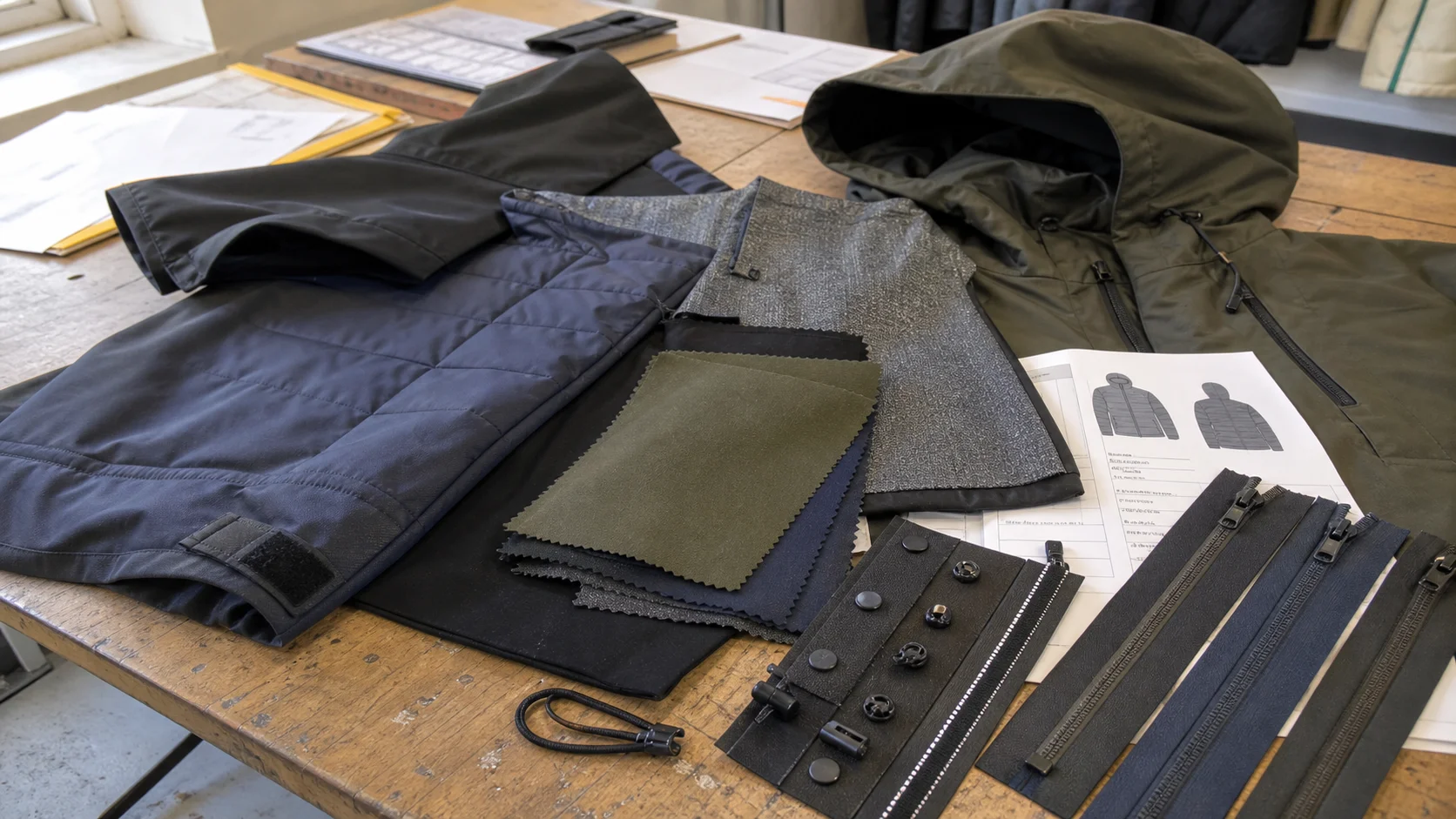
A product-specific outline for gym program buyers evaluating thermal parka factory fabric tests, insulation performance, shell durability, and production...
Thermal Parka Fabric Testing Guide for Gym Buyers - Outerwear & Jackets manufacturing guide
Thermal parkas are no longer a simple “winter jacket” purchase for gym programs. For fitness chains, university recreation departments, sports clubs, outdoor bootcamp operators, and branded gym merchandise buyers, the parka has to work across staff uniforms, member retail, team travel, and cold-weather event use. That means fabric testing cannot be treated as a factory formality.
A thermal parka factory fabric testing guide for gym program buyers should focus on practical risk: warmth that matches the use case, water resistance that survives real weather, fabric strength that handles repeated wear, and trims that do not fail after a few months. The cheapest jacket that passes a visual check can still create expensive problems if the shell wets out, the insulation migrates, the zipper jams, or the lining tears at the armhole.
This guide explains what gym buyers should test before bulk production, which lab and in-line checks matter most, where typical MOQ and lead-time issues appear, and how to judge tradeoffs between price, performance, and delivery speed when sourcing thermal parkas from a factory.
Gym buyers often source thermal parkas for a mix of operational and brand reasons. Staff may need cold-weather uniforms for front-door coverage, parking teams, outdoor training sessions, or event support. Members may buy the same parka as premium merchandise. Coaches and trainers may wear it during travel or sideline use. Each scenario places different pressure on the fabric.
A parka used by a front-desk employee walking between buildings has different requirements from a bootcamp coach standing in sleet for two hours. A jacket sold as lifestyle merchandise may need stronger color consistency and a cleaner hand feel, while a uniform parka may need tougher abrasion resistance and easier care. Testing helps separate these priorities before the purchase order is locked.
Fabric problems are especially costly in outerwear because they are not always visible at pre-shipment inspection. A shell can look smooth on a hanger but fail hydrostatic pressure testing. Insulation can feel lofty in a salesman sample but collapse after washing. A lining can appear acceptable until the wearer layers over a hoodie and stress concentrates at the sleeve seam.
For gym buyers, fabric testing is less about technical perfection and more about preventing mismatches between the jacket promise, the wearing environment, and the factory’s actual production capability.
A practical sourcing process should require test standards, physical samples, and production inspections to work together. Lab results alone do not guarantee good bulk quality. Factory inspection alone does not prove the fabric has the correct performance. Buyers need both.
Before asking a factory for test reports, define the intended parka use. This step sounds basic, but it prevents overbuying and underbuying. Many buyers request “waterproof, warm, premium, breathable, durable, low-cost” in the same brief. That combination usually forces compromises, especially at moderate order quantities.
The best purchasing judgment is to rank requirements. A gym program buying parkas for staff working outdoors in winter should prioritize shell durability, insulation stability, water resistance, and zipper reliability. A retail capsule drop may prioritize silhouette, color, logo execution, and comfort. Trying to make one parka serve every purpose often results in a jacket that is expensive but still not ideal.
If the buyer is still shaping the sourcing brief, reviewing a manufacturer’s production support process can help. Fabrikn outlines apparel development and production services at fabrikn.com/services/, which is a useful reference point when building a technical pack and sample approval flow.
A thermal parka is a system, not a single fabric. The shell, coating or membrane, insulation, lining, pocketing, rib, interlining, and trims all affect performance. Testing only the outer shell leaves important failure points unchecked.
Component Typical Options Main Testing Concern Buyer Judgment Outer shell Polyester taslan, nylon twill, poly pongee, oxford, ripstop Abrasion, tear strength, water repellency, colorfastness Choose tougher shells for staff uniforms and outdoor programs. Coating or membrane PU coating, TPU film, breathable membrane Hydrostatic pressure, breathability, peeling, wash durability Higher specs cost more and may extend fabric lead time. Insulation Polyfill, recycled polyester fill, synthetic down-like fill, down blend Clo value, fill weight, compression recovery, migration Synthetic fill is usually simpler for gym uniform programs. Lining Polyester taffeta, brushed tricot, fleece, quilted lining Seam strength, pilling, snagging, color transfer Slick linings layer better over hoodies; fleece feels warmer but adds bulk. Trims Zippers, snaps, drawcords, stoppers, hook-and-loop, labels Pull strength, corrosion, sharp edges, function after wash Cheap trims are a common source of customer complaints.For gym buyers, the most common shell choices are polyester and nylon. Polyester is generally cost-effective, color-stable, and suitable for branded programs. Nylon can offer a premium feel and good abrasion performance, but it may be more expensive and can show dye variation depending on the fabric and finishing route. Both can work well if the coating, DWR finish, and construction are specified clearly.
The shell fabric carries most of the visible and functional burden. It affects how the jacket looks, how it handles rain or snow, how it resists abrasion, and how it feels in hand. For gym programs with repeated wear, shell testing should not be skipped.
Ask the factory to state fabric composition, yarn type if available, weave or knit construction, and finished weight in GSM. Common thermal parka shell fabrics may range from around 90 GSM for lightweight pongee to 180 GSM or higher for heavier oxford or twill shells. Weight alone is not a performance guarantee, but it helps confirm that the fabric in bulk matches the approved sample.
A buyer should request a fabric swatch card and bulk fabric cutting for comparison. Shade, coating feel, surface texture, and weight should be checked side by side. If the parka is positioned as premium, inconsistent fabric hand feel between colors can create retail complaints even when the garments technically pass inspection.
Tear strength matters when parkas are worn during active work, travel, loading equipment, or outdoor sessions. A fabric with weak tear resistance may fail at pocket corners, sleeve seams, or areas caught on equipment. Ask for tear strength testing using a recognized method such as ASTM D1424 or ISO 13937, depending on the market and lab availability.
There is no single universal pass level for every gym parka, because fabric type and jacket positioning vary. A practical approach is to compare test results against the buyer’s expected use and the factory’s previous production standard for similar outerwear. If the factory cannot explain the normal performance range for the proposed shell, that is a sourcing risk.
Tensile strength measures how the fabric performs under pulling force. Seam slippage checks whether yarns shift at seams. Parkas with large size ranges, heavy insulation, or oversized fits can place extra strain on shoulder, armhole, and side seams. This is especially relevant for gym buyers because users often layer thick hoodies or training gear under the jacket.
Ask the factory to test seam performance on actual construction, not only on raw fabric. A strong shell fabric can still fail if the stitch density, seam allowance, needle size, or seam type is poorly matched.
Abrasion testing is important for uniforms and staff parkas. Wearers may rub against counters, gym bags, metal railings, benches, storage racks, and vehicle seats. Common methods include Martindale or Taber abrasion testing. Higher abrasion resistance usually requires a tougher shell or a more robust weave, which can increase cost and reduce softness.
The tradeoff is clear: a softer lifestyle shell may feel better for retail, while a tougher oxford or twill shell may last longer in daily uniform use. Gym buyers should not pay for premium softness if the jacket will be used mostly as operational workwear.
Outer shell pilling is less common than lining pilling, but brushed, textured, or knit-mix fabrics can show surface wear. Snagging risk increases on certain woven constructions and decorative panels. Ask the factory whether the proposed shell has been used for outerwear before and whether the fabric supplier can provide pilling or snagging results.
Insulation is the reason buyers choose a thermal parka rather than a shell jacket. It is also one of the easiest areas to misunderstand. Fill weight, warmth, loft, and comfort are related, but they are not the same.
For many gym programs, synthetic insulation is the practical choice. It handles moisture better than down in casual wet conditions, simplifies care labeling, and supports more predictable bulk production. Down may be attractive for premium retail, but buyers need tighter controls on fill power, cleanliness, origin documentation, leakage, and care instructions.
Factories usually quote insulation by GSM or by garment fill allocation. Typical synthetic insulation weights for thermal parkas may range from about 100 GSM to 250 GSM, depending on climate target and jacket design. Body panels may use heavier fill than sleeves or hood panels to improve mobility.
Ask the factory to specify fill weight by zone: body, sleeves, hood, collar, and pocket flaps if padded. A sample that feels warm because it is overfilled may become costly or bulky in production. A production jacket that is underfilled may look flat and fail the buyer’s warmth expectation.
Warmth can be measured with thermal resistance testing, often expressed through clo value or related methods. Not every program needs formal warmth lab testing, especially for lower-volume merchandise buys. Still, buyers should request at least a clear insulation specification and compare the approved sample against a known benchmark jacket.
For large uniform programs or cold-weather operations, formal thermal testing is worth considering. It adds cost and time, but it gives the buyer a more objective basis for claims such as “thermal,” “winter-ready,” or “cold-weather staff parka.” Avoid marketing claims that the test data cannot support.
Compression recovery checks whether insulation regains loft after packing, shipping, or storage. This matters for gym buyers receiving cartons that may sit in storage before distribution. Synthetic fill that stays compressed can make jackets look cheaper and feel less warm.
Ask the factory how garments will be packed. Vacuum packing can reduce freight volume but may damage loft if used aggressively or for long storage periods. For premium parkas, standard carton packing with controlled compression is often safer.
Insulation migration occurs when fill moves away from intended zones or leaks through seams and fabric. Quilting pattern, stitch quality, lining density, and fill type all affect this risk. A smooth non-quilted parka may look cleaner, but it needs internal baffles, tacking, or engineered panels to keep insulation from shifting.
Buyers should check sample jackets after wear simulation, light shaking, and washing where care instructions allow. Uneven fill distribution around the chest, shoulder, and hem is a warning sign.
Lining is often treated as secondary, but it strongly affects comfort and durability. Gym users frequently wear parkas over sweatshirts, fleece, compression tops, or uniforms. The lining must allow easy on-off movement and withstand friction.
Ask for pilling tests on fleece or brushed lining. Pocket bags should be tested for seam strength and abrasion, especially if users carry phones, keys, access cards, or small tools. Pocketing failure is a common complaint because it appears quickly and affects daily use.
Color transfer is another risk. Dark linings can transfer to light garments under moisture and friction. Light linings can show dirt quickly in staff uniforms. For gym parkas, medium-dark linings are often practical, but test colorfastness to rubbing and perspiration if the lining contacts clothing.
Water protection is one of the most misused terms in parka sourcing. “Water-repellent,” “water-resistant,” and “waterproof” are not interchangeable. Gym buyers should define the needed level before approving the fabric.
Durable water repellent, or DWR, helps water bead on the fabric surface. It does not make a garment waterproof by itself. DWR performance can decline after washing, abrasion, or long use. Ask for spray rating results before and after washing if the program requires repeated care.
For basic staff parkas used in light rain or snow, a reliable DWR finish may be enough. For outdoor trainers standing in wet weather, a coated or membrane-backed fabric with seam sealing may be necessary.
Hydrostatic pressure testing measures resistance to water penetration. Entry-level coated fabrics may test around 1,000 mm to 3,000 mm, while more protective fabrics can reach 5,000 mm, 10,000 mm, or higher. Higher numbers are not always better for every gym program because cost, stiffness, and breathability can change.
A 3,000 mm fabric may be acceptable for light rain and casual winter use. A 10,000 mm fabric is more appropriate when the jacket is marketed as waterproof or used in extended wet conditions. If the jacket seams are not sealed, the garment should not be sold as fully waterproof even if the fabric has a high hydrostatic rating.
Breathability matters when trainers move between indoor and outdoor environments or when staff wear parkas during active tasks. Breathability is usually measured in grams per square meter per 24 hours or through RET values, depending on the test method.
Highly waterproof fabrics may feel clammy if breathability is low. A breathable membrane adds cost and can complicate lead times. For gym buyers, the decision depends on activity level. Standing outdoors needs warmth and water protection. Active coaching needs moisture management and ventilation.
Seam sealing prevents water from entering through stitch holes. It adds labor cost and production complexity. It also requires compatible seam tape, correct machine settings, and inspection. Poor seam sealing can peel, bubble, or miss critical areas.
Not every thermal parka needs sealed seams. If the buyer only needs water resistance, seam sealing may be unnecessary. If the jacket is promoted as waterproof, sealed seams are usually expected at least on critical seams. Buyers should clarify whether all seams or only shoulder, hood, and upper body seams will be sealed.
Gym parkas often carry a strong brand identity. Black, navy, charcoal, forest green, and team-specific colors are common. Color testing matters because outerwear fabrics can vary between lab dips, bulk fabric, and finished garments.
Dark shell fabrics should be checked for wet rubbing because they may transfer color to light hoodies, car seats, or bags. Bright team colors should be checked for lightfastness and shade consistency. If the buyer needs exact brand color matching, provide Pantone references and approve lab dips under controlled lighting.
Thermal parkas may use embroidery, woven patches, rubber patches, heat transfers, reflective prints, or screen prints. Each method interacts differently with coated fabric and insulation.
Embroidery looks premium but can create needle holes, affect water resistance, and compress insulation. Heat transfer can fail on textured or coated shells if temperature, pressure, and adhesive are not compatible. Rubber patches can look strong but add cost and may require higher MOQs. Reflective trims add utility for outdoor staff but need testing for wash durability and cracking.
Ask the factory to test logo application on the actual bulk shell fabric, not a substitute. This is especially important for PU-coated or membrane-backed fabric. Heat and pressure can damage coatings or leave visible marks.
For buyers preparing artwork and brand placement requirements, early communication with the production team reduces sampling delays. Fabrikn provides contact access at fabrikn.com/contact-us/ for buyers who need to discuss development details before moving into sampling.
Trims can make or break a parka. A shell fabric may pass every test, but the jacket still fails commercially if the zipper jams, puller breaks, snap cap cracks, or drawcord stopper slips.
For thermal parkas, front zippers should be stronger than those used on light jackets. Common choices include molded plastic zippers, coil zippers, and sometimes metal zippers for fashion styling. Molded plastic zippers are often a practical option for gym parkas because they are sturdy and easier to handle with gloves.
Ask for zipper pull strength, slider function, colorfastness, and corrosion testing if metal parts are used. Two-way zippers add convenience for sitting and movement, but they also increase cost and user error risk. For staff uniforms, a reliable one-way zipper may be better than a cheaper two-way zipper that frustrates wearers.
Snaps should be tested for attachment strength and repeated opening. Weak snap attachment can tear fabric or detach during use. Metal hardware should be checked for corrosion, especially if the jacket may be exposed to snow, rain, sweat, or road salt.
Drawcords at the hood or hem improve fit and warmth retention. They also create safety and compliance considerations, especially if the program includes youth sizes. Buyers should review market regulations for children’s apparel if any youth gym teams, school programs, or junior sizes are included.
Care labels must match the actual materials and trims. A jacket with synthetic insulation, heat-transfer branding, coated fabric, and faux fur trim may require more cautious washing instructions than a basic shell. Incorrect care labels can cause disputes when customers wash garments as instructed and damage occurs.
A disciplined sample process is the buyer’s best defense against unclear expectations. For thermal parkas, do not rely on a single salesman sample. Outerwear usually needs several sample rounds because fit, construction, insulation, and branding all interact.
The pre-production sample should be treated as the contract sample. It should use confirmed bulk materials or clearly documented substitutes. If the factory changes fabric mill, coating, lining, zipper, insulation, or logo method after approval, the buyer should require written confirmation and possibly a revised sample.
Sample lead times vary. A basic proto sample may take 7 to 15 days after tech pack and materials are available. A more complex parka with custom fabric, custom trims, lab dips, and branded patches may take 20 to 40 days or longer. Delays often come from fabric sourcing, trim development, color approval, and buyer feedback cycles rather than sewing alone.
MOQ depends on fabric availability, color requirements, trim customization, and factory setup. Gym buyers should separate garment MOQ from fabric MOQ. A factory may be willing to sew 300 jackets, but the fabric mill may require 500 to 1,000 meters per color. Custom dyeing or custom coating can raise the practical MOQ.
These ranges are typical, not universal. Factories may accept lower quantities at higher unit prices, especially when using stock materials. For gym buyers, the tradeoff is straightforward: lower MOQ usually means less customization, fewer color options, and higher unit cost. Higher MOQ can improve pricing and material control, but it increases inventory risk.
Thermal parka lead times are affected by seasonality. Outerwear factories and fabric mills become busier ahead of fall and winter. If a gym program needs jackets delivered before cold weather, development should start well ahead of the selling or wearing season.
Typical bulk production lead times may range from 45 to 90 days after pre-production sample approval and deposit, depending on order size, material availability, testing requirements, and factory capacity. Custom fabric or specialty trims can extend timelines. Lab testing can also add days, especially if retesting is needed after a failed result.
Rush production can work for simple stock-fabric parkas, but it increases inspection risk. Buyers should be cautious when a factory promises a complex custom thermal parka on an unusually short timeline. Fast delivery may mean substituted fabric, skipped testing, compressed quality checks, or production outsourcing that the buyer did not review.
Inspection should not wait until finished goods are packed. Thermal parkas have too many hidden operations. Once the lining is closed, it becomes difficult to check insulation placement, internal seams, and certain construction details.
Incoming inspection should verify shell fabric shade, weight, coating quality, width, defects, and hand feel. Fabric rolls should be checked for shade bands, stains, coating streaks, pinholes, and creases. Insulation should be checked for weight, loft, cleanliness, and consistency.
Trim inspection should confirm zipper length, slider function, puller branding, snap color, cord thickness, stopper performance, label accuracy, and packaging materials. A mismatch in zipper tape shade can be very visible on a dark parka.
In-line inspection should focus on construction steps that affect performance. These include quilting alignment, insulation placement, pocket reinforcement, hood attachment, zipper setting, storm flap construction, seam allowance, and sleeve lining attachment.
Check measurements early. Insulation can change garment dimensions compared with a flat pattern. Sleeve mobility, armhole comfort, and chest width should be reviewed on a body or form, not only on a table.
Final inspection should cover visual appearance, measurements, workmanship, function, labeling, packing, and carton marking. Buyers should define acceptable quality limits before inspection. Common outerwear defects include skipped stitches, uneven quilting, loose threads, puckered seams, fabric shading, dirty marks, broken snaps, zipper malfunction, insulation lumps, and poor logo placement.
For gym programs, size ratio accuracy is important. Staff uniforms often need a wider size range, including larger sizes. Retail drops may require tighter control of core sizes. Packing errors can create distribution problems even when garment quality is acceptable.
Wear testing is not a replacement for lab testing, but it is useful. A small group can test approved samples in realistic conditions before bulk production. Ask testers to wear the parka over typical gym layers, sit, drive, lift arms, zip and unzip repeatedly, use pockets, and walk in light rain or cold wind if conditions allow.
Feedback should be structured. “Feels good” is not enough. Ask about sleeve mobility, zipper ease, hood fit, pocket access, warmth, lining comfort, noise, weight, and overheating. This information helps the buyer decide whether to adjust specs before production.
The following checklist can be used when requesting quotes and samples from a thermal parka factory. It keeps the conversation specific and reduces the chance of receiving a jacket that looks acceptable but performs poorly.
Buyers who are evaluating supplier capability should also look at the manufacturer’s broader background, development process, and communication standards. A general company overview such as fabrikn.com/about-us/ can help buyers understand whether a supplier is positioned for structured apparel production rather than one-off sample handling.
A good thermal parka program starts with a clear performance target. Do not ask every factory for the warmest, most waterproof, lowest-cost option. Ask for a jacket that fits the actual wearing conditions, branding goals, and budget.
For staff uniforms, prioritize durable shell fabric, reliable insulation, practical pocketing, strong zippers, and easy care. For retail merchandise, prioritize fit, hand feel, color consistency, branding execution, and perceived value. For outdoor training programs, prioritize weather protection, warmth retention, mobility, and inspection discipline.
Testing should be scaled to order risk. A small stock-fabric merchandise order may not justify a full lab program, but it still needs fabric specs, sample approval, and trim checks. A large multi-location gym uniform order should require more formal testing because failures affect many users and are expensive to correct.
The best factory partner is not the one that says yes to every requested spec. It is the one that explains fabric limitations, MOQ realities, lead-time dependencies, and construction risks before bulk production begins. That kind of practical communication is often the difference between a parka program that looks good in a sample room and one that performs through a full winter season.
Get a free quote from Fabrikn — your trusted B2B clothing manufacturer with 10+ years of experience. MOQ as low as 200 pieces.
Get a Free Quote →Polyester or nylon woven shell fabrics are common choices. For staff uniforms, a durable polyester oxford, taslan, or twill with water-repellent finishing is often practical because it balances cost, color stability, and wear resistance. Nylon can feel more premium but may cost more.
Typical MOQs may range from 100 to 300 pieces for stock fabrics and standard trims. Custom colors, coated fabrics, membranes, branded hardware, or special patches may push practical MOQs to 300 to 1,000 pieces or more, depending on fabric mill and trim supplier requirements.
Bulk production often takes about 45 to 90 days after pre-production sample approval and deposit. Custom fabric, lab testing, trim development, busy outerwear season, or failed tests can extend the timeline. Sampling can add several weeks before bulk production starts.
Not always. Many gym programs only need water resistance for light rain, snow, or short outdoor exposure. A waterproof claim usually requires higher hydrostatic pressure fabric and seam sealing. If seams are not sealed, buyers should be cautious about calling the garment waterproof.
Synthetic polyester insulation is usually the most practical option for gym uniforms and merchandise. It is cost-effective, predictable in production, and easier to care for than down. Recycled polyester fill can support sustainability goals but may increase cost and documentation requirements.
The most important tests usually include fabric weight, composition, tear strength, abrasion resistance, colorfastness, water repellency, hydrostatic pressure if weather protection is claimed, and trim function testing. Insulation weight and migration should also be checked.
Buyers can review early samples for design and fit, but final approval should wait until the pre-production sample reflects actual bulk fabric, trims, insulation, logo application, and care labeling. Testing should be connected to the approved material package.
Common problems include uneven insulation, zipper malfunction, loose threads, poor seam quality, fabric shading, logo misplacement, weak snaps, lining tears, pocket defects, incorrect labels, and size measurement issues. Many of these risks are easier to catch during in-line inspection than at final inspection.
Use stock fabric colors, standard reliable trims, simple logo methods, and a proven parka construction. Avoid unnecessary waterproof claims, excessive color blocking, and custom hardware unless the program needs them. Spend on shell durability and zipper quality before decorative upgrades.
Yes, but the priorities must be balanced carefully. Staff uniforms need durability, easy care, and size consistency. Member retail needs fit, color, comfort, and branding appeal. If the budget allows only one style, choose a practical shell, clean branding, and reliable trims rather than an overly technical design.