
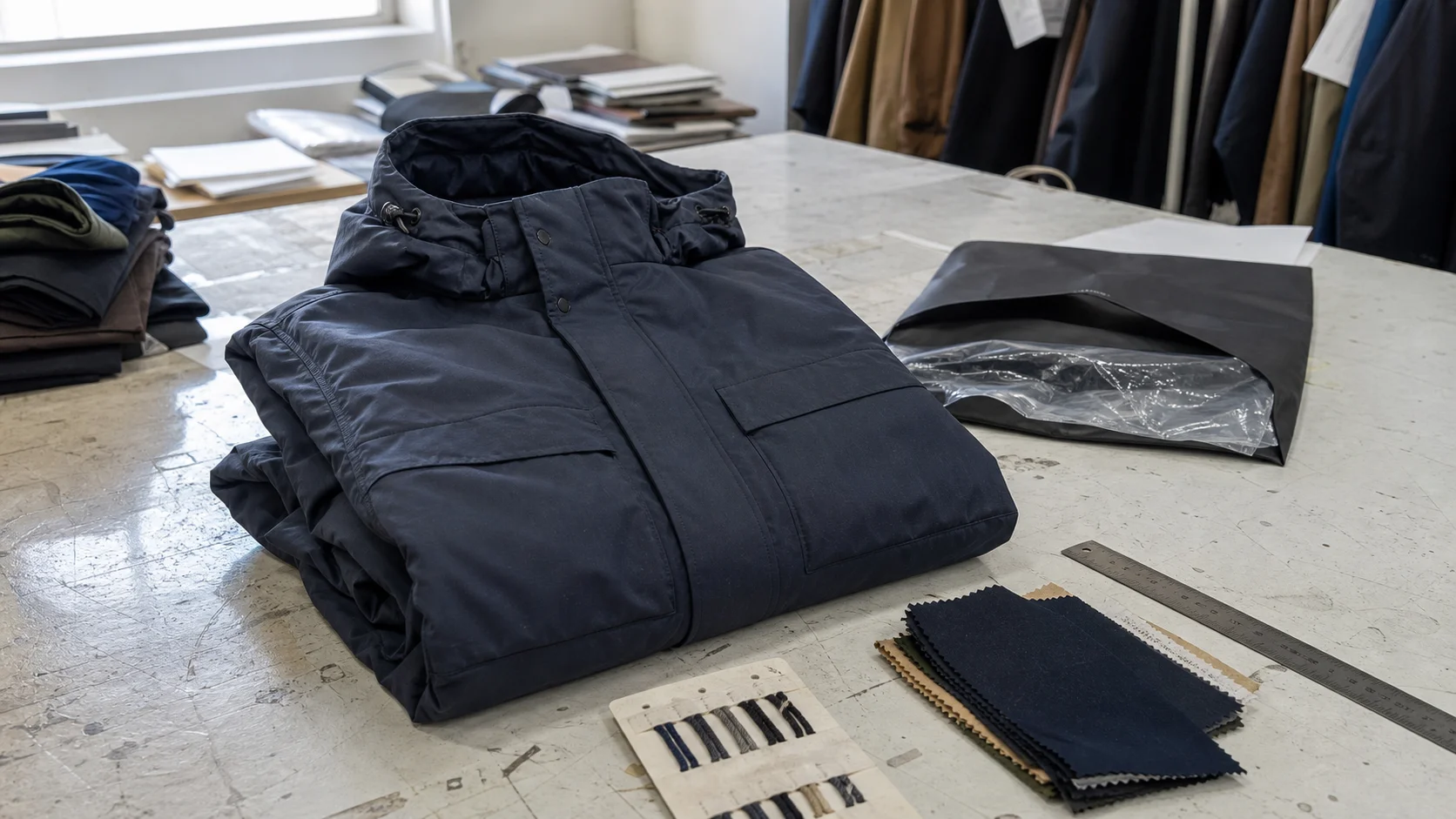
A retail operations-focused quality control outline for thermal parka orders, covering inspection planning, insulation checks, seam performance, trim...
Thermal Parka QC Checklist for Retail Orders - Quality & Inspection manufacturing guide
Thermal parkas are not simple outerwear units. They combine shell fabric, insulation, lining, weather protection details, zippers, snaps, quilting, hood construction, drawcords, labels, and retail packaging into one high-risk product. For retail operations teams, a weak quality control process can quickly turn into shipment delays, high return rates, chargebacks, and customer complaints during the exact season when sell-through matters most.
A thermal parka order quality control checklist should do more than catch loose threads at final inspection. It should confirm whether the product meets the buyer’s approved sample, technical pack, purchase order, size spec, safety requirements, labeling rules, and retail presentation standards. The checklist also needs to reflect the commercial reality of parkas: higher unit cost, bulkier packing, longer production time, and more severe customer expectations around warmth and durability.
Retail operations teams should treat parka QC as a staged process. The best results usually come from checking materials before cutting, approving a sealed pre-production sample, monitoring sewing and filling during production, and conducting a structured final random inspection before shipment release. A final inspection alone is rarely enough for padded outerwear because hidden defects, insulation migration, uneven filling, and seam leakage risks can be expensive to correct after assembly.
Purchasing judgment: if a supplier cannot provide a clear pre-production sample, material test records, packing method, and inspection schedule before bulk starts, the order risk is already high. Thermal parkas require control before production, not only after production.
For teams building seasonal outerwear programs, working with a manufacturer or sourcing partner that understands inspection planning can reduce avoidable disruption. Fabrikn’s apparel production support can be reviewed through its services page, especially when retail orders require material coordination, production tracking, or quality checkpoints across multiple styles.
The pre-production stage sets the standard for the entire order. Retail operations teams should not release bulk cutting until the supplier has confirmed all key inputs: approved fabric, insulation, lining, trims, color standards, grading, care labels, packaging, and shipment instructions. This stage is also where many later disputes can be prevented.
Every production order should have a sealed pre-production sample. This sample should be made with actual bulk materials, not substitute shell fabric, generic lining, or temporary trims. If the buyer approves a sample made from non-bulk components, the approval has limited value. Thermal parkas are especially sensitive to small changes in insulation, lining weight, zipper quality, hood structure, and quilting pattern.
The technical pack should be specific enough for inspection. Vague descriptions such as “warm padding,” “good zipper,” or “standard label” are not sufficient for retail orders. The bill of materials should identify the shell fabric composition, fabric weight, coating or laminate details, insulation type and weight, lining composition, zipper brand or specification, snap finish, drawcord type, label content, and packaging materials.
Typical outerwear purchase orders may include multiple colorways and sizes. Check that the bill of materials applies correctly to each colorway. A black parka may use black lining and gunmetal snaps, while an olive parka may require antique brass snaps and a contrast lining. Mixed trim standards are a common source of retail non-compliance.
Typical minimum order quantities for thermal parkas vary by factory setup, fabric availability, and trim customization. For basic solid-color parkas using available materials, MOQs may start around 300 to 500 pieces per color. For custom shell fabric, special insulation, branded hardware, printed lining, or private-label packaging, MOQs can move into the 800 to 1,500 pieces per color range. Smaller quantities may be possible, but unit prices rise and trim options narrow.
Sampling should be planned realistically. A first development sample may take 10 to 20 days depending on material availability. A revised fit sample may take another 7 to 15 days. A pre-production sample made in actual bulk materials can take longer if fabric, insulation, or trims are still in transit. Retail teams should avoid compressing sample approval into the last few days before production, because unresolved fit and material issues become expensive after cutting.
Pre-Production Item What to Check Risk if Missed Sealed sample Bulk materials, correct trims, approved measurements Production follows an outdated or incomplete standard Tech pack Construction details, tolerances, artwork, labels Inspection becomes subjective and disputes increase Bill of materials Fabric, insulation, lining, hardware, packaging Wrong trims or substitute materials enter production Size set Graded measurements across core sizes Retail fit complaints and inconsistent sizingThermal parka quality begins with material control. The shell fabric affects appearance, weather resistance, seam performance, abrasion durability, and customer perception. The insulation affects warmth, bulk, hand feel, and wash performance. The lining affects comfort, sleeve entry, static, tearing, and overall finish. Retail operations teams should require incoming material checks before cutting starts.
Common parka shell fabrics include polyester taslan, nylon twill, polyester pongee, cotton-poly blends, and laminated or coated woven fabrics. Each fabric type has tradeoffs. Polyester is often cost-effective and stable. Nylon can offer stronger abrasion resistance but may cost more. Cotton blends can deliver a lifestyle look but may absorb moisture and require tighter color and shrinkage control.
Water-repellent finishes need careful wording. A durable water repellent finish is not the same as a waterproof garment. If the product claim says waterproof, the construction usually requires a waterproof fabric, seam sealing, and performance testing. If the product is only water resistant, retail marketing and hangtags should avoid overstating the claim.
Insulation is one of the most important parts of a thermal parka QC checklist. Synthetic insulation is common for retail parkas because it is easier to source, more washable, and less sensitive to animal welfare documentation than down. Down and down-feather blends can support premium positioning, but they require strict fill power, fill weight, cleanliness, species, and labeling control.
Purchasing tradeoff: heavier insulation can improve perceived warmth, but it increases cost, packing volume, shipping expense, and sometimes restricts movement. A lighter insulation may improve comfort and margin, but customers may reject the garment if the product is sold as a severe-cold parka. Align insulation with climate, retail price point, and marketing claims before approving bulk.
Lining defects can create high customer dissatisfaction even when the outer shell looks acceptable. Sleeve lining should allow easy arm entry without twisting. Body lining should not sag below the hem. Pocketing should resist tearing, especially for lower pockets where customers carry keys, phones, and gloves.
Thermal performance is difficult to judge by appearance alone. A parka can look bulky but perform poorly if the insulation is uneven, compressed, or poorly distributed. Retail operations teams should separate appearance checks from functional checks. If warmth claims are part of the product description, the order should have a test plan before production.
Many retail parkas use general wording such as “warm,” “thermal,” or “insulated.” These terms still need product integrity, but they are less specific than a temperature rating. If the parka claims comfort to a stated temperature, the buyer should define the test method, conditions, and acceptable result. Temperature ratings can be subjective because warmth depends on base layers, wind, humidity, activity level, and wearer tolerance.
A cautious retail approach is to avoid precise temperature claims unless they are backed by suitable testing and legal review. For private-label orders, the product team should align hangtags, web copy, carton marks, and care labels with actual garment construction.
Cold spots often appear at seams, baffles, shoulders, lower sleeves, hood edges, pocket areas, and side panels. During inspection, check the garment by touch and visual review under good lighting. Uneven loft, flat panels, and visible clumps are warning signs. For down-filled parkas, inspect channel fill consistency and leakage. For synthetic fill, check whether sheet insulation is caught properly in seams and not folded inside panels.
Fit issues in parkas are more complicated than in light apparel because insulation changes the way the garment sits on the body. A size medium parka may measure correctly on paper but feel tight over a sweater if the armhole, bicep, across-chest, or shoulder slope is not balanced. Retail operations teams should check fit on a form or model where possible, not only flat measurements.
Measurements should be taken from bulk production units across sizes and colorways. The tolerance table should reflect garment type. Parkas usually need practical tolerances because padded garments are harder to measure consistently than flat shirts. Even so, critical fit points must be controlled.
Common retail tolerance ranges for padded outerwear may run from plus or minus 0.5 inch for smaller details to plus or minus 1 inch for larger body measurements. Critical points such as sleeve length, chest, and body length should be controlled tightly because customers notice these quickly. Tolerances should be agreed before production and listed in the tech pack.
Construction quality affects both appearance and function. A thermal parka should withstand repeated wear, sitting, bending, commuting, and bag straps rubbing against shoulders. Weak seams, skipped stitches, and unsecured trims can trigger returns even if the garment looks acceptable in a folded inspection.
Purchasing judgment: do not accept a production lot where the outer shell is neat but inside construction is messy. Customers may not inspect every internal seam in store, but loose lining, thread nests, and poor pocket finishing usually become return issues after wear.
Trim quality is a major source of thermal parka failures. Zippers, snaps, toggles, cord locks, hook-and-loop closures, and elastic cuffs must work smoothly throughout the order. Retail teams should not rely only on visual checks because functional trims may look correct but fail during use.
The main front zipper is a high-risk component. It must align correctly with the placket, glide smoothly, hold under tension, and not catch lining or insulation. Two-way zippers need extra review because customers often complain when sliders are difficult to align. A zipper failure can make a parka unwearable, so inspection standards should be strict.
Drawcords require careful safety review, especially for children’s outerwear. Regulations and retailer standards may restrict drawcord placement, length, knots, toggles, or free ends. Adult parkas also need secure drawcord construction because loose cord exits and broken cord locks create quality complaints.
If the order includes children’s sizes, retail operations teams should confirm applicable safety requirements before sample approval. The supplier should not decide these details independently. Safety requirements must be written into the tech pack and checked at final inspection.
Labeling mistakes can delay shipments or cause retailer chargebacks. Parkas may require brand labels, size labels, care labels, fiber content labels, country of origin labels, warning labels, hangtags, barcode tickets, and price stickers. Each label must match the product, market, and purchase order.
Retail teams coordinating multiple styles can use a structured communication channel before production starts. For inquiries about apparel order support, Fabrikn provides a direct route through its contact page.
Inline inspection is valuable for thermal parkas because many defects become difficult to repair after the garment is fully assembled. A good inline process checks the first output from production, then reviews semi-finished units at critical steps. Retail operations teams should request inspection reports with photos, measurements, defect counts, and corrective actions.
The first bulk output should be compared against the sealed pre-production sample. This is not a full final inspection. It is a production alignment checkpoint. The goal is to catch mistakes while there is still time to correct operators, adjust machines, replace trims, or stop incorrect assembly.
A mid-production inspection is usually performed when a meaningful portion of the order is complete, often around 20% to 50% depending on the schedule and factory flow. This timing can vary because outerwear production may involve separate lines for quilting, lining, hood assembly, sleeve setting, and finishing. The inspection should check both finished and semi-finished goods.
Typical issues found during inline checks include uneven quilting, wavy plackets, mismatched sleeves, inconsistent stitch density, poor pocket bartacks, snap placement variation, and lining caught in seams. These are correctable if found early. At final inspection, correction may require opening seams or sorting a large portion of the shipment.
Thermal parka lead times depend on material sourcing, fabric finishing, insulation availability, trim customization, lab testing, production capacity, and packing volume. A basic parka using stock fabric and standard trims may require around 45 to 75 days for bulk production after sample approval. Custom fabric, coated material, branded hardware, down filling, special testing, or complex packaging can extend timelines to 90 to 120 days or more.
Retail operations teams should map lead time backward from the required delivery date. Include time for sample revisions, lab dips, bulk fabric testing, production, final inspection, rework, carton marking, export documentation, and transit. Seasonal outerwear is unforgiving: a two-week delay can reduce full-price selling time.
Final random inspection should take place when production is complete and most goods are packed. Inspecting too early can miss packing issues and late-production defects. Inspecting too late can create shipment pressure, where teams feel forced to accept defects because the vessel or delivery window is closing.
Many retail inspections use ANSI/ASQ Z1.4 or similar AQL-based sampling plans. The acceptable quality limit should be agreed before inspection. Common settings may include critical defects not allowed, major defects at AQL 2.5, and minor defects at AQL 4.0. Retailers may apply stricter standards for premium outerwear or private-label programs.
Critical defects include safety problems, illegal labeling, sharp objects, mold, severe contamination, broken needles, or any issue that makes the garment unsafe or unsellable. Major defects affect function, appearance, fit, or retail acceptance. Minor defects are small workmanship issues that do not seriously affect use but still matter when they appear frequently.
Defect Class Examples Retail Action Critical Sharp metal, mold, illegal label, unsafe drawcord Reject or hold shipment until fully corrected Major Broken zipper, open seam, wrong measurement, missing insulation Fail lot if above AQL; require rework and reinspection Minor Light thread end, small washable mark, slight stitch variation Accept only if within agreed toleranceA failed final inspection should trigger structured rework, not casual sorting. The supplier should identify root causes, correct affected units, provide evidence, and make goods available for reinspection. Retail teams should not release goods based only on a promise that defects have been fixed.
Thermal parkas are bulky, which makes packaging more than a finishing detail. Poor packing can crush insulation, distort hoods, damage trims, create deep wrinkles, and increase freight costs. Retail operations teams should define folding method, compression rules, polybag size, carton dimensions, carton weight, carton assortment, and labeling requirements before production completion.
The garment should arrive ready for retail handling. Parkas may be packed flat, folded, or on hangers depending on buyer requirements. Compression bags can reduce shipping volume, but they may flatten insulation and create presentation problems. If compression is used, test recovery before approving the method.
Carton errors can cause distribution center delays. Carton marks should match the purchase order, destination, style number, color, size, quantity, carton number, gross weight, net weight, and country of origin where required. Retailers may require specific routing labels, ASN data, UCC-128 labels, or carton content accuracy.
Purchasing tradeoff: reducing carton count can lower freight and warehouse handling costs, but over-compression can damage garment loft and retail appearance. For thermal parkas, preservation of insulation and presentation often matters more than squeezing the last unit into a carton.
A useful QC checklist should focus on likely failure points. Thermal parkas have predictable risks, and retail operations teams can reduce these risks with earlier checks, clearer specifications, and disciplined inspection records.
Retail teams should create a checklist that is practical enough to be used consistently. Long documents are not useful if inspectors cannot apply them on the production floor. The most effective checklists define the standard, the method, the tolerance, the defect classification, and the action required.
Retail operations teams should also maintain clear communication between merchandising, product development, sourcing, logistics, and quality teams. A parka order can pass factory inspection and still fail retail requirements if carton labels, barcode tickets, care labels, or delivery instructions are wrong. Quality control includes product conformance and order compliance.
The following template can be adapted for buyer manuals, inspection agencies, or internal retail operations teams. It is best used together with the approved tech pack, sealed sample, purchase order, and retailer routing guide.
Checkpoint Inspection Method Acceptance Standard Shell fabric Visual review, hand feel, shade check, test report review Matches approved material and color standard Insulation Touch check, weight review, panel consistency review Even loft, correct fill type, no clumping or thin spots Measurements Flat measurement using approved method Within agreed tolerance for each size Zipper function Open and close multiple times Smooth operation, secure stopper, no catching Seams and stitching Visual and light stress check No open seams, skipped stitches, severe puckering, or weak bartacks Labels and tickets Compare with order file and scan barcode Correct size, fiber content, origin, care, price, and barcode data Packing Open carton and review unit packing Correct folding, polybag, carton quantity, marks, and label placementSupplier selection has a direct effect on thermal parka quality. A factory that performs well on lightweight woven shirts may not automatically be suitable for padded outerwear. Parkas require insulation handling, bulky sewing control, strong trim application, pressing discipline, and careful packing. Retail buyers should assess whether the supplier has the right machinery, operators, quality team, and material network for outerwear.
Operations teams should ask suppliers practical questions before order placement. Can they handle the target insulation type? What is their normal MOQ for custom shell fabric? Can they provide trim pull testing if required? How do they control shade lots? Do they inspect filling before closing panels? What is the rework process after inspection failure? These questions are more useful than broad claims about experience.
Fabrikn describes its company background and sourcing focus on the about us page, which may be useful for teams reviewing apparel production support options.
Direct buying guidance: choose the supplier that can show control over materials, measurements, trims, and packing. The cheapest parka quote is often not the lowest-cost option if it creates rework, air freight, claims, or markdowns.
A thermal parka order quality control checklist should protect the retail delivery window, the product margin, and the customer experience. The checklist needs to start before bulk cutting and continue through inline inspection, final random inspection, and carton compliance review. Parkas are too complex to manage through final inspection alone.
The strongest QC process checks actual bulk materials, confirms the sealed pre-production sample, monitors insulation and sewing quality during production, tests functional trims, verifies labels and barcodes, and reviews packing against retailer requirements. Retail operations teams should build enough time into the calendar for corrections and reinspection. When seasonal outerwear ships late or arrives with quality problems, the commercial impact is usually larger than the inspection cost that could have prevented it.
Get a free quote from Fabrikn — your trusted B2B clothing manufacturer with 10+ years of experience. MOQ as low as 200 pieces.
Get a Free Quote →A thermal parka QC checklist should include shell fabric quality, insulation type and distribution, measurements, sewing construction, zipper and snap function, hood and pocket details, labels, hangtags, barcode tickets, packing, carton marks, and safety requirements. It should also reference the approved sample, tech pack, purchase order, and retailer routing guide.
Retail teams should inspect at multiple stages: incoming material review, pre-production sample approval, first bulk output, mid-production inspection, and final random inspection. For complex parkas, inline checks are especially important because insulation and construction defects can be hard to repair after final assembly.
Typical MOQs may range from 300 to 500 pieces per color for simpler parkas using available materials. Custom shell fabric, branded trims, special insulation, printed lining, or private-label packaging may require 800 to 1,500 pieces per color or more. Actual MOQ depends on supplier capacity, material mills, trim suppliers, and order complexity.
Bulk production may take around 45 to 75 days after sample approval for straightforward styles with available materials. Custom fabrics, coated shells, down filling, special testing, or branded hardware can extend lead times to 90 to 120 days or longer. Sampling, testing, inspection, rework, and transit should be added to the full calendar.
Common failures include uneven insulation, broken zippers, open seams, wrong measurements, shade variation, incorrect labels, unsafe drawcords, weak snaps, poor pocket construction, odor, mildew, and incorrect carton packing. Zipper function, insulation consistency, and labeling accuracy deserve special attention.
Warmth testing is recommended when the product makes specific thermal or temperature claims. General insulated outerwear may not always carry a formal temperature rating, but the construction should still match the approved product standard. Precise temperature claims should be supported by suitable testing and reviewed carefully before use in retail marketing.
Many retail inspections use critical defects not allowed, major defects at AQL 2.5, and minor defects at AQL 4.0, though standards vary by retailer and product tier. Premium outerwear, children’s products, or strict private-label programs may require tighter limits. The AQL standard should be agreed before production starts.
Final inspection can identify visible defects before shipment, but many parka problems begin earlier: wrong fabric, poor insulation handling, incorrect trim attachment, or construction mistakes hidden inside panels. Inline checks help catch these problems while correction is still practical and less costly.