
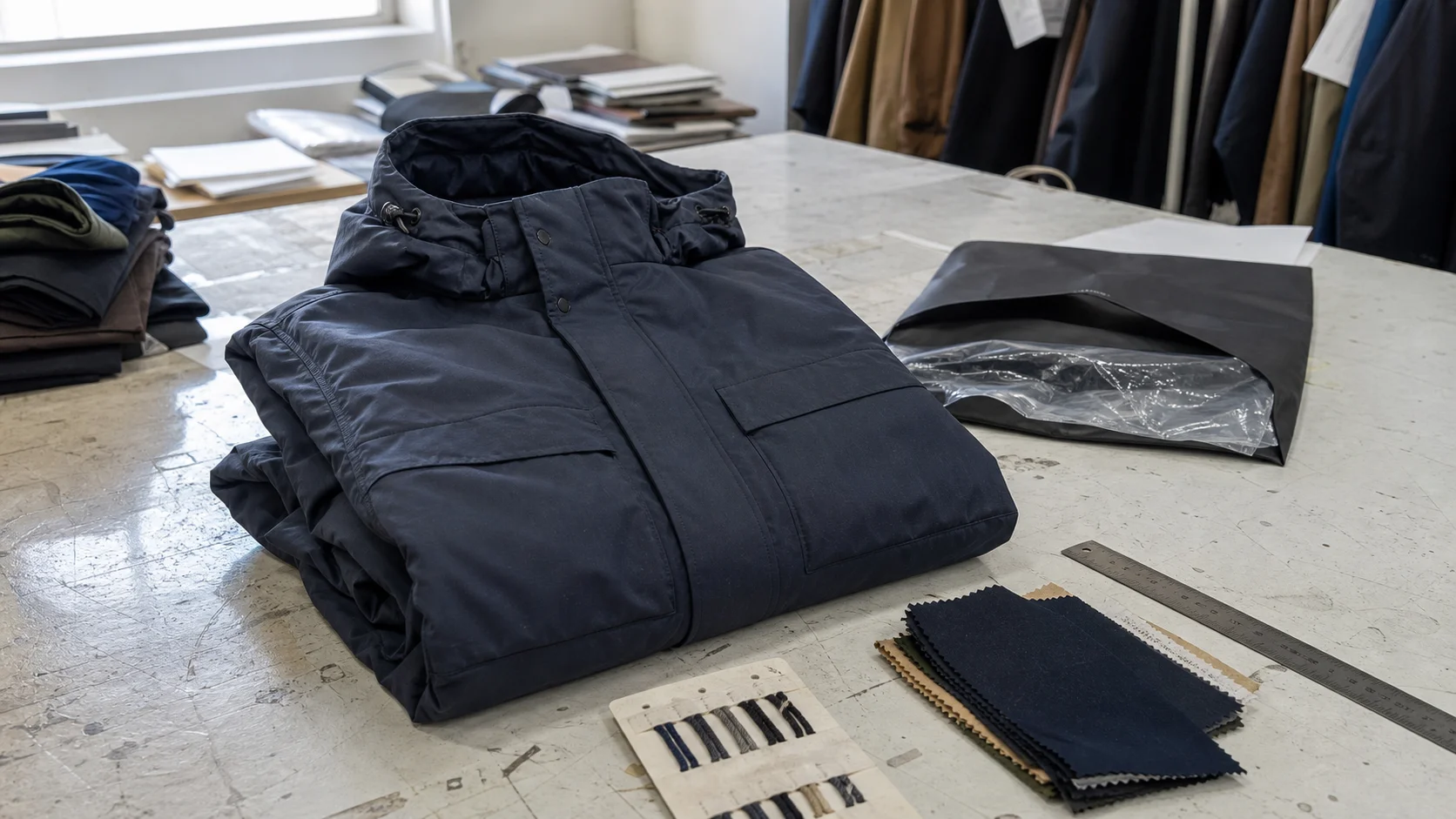
A product-specific quality control checklist for gym program buyers sourcing thermal parkas, covering materials, construction, performance tests, branding,...
Thermal Parka QC Checklist for Gym Buyers - Fabrikn production reference
A thermal parka is not a simple outerwear add-on for a gym merchandise program. It has more components, more production stages, and more quality risks than a T-shirt, hoodie, or jogger. For gym buyers, the product must look branded, feel warm, fit a wide member base, survive regular wear, and arrive in time for seasonal demand. A missed delivery window can turn a strong winter retail item into discounted inventory.
The main quality control challenge is that thermal parkas combine performance expectations with lifestyle styling. Buyers often want a premium handfeel, water-resistant shell, reliable insulation, branded trims, and a clean silhouette. Each feature adds a decision point. Shell fabric can fail color consistency. Insulation can migrate or create uneven bulk. Zippers can jam. Hood shape can collapse. Sleeve length can grade poorly across sizes. Embroidery can pucker on quilted panels. Packing can compress the garment and make the first retail impression look weak.
A thermal parka supplier quality control checklist for gym program buyers should do more than catch defects at the final inspection. It should control the product from supplier selection through technical specification, sample approval, production monitoring, lab testing, and carton inspection. The earlier the checklist is used, the less expensive the correction becomes.
Good parka QC is not just about rejecting bad units. It is about preventing unclear specifications from becoming expensive production problems.
Gym buyers should treat a parka program as a seasonal outerwear project, not a generic merchandise order. If the program supports member uniforms, staff outerwear, event merchandise, or retail resale, the buyer needs clear acceptance standards before bulk production starts. A supplier may be capable of producing outerwear, but the buyer still needs to confirm whether the supplier can control insulation weight, seam quality, trims, branding, shade matching, and packing consistency at the required quantity and price level.
The first QC step is commercial clarity. A supplier cannot quote or control quality properly if the buyer only asks for a “warm branded parka.” A gym buyer should define the end use, climate, target retail price, branding method, expected size curve, and delivery window. These decisions drive fabric choice, insulation level, MOQ, sample rounds, and inspection depth.
A staff winter parka used by trainers and front-desk teams may need better durability, wash resistance, and practical pockets. A retail parka sold to gym members may need stronger visual branding, a more flattering cut, and premium trims. An event parka for a limited winter challenge may prioritize cost and fast delivery. These are different products, even if the silhouette looks similar.
These answers should be included in the tech pack or sourcing brief. If the buyer does not have a complete tech pack, the supplier or development partner should help convert the commercial idea into measurable specifications. Fabrikn’s apparel manufacturing services can be used as a reference point for structuring sourcing, development, and production support around clearer buyer requirements.
Not every apparel factory that produces hoodies can produce thermal parkas well. Outerwear requires different sewing discipline, different machines, different trim handling, and better production planning. Gym buyers should qualify suppliers before sending deposit payments or committing to a seasonal launch.
Supplier qualification should focus on product capability, not general promises. A supplier may say it produces jackets, but the buyer should confirm whether those jackets are padded parkas, lightweight windbreakers, quilted coats, or fashion shells. Thermal parkas require control over bulk, seam thickness, insulation distribution, and attachment strength for heavier trims.
Buyers should ask for recent product photos, construction details, and component references. It is reasonable to request a sample of previous workmanship with labels removed if confidentiality prevents sharing branded examples. Claims such as “premium quality” or “European standard” are not inspection criteria. Stitch density, zipper function, insulation weight, shell composition, and tolerance limits are inspection criteria.
MOQ depends on fabric availability, insulation type, trim customization, color count, and branding method. For thermal parkas, gym buyers should expect higher MOQs than fleece or jersey items.
Small gym chains or boutique fitness brands may be better served by using stock fabrics and customizing embroidery, patches, labels, or zipper pullers. Large programs can justify custom fabric colors and more detailed trim development. The purchasing tradeoff is simple: lower MOQ usually means less control over exact fabric color and trim uniqueness; higher MOQ allows better brand alignment but increases inventory risk.
A clear product specification is the buyer’s best defense against disputes. The supplier should not be left to interpret “warm,” “durable,” or “high quality.” Every major material and construction feature should be defined in measurable terms.
The tech pack should also define tolerances. For outerwear, common measurement tolerances may range from plus or minus 1 cm for smaller points such as collar height or pocket placement to plus or minus 2 cm for body length, chest width, and sleeve length. Tolerances should be realistic. Overly tight tolerances on padded garments can cause unnecessary inspection failures because insulation thickness affects measurement handling.
The shell fabric controls the first impression and much of the weather protection. Common options include polyester pongee, polyester taslan, nylon, polyester-cotton blends, recycled polyester, softshell-style woven fabric, and laminated or coated fabric. For gym programs, polyester-based shells are common because they balance cost, color consistency, and care performance.
Buyers should define whether the shell fabric needs water resistance, wind resistance, breathability, or only a fashion finish. A water-repellent coating may be useful, but it should not be confused with full waterproof construction. A parka with standard seams and no seam sealing is usually water-resistant at best, not waterproof. Claims should match the construction.
Insulation is one of the highest-risk parts of a thermal parka. Synthetic insulation is common for gym programs because it is easier to source, generally more cost-stable, and less sensitive to animal welfare documentation than down. Typical synthetic insulation weights may range from about 80 gsm for mild warmth to 160–220 gsm for colder conditions. Some heavy winter parkas may use higher insulation levels, but bulk, sewing difficulty, and shipping volume increase.
Lining affects comfort, ease of wearing, and perceived value. Polyester taffeta, pongee, brushed tricot, fleece panels, and mesh-lined zones may be used depending on price and use case. A smooth lining is easier to layer over hoodies and uniforms. Fleece lining feels warmer but increases bulk and may catch on inner garments.
Trims create many final inspection failures. A parka may pass fabric and sewing checks but fail because zippers jam, snaps detach, drawcord stoppers slip, or branded patches are placed unevenly. Gym buyers should approve trims separately before bulk production.
For thermal parkas, the front zipper should be strong enough for repeated winter use. Common choices include molded plastic zippers, coil zippers, or metal zippers depending on styling and budget. A two-way zipper can be useful for longer parkas, but it increases cost and user error risk. If the target customer is a gym member looking for easy daily wear, a reliable one-way zipper may be better than an attractive but fussy two-way construction.
Buyers should be cautious with low-cost decorative trims. A premium-looking badge can make a gym parka feel retail-ready, but poor attachment or inconsistent molding can create returns. Trim quality should be tested before bulk production, not discovered during final inspection.
Fit is especially important for gym buyers because the wearer may have broader shoulders, developed arms, or prefer layering over hoodies. A standard fashion parka fit may feel restrictive across the chest and biceps. Unisex sizing can work for staff programs, but the buyer should check whether the size curve and fit model match the intended wearer base.
The size specification should include chest width, sweep, shoulder width, sleeve length, body length, armhole, bicep, cuff opening, hood opening, collar height, and pocket placement. Gym buyers should also check movement: arms raised forward, arms lifted overhead, zip closure while wearing a hoodie, and sitting comfort for longer parkas.
For bulk orders, buyers should approve a size set sample before production cutting. The size set does not need every color, but it should include every size or at least enough key sizes to confirm grading. A common approach is to review small, medium, large, XL, and the largest size for unisex programs. Extended sizes need special attention because grading errors become more visible at the upper end.
A strong sample process reduces production risk. Parka development usually needs more than one sample round, especially if the buyer wants custom fit, custom fabric, branded trims, or revised insulation. Rushing from first sample to bulk production can save two weeks and create a much larger problem later.
Sample approval should be documented. Buyers should avoid approving samples through casual messages such as “looks good” without noting exceptions. If the sample is approved with comments, those comments must be converted into revised specs. A supplier may interpret an approved sample as permission to proceed exactly as received.
For buyers without an internal technical team, a sourcing partner can help translate commercial requirements into approval criteria. Fabrikn’s company background explains the broader role of structured apparel production support for brands that need better coordination between concept, supplier, and finished product.
Bulk production control starts before cutting. Once fabric is cut, many issues become expensive to fix. The supplier should hold a pre-production meeting covering the approved sample, measurement specs, trim cards, fabric roll shade, sewing instructions, branding placement, packing method, and inspection criteria.
For thermal parkas, production flow can include fabric inspection, quilting or padding preparation, shell cutting, lining cutting, pocket preparation, hood assembly, sleeve assembly, body assembly, zipper insertion, trim attachment, branding, finishing, measurement inspection, steaming, packing, and carton loading. Each step has its own risks.
Gym buyers should not rely only on final inspection for thermal parkas. Inline inspection catches problems while the production line can still adjust. A zipper alignment issue found after 1,000 units are packed is a serious problem. The same issue found after 40 units can usually be corrected with limited damage.
A complete QC program uses multiple inspection points. Each inspection should have a purpose. Incoming inspection checks materials before sewing. Inline inspection checks workmanship during production. Final inspection checks finished goods before shipment. Packing inspection checks retail readiness and shipping accuracy.
Final inspection is typically performed when production is complete and at least 80% of goods are packed. Many buyers use AQL sampling, though the acceptable level should depend on buyer risk tolerance, order size, sales channel, and product complexity. For outerwear, buyers often treat functional failures as major or critical defects, especially zipper failure, open seams, missing trims, wrong labels, or severe measurement deviations.
Parkas are bulky. Carton compression can save freight cost but damage presentation. For retail gym programs, the buyer should decide whether lower shipping volume is worth more steaming and handling at destination.
Lab testing should match the product claim and sales market. Not every gym parka needs an advanced performance test package, but every commercial program should consider basic safety, durability, and care performance testing. If the parka is sold to consumers, the buyer should check applicable regulations for labeling, fiber content, country of origin, flammability, chemical restrictions, and children’s product rules if youth sizes are included.
Care testing is often overlooked. A thermal parka may look acceptable before washing but fail after laundering if insulation shifts, shell fabric wrinkles heavily, trims bleed, or lining twists. If the care label says machine washable, the buyer should have confidence that the garment can tolerate the stated method.
Performance claims should stay conservative unless supported by testing. “Water-resistant” is safer than “waterproof” unless the garment has appropriate fabric, seam sealing, construction, and test evidence. “Thermal” should be tied to insulation and intended climate use, not treated as a guarantee for extreme cold.
Thermal parkas have predictable defect patterns. Buyers can reduce risk by classifying these defects in the inspection checklist before production begins. A supplier should know which issues will cause rejection, rework, or acceptance with minor correction.
Gym buyers should pay special attention to branding errors. A parka can be physically wearable but commercially unsellable if the logo is wrong. Since parkas carry higher unit costs than tees or hoodies, a branding mistake can lock up a large amount of budget in unusable stock.
Thermal parka lead time depends on fabric availability, trim development, sample rounds, testing, production capacity, and shipping method. Buyers should not plan outerwear using the same calendar as basic knits. A rushed parka program often pays more for air freight, accepts weaker fabric choices, or skips key QC steps.
A practical buyer calendar for a winter parka should start months before the selling season. If the parka must arrive in October, development should not begin in late August unless the buyer is using stock fabric, limited customization, and a supplier with open capacity. Even then, the risk is high.
The best purchasing choice is not always the cheapest quote. A low quote can be useful if the parka is a limited giveaway with basic expectations. For member retail or staff uniform programs, the buyer should prioritize reliable fit, functional trims, and consistent branding. Returns and unsellable stock can erase the savings from a cheaper supplier.
A thermal parka supplier quality control checklist is only useful if buyers make decisions from it. If the supplier cannot provide a workable pre-production sample, the buyer should not assume bulk will improve. Bulk production usually magnifies small weaknesses. Poor zipper alignment, uneven insulation, or a tight bicep will not disappear at scale.
For gym buyers, the smartest approach is to separate must-have requirements from nice-to-have features. Must-have requirements include correct fit, functional closure, stable insulation, accurate branding, compliant labels, and acceptable delivery timing. Nice-to-have features may include custom lining print, molded zipper pullers, premium badges, extra pockets, or special packaging. When time or budget is tight, protect the must-haves first.
Buyers should also compare quotes carefully. A lower unit price may exclude testing, premium trims, retail packaging, or inspection support. It may also use lighter insulation, lower-grade zipper tape, or stock fabric that is close to the requested color but not exact. Quote comparison should be based on the same specification, not only the same product name.
For a gym program with a firm launch date, buyers should plan a final inspection buffer. If inspection happens one day before vessel closing or air shipment pickup, there is no practical time for rework. A better purchase order schedule includes time for final inspection, correction, repacking, and release.
Communication also matters. The supplier should receive the checklist before production, not after final inspection. A checklist used as a shared standard helps the supplier plan materials, line training, and internal QC. A checklist used only as a rejection tool can create disputes and delay shipment.
A parka program should have a small but complete document set. The goal is not bureaucracy. The goal is to remove ambiguity before money and time are committed.
Buyers who need support structuring a supplier brief, reviewing production feasibility, or preparing a parka program can start a discussion through Fabrikn’s contact page. Clear sourcing input at the beginning usually costs less than correcting unclear production later.
Thermal parkas can be strong products for gym programs because they extend the brand into winter, outdoor training, commuting, and staff uniform use. They also carry higher sourcing risk than many core gym apparel categories. The buyer must control the supplier, the specification, the sample process, and the inspection plan.
A practical QC checklist should cover supplier qualification, fabric and insulation approval, trim testing, fit control, sample approval, inline inspection, final inspection, packaging, and testing. It should also reflect the commercial reality of the order. A 150-piece stock-fabric staff parka and a 2,000-piece retail launch do not need identical development depth, but both need clear acceptance standards.
The best gym buyers make quality measurable before production starts. They define warmth, fit, fabric, trims, branding, and packing in writing. They approve samples carefully. They leave time for inspection. They understand that the cheapest quote is not always the lowest-risk purchase. That is the purchasing discipline that keeps a thermal parka program profitable, wearable, and ready for the season.
Get a free quote from Fabrikn — your trusted B2B clothing manufacturer with 10+ years of experience. MOQ as low as 200 pieces.
Get a Free Quote →Start with supplier capability and a clear product specification. Confirm the supplier has experience with padded outerwear, not only hoodies or lightweight jackets. Then define shell fabric, insulation weight, lining, trims, fit, branding, and packing requirements before requesting a final quote.
Typical MOQ can range from about 100–300 pieces per color for stock fabric styles to 500–1,500 pieces or more for fully custom parkas with custom fabric, trims, and branding. Exact MOQ depends on fabric mills, trim suppliers, color count, and supplier capacity.
A straightforward stock-fabric parka may need one or two sample rounds. A custom gym retail parka often needs development sample, fit sample, pre-production sample, and size set sample. More rounds may be needed if the buyer changes fabric, insulation, fit, or branding.
Synthetic insulation often ranges from about 80 gsm for mild warmth to 160–220 gsm for colder conditions. The right choice depends on climate, garment length, shell fabric, lining, and whether the parka is for commuting, staff uniforms, or retail fashion use.
Most gym parkas are more realistically specified as water-resistant unless they use waterproof fabric, seam sealing, and construction designed for waterproof performance. Buyers should avoid waterproof claims unless supported by proper testing and garment construction.
The biggest risks include zipper failure, uneven insulation, shade mismatch, poor fit grading, incorrect logo placement, weak seams, trim detachment, and packing errors. Branding mistakes are especially costly because they can make otherwise wearable parkas unsellable.
Final inspection usually happens when production is complete and most goods are packed, commonly at least 80%. Buyers should schedule inspection early enough to allow rework, repacking, and shipment release before the delivery deadline.
Lab testing is recommended when the product is sold to consumers, carries performance claims, uses custom materials, or must meet market compliance requirements. Common tests include fiber content, colorfastness, dimensional stability, seam strength, zipper durability, snap strength, and water repellency if claimed.
Use stock shell fabric, standard zipper options, limited colorways, and simple branding methods while protecting core quality points such as fit, insulation consistency, zipper reliability, and label accuracy. Cutting cost from critical trims or inspection usually creates higher downstream risk.
The checklist should include supplier qualification, fabric inspection, insulation verification, lining checks, trim approval, fit and measurement control, sample approval, inline inspection, final inspection, lab testing, packaging inspection, and defect classification.