
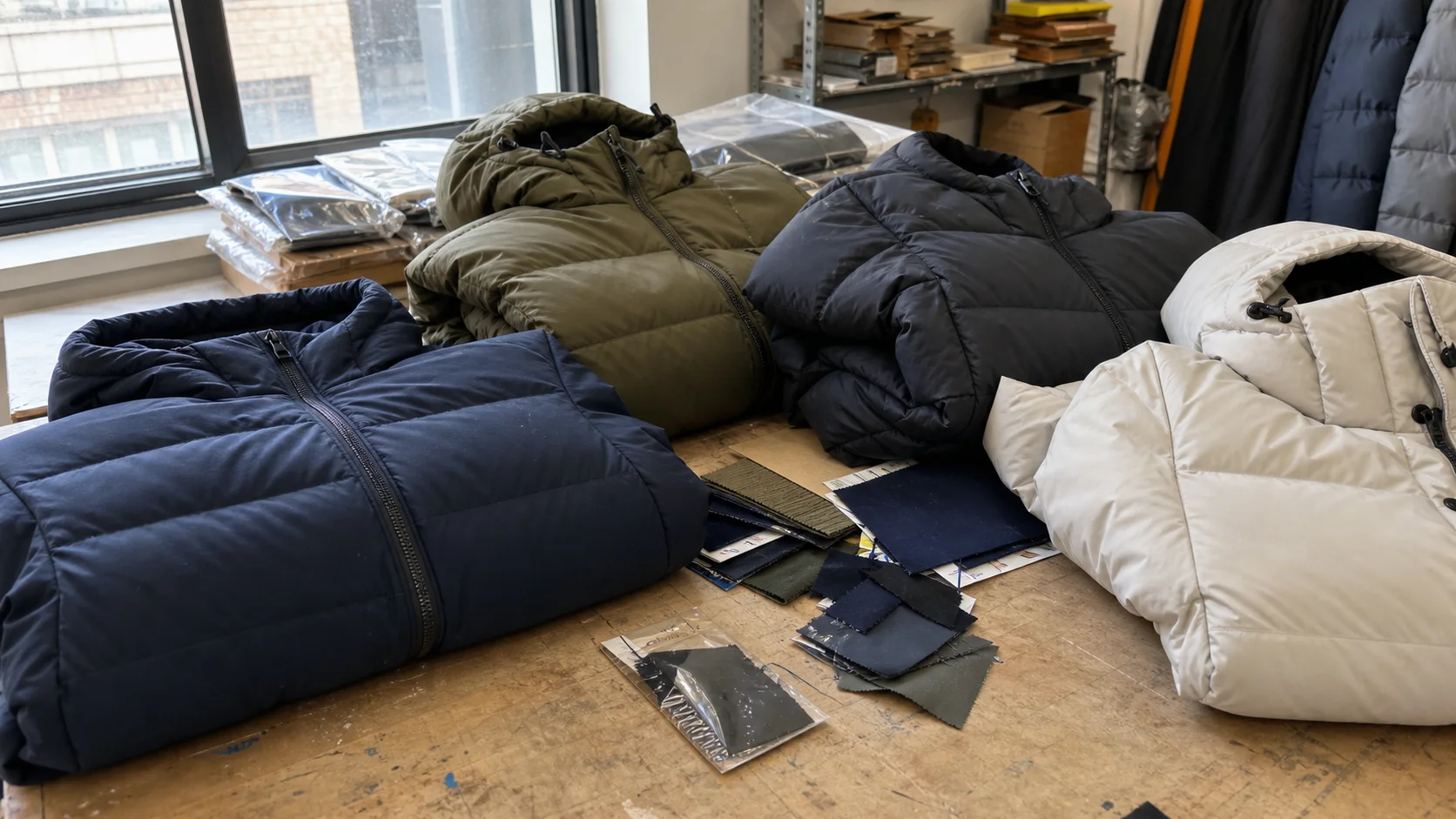
A product-focused outline for gym buyers managing thermal parka shrinkage through fabric choice, wash testing, construction checks, and production control...
Thermal Parka Shrinkage Control Plan for Gym Buyers - Fabrikn production reference
Gym program buyers source thermal parkas for a difficult use case. The garment has to look sharp in a retail display, survive team travel, handle repeated washing by staff or members, and maintain fit across a broad size run. Shrinkage control is not a minor lab detail. It affects size consistency, sleeve length, hem coverage, zipper function, insulation loft, and the buyer’s ability to replenish without complaints.
For gym chains, training clubs, fitness franchises, university recreation departments, and branded merchandise programs, a thermal parka shrinkage control plan should be written before bulk fabric is cut. The plan should define acceptable shrinkage, test methods, fabric pre-treatment, pattern allowances, wash-care labeling, sample approval steps, inspection checkpoints, and corrective action if results drift.
This guide outlines a practical sourcing framework for gym program buyers who need thermal parkas that remain wearable after laundering. It is written for commercial purchasing, not one-off fashion development. The goal is to reduce claims, improve fit reliability, and make production decisions before shrinkage becomes a warehouse problem.
A thermal parka is not a simple fleece hoodie. It often combines woven shell fabric, lining, insulation, rib or elastic components, binding, zipper tape, hook-and-loop closures, drawcords, heat-transfer labels, and sometimes waterproof or water-resistant finishes. Each material can react differently to washing, drying, steaming, pressing, and storage.
Gym buyers usually order parkas for staff uniforms, outdoor training groups, branded merchandise, team travel, or member retail. These programs often reorder seasonally, which means the buyer needs consistent sizing over multiple deliveries. If the first delivery fits correctly but the second delivery shrinks more aggressively, the program loses size confidence quickly.
Shrinkage also creates hidden functional issues. A shell that shrinks more than the lining can cause puckering. A lining that shrinks more than the shell can pull the body inward and reduce comfort. Sleeve shrinkage can expose wrists during outdoor training. Excess body shrinkage can make layering difficult. Zipper tape that does not shrink at the same rate as the body panels may ripple or twist.
For gym programs, returns are not only about product cost. They affect store staff time, member satisfaction, replacement inventory, and brand perception. A shrinkage control plan is therefore a purchasing control tool, not only a technical garment specification.
Good shrinkage control starts before the purchase order. Waiting until finished goods inspection usually leaves only expensive options: accept, rework, relabel, or reject.
Thermal parkas have several material layers. A buyer should not evaluate shrinkage by shell fabric alone. The full garment construction matters because layered materials interact after laundering.
Common shell options include polyester taslan, nylon taslan, polyester pongee, recycled polyester woven, softshell laminates, and coated woven fabrics. Polyester generally offers stable shrinkage compared with some natural fiber blends, but finishing, coating, heat setting, and washing method still matter. Nylon can perform well, though it may show different dimensional response under heat and moisture.
For gym buyers, shell fabric should be assessed for dimensional stability, colorfastness, abrasion resistance, water repellency, and seam performance. A low shrinkage result is not enough if the coating cracks, the handfeel becomes stiff, or the water-resistant finish deteriorates after laundering.
Lining fabrics are commonly polyester taffeta, polyester pongee, brushed tricot, mesh, or fleece-backed materials. The lining can create fit problems if it shrinks more than the outer shell. In insulated parkas, the lining also helps secure the insulation. Poor lining shrinkage can distort quilting or make the garment feel tight even when the shell looks acceptable.
Thermal parkas may use polyester fiberfill, synthetic sheet insulation, recycled insulation, down, or down-alternative fills. Synthetic insulation is common for gym programs because it is easier to specify, more washable, and usually more predictable than down for bulk uniform or promotional orders.
Insulation shrinkage is often less visible on a measurement chart but can appear as clumping, loft loss, uneven cold spots, or panel distortion. The buyer should ask whether the insulation is suitable for the intended wash method and whether quilting, tack points, or internal channels are needed to control migration.
Storm cuffs, rib cuffs, elastic hems, and stretch side panels can shrink or relax differently from woven shell panels. Rib cuffs may tighten after washing, while elastic can lose recovery if exposed to excessive heat. If a gym program expects frequent laundering, these components need separate evaluation.
Trim shrinkage is often underestimated. Zipper tape, reflective tape, drawcords, woven labels, care labels, and binding can all influence garment appearance after washing. Reflective tapes and heat-transfer graphics should be tested for edge lifting, cracking, and dimensional compatibility with the shell fabric.
A shrinkage control plan should define both test method and acceptable tolerance. Without both, the supplier and buyer may interpret results differently. “Low shrinkage” is not a specification. “After three home-laundry cycles, body length and sleeve length shrinkage must remain within agreed tolerance” is much more useful.
Many commercial outerwear programs aim for dimensional change within approximately 1% to 3% after specified laundering, depending on fabric type, construction, wash method, and product category. Some insulated or coated garments may require different tolerances because aggressive laundering is not appropriate. The buyer should set targets based on real end use and care instructions, not on generic apparel assumptions.
Area Suggested Control Point Buyer’s Judgment Body length Measure before and after wash testing Critical for coverage, especially in cold-weather staff use Chest width Track shell and lining response Important for layering over uniforms or gym apparel Sleeve length Measure from consistent approved points High complaint risk if sleeves shorten noticeably Hem sweep Check elastic, drawcord, and shell behavior Can affect comfort and zipper alignment Lining length Compare with shell after laundering Mismatch can cause pulling, twisting, or bubbling Insulation loft Review appearance and handfeel after wash Dimensional stability is not enough if warmth is reducedTesting should be aligned with the care label. If the garment is labeled machine wash cold and tumble dry low, the testing should reflect that. If the parka is dry clean only, the buyer must consider whether that is realistic for gym staff or member retail. A dry-clean-only care label may reduce certain technical risks, but it can create customer dissatisfaction if the garment is intended for daily active use.
Fabric selection is the strongest point of prevention. Pattern compensation can help, but it cannot fully correct unstable fabric. Gym buyers should ask for fabric test data before approving bulk production. At minimum, the supplier should provide information on dimensional stability, colorfastness to washing, colorfastness to rubbing, water repellency if claimed, and any coating or lamination performance relevant to the product.
A useful shell fabric specification should include fiber content, fabric construction, weight, finish, color standard, water-resistant treatment if applicable, and acceptable shrinkage range. For example, a buyer may specify 100% polyester woven shell with durable water-repellent finish, target fabric weight in a defined GSM range, and dimensional change within an agreed limit after the approved wash cycle.
Recycled polyester can be a good option for gym programs with sustainability targets, but it should not be approved only on marketing value. Confirm the handfeel, color consistency, finishing stability, and shrinkage performance. Recycled material programs may also require certification documents depending on the buyer’s claims and market.
The lining should be tested with the shell and insulation, not only as a separate swatch. Layer compatibility affects the finished garment. If a brushed lining is selected for warmth, the buyer should check whether it increases bulk, changes fit, or behaves differently after drying.
For insulation, request details such as fill type, weight, construction method, and recommended care. If the parka is intended for outdoor boot camps, cold-weather commuting, or staff working near entrances, insulation performance matters. A low-cost fiberfill may pass basic shrinkage checks but lose loft after repeated laundering. The purchasing tradeoff is straightforward: lower material cost may increase after-wash appearance risk.
Shrinkage control should not be isolated from color control. Dark navy, black, charcoal, and team colors are common for gym outerwear. These shades may show seam puckering, lint, crocking, and shade variation more clearly. Lab dips should be reviewed under agreed light sources, and bulk shade bands should be controlled before cutting.
If contrast panels are used, both colors should be tested together for color bleeding and dimensional compatibility. A white logo panel on a dark parka can become a complaint point if dye transfer appears after washing.
A structured sample process prevents vague approvals. Gym buyers should not approve a parka only because the first sample looks good on a hanger. The sample must be checked before and after laundering, with measurements recorded against the size specification.
The development sample confirms silhouette, construction direction, general fabric handfeel, insulation concept, pocket placement, hood design, and branding position. At this stage, shrinkage testing may be preliminary if final bulk fabric is not yet available. The buyer should treat the sample as a design reference, not a production approval.
The fit sample should be measured carefully and tried on if a fitting process is available. Gym buyers often need a practical fit that allows layering over T-shirts, hoodies, or staff polos. A tight fashion fit may look clean in photos but fail in daily use.
Fit sample comments should separate style preference from technical requirement. For example, “increase sleeve length by 1.5 cm after wash allowance review” is more actionable than “sleeves feel short.”
The wash test sample is central to the shrinkage control plan. The supplier should measure the garment before laundering, run the agreed wash and dry procedure, then measure again. The buyer should review both the numbers and the garment appearance. Puckering, twisting, zipper distortion, insulation clumping, seam slippage, print cracking, and lining pull-up should all be checked.
The pre-production sample should use confirmed bulk fabric, lining, insulation, trims, labels, and construction methods. This is the sample that should carry the strongest approval weight. If the supplier changes fabric mill, insulation type, zipper tape, coating, or finishing process after approval, shrinkage risk may change.
Size set samples confirm grading across the order. Gym programs often include sizes from XS to 3XL, and some may require 4XL or tall sizing. Larger sizes can reveal grading and shrinkage issues that are not obvious in a medium sample. If only one size is wash-tested, the buyer may miss problems in extended sizes.
Pattern engineering is a practical tool for shrinkage control, but it must be based on actual test results. If the fabric shrinks 2% in length, the pattern can include allowance where appropriate. The risk is overcompensation. A garment that is oversized before wash may look sloppy at retail and may still not settle evenly after laundering.
Gym buyers should approve a measurement specification with points of measure, tolerance, and after-wash expectations. Common points include chest, waist, hem sweep, body length, sleeve length, across shoulder, hood opening, cuff opening, and zipper length. For insulated parkas, measurement technique should be consistent because loft can affect readings.
Thermal parkas for gym programs usually need enough room for layering. Staff may wear them over hoodies, uniforms, or training apparel. Members may buy them as branded outerwear. If shrinkage reduces chest width or sleeve mobility, the garment can become uncomfortable even when it still technically fits the measurement chart.
Hood shrinkage or drawcord distortion can affect comfort and appearance. If the parka includes a storm flap, high collar, or detachable hood, these areas should be checked after laundering. Snaps, hook-and-loop patches, and zipper attachments may pull if surrounding fabric changes dimension.
Gym parkas often include embroidered logos, heat transfers, silicone patches, woven badges, or reflective branding. Shrinkage can shift the visual balance of branding. Large back logos and chest prints should be tested after wash, especially when applied to insulated or coated fabrics.
Embroidery is durable but can cause puckering if stitch density is too high or backing is not suitable. Heat transfers can look clean but may fail if the shell finish, coating, or laundering method is incompatible. The right choice depends on order size, target price, fabric surface, and brand standard.
A written bulk production plan should make responsibilities clear. The buyer, supplier, fabric mill, trim vendors, and inspection team all influence the result. The plan should define what gets tested, when it gets tested, who reviews results, and what happens if goods fall outside tolerance.
Before cutting, bulk shell fabric, lining, insulation, rib, elastic, zipper tape, and major trims should be checked against approved standards. Fabric should be relaxed before cutting where appropriate. Some woven fabrics need time to release tension from rolling and finishing. Cutting immediately after unrolling can increase size variation.
Fabric rolls should be checked for shade variation, width variation, defects, and shrinkage consistency. If different rolls shrink differently, mixed-roll cutting can create inconsistent garments within the same size. A practical control is to keep roll identity traceable through cutting bundles.
Cutting accuracy affects shrinkage perception. If panels are cut off-grain or stretched during spreading, the finished garment may twist after washing. Fabric tension during spreading should be controlled. For coated or slippery fabrics, marker placement and layer height need attention.
Seam construction should suit the shell fabric and insulation. Needle size, thread type, stitch density, seam allowance, and seam sealing if used can influence after-wash appearance. Tight stitching may cause seam puckering after shrinkage. Loose stitching may create seam strength problems. Bulk production should follow the approved pre-production sample, not a simplified factory interpretation.
Heat can change dimensional stability, especially for synthetic materials, coated fabrics, elastics, and heat-transfer decorations. Pressing temperature, dwell time, and steam use should be controlled. If a parka looks flat only after aggressive pressing, it may not maintain that appearance after washing.
Thermal parkas are bulky. Over-compression during packing can affect appearance and insulation loft. Vacuum packing may reduce freight volume but can create recovery and presentation issues depending on insulation type and storage duration. Gym buyers should weigh freight savings against the risk of crushed insulation and wrinkled shell fabric.
Finished goods inspection should include measurement, workmanship, appearance, packaging, labeling, and functional checks. For shrinkage control, inspection should not rely only on dry measurements. A sample of finished garments should be laundered according to the agreed care procedure and reviewed against after-wash standards.
In-line inspection is useful because it identifies issues while production is still adjustable. If seam puckering, incorrect tension, wrong trim, or cutting distortion appears early, the supplier can correct the process before the full order is completed.
Final inspection should confirm that the shipment matches the approved sample and specification. The buyer should define an acceptable quality limit, measurement tolerances, and any critical defects that trigger rejection or rework. For gym programs with strict launch dates, the inspection schedule must leave enough time for corrective action.
Testing frequency depends on order volume, fabric risk, supplier history, and product complexity. For small orders, the buyer may test pre-production and final samples. For larger programs, testing by color, size group, or production lot may be needed. A buyer placing a multi-thousand-piece gym chain order should not depend on a single medium sample wash test.
Thermal parkas have higher sourcing complexity than lightweight jackets. MOQ and lead time depend on fabric availability, insulation type, trim customization, branding method, size range, color count, and testing requirements.
MOQ varies by supplier and specification, but gym buyers can use cautious planning ranges:
Lower MOQ is attractive for pilot programs, but it may limit fabric choice, color accuracy, trim customization, and price competitiveness. Higher MOQ can improve unit cost and control over materials, but it increases inventory risk if sizing or shrinkage is not properly validated.
Lead time should be planned around approval steps, not only sewing time. A basic production timeline may include fabric sourcing, lab dips, sample development, fit corrections, wash testing, pre-production sample approval, bulk material production, cutting, sewing, finishing, inspection, packing, and shipping.
For custom thermal parkas, buyers often need several weeks for sampling and approvals before bulk production starts. Bulk production may take additional weeks depending on order size and factory loading. Shipping time varies by mode and destination. Air freight is faster but expensive for bulky insulated garments. Ocean freight is more economical but requires longer planning.
Rush orders increase shrinkage risk because suppliers may skip fabric relaxation, reduce testing cycles, or approve substitutes quickly. A gym program tied to a winter launch should build the calendar backward from the in-store or uniform distribution date.
Several cost decisions affect shrinkage performance:
The purchasing decision should match the program’s risk level. A limited promotional drop can tolerate fewer custom features. A staff uniform parka that will be worn daily in cold weather needs stronger testing, more stable materials, and better documentation.
A strong specification sheet helps align the buyer and supplier. It should include more than a sketch and logo placement. For shrinkage control, the document should define material requirements, measurements, tolerances, care instructions, test expectations, and packaging standards.
Buyers who need support building a technical sourcing package can review apparel production capabilities through Fabrikn’s services. For program planning, the specification should be locked before bulk purchasing decisions are made.
The care label must be realistic. Gym staff and members are unlikely to follow complicated instructions if the parka is used frequently. “Machine wash cold, gentle cycle, tumble dry low” is more practical than delicate care language, but only if the garment has been tested to support it.
Some technical parkas may require line drying to protect coatings, trims, or insulation. Line drying can reduce heat-related shrinkage risk, but it is less convenient. If the product is intended for gym retail, buyers should consider whether customers will accept that care routine.
Care labels should not be used to hide weak performance. If a product fails under reasonable expected use, the label may not prevent complaints. The better approach is to align fabric selection, construction, and testing with the care method buyers expect customers to follow.
Gym buyers often care as much about brand presentation as technical function. Shrinkage can affect logo alignment, panel balance, and retail appearance. A parka that shrinks unevenly may still be wearable, but it can look lower quality than the brand intended.
Embroidery is a common choice for staff and premium retail parkas. It handles repeated wear well, but stitch density must be controlled. Dense embroidery on a light shell can create puckering, especially after wash. Backing selection should match the fabric and insulation structure.
Heat transfers offer clean branding and can work well on performance outerwear. Testing is essential because coated shells, water-repellent finishes, and heat sensitivity can affect adhesion. The wash test should check lifting, cracking, gloss change, and outline distortion.
Patches can create a premium look but add stiffness and sewing stress. If the patch base does not move with the shell fabric, puckering may appear around the edges. Placement on curved or insulated areas should be tested before bulk approval.
Clear communication reduces disputes. A buyer should confirm whether shrinkage percentages apply to fabric, finished garment, or both. Finished garment testing is usually more relevant for commercial acceptance because it captures the interaction between shell, lining, insulation, trims, and construction.
Purchase orders should reference the approved specification, sample version, test method, shrinkage tolerance, care label, inspection standard, and packaging requirements. If substitutions are allowed, the approval process must be defined. Unapproved substitution is a major source of dimensional and appearance inconsistency.
For buyers evaluating manufacturing partners, company background and sourcing approach matter. A general overview is available on Fabrikn’s about page, and program-specific questions can be directed through the contact page.
Before placing a gym program thermal parka order, buyers should confirm the following:
A gym program buyer should treat shrinkage control as a commercial risk filter. If the order is small, stock fabric and simpler branding may be the best route because the buyer can reduce development time and avoid high fabric minimums. If the program is a core uniform item or a seasonal retail product with repeat orders, stronger material control and more complete testing are worth the added cost.
The weakest sourcing decision is to approve a complex custom insulated parka without finished-garment wash testing. The second weakest is to test one sample and assume every color, size, and lot will behave the same. Thermal parkas are layered products. Their quality is proven by how the full garment performs, not by how the shell fabric looks on a swatch card.
Buyers should also avoid overloading a parka with features that the budget cannot support. Waterproof claims, reflective trims, custom linings, heavy embroidery, detachable hoods, and recycled materials can all be valuable. Each feature adds sourcing and testing requirements. A clean, stable, well-tested parka often performs better for gym programs than an over-specified jacket built to an unrealistic target price.
A thermal parka shrinkage control plan gives gym buyers a practical way to protect fit, appearance, and user satisfaction. The plan should begin with stable material selection and continue through sample approval, finished garment wash testing, pattern review, production controls, and final inspection.
The best results come from written standards. Define the care method, test the full garment, set tolerances, measure before and after laundering, and check visual defects as well as numbers. Shrinkage is not only a lab percentage. It is a fit issue, a branding issue, a warmth issue, and a return-risk issue.
For gym programs, the purchasing tradeoff is clear: invest time in shrinkage control before production, or spend more time handling complaints after delivery. A disciplined plan does not eliminate every risk, but it gives buyers and suppliers a shared standard for making better decisions.
Get a free quote from Fabrikn — your trusted B2B clothing manufacturer with 10+ years of experience. MOQ as low as 200 pieces.
Get a Free Quote →Many outerwear programs target approximately 1% to 3% dimensional change after the agreed wash cycle, but the right tolerance depends on shell fabric, lining, insulation, construction, and care label. The buyer should define acceptable shrinkage by key measurement points such as body length, chest, sleeve length, and hem sweep.
Both are useful, but finished garment testing is more commercially relevant. A thermal parka combines shell, lining, insulation, trims, zippers, and branding. These components can behave differently after laundering, so the finished garment test shows the real user risk.
Wash testing should happen before bulk cutting whenever possible, ideally at the pre-production sample stage using actual bulk materials. Final shipment testing can confirm consistency, but it is too late to prevent most production problems.
Common defects include shortened sleeves, reduced body length, lining pull-up, zipper rippling, seam puckering, insulation clumping, elastic tightening, logo distortion, and reflective tape lifting. These issues may appear even when the garment looked acceptable before washing.
Typical MOQs vary widely. Stock fabric programs may start around 100 to 300 pieces, while custom fabric colors or custom insulated designs often require 500 to 2,000 pieces or more. Technical fabrics, custom trims, and certified materials can increase minimums.
No. Higher price can support better fabrics, trims, insulation, and testing, but only if the specification is clear. Shrinkage control comes from stable materials, correct construction, sample validation, and inspection discipline, not price alone.
Pattern adjustments can help when shrinkage is predictable and consistent. They cannot fully correct unstable fabric, mismatched lining behavior, poor insulation performance, or trim incompatibility. Pattern allowance should be based on actual wash test data.
The best care label is the one the garment can actually pass and users can realistically follow. Machine wash cold and tumble dry low may be practical for gym programs, but the finished garment must be tested under that method. Line drying may reduce heat risk but can be less convenient for users.