
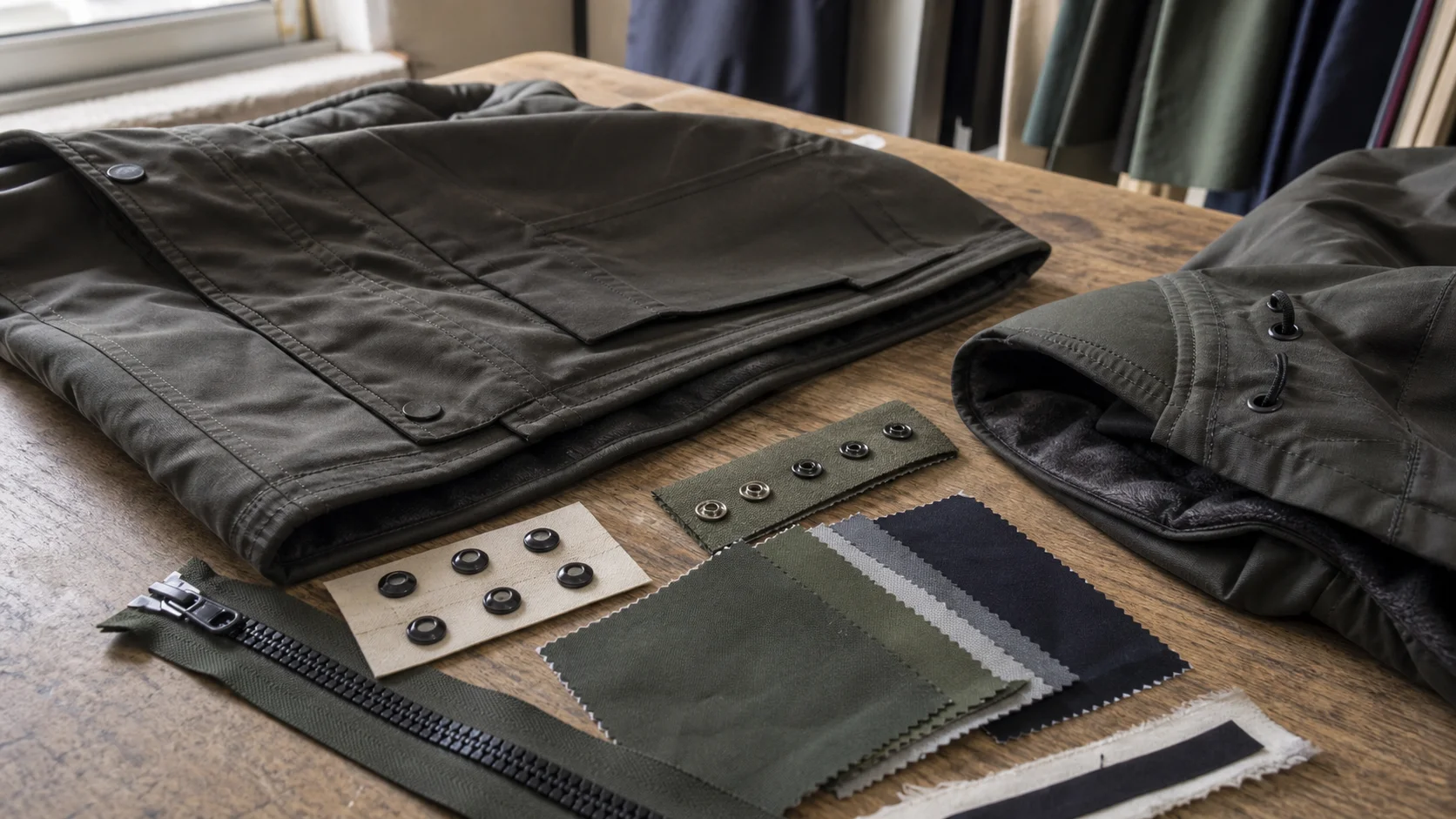
A product-specific SEO outline for clinic purchasing teams evaluating thermal parka trim, from insulation-facing components and cold-weather durability to...
Thermal Parka Trim Sourcing Review for Clinics - Outerwear & Jackets manufacturing guide
Category: Outerwear & Jackets
A thermal parka for clinic purchasing teams is not just a cold-weather jacket with a logo. It is a work garment used by staff who may move between parking areas, mobile units, supply entrances, outdoor screening points, ambulance bays, and temperature-controlled clinical spaces. The shell fabric and insulation get most of the attention during product development, but the trim package often determines whether the parka performs well in daily use.
Trim sourcing covers the components attached to the garment: zippers, snaps, pullers, elastic, drawcords, stoppers, hook-and-loop tape, reflective tape, labels, patches, binding, seam tape, hang loops, pocket bags, and packaging details. In a clinic environment, these parts must be durable, washable, safe against snagging, and easy to operate with cold hands or gloves. A poor zipper can make an otherwise acceptable parka unusable. A sharp snap edge can create a complaint. A drawcord that slips after two weeks can make the hood ineffective.
For clinic purchasing teams, trim review should happen before bulk order approval, not after shipment. The right review reduces service issues, protects staff comfort, and helps standardize future reorders. It also avoids a common sourcing mistake: approving a nice-looking pre-production sample without confirming whether the trims used on that sample are available for bulk production at the same quality level.
Purchasing judgment: do not treat trims as minor accessories. For clinic parkas, zipper quality, hood adjustment, cuff construction, and labeling durability are practical performance issues, not decoration.
Teams building a custom parka program can review broader manufacturing options through Fabrikn’s services, especially when the order involves fabric selection, trim matching, sampling, and bulk production coordination.
Clinic outerwear has a different use profile from fashion outerwear. Staff may wear the parka over scrubs, fleece, uniforms, or light medical layers. The garment may be put on and removed many times per day. Pockets may carry keys, access cards, gloves, pens, thermometers, radios, small forms, or personal phones. Front desk staff, outdoor screening staff, facilities teams, mobile clinic teams, and transport coordinators may all need different levels of warmth and mobility.
This use case creates several trim requirements. Zippers must open and close smoothly without careful handling. Pullers should be large enough for gloved use but not so large that they catch on desks, carts, or vehicle interiors. Snaps and hook-and-loop closures should not damage delicate layers worn underneath. Hood hardware should adjust quickly and stay locked. Elastic at cuffs should retain recovery after repeated wear. Labels should withstand laundering and not irritate the neck.
Cleaning expectations also matter. Some clinics send garments to industrial laundry. Others rely on staff laundering. The trim package should match the expected cleaning method. Metal trims can corrode or discolor if coating quality is weak. Low-grade plastic stoppers can crack in cold conditions. Printed labels can fade. Reflective tape can peel if it is not compatible with the shell fabric and wash conditions.
Before sourcing, the purchasing team should define the expected service environment. A parka used for occasional cold-weather commuting does not need the same trim specification as one used daily at a drive-through testing point or mobile health unit. Buying the strongest trim package for every order can inflate cost unnecessarily. Buying the cheapest package for field use creates replacement headaches.
A clear trim bill is the foundation of a controlled sourcing process. The trim bill should identify every component, material, size, color, finish, supplier requirement if any, testing expectation, and placement. Vague terms such as “good zipper,” “standard snaps,” or “normal label” are not enough for clinic purchasing teams placing repeatable orders.
Trim Component Typical Specification Point Clinic Purchasing Risk Main zipper No. 5 or No. 8 molded, coil, or waterproof-style zipper; two-way option for longer parkas Jamming, weak slider, difficult gloved operation, color mismatch Pocket zippers No. 3 or No. 5 coil or molded zipper with puller Small pullers, pocket failure, poor stitching at zipper ends Snaps Metal or plastic snap with anti-rust finish and pull strength target Rusting, sharp edges, loose setting, fabric tearing Drawcord Polyester or nylon cord, flat or round, matched to stopper size Slippage, fraying, safety concerns, uneven color Stoppers Plastic or rubberized cord lock, cold-resistant grade when needed Cracking, weak spring, difficult adjustment Cuff trim Elastic, rib knit, hook-and-loop tab, or inner storm cuff Loss of recovery, scratchy feel, poor fit over gloves Reflective tape Heat-transfer or sew-on reflective tape, width commonly 2.5 cm to 5 cm Peeling, cracking, low visibility, wash failure Labels Woven, printed satin, heat-transfer, or care label set Incorrect care content, irritation, fading, regulatory errorThe trim bill should be attached to the tech pack and reviewed against the sample. If a factory substitutes a zipper, cord lock, or label during sampling, the change must be recorded. Substitutions are not always bad. They become a problem when the bulk production trim differs from the approved sample without purchasing approval.
The main zipper deserves the most scrutiny. For a thermal parka, a No. 5 zipper may be acceptable for lighter staff jackets, but a No. 8 zipper is usually a stronger choice for heavier insulated parkas. Molded tooth zippers are common for outerwear because they look sturdy and tolerate frequent use. Coil zippers can be smoother and more flexible, especially for pockets, but cheap coil zippers can feel weak on heavy garments.
Two-way zippers are useful on longer parkas because staff can open the bottom when sitting, driving, or climbing steps. The tradeoff is cost and user training. Two-way zippers can be more prone to misalignment if the wearer does not fully seat both sliders before pulling. For clinics ordering parkas for a wide staff group, a two-way zipper is worth considering only if the garment length justifies it. For hip-length jackets, a one-way zipper is often simpler and more reliable.
Water-resistant zippers can improve appearance and weather protection, but they are not always the best default. They are stiffer, more expensive, and may require more careful sewing. If the parka already has a storm flap over the main zipper, a standard molded zipper may be more practical. For pockets exposed to rain or snow, a water-resistant zipper can make sense, particularly for chest pockets used for phones or ID tools.
Purchasing teams should ask for zipper details by type, gauge, tape color, teeth color, slider finish, puller type, and brand level. It is not always necessary to require a premium branded zipper on every clinic order, but the zipper should be tested for smooth operation, strength, and color consistency. If the budget allows, specify a recognized zipper standard or require that the factory submit zipper test results. If budget is tight, prioritize a stronger main zipper over decorative pocket upgrades.
Snaps are commonly used on storm flaps, pockets, hood attachments, and adjustable cuffs. They look simple, but they can cause expensive quality problems. A snap that is set too tightly may tear the shell fabric. A snap that is set too loosely may detach. Metal snaps need an appropriate finish to reduce corrosion risk, especially if garments are exposed to snow, road salt, repeated washing, or disinfectant contact.
Plastic snaps are lighter and avoid rust, but they can crack in cold conditions if the material grade is weak. They also may look less professional on a heavier clinic parka. Metal snaps usually provide a cleaner outerwear appearance, while plastic snaps may be acceptable for hidden hood or inner pocket functions.
Hook-and-loop tape is practical for cuffs and storm flaps, yet it can catch lint and may abrade knit layers. For clinic teams, hook-and-loop is best used where adjustability is important, not as a default replacement for every snap. A storm flap with hidden snaps can look cleaner and reduce snagging. Cuffs with hook-and-loop tabs allow fit adjustment over gloves, but the tab shape and tape strength should be tested.
Buttons are less common on thermal parkas for clinic use because they take longer to fasten and are harder to use with gloves. If buttons are used for styling, they should not be the primary weather closure. A zipper plus storm flap is more suitable for operational outerwear.
The hood system can make or break comfort in cold weather. A fixed hood is simpler and usually more durable. A detachable hood adds flexibility but introduces extra snaps, zippers, or buttons that can fail or get lost. For clinics buying one parka for many roles, a fixed adjustable hood is often the safer purchasing choice. Detachable hoods make more sense when staff need a neater indoor appearance or when uniform policy requires removable components.
Drawcords should be specified carefully. Round cords are common, but flat cords may sit more securely in some channels. Cord ends should be finished with molded tips, metal tips, heat sealing, or knots depending on the desired appearance and safety requirement. Loose cord ends around the face can be a snag risk. In some markets and product categories, drawcord safety rules apply more strictly to children’s garments, but adult clinic outerwear still benefits from conservative cord management.
Cord locks should match the cord diameter. This seems basic, but mismatched cord and stopper combinations are common in low-control sourcing. If the cord is too thin, the stopper slips. If it is too thick, adjustment is difficult. Rubberized stoppers feel better in cold conditions but may cost more and need color approval. Basic plastic stoppers are cheaper and acceptable for many programs if they pass function testing.
Cuffs need the same practical review. Rib knit cuffs provide warmth and comfort but can pill or stretch out. Elastic cuffs are inexpensive and simple, but they may not seal as well. Hook-and-loop adjustable tabs work well for staff wearing gloves, though they add sewing operations and inspection points. Inner storm cuffs provide good warmth but increase cost and bulk. For a clinic parka intended for outdoor shifts, inner storm cuffs are usually worth the added cost. For a staff commuter jacket, a clean elastic cuff may be enough.
Clinic purchasing teams often care about branding, department identification, and a professional appearance. Trim sourcing includes logo patches, embroidery backings, woven labels, size labels, care labels, and sometimes reflective identification marks. These items should be reviewed for both appearance and compliance.
Woven patches are durable and professional, but they can feel stiff on lightweight shells. Rubber or silicone patches create a modern appearance, though they add cost and may not suit every clinic brand. Embroidery looks familiar and permanent, but dense embroidery can compromise water resistance if it pierces the shell fabric in exposed areas. Heat-transfer logos avoid stitching holes, but they must be tested for adhesion and wash resistance.
Placement matters. A chest logo is standard, but staff may also need sleeve identification, back print, or department-specific color coding. Every extra branding location adds cost, approval time, and inspection risk. For procurement efficiency, use one primary logo location and one optional identification element only when it serves a real operational purpose.
Care labels should include accurate fiber content, insulation content where required, country of origin, care instructions, and size information. Purchasing teams should not leave care label wording entirely to the factory without review. Incorrect care labels can create laundering failures and compliance issues. If the clinic has a formal uniform policy, confirm whether staff names, departments, or role identifiers are handled through removable badges rather than permanent garment trims.
Teams that need help aligning product specs with brand and sourcing requirements can review Fabrikn’s background to understand how apparel development support is typically structured.
Trim selection cannot be separated from fabric and insulation. A heavy zipper on a lightweight shell can distort the front opening. A weak zipper on a thick insulated parka can fail under tension. Reflective tape may not bond well to certain water-repellent finishes. Snap reinforcement may be required if the shell fabric is thin or has a coating that tears under pressure.
Common thermal parka shells include polyester pongee, polyester taslon, nylon blends, softshell laminates, and coated woven fabrics. Insulation may include polyester padding, recycled polyester fill, synthetic down alternatives, or quilted lining systems. Trim should match the garment weight and intended durability level. For a practical clinic parka, polyester shell fabrics with water-repellent finishing are common because they balance cost, availability, and maintenance.
Typical outerwear fabric weights vary widely. Lightweight shells may sit around 70 to 120 gsm, while heavier woven shells can exceed 150 gsm. Insulation weights may range from about 100 gsm for moderate warmth to 200 gsm or more for colder outdoor use. These are broad ranges, not fixed rules. The trim package must be reviewed against the actual garment construction, not a catalog description.
Snap points, pocket corners, zipper ends, and drawcord exits often need reinforcement. Bar tacks, backing fabric, interlining, or extra seam allowance can reduce failure risk. If the factory proposes lower-cost trims, ask whether garment construction changes are needed to maintain durability. A cheaper snap may not save money if it requires more rework or causes returns.
Minimum order quantity depends on the factory, fabric availability, trim customization, size range, and color count. For clinic parkas, typical garment MOQs may start around 300 to 500 pieces per style and color for basic programs using available fabrics and standard trims. More customized programs may require 800 to 1,500 pieces or more, especially when custom-dyed fabric, branded zippers, molded patches, or special reflective placements are involved.
Trim MOQs can be the hidden constraint. A factory may accept 500 parkas, but a custom zipper puller supplier may require 1,000 to 3,000 pieces. Custom silicone patches may have mold fees and minimums. Custom-dyed drawcord, rib, or zipper tape may require higher quantities than the garment order. Clinic purchasing teams should ask for trim MOQ details early, especially if the order includes multiple departments, colors, or logo versions.
A disciplined sample approval process reduces risk. The first sample may be a development sample used to check fit, shape, and general construction. The second sample may include closer fabric and trim matching. A pre-production sample should represent bulk production materials as closely as possible. Bulk production should not begin until the purchasing team approves the pre-production sample, trim card, size set if required, and packaging standard.
Approval Stage Purpose Purchasing Team Action Development sample Checks silhouette, fit direction, pocket layout, and basic function Comment on usability, not only appearance Trim card Shows zipper, snaps, cords, labels, patches, tape, and colors Sign off each component separately Fit sample Confirms measurements, layering allowance, sleeve length, and movement Test over intended clinic uniform layers Pre-production sample Represents bulk materials and construction Approve only if trims match bulk sourcing plan Size set Checks grading across sizes Review sleeve, chest, hem, and hood proportions Final inspection Verifies finished bulk quality before shipment Check AQL result and critical trim defectsSampling timelines vary. A simple development sample may take one to three weeks if fabric and trims are available. Custom trims, lab dips, logo approvals, and revised samples can extend the process to four to eight weeks or more before production begins. Purchasing teams with a winter deadline should work backward from the in-hand date, not from the purchase order date.
Bulk lead time for thermal parkas depends on material booking, trim procurement, production capacity, inspection, and shipping method. For standard fabrics and trims, production may fall in a broad range of 45 to 75 days after final approval and deposit. More customized outerwear can require 90 to 120 days or longer, particularly during peak seasonal capacity. These are typical planning ranges, not promises.
Trim lead times can run ahead of garment production. Standard zippers, snaps, elastic, and labels may be available quickly if colors are common. Custom zipper pullers, metal logo snaps, molded patches, special reflective tape, custom-dyed rib, or branded packaging can take longer. If the clinic order has a hard launch date, trim procurement should be treated as a critical path item.
Cost drivers include zipper grade, number of pockets, storm flap construction, hood complexity, reflective materials, branding method, insulation weight, and testing requirements. A parka with a two-way main zipper, waterproof pocket zippers, detachable hood, silicone patch, reflective tape, inner storm cuffs, and multiple embroidery locations will cost meaningfully more than a basic insulated jacket. Some of those upgrades may be justified for outdoor clinical operations. Others may only add visual value.
Freight also matters. Parkas are bulky. Air freight can become expensive quickly, especially for high-fill insulated garments. If production runs late, the savings from low-cost trims can disappear in expedited freight charges. A purchasing team should ask suppliers to flag long-lead trims before confirming the final production calendar.
Purchasing judgment: if the budget is limited, protect the main zipper, cuff function, pocket durability, and care labeling first. Reduce decorative complexity before cutting functional trims.
Final inspection should include trim-specific checks. Many outerwear defects are not visible from a quick front-view photo. Inspectors need to operate zippers, pull pocket openings, fasten snaps, adjust cords, stretch cuffs, check label content, and review reinforcement points. A parka can look acceptable on a hanger while still having functional trim failures.
Common inspection risks include zipper waviness, uneven zipper tape, broken sliders, missing pullers, snap misalignment, loose snap caps, frayed cord ends, weak cord locks, puckering around reflective tape, poor patch stitching, wrong label sequence, incorrect size labels, and sharp trim edges. Pocket zippers are often overlooked, but they receive frequent use. Hood attachments and cuff tabs also deserve attention.
Color variance should be checked between trims and fabric. Black is not always the same black. Navy, charcoal, royal blue, and medical-brand colors can vary noticeably between shell fabric, zipper tape, cords, snaps, and patches. A clinic team should approve acceptable shade tolerance before bulk production. If exact brand color is critical, custom dyeing may be required, with higher MOQ and longer lead time.
Measurement inspection should include trim-related dimensions. Hood opening, drawcord length, zipper length, pocket opening, cuff relaxed and extended width, storm flap width, and reflective tape placement can all affect usability. For size grading, larger sizes should not simply scale all trim placements without checking function. A chest pocket that works on size M may sit awkwardly on size 3XL if grading is poorly managed.
Clinic purchasing teams should start with the wearing scenario. A parka for outdoor screening, mobile clinics, or transport coordination should be specified more robustly than a parka used mainly for commuting. Warmth, closure function, pocket security, and hood adjustability should be prioritized over extra decoration. Staff comfort matters, but comfort is not only about insulation. It is also about whether the wearer can move, sit, reach, access pockets, and adjust the garment quickly.
For most clinic programs, a practical trim package may include a No. 8 molded main zipper for heavier parkas, No. 5 pocket zippers, reinforced snap storm flap, adjustable hood with reliable cord locks, inner storm cuffs or adjustable cuffs, durable woven and care labels, and limited but professional branding. Reflective trim is worth considering when staff work near vehicles, parking areas, or low-light entrances. It may be unnecessary for purely indoor or commute-focused use.
Do not overcomplicate the order with too many colorways and department-specific trim variations unless volume supports it. Every variation increases MOQ pressure, sample approval work, inventory complexity, and risk of mixed shipments. A better approach is often one core parka color, consistent trim package, and controlled logo or badge solution. If departments need differentiation, removable badges or small sleeve identifiers can be easier than separate garment builds.
Price comparisons should be based on full specification, not only unit cost. One supplier may quote lower by using lighter zippers, cheaper snaps, no reinforcement, basic labels, or lower-grade elastic. Another may include stronger trims and better inspection preparation. Purchasing teams should ask for a trim breakdown when quotes differ sharply. The cheapest quote is not automatically wrong, but it needs explanation.
When reaching out for sourcing support, prepare the expected order quantity, size range, delivery deadline, climate use case, branding needs, cleaning method, target price range, and any compliance requirements. That information allows a manufacturing partner to recommend realistic trim options rather than guessing. Clinic teams planning a new outerwear program can contact Fabrikn through the contact page to discuss sourcing direction, sampling, and production requirements.
A thermal parka trim sourcing review for clinic purchasing teams should be structured, documented, and tied to real staff use. The safest path is not always the most expensive trim package. It is the package that fits the work environment, survives the cleaning method, meets the delivery calendar, and can be repeated in future orders.
Focus first on functional trims: main zipper, pocket closures, hood adjustment, cuffs, reinforcement, and labels. Then review branding and decorative elements. Approve trims through a physical trim card and pre-production sample, not only by email descriptions or catalog images. Confirm MOQ and lead time before finalizing the purchase order. Inspect trim function before shipment, not after staff begin wearing the garments.
Clinic outerwear programs benefit from practical standardization. A well-specified parka can support staff comfort, present a consistent brand image, and reduce replacement issues. A poorly controlled trim package can turn a warm jacket into a procurement problem. Treat trims as part of the garment’s performance system, and the sourcing process becomes easier to manage.
Get a free quote from Fabrikn — your trusted B2B clothing manufacturer with 10+ years of experience. MOQ as low as 200 pieces.
Get a Free Quote →The most important trims are the main zipper, pocket zippers or closures, snaps, hood drawcords, cord locks, cuffs, labels, and any reflective or branding elements. For daily clinic use, the main zipper and cuff construction usually deserve the closest review because they affect comfort and function every time the parka is worn.
Typical garment MOQs may start around 300 to 500 pieces per style and color when using available fabrics and standard trims. More customized programs often move into the 800 to 1,500 piece range or higher. Custom trims such as molded patches, branded zipper pullers, or custom-dyed components can create their own MOQs.
A No. 5 zipper may be suitable for lighter jackets and moderate use. A No. 8 zipper is often a better choice for heavier insulated parkas or staff who use the garment outdoors for long periods. The decision should consider garment weight, length, staff use, and budget.
Waterproof-style or water-resistant zippers are not always necessary. If the parka has a storm flap, a good molded main zipper may be enough. Water-resistant zippers can be useful on exposed pockets, but they add cost and can feel stiffer.
A practical workflow includes a development sample, trim card approval, fit sample, pre-production sample, size set review when needed, and final inspection. Bulk production should not begin until the pre-production sample and trim card are approved.
Common defects include zipper jamming, loose snaps, snap misalignment, missing pullers, weak cord locks, frayed drawcords, peeling reflective tape, incorrect labels, poor patch stitching, and color mismatch between trims and shell fabric.
For standard fabrics and trims, bulk production may take about 45 to 75 days after final approval and deposit. More customized outerwear can require 90 to 120 days or longer, especially during peak season or when special trims are involved.
Detachable hoods offer flexibility, but they add snaps, zippers, or buttons that can fail or be misplaced. A fixed adjustable hood is often more reliable for general clinic operations. Detachable hoods are better when uniform policy or indoor appearance requires removal.
Reflective tape is worth considering when staff work near parking lots, vehicle lanes, ambulance bays, mobile units, or low-light entrances. It may not be necessary for commute-only parkas or garments used mainly indoors.
Use a detailed trim bill, approve a physical trim card, confirm trim MOQs, test sample function, document all substitutions, and require trim-specific inspection before shipment. Standardizing colors and components across departments also reduces errors.