
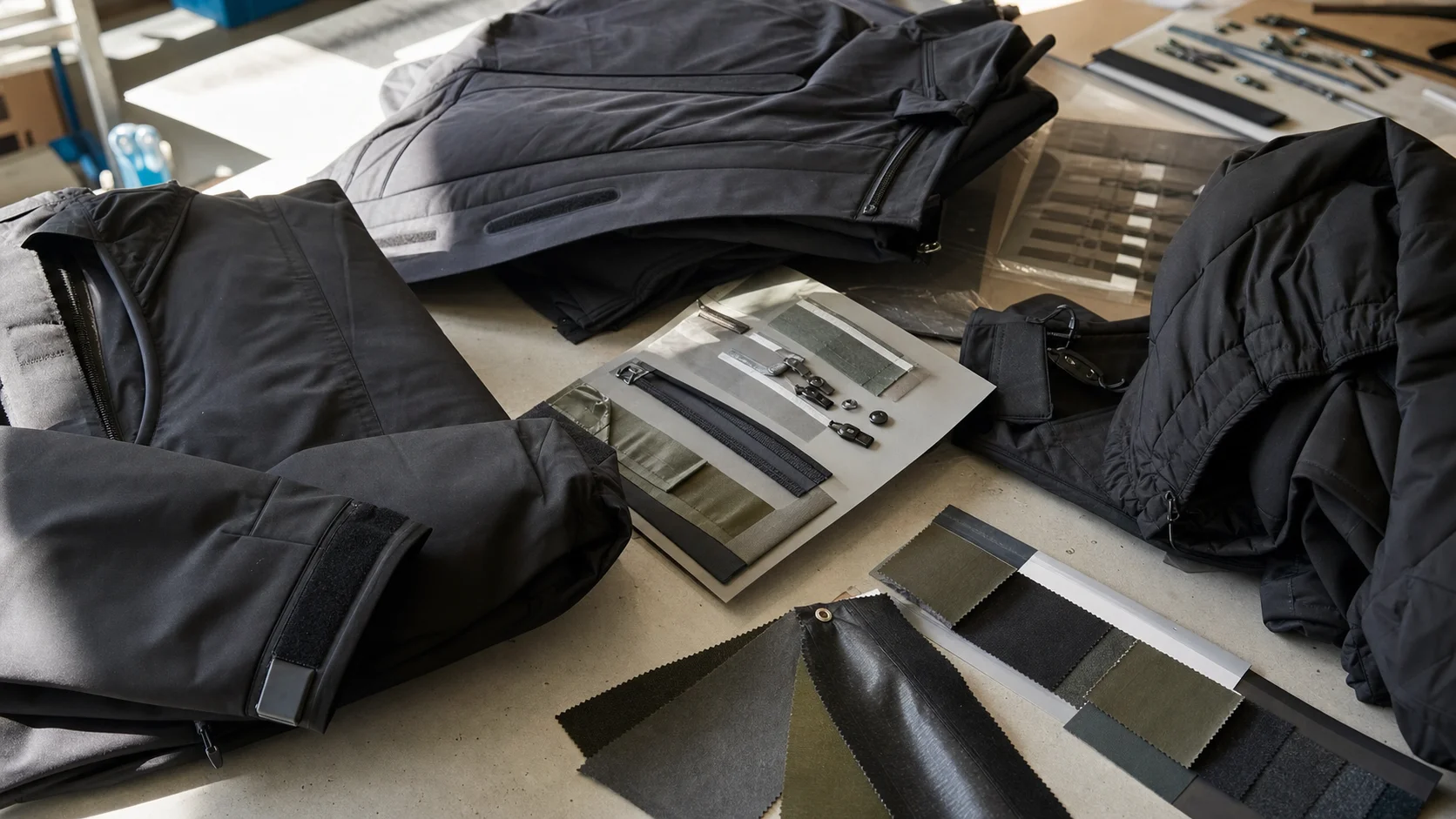
A quality inspection outline for gym program buyers reviewing trim sourcing on thermal parkas, from zippers and snaps to drawcords, insulation labels,...
Thermal Parka Trim Review for Gym Buyers - Quality & Inspection manufacturing guide
Thermal parkas for gym programs are not just cold-weather outerwear. They are brand-facing staff uniforms, coach jackets, athlete travel pieces, sideline gear, retail merchandise, and member loyalty products. Buyers often focus on shell fabric, insulation weight, and silhouette first. That is understandable, but trim sourcing is where many quality problems start.
A thermal parka manufacturer can cut and sew a good shell, but the garment will still fail commercially if the zipper catches, the snaps rust, the drawcord frays, the logo badge peels, or the hood adjuster cracks in cold weather. For gym buyers managing seasonal drops or multi-location uniform programs, these small components decide whether the parka feels premium or disposable.
Trim also affects delivery risk. Fabric may be available, but a custom zipper puller, branded rubber patch, molded snap, waterproof zipper, or reflective tape can hold the whole order. A practical sourcing review should treat trims as critical-path materials, not decoration.
Purchasing judgment: if the parka is for staff uniform use, prioritize durable standard trims over highly customized trims. If it is for retail or premium member merchandise, custom trims can justify the cost, but only when sampling time and MOQ support the launch calendar.
This review is written for gym program buyers evaluating a thermal parka manufacturer, especially when the order involves team branding, cold-weather performance, repeated wear, and inspection requirements. It covers trim specifications, typical MOQ ranges, sampling steps, lead-time dependencies, and the quality risks worth checking before bulk production.
Gym buyers usually have a different buying profile from fashion outerwear buyers. A fashion brand may chase seasonal shape, novelty trims, and retail storytelling. A gym program buyer normally needs consistency, practical durability, brand alignment, and predictable replenishment.
The end users may include front desk staff, personal trainers, coaches, outdoor class instructors, facility teams, athletes, or members purchasing branded gear. Each group stresses the parka differently. Coaches may wear it outdoors in wet conditions. Staff may use it daily during commutes. Athletes may throw it into buses, lockers, or training bags. Members may judge it against mainstream outdoor brands.
A good thermal parka manufacturer should be able to translate these use cases into materials and trims. That means discussing zipper gauge, hood construction, cuff closure, pocket security, puller grip, label placement, badge attachment method, and wash-care performance early in development.
For broader production support, buyers can review apparel sourcing and manufacturing capabilities through Fabrikn services. For supplier discussion or program planning, contacting the sourcing team is usually more useful than requesting a generic price list, because parka pricing depends heavily on trim choices.
A trim review should start with a full bill of materials. Many quote requests say “thermal parka with logo,” but that is not enough for reliable pricing. The manufacturer needs to know every visible and functional component.
Trim Area Common Options Buyer Risk Practical Recommendation Main front closure Plastic zipper, metal zipper, waterproof zipper, zipper plus storm flap Jamming, weak slider, color mismatch, leakage Use reliable coil or molded zipper; specify gauge and slider type Pockets Zipper pockets, snap pockets, flap pockets, fleece-lined pockets Pocket opening distortion, weak bartacks, poor zipper smoothness Test hand feel with gloves and inspect pocket reinforcement Hood Fixed hood, detachable hood, drawcord hood, Velcro tab hood Loose adjusters, sharp cord ends, poor hood shape Confirm adjuster strength and cord safety compliance Cuffs Rib cuff, Velcro tab, elastic cuff, inner storm cuff Pilling, weak hook-and-loop, loss of elasticity Choose cuff type based on use: staff wear, outdoor coaching, or retail Branding Embroidery, woven patch, rubber badge, heat transfer, zipper pull logo Peeling, color shift, cracking, inconsistent placement Approve branding on actual shell fabric, not only on a flat lab swatch Labels Main label, size label, care label, hangtag, barcode sticker Wrong composition, missing care symbols, label irritation Lock label artwork before production sample approvalFor gym buyers, the most important trim decision is not always the most expensive one. It is the trim that receives the most stress. On a parka, that is usually the main zipper, pocket zippers, hood adjusters, cuff closures, and logo applications. These items should be reviewed on the first physical sample, not left until pre-production.
Trim sourcing cannot be separated from fabric and insulation. A lightweight zipper may work on a thin windbreaker, but it can look weak and perform poorly on a padded thermal parka. A heavy metal zipper may look premium but add weight and stiffness. A rubber badge may attach cleanly to a smooth woven shell but fail on a coated, textured, or quilted surface if the bonding method is wrong.
Typical thermal parka shell options include polyester pongee, taslon, nylon taslan, recycled polyester, polyester oxford, ripstop nylon, and coated woven fabrics. For gym programs, polyester and nylon shells are common because they balance cost, durability, and color consistency. Water-resistant coating or durable water repellent treatment may be required, but buyers should not assume that “water-resistant” means waterproof.
Insulation options include polyester padding, recycled polyester fill, synthetic down-like fill, and down or down-blend insulation. Gym buyers often choose synthetic insulation because it is easier to manage, usually more cost-stable, and more suitable for programs where washing, storage, and animal-origin documentation may create complications.
A strong manufacturer will ask for fabric and trim decisions together. A weaker supplier may quote quickly with vague descriptions such as “good zipper,” “normal button,” or “custom badge.” That type of quote is hard to compare and risky for inspection because there is no measurable standard.
The main zipper is the first trim most users touch. If it feels rough, catches the storm flap, or separates at the bottom, the garment immediately feels cheap. For gym buyers, the zipper also carries operational risk because staff and members may wear the parka daily.
Common zipper choices include coil zippers, molded plastic zippers, metal zippers, and waterproof or water-resistant zippers. Coil zippers are flexible and widely used. Molded plastic zippers can feel strong and sporty. Metal zippers provide a heavier look but may not be ideal for cold-weather gym programs where weight and corrosion resistance matter. Waterproof zippers can improve appearance and water resistance, but they cost more and may feel stiffer.
Purchasing judgment: a branded zipper puller gives good visual value at a lower cost than a fully custom zipper, but it can still create MOQ and tooling requirements. For smaller gym programs, a standard zipper with a clean cord puller is often the safer buy.
Inspection should include zipper smoothness, slider locking, tape waviness, top stop security, bottom stop strength, and alignment at the hem or collar. If the parka has a two-way zipper, testers should check both sliders several times. Two-way zippers are useful for long parkas and sideline coats, but they add failure points and may frustrate users if the insertion system is not smooth.
Secondary trims often decide whether a thermal parka performs well in real gym environments. Snaps secure storm flaps and pockets. Hook-and-loop tabs adjust cuffs and hoods. Drawcords control hem and hood fit. Cord locks and stoppers keep warmth in. These components are less glamorous than logo badges, but they carry high wear risk.
Snaps are common on storm flaps, pocket flaps, detachable hoods, and cuffs. Buyers should specify material, finish, cap diameter, color, and whether the snap is branded or plain. Metal snaps should be checked for rust resistance and secure attachment. Plastic snaps reduce corrosion risk but may look less premium or crack under stress if quality is poor.
Snap attachment must be reviewed carefully on padded garments. If the shell, insulation, and lining thickness are not managed correctly, snaps may sit poorly, pull through the fabric, or create puckering. Reinforcement fabric or backing may be needed.
Hook-and-loop tape is useful for adjustable cuffs and storm flap closures, but it can collect lint and snag softer fabrics. For gym programs, cuff tabs may be handled frequently by users wearing gloves or carrying equipment. Low-quality hook-and-loop tape loses grip quickly and looks messy after repeated wear.
Buyers should review tape width, color, edge softness, stitch placement, and grip strength. A narrow strip may reduce bulk but provide weak closure. A wider strip holds better but can look industrial. The best choice depends on whether the parka is a staff uniform, a sideline coat, or a retail garment.
Drawcords are used at hoods, hems, and sometimes waists. Common options include round elastic cord, flat cord, woven cord, and reflective cord. Cord locks may be plastic, rubberized, or metal. Gym buyers should consider safety and compliance, especially if the product could be sold to younger users or used in youth sports programs.
Drawcord length, exit point, stopper strength, and cord end finishing must be approved. Loose ends can catch on equipment. Poorly sealed cord tips fray. Weak stoppers slide under tension. If the parka is intended for athletic teams or outdoor coaching, a one-hand adjustment system can improve function, but it adds component cost and assembly complexity.
Branding trims are where gym buyers often want differentiation. The challenge is to make the parka look branded without adding avoidable quality risk. Embroidery, woven patches, rubber badges, silicone patches, PVC patches, heat transfers, reflective logos, zipper pull logos, and custom neck labels are all possible. Each has tradeoffs.
Branding Method Best Use Main Risk Buyer Judgment Embroidery Staff logos, chest logos, team marks Puckering, thread color mismatch, needle holes Durable and familiar, but test on padded panels Woven patch Club logos, brand crests, sleeve marks Frayed edges, poor stitching, stiff hand feel Good for classic branding and moderate MOQs Rubber or silicone badge Premium gym retail, outdoor look Peeling, cracking, color variation Strong visual value, but confirm tooling and attachment method Heat transfer Clean logos, lightweight branding Peeling, cracking, poor wash durability Works best when tested on actual coated shell fabric Reflective logo Outdoor running clubs, evening visibility Low reflectivity, cracking, misalignment Useful feature, not a substitute for certified safety gear unless testedLogo placement should be controlled with measurements from fixed points such as center front, shoulder seam, cuff edge, or hem. On padded garments, quilting and insulation movement can make placement inconsistent if the factory does not use proper templates.
For background on supplier positioning and sourcing approach, buyers can review Fabrikn’s company information. A supplier’s ability to manage brand details matters more on outerwear than on basic tees because the trims are more expensive, more visible, and harder to correct after sewing.
MOQ for thermal parka manufacturing depends on fabric, insulation, trim customization, color count, and size range. Buyers should treat any quoted MOQ as conditional until the bill of materials is confirmed.
For standard trims and available shell fabric, a typical MOQ may fall around 300 to 500 pieces per style and color, depending on the manufacturer and material market. Some suppliers may accept 100 to 200 pieces for a sample run or trial order, but unit cost will usually be higher and trim options may be limited. For fully custom fabric colors, custom zipper pullers, molded rubber badges, branded snaps, or special insulation, MOQ may rise to 500, 800, 1,000 pieces or more.
Custom trims can also have separate MOQ requirements. Zipper suppliers may require a minimum length quantity or color batch. Rubber badge makers may require tooling fees and a minimum number of pieces. Custom woven labels may be easy at low quantities, while molded components usually require more commitment.
These ranges are not fixed rules. They vary by country, supplier, season, and material availability. The important point is that gym buyers should not negotiate MOQ only at garment level. Trim MOQ can quietly control the true minimum.
Purchasing judgment: for a first gym parka order, spend customization budget on one or two high-impact trims, such as a clean chest badge and branded zipper puller. Avoid custom snaps, custom cord locks, and unusual zipper colors unless the order volume supports reorders.
A disciplined sample approval process reduces bulk defects. For thermal parkas, buyers should expect more than one sample stage because fabric thickness, insulation loft, and trim behavior cannot be judged accurately from a flat sketch.
Gym buyers should be cautious when suppliers skip directly from a development sample to bulk production. That may work for simple fleece or basic tees, but thermal parkas have more components. Each trim needs confirmation under real garment conditions.
Sample comments should be specific. “Make zipper better” is not a useful instruction. Better comments include “main zipper slider catches storm flap at lower front,” “rubber badge edge lifting after flex test,” “pocket zipper puller too small for gloved hand,” or “Velcro cuff tab too stiff and scratches wrist.” Specific comments reduce argument and improve correction speed.
Lead time for thermal parkas depends on season, fabric availability, trim complexity, production capacity, and inspection schedule. A standard program using available fabric and trims may take around 45 to 75 days after sample approval and deposit. More customized programs may need 75 to 120 days, especially if fabric dyeing, custom molded trims, or multiple approval rounds are involved.
Buyers should separate development lead time from bulk production lead time. Sampling may take two to four weeks for a basic development sample, then more time for revisions. Custom badge tooling, lab dips, strike-offs, embroidery trials, and zipper puller samples can add several weeks before the production clock even starts.
The highest-risk timing mistake is approving the garment body while leaving trims unresolved. Factories may begin cutting or preparing production, but unresolved trims can delay sewing, packing, and inspection. For gym launches tied to winter events, outdoor training season, or membership campaigns, late trims can damage the entire program.
Purchasing judgment: if the delivery date is fixed, reduce trim novelty. Standard zipper colors, stock cord locks, and simple woven labels are safer than custom hardware. If brand impact is more important than speed, protect extra time for trim development and approval.
Inspection for thermal parkas should cover both visible appearance and functional stress points. Trim defects are often easy to see, but some only appear after repeated handling. A final random inspection should include zipper operation, snap pull strength, cord lock function, badge attachment, label accuracy, seam security near trims, and packaging correctness.
Inspection should use an approved sample as reference. Without a sealer sample, inspectors may only judge general workmanship, not whether the factory followed the buyer’s approved trims. This is especially risky when the manufacturer substitutes similar-looking components due to stock shortages.
Trim substitution is a common risk in outerwear. A zipper may be swapped for a different supplier, a cord lock may change shape, or a badge backing may differ from the approved sample. Some substitutions are harmless. Others create performance or appearance problems. Buyers should specify that all trims must match approved samples unless written approval is given.
Laboratory testing may be needed for larger programs, retail sale, or claims such as water resistance, thermal performance, recycled content, or safety visibility. Claims should be tested and documented. A parka should not be marketed as waterproof, high-visibility, flame-resistant, or certified cold-weather PPE unless the relevant standards have been met.
The right questions help identify whether a thermal parka manufacturer understands trim sourcing or is simply offering a cut-and-sew quote. Buyers should ask for clear component descriptions, not vague assurances.
These questions are not just administrative. They reveal whether the manufacturer has a controlled sourcing process. A supplier who cannot describe zipper gauge, snap material, badge attachment, or trim approval timing may still produce basic outerwear, but the risk is higher for branded gym programs.
A thermal parka manufacturer trim sourcing review should lead to a simple buying decision: is the supplier controlling the parts that users touch, see, and stress every day? If yes, the program has a better chance of delivering consistent quality. If no, the buyer may be accepting hidden risk behind a low unit price.
For gym buyers, the best value is rarely the cheapest trim package. It is the most stable package for the intended use. A staff uniform parka should prioritize reliable zippers, practical pockets, durable cuffs, and washable branding. A premium retail parka can carry more custom trims, but only with enough time for tooling, sampling, and testing. A short-run launch should stay close to standard components and use branding methods that do not force high trim MOQs.
There is also a practical inspection lesson. Most parka failures are not dramatic fabric failures. They are zipper issues, loose snaps, peeling logos, weak cord locks, poor label accuracy, and inconsistent trim placement. These are preventable when the buyer and manufacturer define trims clearly before bulk production.
For buyers planning a gym program, the strongest approach is to request a full bill of materials, approve a trim card, review a pre-production sample made with bulk trims, and inspect final goods against a sealed reference sample. That process may feel slower at the beginning, but it protects delivery, brand presentation, and user satisfaction.
A clean thermal parka program depends on disciplined trim sourcing. The shell and insulation create warmth, but trims create usability, durability, and perceived value. Gym buyers should treat them as core product decisions, not afterthoughts.
Get a free quote from Fabrikn — your trusted B2B clothing manufacturer with 10+ years of experience. MOQ as low as 200 pieces.
Get a Free Quote →The main zipper, pocket zippers, snaps, hood adjusters, cuff closures, drawcords, labels, and branding patches are the most important trims. These components receive frequent use and are highly visible, so they carry both quality and brand risk.
A practical MOQ range is often 300 to 500 pieces per style and color when using standard trims and available fabrics. Custom fabric colors, molded badges, branded zipper pullers, or special hardware can push MOQ toward 500 to 1,000 pieces or more.
Custom zipper pullers can add strong brand value without changing the full garment design. They are usually worthwhile for premium programs or repeat orders. For small trial runs, standard pullers are safer because custom pullers may add tooling cost, MOQ, and sampling time.
Waterproof or water-resistant zippers are useful for outdoor performance styling, but they are not always necessary. They cost more and may feel stiffer. If the parka is not fully seam-sealed or marketed as waterproof, a quality standard zipper with a storm flap may offer better value.
Logo badges should be tested on the actual shell fabric and construction panel. Buyers should check adhesion or stitching, edge lifting, color accuracy, flexibility, wash performance, and appearance after handling. Testing only on a flat trim sample is not enough.
Buyers should approve a pre-production sample made with bulk fabric, bulk insulation, final trims, correct labels, and final branding. This sample should become the sealer reference for production and inspection.
The biggest risks include rough zippers, weak snap attachment, crooked logo placement, peeling heat transfers, loose cord locks, inconsistent drawcord lengths, mismatched zipper tape, incorrect labels, and trim substitution without approval.
Bulk production may take around 45 to 75 days after approvals for standard programs. More customized programs can require 75 to 120 days or more when fabric dyeing, trim tooling, lab dips, and multiple sample rounds are involved.
Some manufacturers may accept 100 to 200 pieces for a trial run, but unit cost will usually be higher and trim customization will be limited. A trial order is best kept simple, using standard trims and one or two controlled branding elements.
A trim card should include zipper samples, pullers, snaps, cords, cord locks, Velcro, labels, badges, patches, reflective trims, hangtags, and packaging references. Each item should show color, material, size, finish, placement, and approval status.