
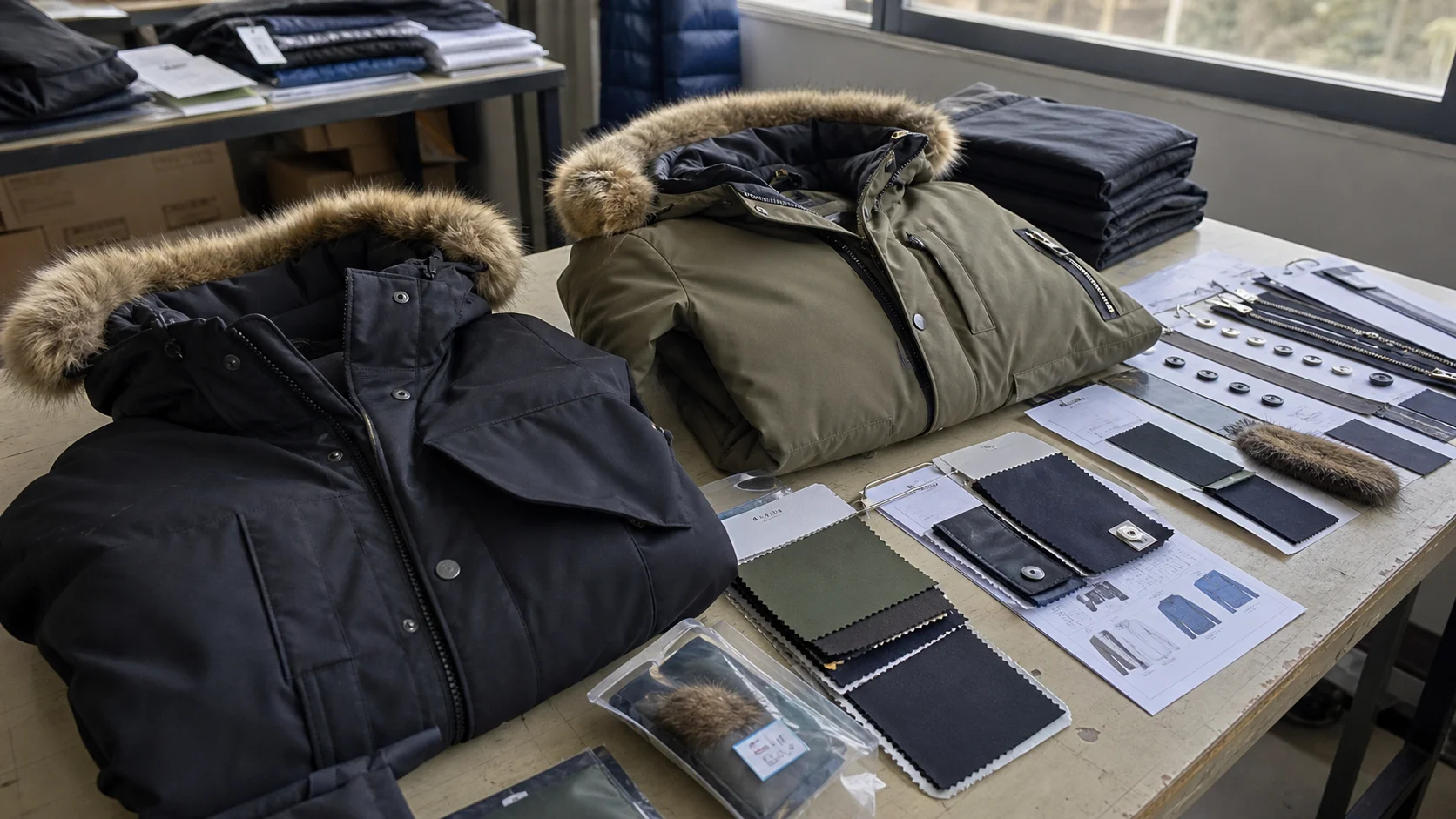
A quality-focused outline for retail operations teams reviewing thermal parka factory trim sourcing, from zipper durability and drawcord compliance to...
Thermal Parka Trim Sourcing Review for Retail Buyers - Quality & Inspection manufacturing guide
Thermal parka factory trim sourcing review for retail operations teams is not a side task. It is one of the main controls that determines whether a winter outerwear program ships on time, passes inspection, and performs in stores without avoidable returns.
Retail buyers often spend most of their attention on shell fabric, insulation weight, fit, and price. Those are critical. Yet the trim package can quietly create some of the most expensive problems in a thermal parka order: zipper failure, snap corrosion, drawcord non-compliance, weak hook-and-loop tape, color mismatch, loose faux fur shedding, label errors, and packing delays caused by missing components.
This review is written for retail buying, sourcing, production, and quality teams that need a practical way to evaluate parka trim sourcing at factory level. It focuses on commercial judgment: what to specify, what to approve, where risks usually appear, and how trim decisions affect MOQ, lead time, inspection results, and final retail margin.
A thermal parka is a system garment. The shell fabric, lining, insulation, quilting, hood, placket, pockets, cuffs, and closure trims all need to work together under cold-weather use. A weak trim decision can undermine an otherwise acceptable jacket.
For retail buyers, trim sourcing affects four areas directly: product performance, inspection pass rate, production timing, and consumer perception. A customer may not know the difference between two insulation suppliers, but they will notice a zipper that catches, a snap that pulls out, or a hood drawcord that feels cheap.
Retail operations teams also need to treat trims as supply-chain items, not decorative details. Zippers, snaps, toggles, labels, elastic cuffs, cord locks, faux fur, and hangtags all have their own MOQ, color approval, testing requirements, and shipment schedules. One late trim can hold up an entire parka line even when the cut fabric is ready.
Purchasing judgment: for thermal parkas, trim risk is usually higher than the unit cost suggests. A low-cost zipper saving can become a high-cost return issue if it fails during normal wear.
In factory sourcing reviews, buyers should ask whether the factory is buying trims from nominated suppliers, approved local vendors, or ad hoc market sources. Nominated trims provide more control but may increase lead time and price. Local trims can be faster and cheaper, but they require tighter testing, sample approval, and incoming inspection.
There is no single correct answer. The right trim sourcing model depends on order volume, retail positioning, target margin, selling season, compliance requirements, and how much product liability the buyer is willing to carry.
A complete trim review should cover every visible and functional component. Thermal parkas contain more trims than many buyers expect, especially when the style includes a detachable hood, storm placket, inner pocketing, rib cuffs, waist adjusters, and branded packaging.
The front zipper is usually the highest-risk trim on a thermal parka. It is used daily, exposed to cold, stress, moisture, and tension from bulky insulation. For mid-market and premium retail programs, buyers often specify branded zippers or at least require tested coil, molded plastic, or metal zippers from an approved trim supplier.
Common specifications include zipper type, tape width, slider size, puller design, teeth material, auto-lock or non-lock slider, color, bottom stop strength, and two-way function if required. A two-way zipper improves wearability on longer parkas but adds cost and increases failure risk if the quality is weak.
Typical risks include wavy zipper setting, poor slider movement, teeth separation, tape color mismatch, weak puller attachment, and zipper length inconsistency between size sets. Buyers should not approve a zipper only by appearance. Smoothness, strength, and compatibility with placket construction matter more.
Snaps are common on storm plackets, pocket flaps, detachable hoods, and cuff tabs. They can be metal, plastic, hidden, branded, or plain. Metal snaps need review for plating, corrosion resistance, cap strength, and attachment quality. Poorly set snaps can detach during wear or create sharp edges inside the garment.
Retail teams should specify snap size, finish, logo embossing if used, pull strength requirements, and placement tolerance. If the parka is sold in children’s or youth categories, small-part safety requirements become more sensitive and must be verified against the destination market.
Drawcords are used at hoods, waists, and hems. They affect function and compliance. Retail buyers must be careful with drawcord placement, free-end length, knots, toggles, and potential entrapment hazards, especially in children’s apparel.
For adult parkas, practical review points include cord diameter, elasticity, colorfastness, end tipping, toggle strength, and tunnel construction. For family retail programs, compliance review should happen before salesman sample approval, not during final inspection.
Faux fur trim can improve shelf appeal, but it adds sourcing and inspection risk. Length, density, color, backing quality, shedding, matting, and detachable construction should all be reviewed. A faux fur that looks acceptable on one sample can vary noticeably across bulk lots if the source is not controlled.
Buyers should request bulk lot confirmation and approve both appearance and attachment method. Detachable faux fur usually requires buttons, snaps, or zipper tape, each adding another trim control point.
Thermal parkas often use rib cuffs or elasticated inner cuffs to reduce cold air entry. Review rib composition, recovery, color, hand feel, and pilling tendency. Weak rib recovery makes a jacket feel old quickly, even if the shell fabric remains intact.
Elastic tapes should be checked for width, stretch recovery, wash stability, and sewing tension. Overstretched elastic during sewing can cause puckering and discomfort. Underpowered elastic reduces function.
Labels look simple, but they carry compliance and brand risk. Care labels, size labels, country-of-origin labels, hangtags, price tickets, barcode stickers, woven patches, rubber badges, and heat-transfer logos must match the retail buyer’s approved artwork.
Errors in fiber content, care instructions, RN numbers where applicable, country-of-origin wording, or barcode data can delay shipment or trigger rework. Retail operations teams should centralize approved label artwork and issue it with the technical pack.
Hidden trims deserve attention because they affect durability and inspection results. Pocketing fabric should be strong enough for keys, phones, and daily use. Binding tapes need correct width and color. Interlining must support areas such as plackets, pocket flaps, hood brims, and snap positions.
Cheap pocketing is a common false economy. It may pass visual inspection but fail after short use if the yarn, density, or seam strength is poor.
Trim sourcing should be reviewed together with shell fabric, lining, and insulation. Parkas are bulky garments, and trims must be suitable for thickness, seam construction, and intended wear conditions.
A zipper that works well on a lightweight jacket may not perform well on a heavily padded parka. Snap posts need the correct length for layered fabric and insulation. Cord locks must fit the drawcord diameter. Labels and patches need backing and stitching methods that do not damage coated or laminated fabrics.
Retail buyers should ask the factory to confirm trim compatibility during development sampling. This includes actual shell fabric, lining, insulation, and bulk-equivalent construction. Substitute sample materials can hide problems that appear later in production.
Trim Item Compatibility Check Inspection Risk Main zipper Works with garment thickness, placket, and hem length Jamming, wavy stitching, teeth separation Snaps Post length suits fabric layers and insulation Loose snaps, cap damage, pull-out failure Drawcord and toggle Cord diameter fits toggle and tunnel Slipping, fraying, compliance issues Rib cuff Recovery suits sleeve opening and lining bulk Loose cuffs, twisting, poor appearance Faux fur trim Attachment method suits hood shape Shedding, uneven length, color variationColor matching is another frequent issue. Trim suppliers may dye zipper tape, rib, drawcord, labels, and binding separately from the shell fabric. Even when all trims are listed as black, navy, olive, or beige, the undertone can differ under store lighting. For fashion colors, lab dip and bulk approval are important.
Retail teams should decide which trims must match exactly and which can be tonal. Exact matching increases complexity, cost, and lead time. Tonal matching can be acceptable for utility parkas, but it needs to be approved clearly so inspection teams do not reject reasonable variation.
Trim MOQ is one of the most practical issues in parka sourcing. A factory may accept a garment MOQ of 300 or 500 pieces per color, but custom trims may require much higher minimums. This is especially true for branded zippers, logo snaps, custom rubber patches, printed lining tape, molded toggles, or special faux fur.
Typical MOQ ranges vary by trim type, customization, and supplier market. Retail teams should treat the figures below as planning ranges, not guarantees.
Trim Type Typical MOQ Range Lead-Time Notes Standard zipper 300 to 1,000 pieces per color/length Faster if available from stock color cards Custom logo zipper puller 1,000 to 5,000 pieces Mold, plating, and approval add time Logo snaps 1,000 to 10,000 sets Finish and corrosion testing may extend timing Drawcord and elastic 500 to 3,000 meters Color dyeing can be the main delay Faux fur trim 300 to 1,000 meters Bulk lot variation needs early approval Woven labels 1,000 to 5,000 pieces Artwork approval is usually the bottleneck Rubber or silicone patch 1,000 to 3,000 pieces Mold development and color matching add riskRetail buyers should review trim MOQ before confirming assortment width. A style with six colors and low per-color quantities may look attractive on a line plan, but it can create excess trim inventory, surcharge requests, or factory resistance. It may also force the use of stock trims, reducing brand consistency.
Lead time depends on more than trim production. Approval cycles, courier time, lab testing, holiday closures, dyeing capacity, mold development, and payment terms all affect the schedule. A factory that says trims take 10 days may be referring only to production after approval and deposit. The full calendar can be longer.
For thermal parkas, trim lead times often become critical because outerwear orders need to hit seasonal delivery windows. Missing the autumn floor set can turn a profitable winter program into markdown exposure.
If a buyer needs fast replenishment, standard trims from reliable suppliers may be smarter than custom branded hardware. Customization improves perceived value, but it reduces flexibility when demand changes.
A strong sample process prevents most trim issues before bulk production. The process does not need to be complicated, but it must be disciplined. Retail operations teams should avoid approving a salesman sample as a full production standard unless all trim items are confirmed as bulk-available and tested.
The technical pack should list each trim with clear specifications. At minimum, include material, size, color, finish, placement, supplier requirement if any, testing requirement, artwork reference, and approved sample status.
Vague descriptions such as “good quality zipper,” “matching drawcord,” or “standard snap” invite disputes. A factory may interpret those phrases differently from a buyer or inspector.
Development samples are used to check concept, styling, construction, and early compatibility. At this stage, substitute trims may be acceptable if clearly marked. The buyer should record which trims are temporary and which are proposed for bulk.
If the sample uses substitute trims, do not rely on it for final cost or delivery assessment. The actual trim package may change both.
For dyed trims such as zipper tape, drawcord, rib, elastic, binding, and faux fur, lab dips or trim color submissions should be reviewed under standard light sources. For printed or molded trims, strike-offs should confirm artwork, color, size, and finish.
Approval should be documented with date, approver, version, and reference number. This helps prevent a factory from using an old artwork file or unapproved color.
The fit sample should use trims close to bulk standard. The size set should confirm that zipper lengths, pocket placement, drawcord lengths, hood trim, and label placement scale correctly across sizes.
Parka trims can behave differently across size ranges. A zipper length that works on a medium may look unbalanced on an extra-small or strain at the hem on larger sizes if grading is not reviewed.
The pre-production sample should represent the approved bulk trim package. This is the most important approval before cutting. It should include the actual zipper, snaps, cord locks, labels, patches, faux fur, rib cuffs, and packaging trims.
Retail buyers should not release bulk production if major trims are still pending. Doing so shifts risk from development to production, where fixes are more expensive.
A bulk trim card is a physical reference containing approved trims for inspection and production control. It should be signed or digitally approved and shared with the factory, buyer, third-party inspection team, and internal quality staff.
This card is especially useful when colors are similar, trims have multiple finishes, or the order includes several styles in the same program.
Trim-related defects can appear at incoming material inspection, inline inspection, final inspection, or after retail sale. The earlier they are caught, the lower the cost.
Factories should inspect trims before sewing. Final inspection is too late to discover that snap plating is wrong or zipper tape color does not match. At that stage, the garment may require rework, replacement, discount acceptance, or shipment delay.
Inspection should include repeated open-close checks, visual alignment review, and stress checks at high-tension points. For long parkas, two-way zippers need extra attention because consumer misuse and poor slider quality both increase failure rates.
Snap issues often come from machine setting, incorrect post length, or insufficient reinforcement. Buyers should require the factory to conduct inline pull checks, especially on plackets, pocket flaps, and hood attachments.
Drawcord issues are not only cosmetic. In some categories and markets, they can become safety and regulatory problems. Retail operations teams should align product design with compliance review early.
Faux fur can create consumer complaints quickly because defects are visible. If a program is price-sensitive, a clean hood shape without faux fur may be more reliable than a low-grade faux fur trim.
Label mistakes are operationally painful because the garment itself may be acceptable, but the shipment cannot move cleanly. Retailers should lock label approvals before bulk production and use SKU-level packing checks.
Trim sourcing is a balancing exercise. Retail teams need enough quality to protect the customer experience, but not every parka needs premium branded hardware. The right decision depends on selling price, expected wear, brand promise, and return tolerance.
For opening-price parkas, standard trims can be acceptable if tested and consistent. The danger is cutting too deeply on zippers, snaps, pocketing, and labels. These components are small in cost but large in failure visibility.
For mid-tier parkas, buyers should usually prioritize reliable zippers, secure snaps, decent rib recovery, and accurate labels over purely decorative trims. A custom patch may support branding, but it should not come at the expense of functional hardware.
For premium parkas, trim quality becomes part of the value proposition. Zipper smoothness, metal finish, branded pullers, soft pocketing, controlled faux fur, reinforced plackets, and refined label execution all affect perceived quality.
Retail Position Recommended Trim Strategy Main Tradeoff Opening price Use reliable standard trims with basic testing Limited branding and fewer custom options Mid-market Upgrade functional trims, control color and labels Moderate cost increase but better return protection Premium Use approved branded or custom trims with full testing Higher MOQ, longer lead time, tighter approval needsThe strongest purchasing decision is often not the cheapest or most expensive option. It is the option with the lowest total risk for the retail plan. A trim package that saves $0.40 per unit but increases return claims, rework, or late shipment risk may not be a saving.
Retail buyers should also consider continuity. If the parka is planned as a repeat style, using stable trims from repeatable suppliers supports long-term consistency. If the product is a short seasonal fashion buy, the team may accept more standard trims to protect speed and reduce inventory liability.
A factory’s trim sourcing process reveals a lot about its production discipline. Buyers should not only ask for prices. They should ask how trims are sourced, tested, received, stored, and controlled.
Answers should be specific. If the factory cannot explain where the zippers, snaps, labels, and drawcords come from, the buyer should assume higher risk and tighten approval requirements.
Retailers that need sourcing support, production follow-up, or inspection planning can review available service structures at fabrikn.com/services/. For teams evaluating supplier communication and order control, early alignment is usually more useful than late-stage problem solving.
Testing should be aligned with the product category, destination market, retailer standards, and risk level. Not every order requires an expensive full test package, but functional trims on thermal parkas should not be accepted without basic performance checks.
Common test areas include colorfastness, corrosion resistance, nickel release where relevant, pull strength, seam strength, zipper strength, dimensional stability, pilling, abrasion, and restricted substances. For children’s outerwear, safety testing and drawcord compliance become more important.
Buyers should confirm whether testing is performed on components, finished garments, or both. Component testing is useful before production. Finished garment testing confirms that trims perform after sewing and construction.
Test Area Relevant Trims Reason for Review Pull strength Snaps, buttons, patches, zipper pullers Prevents detachment and safety complaints Colorfastness Zipper tape, rib, drawcord, faux fur, labels Controls staining and shade change Corrosion resistance Metal snaps, rivets, zipper parts Reduces rust, staining, and finish failure Zipper performance Main zipper, pocket zippers, hood zippers Checks strength, smoothness, and durability Restricted substances All trims, especially coated and plated items Supports chemical complianceTesting schedules should be built into the production calendar. If testing starts only after bulk garments are finished, a failure can create a major shipment problem. Early component testing is usually cheaper than finished-garment rework.
Retail operations teams need a repeatable checklist for trim control. The checklist should be used before order placement, during sample approval, before bulk production, and before final inspection.
This structure helps teams avoid a common mistake: treating trims as one line item. A parka may have twenty or more trim elements, and each can affect shipment acceptance.
Some warning signs should trigger closer review before purchase order confirmation. A low quoted price can be valid, but it must be supported by clear trim assumptions.
These are not automatic deal-breakers. They are signals that the buyer should slow down and clarify risk. In outerwear, rushing a trim decision often moves problems into the final inspection window.
Teams that want to discuss sourcing controls or supplier coordination can use fabrikn.com/contact-us/ to start a more specific conversation about order requirements, inspection priorities, and production follow-up needs.
Retail returns are not always caused by dramatic failures. Many are caused by small disappointments: rough zipper movement, loose threads near trim attachments, cuffs that stretch out, weak pocket closures, or snaps that feel cheap.
Thermal parkas are usually higher-ticket seasonal items. Customers expect them to perform in cold weather, look durable, and feel secure. A buyer can meet the fabric specification and still receive complaints if trims do not support the garment’s intended use.
Return risk increases when the trim package is inconsistent across colors or production lots. A black parka with smooth zippers and strong snaps may receive good reviews, while the olive colorway from a later trim lot may receive complaints. Operations teams should compare trim consistency across all colorways, not only the first approved sample.
Online retail makes trim quality even more visible. Product reviews often mention zipper quality, pocket function, hood fit, and drawcord usability. These comments influence future conversion, not just one season’s return rate.
Good documentation reduces disputes between buyer, factory, agent, and inspector. It also helps new team members understand what was approved and why.
Documentation does not need to be excessive, but it must be controlled. Multiple versions of label artwork or zipper puller design can create confusion. A single approved source of truth is essential.
For broader context on supplier management and apparel production support, buyers can review company background information at fabrikn.com/about-us/. The main point for retail teams is to connect sourcing decisions with inspection controls before production risk becomes visible.
A thermal parka trim sourcing review should not be treated as administrative detail. It is a commercial control point. The trim package influences quality perception, inspection outcome, delivery timing, compliance exposure, and return rate.
The best approach is not to over-specify every component. That can raise cost, slow production, and create MOQ problems. The better approach is to identify critical trims, approve them properly, test them where risk justifies it, and make clear tradeoffs between customization, cost, and speed.
For most retail parka programs, the highest-priority trims are the main zipper, snaps, drawcords, rib cuffs, faux fur if used, labels, and packaging identifiers. These items should be reviewed before order confirmation and locked before bulk production.
Retail operations teams should insist on three practical controls: a clear trim specification sheet, a bulk-approved trim card, and an inspection checklist that treats trims separately from sewing. Those controls do not guarantee perfection, but they sharply reduce preventable failures.
Buyer takeaway: spend more time on trims before production starts. It is cheaper to reject a weak zipper, incorrect snap, or risky drawcord at sample stage than to negotiate rework after finished parkas are packed.
Get a free quote from Fabrikn — your trusted B2B clothing manufacturer with 10+ years of experience. MOQ as low as 200 pieces.
Get a Free Quote →Trim sourcing is the process of selecting, approving, purchasing, and controlling all non-main-fabric components used in the parka. This includes zippers, snaps, drawcords, toggles, labels, rib cuffs, faux fur, patches, pocketing, binding, hangtags, and packaging trims.
The main front zipper, snaps, drawcords, faux fur, rib cuffs, and labels usually create the highest risk. They affect function, appearance, compliance, and customer satisfaction. Zippers and snaps are especially important because they receive repeated stress during wear.
Standard trims may start around 300 to 1,000 pieces or meters, depending on the item. Custom trims such as logo snaps, molded pullers, rubber patches, and special dyed components often require 1,000 to 10,000 pieces. Exact MOQ depends on supplier, material, color, and customization level.
Critical trims should be reviewed during development and approved before pre-production sample signoff. Bulk production should not begin until the actual trim package is approved or the buyer has accepted the risk in writing.
Nominated suppliers provide stronger control and consistency but may increase cost and lead time. Factory-sourced trims can be faster and more flexible, but they require tighter approval, testing, and incoming inspection. The better option depends on order volume, retail price point, and risk tolerance.
Thermal parkas are bulky, and the zipper must work across thick fabric, insulation, plackets, and seam intersections. Poor zipper quality, incorrect length, weak slider performance, and uneven sewing can all cause problems. Two-way zippers add convenience but need stronger quality control.
Retail teams can reduce failures by issuing clear trim specifications, approving a physical or digital trim card, testing critical components early, confirming trim delivery before sewing, and giving inspectors trim-specific checkpoints. Incoming factory inspection is also important.
Not always. Exact matching may be important for premium or fashion-focused parkas, but tonal matching can be acceptable for utility styles. The key is to define the acceptable standard before production so factories and inspectors use the same expectation.
The technical pack should include trim descriptions, dimensions, materials, colors, finishes, placement, artwork references, supplier requirements, testing needs, and approval status. Label and packaging artwork should be version-controlled to prevent SKU and compliance errors.
Low-cost trims can be acceptable when they are standard, tested, and suitable for the garment. The risk comes from using weak functional trims to meet a target price. For most parkas, saving too much on zippers, snaps, pocketing, or labels creates more risk than value.