
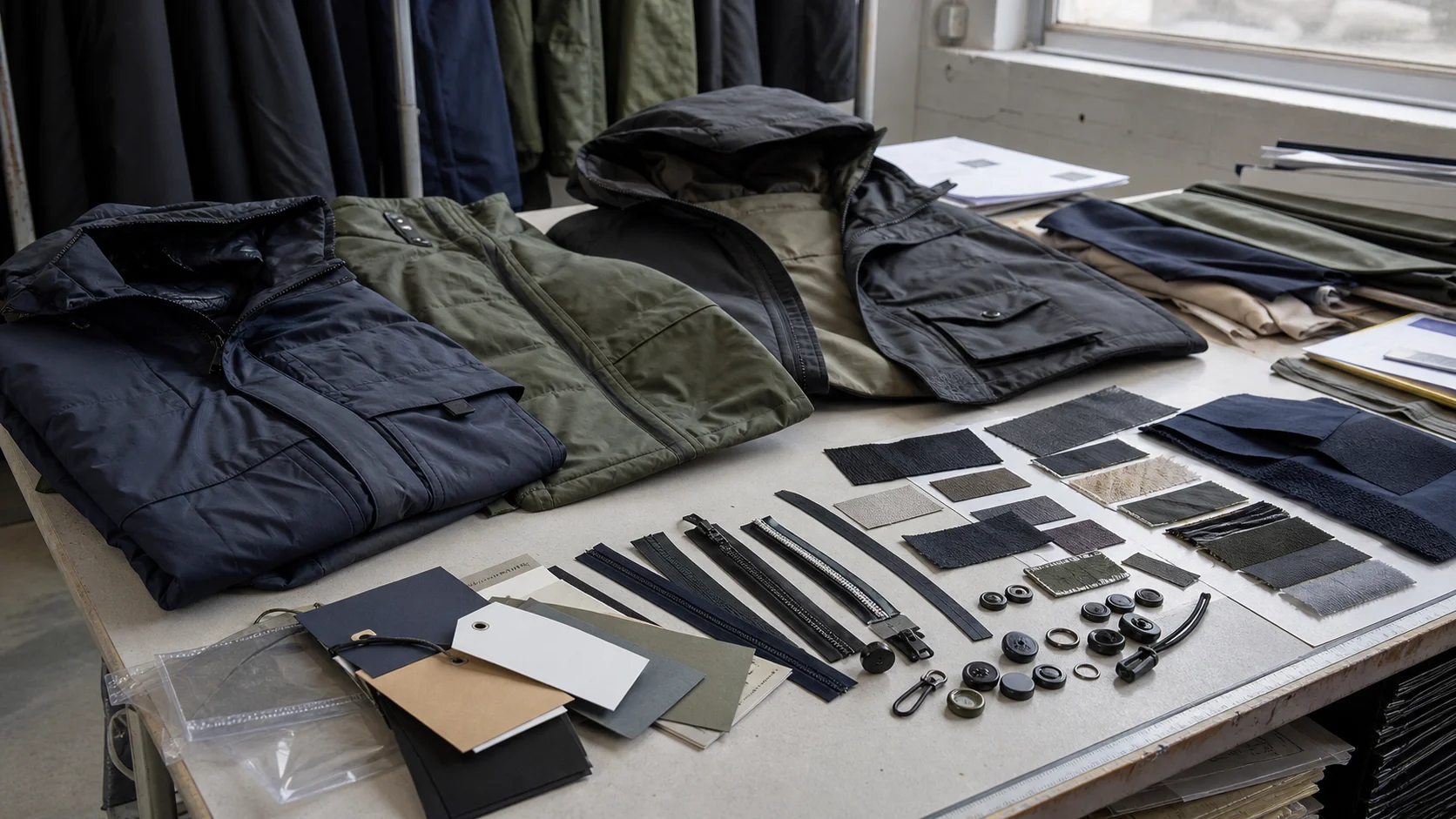
A product-specific review of thermal parka trim sourcing for retail operations teams, covering trim quality, inspection checkpoints, performance risks, and...
Retail teams sourcing thermal parkas tend to focus on the outer shell, insulation, and price first. That is understandable, but trim sourcing can make or break the final product. Zippers, snaps, drawcords, cordlocks, hook-and-loop tape, labels, seam tape, elastic, and faux-fur components all affect appearance, function, compliance, and repeatability. When the trim package is weak, the garment can fail inspection, miss launch dates, or create avoidable return risk in the market.
This review is written for retail operations teams that need a practical sourcing view of thermal parka trim selection. The goal is not to overcomplicate the process. It is to show where trim decisions usually affect cost, lead time, quality consistency, and fit performance, so buying teams can reduce surprises before bulk production.
Thermal Parka Trim Sourcing Review for Retail Teams - Fabrikn production reference
Thermal parkas are technically demanding garments. They need weather resistance, warmth, durability, and a clean retail finish. Trims support all four requirements. A zipper that freezes, a snap that pops open, or a drawcord that frays can quickly turn a good-looking coat into a problem item.
From a retail operations standpoint, trim sourcing is not just a product detail. It affects factory planning, incoming inspection, testing, replenishment, and markdown risk. Trims also influence how easy a parka is to produce consistently across size runs and colorways. In outerwear, even small changes in trim sourcing can shift the overall production schedule because several trims have long procurement cycles and limited substitute options.
The practical issue is that many thermal parka programs start with a seasonal calendar already under pressure. When trims are not approved early, production delays tend to cascade. Shell fabric may be ready, but the garment cannot move into cutting or sewing if the final zipper, button, or reflective detail is still pending confirmation. That delay matters more in outerwear than in simpler categories because the supply chain usually has more components and more testing steps.
Retail teams should review thermal parka trims as a complete system, not as isolated parts. The following components are the most common points of sourcing control.
Zippers are often the most important functional trim in a thermal parka. Main front zippers may need to be reversed coil, molded tooth, or metal depending on design and weather performance. A two-way zipper is common in longer parkas because it improves mobility. Puller size, tape width, slider finish, and anti-snag performance should be checked early.
For cold-weather outerwear, zipper quality affects both user comfort and failure rate. Retail teams should confirm whether the factory is sourcing from a consistent approved zipper supplier, or whether equivalent substitutions are allowed. Substituting zipper brands late in the process can create fit, color, or smoothness differences that are visible at inspection.
Snaps are used on storm flaps, pockets, cuffs, and detachable components. They seem simple, yet they are common inspection risk items because they can crack, loosen, or misalign. For thermal parkas, snap strength should be matched to fabric thickness and reinforcement. If the shell is stiff or heavily padded, the snap installation method becomes important.
Magnetic closures are less common in performance parkas but may appear in fashion-led retail programs. These need careful review because they can complicate compliance and durability testing depending on the market.
Waist and hem adjusters improve warmth retention and fit. Hood drawcords affect comfort and wind resistance. Cord material, tip finish, and cordlock tension should be specified clearly. Thin, low-grade cords tend to fray, while weak cordlocks can slip during wear.
Retail buyers should be careful about elastic cord substitutions. A cord that looks acceptable in development can behave differently under cold conditions or repeated wash testing. That risk rises when the supplier is using locally sourced trim alternatives to meet target cost.
Hook-and-loop tape is common on storm flaps, cuffs, and internal adjustment points. The main issue is not only adhesion strength but also noise, lint pickup, and cycle life. Poor-quality tape often loses grip too quickly or curls after repeated use.
For retail outerwear, a noisy or bulky hook-and-loop closure can make the garment feel cheaper than intended. That matters in premium or mid-premium segments where hand feel and closure performance influence customer perception.
Brand labels, size labels, care labels, and country-of-origin labels are small items with significant compliance impact. Retail teams should confirm content, placement, and attachment method. Heat-transfer labels may feel cleaner, while woven labels are often more durable. Care labels must be readable and correctly formatted for the target market.
Label sourcing also affects inspection because wrong label content is a frequent cause of shipment holds or rework. It is not enough to approve artwork. Material, print clarity, and wash durability should also be checked.
Elastic is often used at cuffs, waist sections, hood openings, or internal adjusters. Webbing supports straps, hang loops, and attachment points. Tape may be decorative, reflective, or structural. These items look basic, but they need consistent width, stretch recovery, and color matching.
Reflective tape deserves special attention because it can be subject to performance requirements in some markets. The appearance under standard light and the reflectivity under test conditions are not the same issue, and both should be reviewed.
Many thermal parkas use faux-fur hood trim or detachable trim pieces. These items are highly visible and often consumer-sensitive. Fiber length, density, backing, dye lot control, and attachment system need scrutiny. A poor faux-fur match can be obvious across a production lot, especially if the main body fabric and trim are sourced from different vendors.
Detachable components also increase complexity. Snaps, zips, and attachment loops must align properly, and the product should still pass wear and wash expectations after detachment and reattachment.
When reviewing a thermal parka supplier’s trim sourcing approach, retail operations teams should look beyond price quotes. A low trim price may hide weak control over color consistency, testing, minimums, or delivery reliability. The supplier review should focus on the following areas.
Ask whether the supplier works from an approved trim list or chooses trims case by case. Approved source control reduces variation. If the supplier offers substitutes, the team should ask how substitutions are approved, who signs off, and whether a physical counter sample is required before bulk release.
Outerwear trims need visible alignment with shell fabric, lining, and branding. Zipper tape, snaps, labels, cords, and faux-fur should all be reviewed against target standards. Color differences may be acceptable for some hidden components, but not for visible trims. Retail teams should insist on color lab dips or physical references where relevant.
Trims should be tested for the expected use environment. That may include zipper cycle testing, colorfastness, rust resistance, pull strength, and wash performance. The right test depends on the trim type and the market. The key question is whether testing is built into the sourcing process or only handled after a problem appears.
A strong trim supplier is not only a vendor of parts. It is also part of production readiness. The supplier should be able to confirm lead times, package quantities, labeling format, and whether trims can be delivered in line with factory production staging. Retail teams should watch for mismatch between trim delivery and garment production timing.
At minimum, teams should ask for trim specifications, color references, material composition, test reports if available, and batch identification where applicable. Traceability matters when a problem appears after shipment. Without it, root-cause investigation becomes slower and more expensive.
Retail trim sourcing is usually less about finding the cheapest component and more about reducing uncertainty. A slightly higher trim cost is often easier to absorb than a delayed shipment or a failed inspection.
MOQ ranges vary widely by trim type, customization level, and supplier base. Retail teams should treat the following as typical working ranges rather than fixed rules.
Trim Type Typical MOQ Range Lead-Time Notes Main Risk Main zipper 1,000 to 5,000 pcs per color/style May require longer lead time if custom pullers or tape colors are involved Color mismatch, delayed approval Snaps / studs 5,000 to 20,000 sets Usually faster for standard finishes, slower for special plating Rust resistance, installation defects Drawcord / cordlock sets 1,000 to 3,000 sets Custom colors or molded shapes extend timing Slippage, fraying Hook-and-loop tape 1,000 to 10,000 meters Cut-to-length packaging can affect schedule Grip failure, curling Labels 500 to 5,000 pcs per artwork Content approval is usually the time driver Incorrect legal content Faux-fur trim 200 to 1,000 meters Higher variation when pile height or backing is custom Shade variation, attachment issuesLead times depend on several factors: whether the trim is stock or custom, whether color matching is required, whether tooling is needed, and whether the supplier is holding raw materials. For retail programs, a practical plan is to assume that custom trims will take longer than expected unless the supplier has already proven repeat supply on the same construction.
Shipping mode also matters. A trim component can be technically ready, but if it is moving by sea in small quantities, the procurement calendar may still not support an on-time factory start. Teams should build trim timing into the garment critical path, not treat it as a separate purchase.
Sample approval should be treated as a staged process, especially for thermal parkas. A single approved photo is not enough. Retail teams should expect a sequence that may include trim swatches, lab dips, sewn development samples, fit samples, pre-production samples, and finally a sealed approval sample or top-of-production reference.
Retail operations teams should be strict about sample continuity. If one sample uses a different zipper or cord than the intended bulk version, the approval loses value. That issue happens more often than it should, especially when development uses substitute trims to save time.
The safest approach is to ask the supplier to identify every trim on the sample with supplier name, item code, material, and color reference. This may feel administrative, but it reduces ambiguity later when a disputed shipment needs review.
Thermal parka trim sourcing becomes easier when the technical package is specific. Vague trim descriptions create room for interpretation, and interpretation creates risk. Retail teams should lock down the following details where relevant.
Fabric and trim compatibility is worth extra attention. A trim that works on a light nylon shell may not work on a heavier coated fabric or a padded construction. Reinforcement points, stitch density, and needle penetration can all change with the base material. When the wrong trim is paired with the wrong fabric, the factory may compensate during sewing, which often shows up later as uneven finishing or weak attachment.
Quality and inspection teams see the same trim issues repeatedly. The patterns are predictable, which makes them preventable. Retail buyers who understand the common failure points can reduce surprise claims and avoid expensive rework.
Inspection risk is higher when the order is split across multiple trim lots. That can happen when a supplier buys trims in smaller batches to manage cash flow or when there is a shortage in one color. Retail teams should ask whether all production units will use one trim lot, and if not, how lot-to-lot consistency will be controlled.
Packaging is another overlooked issue. Metal trim and hardware can scuff shell fabric during transport if not packed carefully. Small trims should be bagged and labeled clearly. If a supplier bundles multiple trim types loosely, the risk of missing pieces and line-side confusion increases.
Trim sourcing is full of tradeoffs. A team can reduce unit cost by accepting stock trims, simpler finishes, or wider supplier substitution rights. That may be reasonable for value programs. The tradeoff is that the garment can lose visual consistency or long-term reliability.
In premium thermal parkas, visible trim quality matters more than many teams expect. A stronger zipper pull, cleaner label application, and better faux-fur finish can support perceived value. In contrast, a visible mismatch in hardware or a rough cord finish can undermine the product before the customer even tries it on.
The right balance depends on the retail positioning. For high-volume basics, the trim package should be simple, durable, and repeatable. For higher-margin outerwear, the sourcing plan should allow more control and more approval gates. The cheapest trim is not always the least expensive choice once returns, chargebacks, and markdowns are included.
When reviewing a thermal parka supplier’s trim sourcing capability, retail operations teams should ask direct questions. These are practical questions, not formalities.
Teams looking for support across development, sourcing coordination, and production readiness may want to review Fabrikn’s services page for the scope of support available. For supplier conversations or project requests, the contact page is the fastest route. Buyers who want a better understanding of the company background can also review the about page.
Good trim sourcing is usually the result of disciplined process, not luck. A few habits make thermal parka programs more reliable.
Retail teams should also think in terms of resale risk. A trim issue rarely affects only one unit. It can damage the whole size run, create service tickets, or force a store-wide markdown if the defect is visible. That is why trim control belongs in the quality plan, not just the buying checklist.
For thermal parkas, the best sourcing decision is usually the one that keeps product performance stable while allowing the factory enough time to produce cleanly. That means choosing trims that are technically sound, commercially practical, and easy to approve before bulk.
Thermal parka trim sourcing deserves more attention than it often gets. Retail teams that review trims carefully can improve product durability, reduce inspection issues, and protect launch timing. The most important controls are straightforward: approve the right trim sources, confirm detailed specifications, manage sample stages properly, and watch MOQ and lead time dependencies early.
In outerwear, trim is not decoration. It is part of the product’s performance story. A practical sourcing process will treat it that way from the first development sample through final inspection.
Get a free quote from Fabrikn — your trusted B2B clothing manufacturer with 10+ years of experience. MOQ as low as 200 pieces.
Get a Free Quote →Main zippers, snaps, drawcords, cordlocks, labels, hook-and-loop tape, and faux-fur trims are usually the most critical. These components affect function, appearance, and inspection risk.
It depends on the trim type. Zippers may start around 1,000 pieces per color or style, while snaps can require much larger set counts. Labels often have lower MOQs. Custom trims usually require higher minimums than stock items.
Because trim sourcing often depends on color matching, testing, and supplier lead times. If a zipper, label, or faux-fur component is not approved, the factory may not be able to start or finish production on time.
Common issues include zipper snagging, snap misalignment, label errors, weak hook-and-loop grip, rust on metal parts, and uneven faux-fur appearance. Lot-to-lot variation is also a frequent problem.
Only with control. Substitutions can help protect timelines, but they should be reviewed for appearance, fit, compliance, and test performance before bulk use.
Start with detailed specifications, approved references, and incoming inspection. Keep the trim package consistent across production lots and avoid late changes unless there is a clear technical reason.