
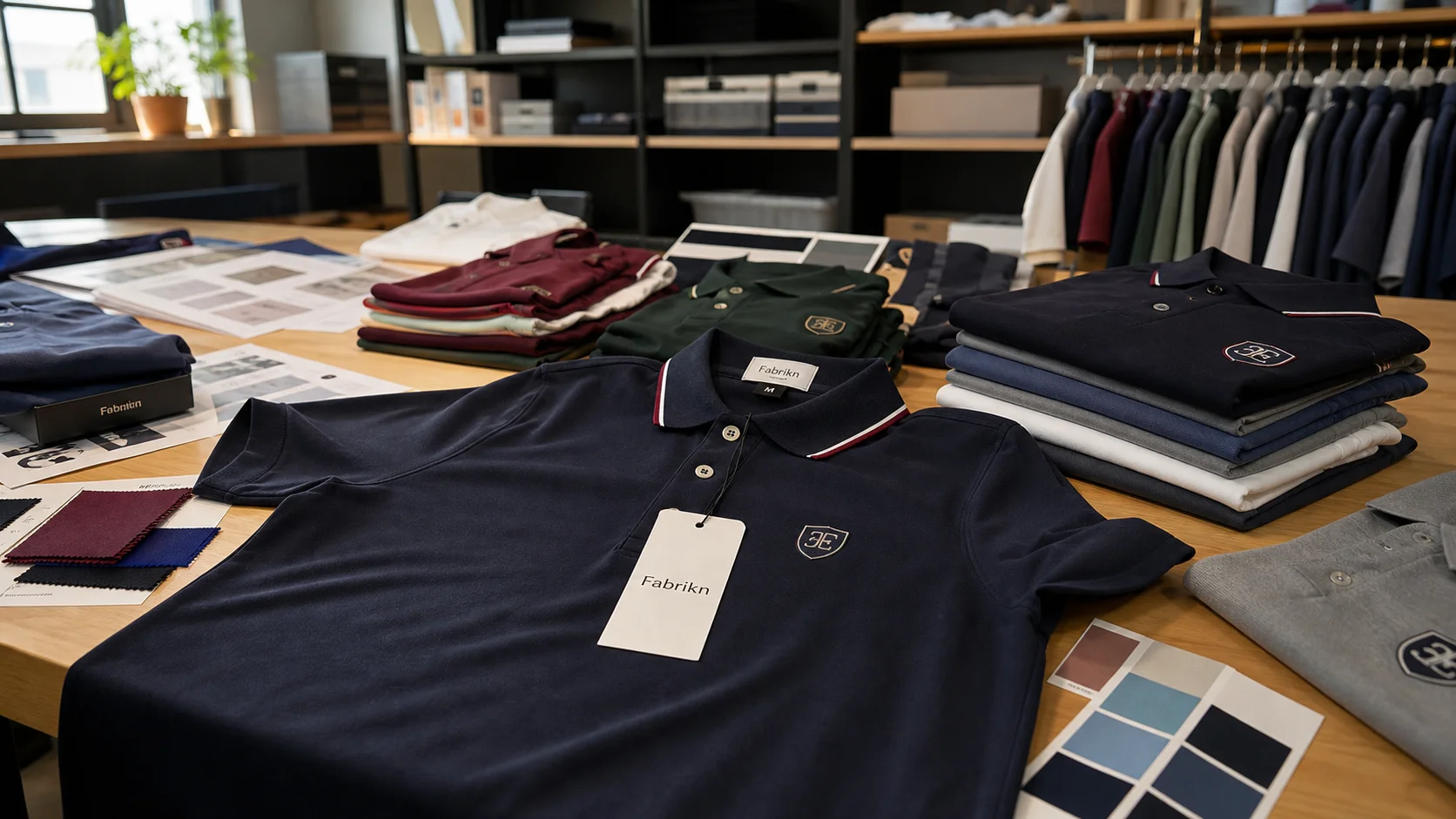
A focused outline for evaluating heat transfer durability on logistics uniforms and jackets, with checks tied to abrasion, laundering, flexing, and field use.
Top 5 Heat Transfer Checks for Logistics Jackets - Fabrikn production reference
Logistics jackets work harder than most buyers expect. They get worn over base layers, zipped and unzipped repeatedly, packed into lockers or vehicle cabins, exposed to weather swings, and washed often. If a heat transfer graphic, logo, role mark, or safety identifier fails early, the jacket still exists, but the uniform program starts to look careless.
That is why durability checks for heat transfer decoration should be treated as a sourcing issue, not a design detail. A label, badge, or logo that peels after a few wash cycles creates replacement cost, rework cost, and brand inconsistency. In logistics uniforms, failure is usually visible before it becomes technical. Edge lift, gloss change, cracking, or print distortion can make a jacket look tired long before the garment itself wears out.
Buyers typically focus on jacket shell fabric, lining, and weather performance first. That is right, but incomplete. Decoration method, film chemistry, and application control can decide whether a program holds up across season changes and repeated laundering. For most uniform programs, the practical question is not whether a heat transfer can pass a lab test in one perfect sample. It is whether it stays intact after real use, standard care, and a reasonable margin of abuse.
The first check is straightforward: can the heat transfer survive routine laundering and surface wear without losing legibility or edge integrity? For logistics uniforms, this is the baseline test. Jackets may be washed less often than T-shirts, but they still face abrasion from seat belts, conveyor contact, backpacks, shelving, and repeated folding.
A proper wash resistance check should look at both appearance and adhesion after multiple cycles. Many buyers use a practical benchmark of 20 to 50 home-laundry cycles, depending on program expectations and price point. For some lower-cost promotional outerwear, a smaller cycle target may be accepted. For managed uniform programs, a stronger wash profile is usually worth the added cost.
Surface abrasion matters as much as wash performance. A transfer that survives washing can still scuff at the edges if the jacket fabric is textured or if the graphic sits in a high-contact zone. The risk rises on coated shells, ripstop fabrics, and brushed polyester surfaces, where the transfer may not bond evenly or may show visible wear earlier than expected.
Good sourcing practice is to test after the garment is fully assembled, not on fabric swatches alone. Construction details change behavior. A seam near the graphic, a zipper tape running beside the transfer, or a pocket edge can alter pressure distribution during pressing and later use. That is often where small failures begin.
For logistics jackets, a transfer that looks perfect on day one but loses edge quality after routine wash and rub testing is not a strong commercial choice, even if the garment itself passes.
Adhesion is the core technical question. If the bond between transfer and shell fabric is weak, the rest of the performance discussion becomes secondary. Peel strength testing should confirm that the transfer does not lift at corners, lift from textured areas, or detach after laundering and flexing.
Buyers should ask suppliers how adhesion is measured. Not every factory uses the same method, and not every result is meaningful without context. The important part is consistency across the actual jacket fabric, not just the transfer film alone. Polyester shells, nylon blends, and PU-coated fabrics can behave very differently under heat and pressure.
One common sourcing mistake is to approve a transfer based only on a press-room sample. That sample may have received ideal temperature, dwell time, and pressure. Production reality is less tidy. Operators vary, platen calibration drifts, and batch-to-batch differences in film thickness can affect the bond. That is why peel testing should be repeated across a small production run, not just a first strike-off.
For typical logistics uniform programs, the MOQ for custom heat transfers can start in the low hundreds, but practical minimums depend on the decoration type, color count, and whether the supplier is buying from an external transfer vendor. Small runs often carry higher per-piece cost because setup and approval time are fixed while volume is limited. Buyers should weigh that against the cost of a uniform recall or rework.
In purchasing terms, strong adhesion is worth paying for. Weak adhesion creates hidden expense. It increases inspection time, raises complaint risk, and tends to fail at the worst time, usually after garments have already been distributed.
Logistics jackets are not only worn; they are handled during production, packing, and post-production finishing. Heat transfer graphics need to tolerate the kinds of heat exposure that occur during garment pressing, folding, and occasional remedial work. The check here is whether the transfer softens, shines, shrinks, or reactivates in ways that damage the jacket.
This matters more on outerwear than on basic knits. Jacket shells often use performance coatings, waterproof membranes, or laminated layers. Excessive heat can deform the shell fabric, imprint the transfer into the surface, or cause localized glossing. That is a garment issue, not just a decoration issue.
Buyers should confirm the transfer application temperature window and the shell fabric heat tolerance before production starts. That temperature window is not a suggestion. It is a boundary. If the garment uses sensitive trims, reflective tape, or heat-reactive finishes, those components can be damaged even when the transfer itself appears fine.
Repressing is another useful check. Uniform programs often need small corrections after sewing or after inspection. A well-made transfer should survive one controlled repress cycle without visible distortion. If it cannot, the production team will need to avoid rework in the graphic zone, which is not always realistic on a busy line.
Lead time also depends on this check. If the sample approval process includes only one transfer method and no fallback option, a failure here can push the full order back while a second round of testing is arranged. For seasonal outerwear, that delay can be expensive.
Logistics jackets bend constantly. Elbows flex, shoulders move, backs fold, and cuffs get pulled over layers. A transfer that looks stable on a flat table can crack once the garment is worn in motion. That is why flex testing is essential, especially on areas near sleeves, side panels, and chest positions that move with the body.
Flex crack checks should be done after washing and after a controlled stretch or bend cycle. The aim is to see whether the image develops hairline cracks, surface whitening, or partial separation. Thin films often look clean initially, while thicker films may resist cracking better but feel stiffer and show a heavier hand.
There is always a tradeoff. A softer transfer usually improves comfort and drape, which is useful on jackets that are worn all day. A tougher, thicker transfer may deliver better durability but can look more industrial and less refined. The right answer depends on brand position, garment fabric, and the visibility of the graphic area.
Stretch recovery is especially important on jackets made from stretch polyester or softshell materials. Those shells move more than woven canvas-style fabrics, so the transfer needs to move with the garment without splitting. If the decoration sits across a seam or curved panel, the risk rises. Buyers should avoid approving oversized graphics in high-flex areas unless the supplier has already proven that placement on the same construction.
For outerwear programs, the safest route is to request a physical wear test on a stitched sample, not only a print panel. Decoration that performs on a flat test sheet may underperform once attached to the full jacket. That is a production reality worth paying attention to early.
Durability is not only about chemical bonding and surface integrity. It is also about whether the decoration remains functional in the field. Logistics uniforms often rely on heat transfers for role identification, branding, or compliance marks. If the transfer is poorly placed, too small, obscured by zips or seams, or washed out visually against the shell color, the jacket fails its purpose even if the print technically survives.
A field wear check should examine visibility under real working conditions. That means looking at the jacket with the wearer moving, bending, carrying parcels, sitting in vehicles, and working in low light if reflective elements are part of the design. Placement must remain readable from the intended distance. The transfer should not sit where straps, harnesses, or bags will rub it constantly.
Heat transfers on outerwear can also fail through poor proportional design. A logo that is too large can crease around a pocket edge. A badge that is too small can become unreadable once it starts to wear. In logistics, clarity usually beats decoration. Straightforward placement, restrained sizing, and good contrast are more useful than decorative complexity.
Ask the supplier for a placement mockup on the actual pattern, not just on a flat front view. Jacket construction changes where a transfer lands. Pockets, darts, storm flaps, and curved hems all matter. A strong looking design on paper can become awkward once it meets the sewn garment.
Several technical choices shape how a heat transfer performs on logistics jackets. These are worth locking down before bulk production begins.
Thread color, zipper tape, and reflective trims can also influence the final look. A transfer that appears strong on white sample fabric may disappear on dark high-vis shells unless opacity is specified correctly. If the jacket is part of a safety program, visibility needs to be judged under the same light conditions the wearer actually faces.
Documentation helps. A clear tech pack should state artwork dimensions, Pantone references where relevant, placement tolerances, acceptable edge behavior, and the minimum wash standard. Ambiguity usually becomes a production dispute later.
For buyers sourcing through a service partner, it is worth reviewing the decoration method alongside the garment build. Fabrikn’s services page is a practical place to review how apparel development and production support can be structured around those decisions.
A disciplined sample process saves time later. For heat transfer durability on logistics jackets, the usual approval path should include a strike-off or lab dip equivalent for the transfer, a pre-production garment sample, and a wash or wear test on the final jacket construction.
Start with artwork confirmation. Then confirm transfer type, finish, and placement. After that, request a sample on the actual shell fabric. If the jacket includes multiple trims or performance layers, the sample should reflect the final material set, not a simplified test build. Otherwise, the approval may not mean much.
Typical lead time depends on transfer sourcing, jacket complexity, and sample rounds. A basic sample can be turned faster than a fully engineered outerwear sample, but any revision adds time. If the program depends on reflective or specialty film, expect less flexibility. Those materials often have their own supply constraints and press requirements.
Buyers should also confirm the number of approval rounds allowed before bulk is released. One round may be enough on a mature repeat order. New programs usually need more. Cutting corners here can save a week and cost a season.
If the order is sensitive or the schedule is tight, align early with the production team through the supplier’s contact-us page. Clear communication at the start often prevents an expensive assumption later.
Inspection for heat transfer jackets should cover both visual and functional risk. The most common issues are easy to miss if teams look only at overall appearance.
Factory inspection should include both in-line checks and final random checks. A transfer can be perfect in the first few pieces and drift later in the run if platen temperature changes, workers are rushed, or the shell fabric batch shifts. That is why a bulk approval should not rely on one lucky sample.
Packaging is another practical risk. Jackets packed before the transfer has fully cooled or stabilized can show blocking, ghosting, or surface marking. The supplier should specify handling time before folding and bagging. That detail is often ignored until a complaint lands on the buyer’s desk.
For logistics uniforms, the right place to spend is usually the decoration specification, not decorative complexity. A simple, well-tested transfer on a good shell fabric outperforms a flashy design on an under-specified build. Buyers often get better commercial results by simplifying artwork, tightening material specs, and insisting on repeatable press settings.
Where to save is on unnecessary options. If the uniform program does not need oversized graphics, multiple print effects, or specialty finishes, avoid them. Each extra feature increases sample time, inspection burden, and the chance of rejection. A clean, durable mark is more defensible than an elaborate one that degrades early.
MOQ decisions matter here. Lower MOQs improve flexibility, but they usually raise unit cost and can limit the breadth of testing available in the first run. Larger orders usually support more consistent production control and lower cost per piece, but only if the spec is locked down. For a first-time logistics jacket program, a moderate MOQ often gives the best balance between risk and price.
That balance is easier to manage when supplier capability is clear. A reliable partner should be able to explain what transfer methods work on which shell fabrics, how they test adhesion, and what failure modes they watch for during production. Fabrikn’s about-us page can help buyers understand the kind of manufacturing support to look for before moving into a uniform program.
Heat transfer durability on logistics jackets should be treated as a controlled sourcing decision. Wash resistance, adhesion, heat tolerance, flex crack behavior, and field visibility all need to be checked against the real garment, not just the artwork file. The strongest programs are usually the ones that keep the decoration specification simple, test on final construction, and leave enough time for sample correction.
For buyers in outerwear and jackets, the practical goal is steady performance across wear, laundering, and inspection. A transfer that looks good on the first day is not enough. A transfer that stays readable, bonded, and clean after use is what protects the uniform program.
Get a free quote from Fabrikn — your trusted B2B clothing manufacturer with 10+ years of experience. MOQ as low as 200 pieces.
Get a Free Quote →Adhesion and wash resistance usually matter most. If the transfer does not bond well to the shell fabric, the rest of the performance profile becomes less useful. Wash and abrasion testing should be done on the final jacket construction.
It depends on the program. A practical target for many uniform orders is 20 to 50 wash cycles, though some programs accept less and some require more. The key is to match the target to the jacket’s expected service life and care routine.
Yes, but the shell fabric must be tested carefully. Coated, laminated, and waterproof fabrics can react badly to heat if press settings are too aggressive. A sample on the actual garment is the safest way to confirm compatibility.
MOQs vary by supplier and decoration method. Small programs may start in the low hundreds, while larger programs may need higher quantities for better pricing. Specialty reflective or multi-effect transfers usually carry stricter minimums.
Flexing, folding, and repeated movement can create cracks that washing alone does not reveal. That is why bend and stretch recovery checks are useful, especially on sleeves, shoulders, and other high-motion zones.
Approve the artwork, transfer type, placement, press settings, and a sample on the final jacket construction. A washed or worn sample is better than a flat test piece, because outerwear construction changes how the decoration behaves.