
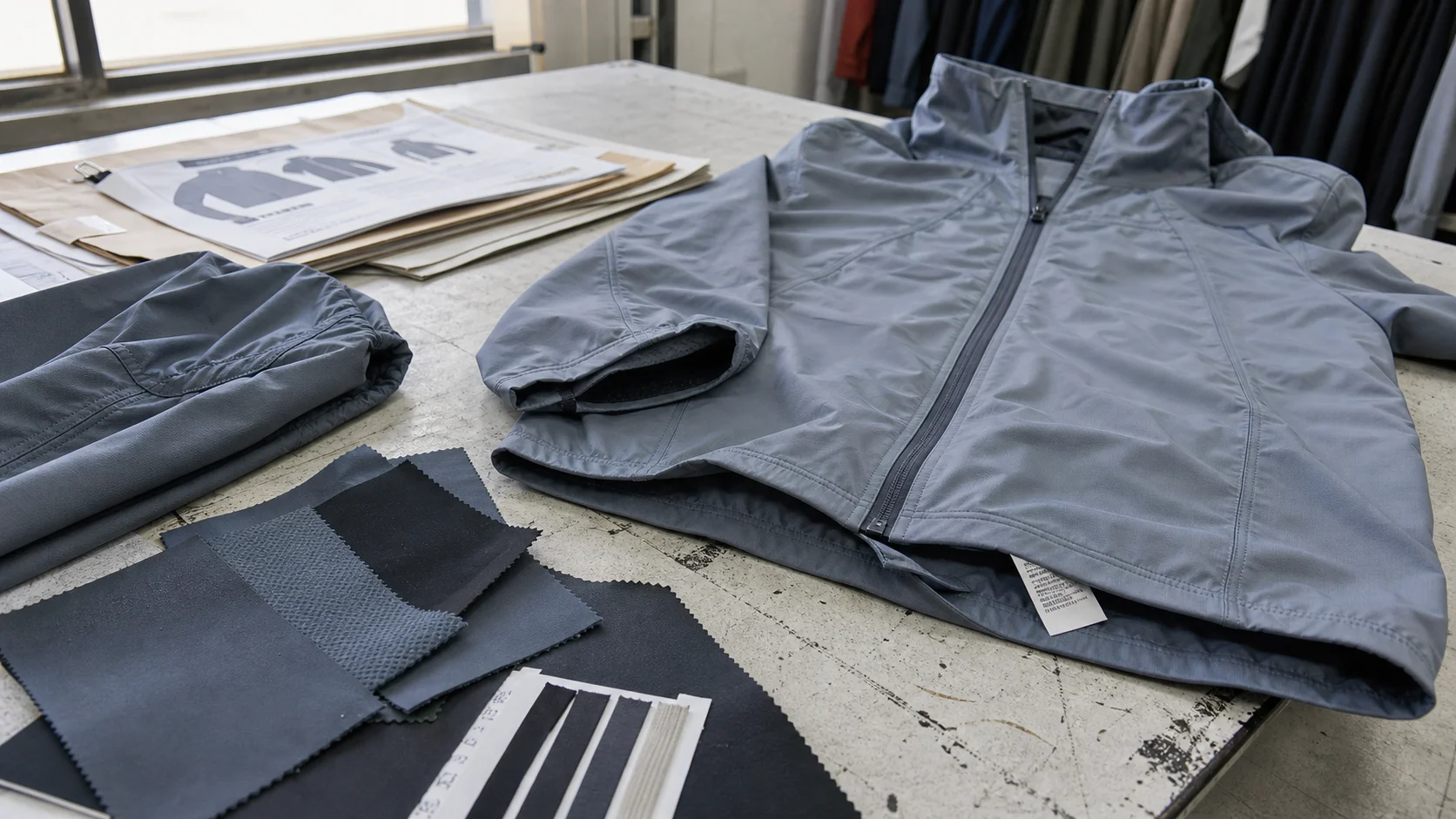
A distributor-focused breakdown of every cost driver in training jacket sourcing, from fabric and decoration to freight, duties, and margin planning.
Training Jacket Landed Cost Guide for Buyers - Fabrikn production reference
For distributor buyers, the quoted unit price of a training jacket is only the starting point. The real buying decision should be based on landed cost: the total cost to get finished jackets approved, produced, packed, shipped, cleared, and ready for sale in your warehouse. A low FOB price can become expensive after fabric upgrades, trim substitutions, carton inefficiency, freight volatility, duties, inspection rework, and late-season air freight.
This training jacket landed cost guide is written for distributor buyers comparing suppliers, building seasonal budgets, or preparing RFQs for contract manufacturing. It focuses on practical sourcing factors: MOQ, material specification, sample approval, lead-time dependencies, packing details, freight choices, customs charges, and inspection risks. The goal is not to chase the cheapest quote. The goal is to understand which cost drivers are controllable, which are structural, and which should be negotiated before the purchase order is issued.
Landed cost is the full cost of ownership for imported or domestically sourced training jackets. It includes the factory price, development charges, packaging, freight, insurance, import duty, customs fees, local delivery, inspection, compliance testing, financing costs, and any rework or shortage adjustment that affects sellable inventory.
Distributor buyers often compare FOB prices because FOB is easy to read and quick to benchmark. A jacket quoted at $14.80 FOB may appear stronger than one quoted at $15.60 FOB. That comparison is incomplete if the cheaper option uses a thinner shell fabric, lower-grade zipper, inefficient carton packing, longer lead time, or a supplier that cannot consolidate trims across colorways. A properly calculated landed cost may show the higher FOB quote is the safer commercial option.
Training jackets sit in a tricky category. They are less complex than technical waterproof outerwear but more specification-sensitive than basic fleece or cotton tees. Small decisions can change cost and performance: brushed or unbrushed tricot lining, mesh panel placement, rib quality, zipper brand tier, drawcord ends, reflective tape, heat-transfer logos, water-repellent finish, seam tolerance, and packing method.
Purchasing judgment: do not approve a training jacket quote until the supplier has confirmed fabric weight, composition, construction, zipper type, logo technique, packing ratio, carton dimensions, incoterm, lead time, and inspection standard. Without these details, the unit price is not yet comparable.
A practical landed cost model should separate visible factory costs from downstream import and handling costs. This makes supplier comparison cleaner and prevents the sourcing team from blaming the factory for costs caused by freight routing, customs classification, or internal delivery requirements.
The product unit cost is usually quoted as FOB, EXW, FCA, CIF, or DDP depending on the supplier and shipping arrangement. For distributor buyers importing from overseas manufacturers, FOB is common because it places export handling under the supplier and main freight under the buyer or freight forwarder.
The unit cost should include the garment, normal labeling, standard polybag, carton packing, and export-ready documentation unless otherwise stated. If the quote excludes hangtags, barcode stickers, woven labels, special polybags, or master carton marks, those charges must be added separately.
Training jacket development is rarely free in a meaningful way. The supplier may waive sample charges after bulk order confirmation, but the cost still exists. Distributor buyers should budget for proto samples, fit samples, size set samples, pre-production samples, lab dips, strike-offs, and courier charges.
Typical sample charges vary by complexity. A basic knit or woven training jacket sample may cost $80 to $250 per style, while a more detailed sample with custom trims, contrast panels, lining, reflective elements, and branded zipper pulls may cost $150 to $400 or more. Courier charges can be material when multiple approval rounds are needed.
Packaging costs are often underestimated. A standard individual polybag is low cost, but distributor requirements can add expense: recycled polybags, suffocation warnings, barcode labels, size strips, retail hangtags, carton stickers, inner packs, assortment packs, or club/team allocation labels.
For e-commerce distributors, packaging must survive parcel handling. For wholesale distributors, carton efficiency and warehouse scan accuracy may matter more. The best packaging choice depends on the selling channel, not just the factory’s default packing method.
Freight can make or break landed cost, especially when jackets have bulkier packing than lightweight apparel. Ocean freight is usually cheaper per unit but slower. Air freight protects launch dates but can erase margin. Trucking, port charges, destination handling, and last-mile warehouse delivery should also be included.
Import duty depends on destination country, HS code classification, fiber composition, construction, origin, and any applicable trade program. Distributor buyers should not rely only on a supplier’s duty estimate. Customs brokers or internal compliance teams should validate classification before bulk shipment.
Compliance costs may include fiber content labeling review, care label verification, flammability testing, restricted substance testing, CPSIA-related review for children’s products, or market-specific documentation. Adult training jackets are usually less burdensome than children’s outerwear, but compliance still needs confirmation.
MOQ is one of the most important cost levers for training jackets. It affects fabric procurement, dyeing minimums, trim ordering, cutting efficiency, printing setup, embroidery setup, packing labor, and supplier willingness to allocate production time. Buyers should treat MOQ as a cost structure issue, not just a negotiation point.
Typical training jacket MOQ ranges vary by supplier model and specification:
These ranges are not universal. A supplier with stock fabric and flexible sewing capacity may accept lower quantities, while a mill-backed program may require higher commitments. The question buyers should ask is not only “What is your MOQ?” but “Which part of the style creates the MOQ?” The answer may be fabric dyeing, zipper color, rib knitting, lining color, logo application, or carton allocation.
Low MOQ reduces inventory risk and helps test demand. It also raises unit cost, limits color accuracy, reduces trim customization, and may push production into less efficient lines. High MOQ improves cost and consistency but increases working capital exposure. For distributors selling to clubs, teams, schools, gyms, or promotional channels, mixed-size demand can be uneven. Buying too deeply into slow sizes can destroy the margin gained from a lower unit price.
A balanced approach is to consolidate fabric and trims while varying decoration. For example, one body fabric, one zipper quality, and one lining can support multiple logo programs. This can help buyers achieve better fabric purchasing economics without committing to excessive inventory in one customer design.
Buyers sourcing broader apparel programs can review manufacturing scope and development support through Fabrikn’s services page when planning multi-style orders or private-label ranges.
Fabric is usually the largest cost driver in a training jacket. It affects the garment price, performance, carton size, duty classification, shrinkage risk, color consistency, and customer satisfaction. A vague fabric description such as “polyester jacket” is not sufficient for a landed cost comparison.
For cost comparison, buyers should ask for fabric composition, weight in GSM, construction, width, finish, color standard, shrinkage tolerance, pilling rating, and whether the fabric is stock, greige-dyed, piece-dyed, or custom-developed. If the jacket needs moisture management or water repellency, request the finish standard and expected wash durability.
Trims can look minor on a spreadsheet but cause real landed cost variation. Zippers are a good example. A generic coil zipper may be cost-effective, but a higher-tier zipper with better slider movement and color consistency may reduce customer complaints. The right choice depends on selling price and expected use.
Decoration method should match both price point and end use. Embroidery has a premium feel and durability, but it may add weight and pucker risk on lightweight fabric. Heat transfer gives a clean athletic look but requires testing for wash, stretch, and peeling. Screen print can be economical at volume, but setup and color count matter.
Fabric consumption is not only about GSM. Pattern shape, size range, paneling, hood option, contrast inserts, and pocket construction all affect yield. A jacket with many contrast panels may look dynamic, but it can create more cutting waste and complicate sewing alignment. For distributor buyers, every design line should justify itself commercially.
Ask suppliers to quote estimated fabric consumption per size or per size range when the order is large enough to warrant detailed costing. This helps identify whether a price difference comes from better fabric efficiency or a thinner, cheaper material.
A disciplined sample approval process prevents expensive surprises during production. Training jackets often involve multiple components that must work together: fabric stretch, zipper tension, collar shape, sleeve length, pocket placement, logo position, and overall fit. Approving a style only from photos is risky.
Not every program needs every step, but skipping the wrong step can become expensive. For repeat styles in known fabric, the process can be shorter. For new distributor programs, custom colors, new fits, or new factories, a pre-production sample is a minimum safeguard.
Sample rounds affect lead time and cost. Each round may add one to two weeks depending on material availability, factory workload, buyer response speed, and courier timing. A buyer who takes seven days to comment on a sample can create the same delay as a factory production issue.
Buyers should issue clear comments with measurement deviations, photos, and required changes. Avoid broad feedback such as “make it fit better.” The supplier needs exact instructions: reduce sleeve length by 1.5 cm, raise pocket opening by 2 cm, change zipper pull to matte black, reduce collar height, or adjust body sweep.
Once the pre-production sample is approved, changes should be tightly controlled. Late design changes can trigger fabric waste, trim reordering, delayed sewing, and split shipments. If the distributor’s customer keeps changing logo position or color, the buyer should treat that as a commercial cost, not absorb it silently.
Training jacket lead time depends on material readiness, order size, factory capacity, decoration method, testing requirements, and shipping route. A typical production timeline for custom training jackets may range from 45 to 90 days after final approval and deposit. Stock fabric programs can be faster, sometimes around 25 to 45 days, if trims are available and decoration is simple.
Lead time should be broken into stages:
A supplier quoting an unusually short lead time may be using stock materials, subcontracting production, or leaving little room for correction. That may be acceptable for a simple reorder, but it is risky for a new style. A longer lead time is not automatically bad if it includes proper material approval and quality control.
Training jackets often align with sports seasons, school seasons, corporate uniform programs, and retail drops. Missed delivery windows can force discounting or air freight. Distributor buyers should map backward from the required warehouse date, not the selling date. Include time for inbound receiving, quality checks, allocation, customer delivery, and any relabeling.
Early purchasing discipline creates negotiating power. Late orders reduce options. Suppliers may accept the order but charge more for rush production, prioritize larger clients, or rely on overtime. Overtime can increase quality risk, especially on zipper setting, pocket symmetry, topstitching, and logo placement.
Freight is one of the most variable parts of landed cost. Training jackets are not as dense as denim or footwear. They can cube out cartons before reaching weight limits, especially when fleece-backed, padded, or individually folded with retail packaging. Buyers should ask for estimated carton dimensions, units per carton, gross weight, and net weight before finalizing freight estimates.
Ocean freight is usually the best choice for planned distributor programs. It lowers cost per unit and supports larger seasonal buys. The tradeoff is longer transit and exposure to port delays, container availability, and customs timing.
Air freight is suitable for urgent replenishment, launch rescue, or high-margin orders with strict delivery dates. It is rarely the right default for cost-sensitive training jackets. Air freight can add several dollars per jacket depending on volume, weight, route, and fuel surcharges. If air freight is needed because of late approval or factory delay, buyers should negotiate responsibility before shipment.
Incoterms determine where cost and risk transfer from seller to buyer. EXW can look cheap but pushes export handling and local pickup burden to the buyer. FOB is often practical for overseas sourcing because the supplier handles export clearance and delivery to the port. CIF includes main freight and insurance, but buyers may have less control over freight arrangements. DDP offers convenience but can hide duty, tax, and compliance costs inside a single price.
For distributor buyers with internal logistics or a freight forwarder, FOB often gives the best balance of cost visibility and control. DDP can work for small programs, first orders, or buyers without import infrastructure, but compare it carefully against broker-validated landed cost.
Duty can vary significantly based on construction and fiber content. A knit polyester training jacket may classify differently from a woven windbreaker or softshell jacket. Lining, coating, water-resistant treatment, and intended use may affect classification. Country of origin rules should be reviewed when fabric, cutting, sewing, or finishing occur in different places.
Before confirming a large order, ask for a product description detailed enough for customs review: fiber content, knit or woven construction, gender, adult or children’s, lining details, coating status, and intended garment category. A customs broker can help validate the HS code and duty rate. Supplier estimates are useful, but they should not be the only source.
Quality problems are landed cost problems. A jacket that arrives late, short, mislabeled, off-shade, or with zipper failures may still be physically present in the warehouse, but it is not fully sellable inventory. Distributor buyers should budget for inspection and define acceptance criteria before production starts.
AQL inspection is common for bulk apparel, but buyers should define critical, major, and minor defects for the product. A zipper that does not function should be critical or major, not minor. Wrong fiber label can create compliance exposure. Slight thread trimming may be minor if it does not affect sellability.
Depending on the market, buyers may request tests for colorfastness, pilling, dimensional stability, seam strength, zipper durability, print wash resistance, and restricted substances. Not every order needs a full lab test package, especially for repeat fabric. New fabric or new decoration should receive more scrutiny.
Wash testing is especially useful for heat transfers, rib cuffs, elastic hems, and brushed fabrics. A jacket that looks good in a sample room can fail after several washes if the print cracks, zipper tape shrinks, or rib loses recovery. These failures create returns and brand damage that exceed the cost of early testing.
Buyers considering supplier qualification, order planning, or a new private-label project can use Fabrikn’s contact page to discuss sourcing requirements and documentation expectations.
The following table shows a simplified landed cost structure. Actual figures vary by country, season, duty rate, freight market, garment specification, and order quantity. Use this as a buying framework, not as a universal price list.
Cost Item What It Includes Typical Buyer Risk Purchasing Judgment FOB Unit Price Garment, standard labels, standard packing, export-ready production Low quote may exclude trims, packaging, or approved fabric quality Compare only after fabric, trim, and packing specs are equal Sample and Development Proto, fit, size set, PP sample, lab dips, courier charges Multiple rounds can delay production and add hidden costs Budget sample costs separately and control approval comments Fabric and Trim Upcharges Custom dyeing, better zipper, rib, reflective print, labels, hangtags Late changes may trigger MOQ or reordering Lock trim cards before bulk material purchase Packaging Polybag, barcode, hangtag, carton marks, retail pack, inner pack Warehouse non-compliance and relabeling cost Share packaging manual with RFQ, not after PO Inspection and Testing AQL inspection, lab tests, measurement checks, wash tests Rejected goods, rework, late shipment, customer claims Define inspection standard before production starts Freight Ocean, air, trucking, destination handling, warehouse delivery Bulky cartons and late shipment increase cost Request carton dimensions before freight comparison Duty and Customs Import duty, customs entry, broker fees, tariffs, taxes where applicable Wrong classification or origin assumptions Validate HS code with broker before large orders Finance and Inventory Deposit, balance payment, credit terms, warehousing, markdown risk High MOQ can tie up cash in slow sizes or colors Model sell-through by size and customer segmentA simple landed cost formula for distributor buyers is:
FOB unit cost + sample amortization + packaging extras + inspection/testing + international freight + insurance + duty/tariff + customs/broker fees + destination delivery + financing/handling allowance = landed cost per sellable unit.
The phrase “per sellable unit” matters. If inspection finds 2% of jackets are unsellable or need rework, the landed cost of the remaining sellable units increases. Short shipments have the same effect. A factory that ships 4,900 acceptable jackets against a 5,000-piece order may still leave the buyer with customer allocation problems.
Assume a distributor is buying 1,000 polyester training jackets at $15.00 FOB. Packaging extras add $0.35 per unit. Inspection and testing add $0.20 per unit after allocation. Ocean freight and destination charges add $1.10 per unit. Duty and customs charges add $2.25 per unit. Local delivery and handling add $0.40 per unit. The landed cost becomes $19.30 per unit before financing, overhead, and any allowance for defects or markdowns.
If the same order requires air freight at $4.50 per unit instead of ocean freight at $1.10, landed cost rises to $22.70. That $3.40 increase may remove the distributor’s margin unless the customer accepts a higher price. This is why calendar control is a cost control tool.
A strong RFQ reduces quote confusion and gives suppliers less room to make assumptions. The following details should be included when requesting training jacket pricing.
Buyers should also ask the supplier to identify cost-saving alternatives. A good alternative is specific: change from custom-dyed zipper tape to black stock zipper, reduce contrast panels, use one rib color across all colorways, switch from embroidery to heat transfer, or consolidate carton packing. A vague statement such as “we can make cheaper quality” is not useful.
Cutting cost should not mean weakening the jacket. Distributor buyers need repeat business and low complaint rates. The better approach is to remove unnecessary complexity while protecting the features customers notice and use.
Using the same shell fabric across several jacket styles can improve fabric purchasing efficiency and color consistency. It can also simplify testing and reduce development time. The tradeoff is less uniqueness between products, so this works best when branding, paneling, or decoration can create enough differentiation.
Custom colors are important for teamwear and branded programs, but they can raise MOQ and increase lead time. Stock black, navy, grey, royal, and red fabrics may reduce cost and speed production. The risk is shade mismatch with the customer’s brand standard. For strict brand colors, custom dyeing may still be worth the cost.
Contrast panels add visual interest but increase cutting, sewing, and shade control complexity. Reducing panel count can improve efficiency and reduce defect risk. Keep design lines that support fit, movement, or brand identity. Remove lines that only add sewing minutes.
Using one zipper quality and one label system across multiple orders helps suppliers buy trims more efficiently. It also reduces approval workload. The tradeoff is less customization for each customer. For distributor programs serving many accounts, standardized internal trims with customer-specific external decoration often make commercial sense.
If the jacket is part of an ongoing program, ask whether fabric or trims can be reserved for reorders. This may require deposit or forecast commitment, but it can protect color continuity. Reorders produced from a different dye lot may be acceptable for separate customers but risky for team uniforms where garments are worn together.
Price matters, but supplier selection should include more than the lowest quote. Training jacket distributors should compare suppliers on technical capability, communication clarity, material access, sampling discipline, production capacity, inspection history, and documentation readiness.
A practical supplier scorecard may include:
The best buying decision is often not the cheapest supplier. It is the supplier whose quote can be explained, repeated, inspected, and delivered without emergency cost. A slightly higher unit price can be worthwhile if it reduces rework, delay, customer claims, and air freight exposure.
For buyers evaluating manufacturing partners and company background, Fabrikn’s about us page provides context on sourcing and apparel production support.
Landed cost is also affected by cash timing. Many apparel manufacturers require a deposit before production and balance payment before shipment or against documents. Common structures include 30% deposit and 70% balance, though terms vary by supplier relationship, credit history, order size, and risk profile.
Distributor buyers should include financing cost in the landed cost model, especially for long production and ocean freight timelines. A jacket ordered months before selling season ties up capital. If the buyer must pay early but receives customer payment late, margin needs to cover that funding gap.
Credit terms can be valuable, but they are not free. Suppliers may build financing cost into the unit price or offer better pricing for faster payment. Buyers should compare the total commercial package: unit price, payment term, production risk, delivery timing, and cash flow impact.
Several mistakes appear repeatedly in training jacket sourcing. They are avoidable with better RFQ discipline and earlier logistics planning.
The most expensive mistake is late decision-making. Late artwork, late sample comments, late color approval, and late deposit all compress production. Compressed production increases the chance of defects and pushes buyers toward air freight. A disciplined calendar is one of the strongest cost controls available.
For distributor buyers, a training jacket should be sourced as a margin-managed product, not just a garment. Build the landed cost model before committing to the order. Include every cost that affects sellable inventory: development, materials, trims, packaging, freight, duty, compliance, inspection, defects, financing, and delivery.
Choose fabric and trims that match the selling channel. A budget promotional jacket does not need premium trims, but it still needs correct sizing, working zippers, durable seams, and compliant labeling. A teamwear or retail training jacket may justify better fabric, stronger zipper quality, and more controlled decoration. The right specification is the one that protects customer expectations at the intended price point.
MOQ should be negotiated intelligently. Push for flexibility where it reduces inventory risk, but recognize when low MOQ causes higher unit cost or quality inconsistency. Consolidate materials, standardize trims, and plan reorders when the program has long-term potential.
The safest supplier quote is detailed, not just cheap. It should define what is included, what is optional, what drives MOQ, what may affect lead time, and what inspection standard will be used. Distributor buyers who control these details early usually avoid the worst landed cost surprises.
Get a free quote from Fabrikn — your trusted B2B clothing manufacturer with 10+ years of experience. MOQ as low as 200 pieces.
Get a Free Quote →Landed cost is the total cost to get a training jacket from supplier quotation to sellable inventory. It includes the unit price, samples, packaging, freight, insurance, duty, customs fees, inspection, testing, local delivery, financing, and any rework or defect allowance.
Typical MOQ may range from 100 to 300 pieces for stock fabric and simple branding, 300 to 600 pieces for custom colors, and 500 to 1,000 pieces or more for fully custom fabric, trims, or performance finishes. Higher-spec programs may require larger commitments.
FOB often gives distributor buyers better visibility and control if they have a freight forwarder or import process. DDP can be convenient for smaller buyers but may hide duty, tax, and logistics costs. The better choice depends on import capability, order size, and need for cost transparency.
Polyester interlock, polyester tricot, woven polyester, fleece-backed knit, softshell, and polyester-spandex blends are all common. The best option depends on target price, climate, sport use, stretch requirement, warmth, decoration method, and carton efficiency.
Buyers can consolidate fabrics, use stock colors, standardize zippers and labels, simplify paneling, improve carton efficiency, approve samples faster, and plan ocean freight instead of relying on air freight. Cost reduction should remove unnecessary complexity, not weaken core performance.
Common risks include zipper defects, shade variation, wrong logo placement, measurement deviations, seam puckering, pocket misalignment, incorrect labels, and packing errors. These issues should be covered in the inspection checklist before production begins.
Custom training jacket production commonly takes 45 to 90 days after final approval and deposit. Stock fabric programs may be faster, sometimes around 25 to 45 days. Lead time depends on fabric availability, trims, decoration, order size, testing, and factory capacity.
Training jackets can be bulky, especially with fleece or retail packaging. Carton dimensions, units per carton, and gross weight affect freight cost. Buyers should request packing details before finalizing landed cost estimates.