
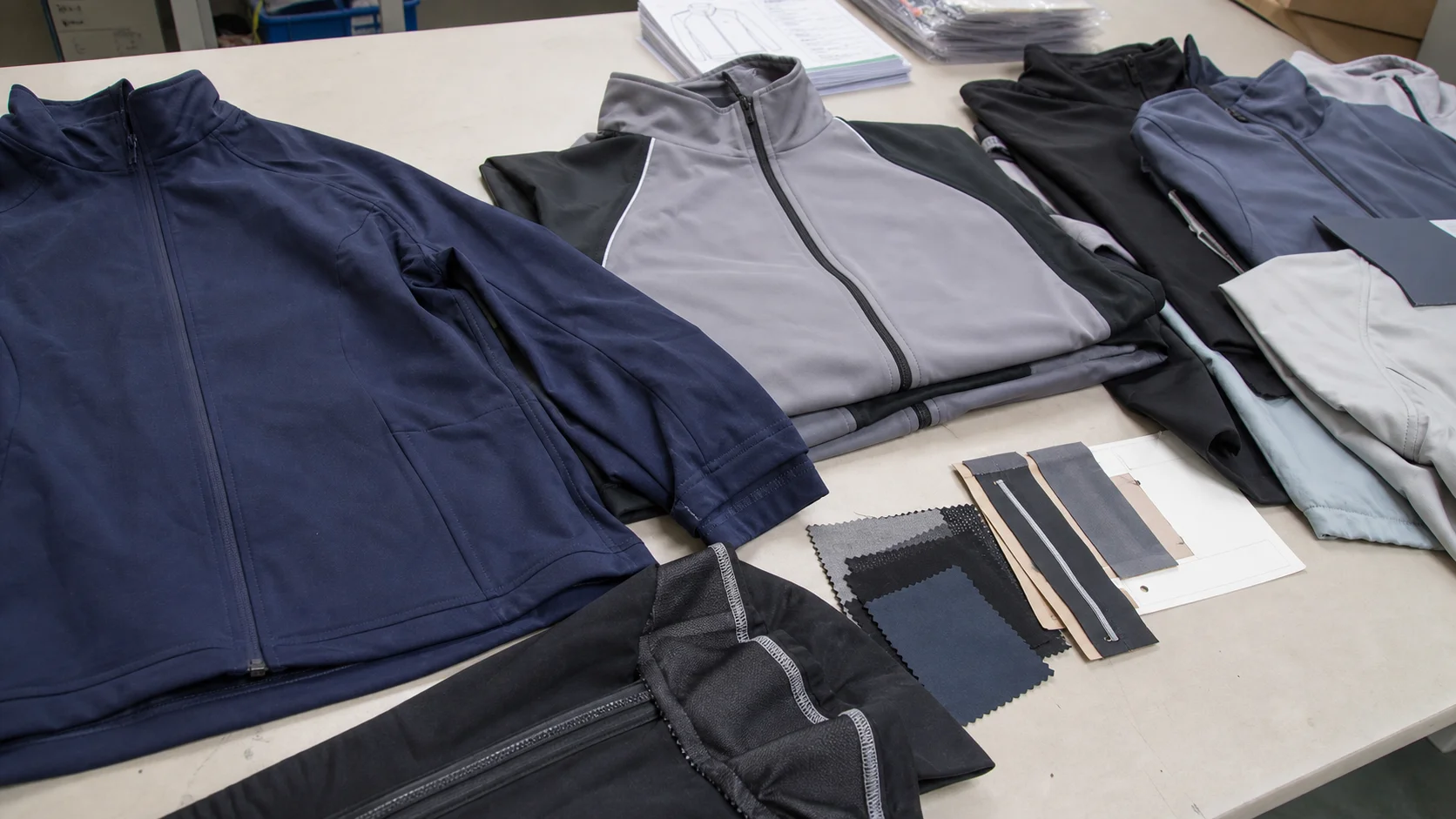
A product-specific outline for corporate uniform buyers assessing reorder risks tied to training jackets, including fabric continuity, decoration...
Training Jacket Reorder Risk Review for Buyers - Activewear & Teamwear manufacturing guide
Category: Activewear & Teamwear
Training jackets look simple on a purchase order, but they carry more reorder risk than many corporate uniform buyers expect. A jacket is not just a shell garment with a zipper. It combines fabric performance, shade matching, logo placement, elastic recovery, zipper quality, pocket construction, lining choices, and size grading. When a buyer places a repeat order six months or one year after the original bulk run, any one of those inputs may have changed.
For corporate uniform programs, the risk is practical. New employees need to look consistent with existing staff. Regional teams may receive garments at different times. A sales team, warehouse crew, gym staff, event team, or field support group may wear the same jacket across multiple seasons. If the reorder does not match the first issue, the difference is visible. Slight shade variation, a different collar height, a weaker cuff, or a changed logo position can make a uniform program look unmanaged.
A training jacket supplier reorder risk review helps buyers identify what may go wrong before approving another production run. The goal is not to reject every variation. Some differences are unavoidable when fabric lots, dye batches, trims, and production lines change. The buyer’s job is to decide which changes are acceptable, which require approval, and which should stop production until corrected.
This review is especially important for buyers sourcing corporate uniforms through activewear and teamwear suppliers. Training jackets often use performance fabrics and sportswear construction, but corporate buyers usually need repeatability more than trend updates. A teamwear supplier may be comfortable replacing a zipper puller, adjusting a panel seam, or changing a fabric finish for the next season. A corporate uniform buyer may not be able to accept those changes if staff members will wear old and new jackets together.
The key question is not “Can the supplier make the jacket again?” The better question is “Can the supplier make the jacket again close enough to the approved standard, at the required quantity, within the required delivery window, and with documented control of any changes?”
Buyers who need structured production support can review manufacturing service options at fabrikn.com/services/. A reorder risk review should sit alongside costing, sampling, production planning, and quality control rather than being treated as a last-minute check.
Reorder risk is the chance that a repeat order will differ from the approved product in a way that affects appearance, fit, function, cost, delivery, or compliance. In training jackets, the biggest risks usually fall into five areas: material continuity, trim availability, pattern control, branding accuracy, and production capacity.
Material continuity is often the first issue. The original fabric may have been a polyester interlock, brushed tricot, double-knit, stretch woven, bonded fleece, or lightweight softshell. If that fabric was not reserved, documented, or kept as a carryover material, the supplier may need to source an alternative. Even when the composition is the same, hand feel, weight, stretch, recovery, sheen, and color absorption can differ.
Trim continuity is the second issue. Zippers, drawcords, stoppers, snaps, elastic tape, rib cuffs, reflective details, and pocket bags are commonly substituted when suppliers run out of the original trims. Some substitutions are minor. Others change the perceived value of the jacket. A lower-grade zipper can create field complaints quickly, especially in uniforms worn daily.
Pattern control matters because jackets are often graded across a wide size range. A reorder may include different size ratios from the original run. If the original pattern, grading rules, and shrinkage allowances were not archived properly, the supplier may recreate the jacket from a sample. That increases risk in sleeve length, chest width, shoulder slope, cuff opening, hem sweep, and overall garment length.
Branding accuracy is another common problem. Corporate jackets often carry embroidered logos, heat transfers, woven patches, reflective prints, silicone badges, or private labels. Each decoration method has tolerances. Logo color, size, placement, backing, stitch density, transfer temperature, and pressure must be controlled if old and new garments will be worn together.
Production capacity also affects reorder quality. A supplier may accept the order but move it to a different line, subcontract a process, or compress the schedule to meet delivery. None of those decisions are automatically wrong, but they increase inspection risk. Buyers should ask what will be repeated exactly, what has changed, and what must be reapproved.
A reorder should start with supplier capability, not only price. The supplier should confirm whether it still has the original tech pack, approved sample, fabric swatches, trim cards, size specification, logo artwork, production comments, and inspection report. If these documents are missing, the reorder is closer to a redevelopment project than a repeat order.
Corporate uniform buyers should request a written reorder confirmation covering product code, style name, fabric reference, color reference, trim details, size range, packaging method, labeling, decoration method, and delivery schedule. This does not need to be complicated, but it must be specific. “Same as last order” is not enough for a jacket that will be compared against previous stock.
Typical supplier capability questions include:
A reliable supplier should be able to separate confirmed repeats from uncertain points. Buyers should be cautious when every answer is “no problem” but no documents are supplied. Reorder risk is not removed by confidence. It is reduced by evidence: swatches, lab dips, strike-offs, fit samples, trim cards, production schedules, and inspection checkpoints.
Buyers evaluating a manufacturing partner can also review company background information at fabrikn.com/about-us/. Supplier selection for corporate uniform reorders should weigh documentation discipline as heavily as sewing capability.
Fabric is the largest driver of training jacket consistency. A reorder may use the same nominal fabric description but still feel different. For example, “100% polyester interlock, 220 gsm” does not fully define yarn type, knitting gauge, dyeing process, brushing, wicking finish, anti-pilling finish, stretch, or shrinkage. A training jacket made from a slightly glossier fabric can look like a different uniform even if the color is close.
For corporate uniform jackets, the fabric specification should include more than composition. At minimum, buyers should keep records of fabric weight, construction, finish, stretch direction, shrinkage target, color standard, and performance requirements. If the jacket is used outdoors or in high-movement roles, the review should also consider abrasion resistance, snagging risk, pilling resistance, water repellency, breathability, and seam strength.
Common training jacket fabric options include:
Fabric Type Typical Use Main Reorder Risk Buyer Judgment Polyester interlock Light to midweight teamwear jackets Shade, sheen, pilling, hand feel Good for controlled corporate programs if the mill reference is stable Brushed tricot Warm-up jackets and tracksuits Brushing level, snagging, surface shine Useful for cost-sensitive uniforms but inspect surface consistency carefully Double-knit polyester Premium active uniforms Weight variation, recovery, dye lot difference Better appearance and durability, usually higher MOQ and cost Stretch woven Outdoor training and field teams Stretch recovery, coating, noise, water repellency Good for mobility, but trim and seam construction need stronger control Bonded fleece or softshell Cool-weather staff uniforms Delamination, weight, color matching, bulk at seams Higher perceived value, but testing and lead time become more importantTrim risk is often underestimated. Zippers should be specified by brand or quality level, tape color, teeth type, slider type, puller shape, length, and end finish. A reorder with a cheaper zipper may pass visual inspection but fail during daily use. Pocket zippers, reverse coil zippers, waterproof-look zippers, and branded pullers need special attention because replacements may not match the original garment.
Elastic, rib, binding, and drawcords also affect fit and appearance. Rib cuffs can change in recovery and width. Elasticated hems can become tighter or looser. Drawcord color may shift from garment shade. Reflective tape may vary in brightness and wash durability. Buyers should approve a new trim card for every reorder unless the supplier can prove trims are from the same stock or same controlled specification.
Color is one of the most visible reorder risks in corporate uniforms. A training jacket may be navy, black, charcoal, red, royal blue, or green, but corporate buyers know that one navy is not the same as another. Shade variation is especially visible when old and new garments are worn side by side in meetings, retail floors, events, or team photos.
A reorder should reference a physical color standard, not only a Pantone number or digital artwork. Pantone references are helpful for communication, but fabric dyeing depends on fiber, construction, finish, and dye process. A Pantone color printed on paper does not guarantee the same result on polyester knit or softshell fabric.
Buyers should request lab dips or bulk fabric cuttings before approving production if fabric is newly dyed. For stock fabric, suppliers should send actual roll cuttings from the available lot. If multiple fabric lots are needed, shade band approval becomes more important. A small reorder may come from one roll lot. A larger reorder may require several dye lots, increasing the chance of panel-to-panel variation.
Color review should include:
Black jackets are not risk-free. Some black polyester fabrics have a brown, blue, or green cast under certain lighting. Navy and charcoal are often more difficult because minor shade changes are easy to spot. Bright corporate colors, such as red, orange, and royal blue, may require more careful dye approval and colorfastness testing.
The buyer’s practical decision is whether the new order must be a strict match or only commercially acceptable. A strict match may require higher cost, longer lead time, and more rejected lab dips. A commercial match may be acceptable if the jackets are issued to a new branch, different department, or separate event team. The purchase order should state the tolerance clearly.
Fit problems in reorders usually appear when the buyer assumes the supplier is using the same pattern, while the supplier has adjusted the garment to suit fabric changes, shrinkage, or production convenience. Training jackets have multiple fit-sensitive areas: shoulder width, armhole depth, sleeve length, chest, bicep, cuff, hem sweep, collar height, and front length.
If the original jacket was approved after several fit rounds, the supplier should use the final approved pattern. Recreating a pattern from a production sample is risky because the sample may already include sewing tolerance, wash movement, or wear distortion. A buyer should ask whether the supplier has the digital pattern and grading file. For larger programs, the buyer may also hold a sealed sample and measurement chart.
Size-set review is important when the reorder includes sizes that were not produced heavily in the first order. Corporate uniform programs often need XS through 4XL or 5XL. Extended sizes require careful grading. Simply increasing measurements evenly can create oversized shoulders, too-long sleeves, tight hems, or poor collar balance. If the reorder adds plus sizes, tall sizes, women’s fit, or youth sizes, treat that portion as new development.
A standard size tolerance for jackets may be around plus or minus 1 cm for smaller points and plus or minus 1.5 cm to 2 cm for larger body measurements, depending on the buyer’s quality manual and garment type. Sleeve length and front zipper length should be controlled tightly because wearers notice them quickly. Rib and elastic openings should be checked after relaxation, not only immediately after sewing.
Fit approval for reorders should include:
The tradeoff is speed versus certainty. Skipping a size-set sample can save time and money on a low-risk repeat using identical materials. It is a poor saving if the fabric has changed, the supplier has moved production, or the reorder includes new sizes.
Minimum order quantity is a major reorder risk because corporate uniform demand rarely arrives in neat factory-friendly quantities. A buyer may need 80 jackets for new staff, while the fabric mill requires 300 meters or the supplier prefers 500 pieces. The gap between business need and production MOQ affects cost, delivery, and product consistency.
Typical MOQ ranges vary by supplier, country, material, and decoration complexity. For training jackets, buyers may see low MOQs around 100 to 300 pieces for stock fabrics and simple branding. Custom-dyed fabrics may require 300 to 800 pieces or more depending on fabric consumption and mill minimums. Fully custom jackets with special trims, engineered panels, custom zipper pullers, or multiple decorations may require 500 to 1,500 pieces to keep unit costs reasonable.
These are general market ranges, not fixed rules. A supplier may accept a smaller quantity with a surcharge if fabric is available. A mill may require higher minimums for special colors, bonded fabrics, or technical finishes. Buyers should separate garment MOQ from fabric MOQ, trim MOQ, and decoration MOQ. The limiting factor is often not sewing capacity but one input that cannot be bought in small quantity.
Reorder Scenario Typical MOQ Range Risk Level Purchasing View Stock fabric, standard zipper, simple logo 100-300 pieces Lower Good for replenishment if shade and trim are approved Custom color fabric, standard trims 300-800 pieces Medium Better color control, but overstock risk increases Custom trims or branded zipper pullers 500-1,500 pieces Medium to high Useful for long programs, inefficient for small staff additions Bonded fleece or softshell with testing needs 300-1,000 pieces Medium to high Plan early because fabric and testing lead times matter Urgent top-up order below supplier MOQ Below standard MOQ High Expect surcharge, limited material choice, or shade compromisePrice should be reviewed carefully on reorders. A higher unit price may be justified if the reorder is smaller, raw material costs have changed, or trims must be purchased at higher minimums. A lower unit price can also be a warning sign if the supplier is substituting fabric, simplifying construction, or reducing inspection. Buyers should ask for a cost explanation when the price moves significantly in either direction.
The best reorder economics usually come from forecasting. If the uniform program will need regular replenishment, buyers can negotiate annual call-off quantities, reserved fabric, or scheduled production windows. This reduces urgent small-batch buying. It also gives the supplier a reason to maintain the correct fabric and trim standards.
A reorder does not always need the same sampling process as a new style, but it still needs formal approval. The depth of sampling should match the level of change. If the fabric, trims, pattern, decoration, and factory line are unchanged, a pre-production sample and material confirmation may be enough. If any major component has changed, buyers should add more checkpoints.
A practical reorder approval flow may include:
The most common mistake is approving only a photo. Photos are useful for communication, but they do not confirm fabric hand feel, zipper smoothness, stretch recovery, shade under real light, or garment measurements. For low-risk reorders, a photo plus retained sample may be enough for minor details. For corporate uniform jackets that must match previous stock, physical samples remain the safer option.
Approval records should be dated and specific. If the buyer approves a substitute zipper, the approval should identify the substitute. If the buyer accepts a slight shade variation, the accepted standard should be kept. This protects both parties. It also prevents the next reorder from drifting further away from the original product.
Training jacket reorder lead time depends on material availability, decoration method, production capacity, inspection schedule, and shipping mode. Buyers should avoid treating a repeat order as automatically fast. Some reorders move quickly because fabric and trims are in stock. Others take as long as new production because fabric must be knitted, dyed, finished, tested, and transported before cutting can begin.
General lead-time ranges may look like this:
Stage Typical Time Range Main Dependency Document and cost confirmation 2-7 days Completeness of previous order records Lab dips or fabric lot approval 5-14 days Custom dyeing versus available stock Trim sourcing 5-21 days Zipper, rib, elastic, and custom trim availability Pre-production sample 7-14 days Pattern readiness and decoration approval Bulk production 20-45 days Order quantity, factory loading, construction complexity Inspection and shipment preparation 2-7 days Inspection booking, rework needs, packing statusThese ranges are indicative. Peak season, holidays, fabric mill congestion, customs delays, or urgent capacity shifts can extend them. A reorder using stock fabric and simple embroidery may be completed faster. A custom softshell jacket with a corporate color and multiple logo placements may need a longer schedule.
Lead-time risk increases when the buyer delays approval. Lab dips, trim cards, strike-offs, and pre-production samples often sit waiting for sign-off. Suppliers may not hold production space indefinitely. If approval comes late, the order may miss the planned sewing slot. Buyers should assign internal responsibility for approvals before placing the purchase order.
Shipping mode also changes the risk profile. Air freight can rescue a late uniform launch but damages the landed cost. Sea freight is economical for planned replenishment but less forgiving. Split shipping may be practical: air freight urgent sizes for onboarding or events, then ship the balance by sea. This should be costed before the order becomes urgent.
Branding errors are costly because they are visible and often difficult to repair. A training jacket may be perfectly sewn but commercially unusable if the logo is wrong. Corporate uniform buyers should review decoration with the same seriousness as fabric and fit.
Embroidery works well for durable corporate logos, especially on chest positions. Risks include puckering, wrong thread color, poor backing, excessive stitch density, distorted small text, and inconsistent placement. Stretch fabrics need careful stabilization. Heavy embroidery on lightweight training fabric may pull or ripple. If the original jacket used embroidery, the reorder should use the same artwork file, thread references, backing method, and placement measurement.
Heat transfers and prints are common in activewear because they keep the garment lightweight. Risks include cracking, peeling, shine difference, poor stretch, color mismatch, and scorch marks from incorrect temperature or pressure. Transfers used on softshell or coated fabrics need special testing because adhesion may differ from standard polyester knit.
Reflective logos and trims need additional caution. Reflective materials can vary in brightness and wash durability. If staff use jackets in low-light environments, reflective performance may be more than decorative. Buyers should specify whether reflective elements are cosmetic or functional. Functional claims may require testing and compliance review.
Logo placement should be measured from fixed garment points, such as center front, shoulder seam, chest line, zipper edge, or hem. “Left chest” is too vague. Placement can shift across sizes if the supplier does not define grading rules for decoration. On larger sizes, a logo may need proportional positioning rather than a simple fixed distance from one seam.
For buyers planning a new reorder or correcting a previous issue, direct supplier communication is useful. Contact options are available at fabrikn.com/contact-us/.
Inspection is the buyer’s final chance to catch reorder drift before jackets leave the factory. A reorder inspection should compare bulk goods against the approved standard, not only check general workmanship. The inspector should have access to the approved sample, measurement spec, bill of materials, artwork placement sheet, packing instructions, and accepted shade standard.
Common inspection risks for training jackets include:
Buyers should decide the inspection level before production starts. Random final inspection is common, but it may not catch problems that affect the entire order if the issue is systemic. For higher-risk reorders, inline inspection or first-output inspection is more useful. Early review can catch wrong logo placement, fabric shade problems, or construction misunderstandings before the full quantity is completed.
AQL standards may be used for final inspection, but buyers should remember that AQL is a sampling method, not a product development tool. AQL can help determine whether a shipment is acceptable based on defect counts. It does not replace material approval, fit approval, or decoration strike-off approval. Serious defects, such as wrong logo, wrong color, unsafe trims, or incorrect size labeling, may justify rejection even if defect counts are low.
Measurement inspection should include enough sizes to detect grading issues. Checking only the base size can miss problems in XS, 3XL, or 5XL. Corporate uniform complaints often come from the ends of the size range because wearers in those sizes have fewer alternatives and notice poor fit quickly.
A disciplined reorder checklist helps buyers avoid informal decision-making. The checklist does not need to be long, but it should force clear answers before money, materials, and production capacity are committed.
Not every reorder deserves the same decision. Buyers should classify the order by risk and business need. A simple repeat with available materials, stable supplier records, and no design change can move quickly. A reorder with missing records, changed fabric, new decoration, or tight delivery should be treated as a controlled redevelopment.
Reorder when the supplier can prove continuity. This means the fabric is available, trims are confirmed, pattern files are retained, artwork is unchanged, and sample approval is straightforward. In this case, the buyer’s main job is to control shade, check the pre-production sample, and confirm inspection criteria.
Renegotiate when quantity, price, or lead time no longer fits the program. If the supplier requires a high MOQ for custom fabric, the buyer may negotiate a call-off program, hold fabric stock, simplify trims, or move to a stock-supported fabric. Paying a higher unit price for a small urgent reorder may be reasonable if uniform consistency matters. It is not always economical to chase the lowest price on a small replenishment order.
Respec the jacket when the original product is no longer practical to repeat. This may happen if the fabric is discontinued, trims are unavailable, the old pattern is missing, or the uniform program is expanding into new climates or job roles. Respecing does not mean abandoning brand consistency. It means creating a new controlled standard with updated materials and clear transition planning.
The hardest decision is whether to accept a substitute. A substitute fabric may be acceptable if the jackets are issued to a different team or if old stock is nearly depleted. It may be unacceptable if employees will wear old and new jackets together daily. A zipper substitution may be acceptable if quality and appearance are equal. A logo color substitution is rarely worth the risk unless the buyer formally approves a brand update.
Corporate buyers should also consider lifecycle planning. If a training jacket is expected to stay in the uniform program for several years, the first order should be built around repeatable materials. Seasonal fashion fabrics, unusual trims, and one-off stock lots can look attractive at launch but create problems later. A slightly less distinctive jacket using stable inputs may be the better sourcing choice for a long-running uniform program.
A good supplier will help the buyer understand these tradeoffs rather than pushing a repeat order through without questions. The best reorder process is direct, documented, and realistic: confirm what is unchanged, test what is uncertain, approve what is visible, and inspect what matters before shipment.
Get a free quote from Fabrikn — your trusted B2B clothing manufacturer with 10+ years of experience. MOQ as low as 200 pieces.
Get a Free Quote →The biggest risk is usually material change. Fabric shade, weight, stretch, finish, and hand feel can shift between production runs. Trim substitutions and logo inconsistencies are also common. Buyers should approve fabric cuttings, trim cards, and decoration strike-offs before bulk production.
Typical MOQs may range from 100 to 300 pieces for stock fabric programs, 300 to 800 pieces for custom-dyed fabrics, and 500 to 1,500 pieces for jackets with custom trims or more complex specifications. Actual MOQ depends on the supplier, fabric mill, trim requirements, and decoration method.
Skipping all sampling is risky. A low-risk reorder may only need material confirmation and one pre-production sample. If fabric, trims, pattern, production line, logo method, or size range has changed, buyers should request more sampling, including a size set where needed.
Buyers should keep a physical color standard, approve lab dips or bulk fabric cuttings, review trim color matching, and define whether the reorder requires a strict match or commercial match. For large orders, shade band approval may be needed if multiple dye lots are used.
Final inspection should check shade, measurements, zipper function, stitching, seam strength, logo placement, decoration quality, size labels, carton ratios, and packing accuracy. The inspector should compare bulk goods against the approved sample and specifications, not only general workmanship.
A buyer should consider respecing when the original fabric is discontinued, trims are unavailable, the pattern records are missing, or the old design no longer fits the uniform program. Respecing is often better than forcing a poor match that creates complaints and inconsistent staff appearance.
Embroidery is durable and suitable for many corporate logos, but it can pucker lightweight or stretchy fabrics. Heat transfers are lighter and common in activewear, but they need adhesion and wash testing. The better choice depends on fabric type, logo detail, expected wash cycle, and brand appearance requirements.