
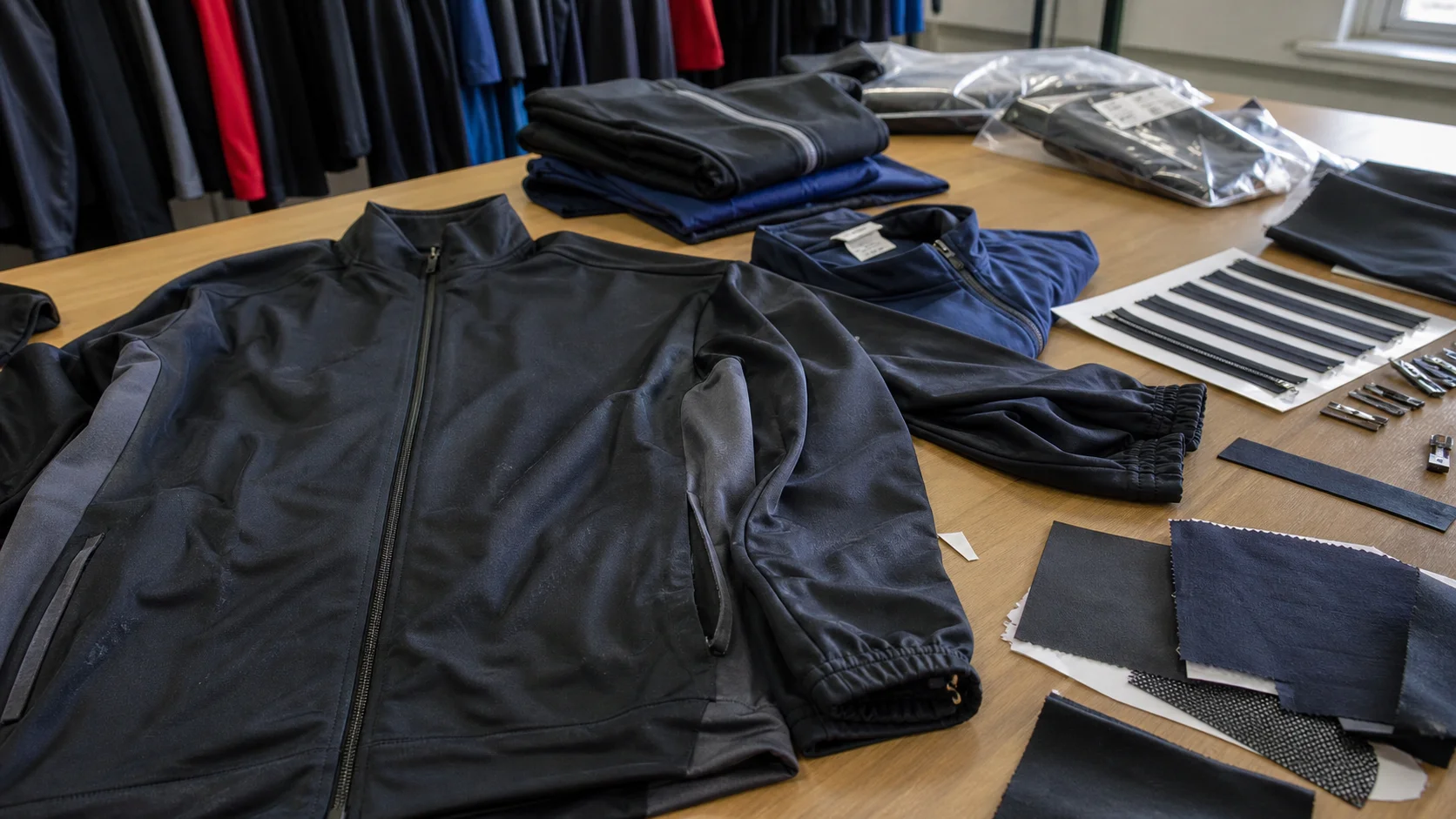
A practical review of training jacket size grading for distributor buyers, covering fit consistency, spec checks, production tolerances, and cost impacts...
Training Jacket Size Grading for Distributor Buyers - Fabrikn production reference
Training jacket size grading is one of the quiet cost drivers in distributor sourcing. It affects fit approval, carton planning, return rates, sell-through, and whether a manufacturer can reproduce the same jacket across repeat orders. For distributor buyers, the question is not only “Can the factory make this jacket?” It is “Can the factory grade it consistently across sizes, fabrics, trims, and production batches?”
A training jacket manufacturer size grading review should happen before bulk production, not after the sales team has already booked units. The right review checks base size measurements, grade rules, tolerance limits, sample progression, fabric behavior, and inspection risks. It also confirms whether the manufacturer understands the target market: men’s, women’s, youth, unisex, club teamwear, school uniforms, gym chains, promotional apparel, or private-label sportswear.
This guide is written for distributor buyers comparing suppliers, negotiating MOQ and cost, and trying to avoid fit-related rework. It covers practical size grading checkpoints, typical MOQ ranges, lead-time dependencies, and purchasing tradeoffs that matter when sourcing training jackets at scale.
Training jackets are often sold into programs where buyers expect repeatable sizing. A sports club may reorder the same jacket for new members next season. A distributor may carry inventory across small, medium, large, and extended sizes. A corporate buyer may compare the jacket against a previous uniform garment. If the size grading is weak, the distributor absorbs the problem through returns, markdowns, replacement stock, or damaged account trust.
Size grading is especially important in training jackets because the garment sits between performance wear and casual outerwear. It must allow shoulder movement, sleeve reach, layering, and zip closure without looking bulky. A jacket that fits correctly in medium can still fail in 2XL if the chest grade is too small, the sleeve length grows too aggressively, or the hem does not account for body shape.
For distributor buyers, size grading should be treated as a commercial control point. It is not just a technical pattern issue. It influences:
Buying teams often focus on fabric weight, zipper quality, color matching, and logo decoration first. Those are visible and easy to discuss. Size grading is less visible until the customer tries on the garment. That is why it deserves an early review in the sourcing process.
Size grading is the method used to increase or decrease a garment pattern from one base size into the full size range. For a training jacket, this usually includes chest, waist or hem width, shoulder width, sleeve length, body length, collar height, cuff opening, armhole, and sometimes bicep or sleeve width.
The base size is normally the sample size used for fit approval. For adult men’s or unisex jackets, many suppliers use size M or L as the base. For women’s jackets, size S or M is common depending on the target market. For youth ranges, the base may be age 10, age 12, or a mid-range numeric size. The correct choice depends on where sales volume is expected to sit.
A grade rule defines how much each measurement changes between sizes. For example, a men’s training jacket may increase by around 4 cm in chest circumference per size, while sleeve length may increase by 1 to 1.5 cm. These figures are not universal. Brand positioning, market region, garment style, fabric stretch, and layering assumptions all affect the final rule.
Distributor buyers should ask the manufacturer for a graded measurement chart before bulk production. This chart should show every size and each point of measure. It should also include tolerances. Without this document, inspection becomes subjective and disputes become harder to settle.
A practical rule: if the supplier cannot explain the difference between the sample measurement chart and the graded production measurement chart, the buyer should not approve bulk production yet.
The base size is where fit decisions are made first. It is the size that receives the most attention during sampling, wearer trials, and pattern correction. A poor base size choice can distort the whole range.
For distributor buyers selling adult training jackets, size M is often the safest base if the range is retail-oriented and relatively fitted. Size L may be more realistic for teamwear, workwear-style sports jackets, or North American sizing where customers expect more room. Women’s base sizes require closer market alignment because shoulder width, waist shaping, and hip coverage vary widely between brands.
Youth sizing needs extra care. Age labels are not consistent across regions. A “12Y” jacket from one manufacturer may fit like another supplier’s “10Y” or “14Y.” If the distributor sells to schools or clubs, the jacket should be checked against the actual user group, not only a generic size chart.
The buyer should decide the base size based on sales demand, not supplier convenience. If 70 percent of expected orders are M to XL, the base should sit near that demand. If the range is mainly for larger adult sizes, grading from a small base may create fit problems in the upper sizes.
A training jacket size grading review should focus on measurements that affect comfort, movement, and customer perception. Not every measurement is equally important. A small variation in pocket placement may be acceptable; a tight armhole or short sleeve can cause immediate complaints.
Chest width is usually the most important graded measurement. Training jackets need enough room for movement and sometimes a base layer or team jersey underneath. A common adult grade may be around 4 cm circumference per size, sometimes more for relaxed fits and less for athletic fits.
Buyers should review whether the chest grade remains realistic in larger sizes. Some factories use simple linear grading that works from S to XL but becomes tight from 2XL upward. Extended sizes often need adjusted grade rules, not only continued increments.
Shoulder width affects posture, sleeve hang, and mobility. If the shoulder grows too slowly, larger sizes feel restrictive. If it grows too much, the jacket looks dropped and sloppy. Raglan sleeves are more forgiving, while set-in sleeves need more precise shoulder grading.
Sleeve length should be checked both at rest and during arm movement. Training jackets are worn during warm-ups, travel, and light activity, so the sleeve cannot feel short when the arm extends forward. Sleeve width and bicep area also need review, especially for men’s athletic sizing and plus-size ranges.
Body length influences the jacket’s look and coverage. A short training jacket may suit a fitted retail style, while teamwear jackets often need more coverage over training pants. Length grading is usually smaller than chest grading, but it still matters. If larger sizes do not gain enough length, they can look boxy.
Hem opening should match the intended fit. Elastic hems, drawcord hems, rib cuffs, and self-fabric cuffs all behave differently. Collar height should remain comfortable across sizes and should not become oversized in small sizes or too low in large sizes.
Point of Measure Why It Matters Common Review Risk Chest circumference Main fit and layering measurement Too tight in XL and above Shoulder width Affects posture and sleeve position Overly narrow grading on larger sizes Sleeve length Controls comfort during movement Short sleeves after fabric shrinkage Body length Affects coverage and proportion Boxy appearance in larger sizes Hem opening Controls closure and lower-body comfort Hem too tight when zipped Armhole Affects movement and layering Restricted reach in athletic stylesDistributor buyers should define the fit type before reviewing grade rules. A manufacturer cannot grade correctly if the buyer only says “standard fit.” Standard for which customer? Retail sportswear, school teamwear, promotional apparel, and staff uniforms all have different expectations.
Athletic fit training jackets usually have a closer chest, narrower waist or hem, and cleaner sleeve shape. They may look better in online product images and appeal to performance sports buyers. The tradeoff is higher fit risk. Customers with broader body shapes may size up, which affects size demand and stock planning.
Regular fit is often the safest choice for distributors. It gives enough room for varied body types while keeping the jacket commercially presentable. This fit works well for club programs, corporate sportswear, and general private-label ranges.
Relaxed fit allows layering and reduces returns caused by tightness. It may be useful for outerwear-style training jackets, winter warm-up garments, or workwear-inspired sportswear. The downside is fabric consumption. Larger patterns increase material cost, and the jacket may look less modern if not balanced properly.
Unisex training jackets are common in distributor programs because they simplify MOQ and stock. One pattern can serve broad demand, especially for teamwear and promotional orders. The tradeoff is fit compromise. Women’s customers may find the shoulders broad or the body long, while some men may need more chest or sleeve room. If the distributor sells heavily into both men’s and women’s channels, separate patterns may be commercially better despite higher development cost.
Size grading cannot be reviewed separately from fabric and construction. The same pattern behaves differently in woven polyester, bonded fleece, interlock knit, softshell, or lightweight stretch fabric.
Training jackets often use polyester interlock, tricot, woven stretch, double-knit, fleece-backed knit, softshell, or mixed-panel constructions. Each fabric has different stretch, recovery, shrinkage, drape, and seam behavior. Buyers should request fabric specifications early and connect them to fit approval.
A stretchy knit can tolerate a closer fit. A woven shell with limited stretch needs more ease in the chest, shoulder, and armhole. A bonded softshell may require more relaxed grading because the fabric is thicker and less forgiving. Fleece-backed fabric can feel tighter than its measurement suggests because the inner surface adds bulk.
Trim choices also affect grading. Rib cuffs need stable elasticity. Zippers must match body length grades. Drawcords, toggles, and elastic hems can restrict the lower opening if not specified carefully. A manufacturer may produce a good base sample but create production issues when trims are not graded or sourced correctly across sizes.
If the jacket includes contrast panels, piping, reflective tape, or printed inserts, grading becomes more complex. Panel proportions should remain balanced across the size range. Reflective tape placement must not shift into uncomfortable seam positions. Logo zones should be checked so decoration remains centered in each size.
Size grading directly affects MOQ planning. A distributor may request 500 jackets, but the real production challenge is how those 500 units are divided across colors and sizes. A supplier’s MOQ may be based on total style quantity, fabric dye lot, color, or size. Buyers should clarify this early because it affects both cost and inventory risk.
Typical MOQ ranges for custom training jackets vary by supplier, fabric, and decoration method. For a basic stock-fabric jacket with simple branding, a practical MOQ may be around 100 to 300 pieces per style or color. For custom fabric, custom dyeing, multiple panels, or private-label trims, MOQ may rise to 500 to 1,000 pieces or more. For fully custom development with extended sizes and several colorways, the effective MOQ can be higher because fabric, rib, zipper, and label suppliers may each have their own minimums.
Small MOQs are attractive, but they can limit grading control. Some low-MOQ programs use existing block patterns, which may be acceptable if the distributor needs speed and low risk. A fully custom graded pattern requires more development time and often a higher commitment. The buyer’s decision should depend on the sales channel. For a one-time promotional order, a standard block may be enough. For a repeat private-label program, custom grading is usually worth the development cost.
Sourcing Scenario Typical MOQ Range Size Grading Tradeoff Stock fabric, simple logo, standard fit 100 to 300 pieces Lower cost, less custom fit control Private-label training jacket using available fabric 300 to 600 pieces Moderate control over measurements and trims Custom fabric color or custom panel design 500 to 1,000 pieces Better brand control, higher fabric MOQ exposure Full custom range with extended sizes 800 to 2,000 pieces or more Best fit control, greater sampling and inventory riskSize-break planning should reflect expected demand. Many adult distributor orders are concentrated in M, L, and XL, but the exact curve depends on market and fit. Youth orders may be spread more evenly across age sizes. Women’s programs may need a separate curve. Extended sizes should be included only if the manufacturer can grade and inspect them properly.
Cost is affected by size range. Larger sizes consume more fabric. Some manufacturers average the cost across all sizes, while others apply surcharges for 2XL and above. Buyers should clarify this in the quotation. If the distributor needs 3XL, 4XL, or larger, the supplier should quote transparently rather than hiding the cost in the overall unit price.
For buyers comparing manufacturing partners, services and development support matter as much as quoted unit price. A supplier that can help structure size charts, samples, and production checks may reduce downstream costs. Buyers reviewing broader sourcing support can explore Fabrikn services for apparel development and manufacturing guidance.
A disciplined sample process is the best protection against grading problems. It gives both buyer and manufacturer a controlled path from concept to bulk production. Skipping steps may save two weeks during development and lose much more time during production correction.
The buyer should provide a tech pack or at least a clear product brief. It should include target fit, size range, base size, fabric, trims, construction details, decoration, label requirements, and measurement chart. If the buyer does not have a complete chart, the manufacturer may propose one, but the buyer should review it against market expectations.
The proto sample checks style, construction, and general fit direction. It may use substitute fabric if final fabric is not ready, but that limits fit accuracy. Buyers should not approve grading based only on a proto made in a different fabric weight or stretch level.
The fit sample should be made in correct or very close fabric. This is where chest, shoulder, sleeve, armhole, body length, and hem are reviewed carefully. Any pattern correction should be documented in writing. Verbal comments like “make it a bit looser” create risk. Use exact measurement changes where possible.
The size set is critical for grading review. It usually includes several sizes across the range, such as S, M, L, XL, and 2XL for adult jackets, or selected youth sizes. Some buyers request every size, while others review representative sizes. For a new private-label program, reviewing more sizes is safer.
The pre-production sample should reflect final approved fabric, trims, colors, labels, decoration, and workmanship. It becomes the production reference. The graded measurement chart should be locked at this stage.
Production should include inline measurement checks before the full order is completed. If the factory discovers that sleeve length or chest width is drifting, early correction is possible. Waiting until final inspection increases the risk of rejected goods or negotiated discounts.
Sample Stage Main Purpose Buyer Decision Proto sample Check design and construction direction Approve direction or request style changes Fit sample Confirm base size fit Approve or correct pattern Size set sample Check grading across sizes Approve grade rules or adjust size chart Pre-production sample Confirm final production standard Release bulk production Inline production check Catch measurement drift early Correct before full outputLead times depend on fabric availability, sample revisions, trim sourcing, decoration, and factory capacity. A simple training jacket using available materials may move from sample approval to bulk shipment in roughly 4 to 8 weeks. Custom fabric, dyeing, complex paneling, or multiple sample rounds can push the schedule to 8 to 14 weeks or more. Size set delays are common when buyers approve the base size but do not review the full graded range promptly.
Inspection should be tied directly to the approved measurement chart. A final inspection without a clear chart becomes a visual check, not a fit control process. Distributor buyers should define measurement points, tolerances, and sampling method before production starts.
Common measurement tolerances for training jackets may be around plus or minus 1 cm for smaller points and plus or minus 1.5 to 2 cm for larger measurements such as chest or body length. These are only general references. The tolerance should reflect fabric type, garment complexity, and buyer requirements. Tight tolerances increase rejection risk and may increase manufacturing cost. Loose tolerances reduce disputes but can allow noticeable fit variation.
Inspection risk rises when the order has many sizes and colors but low quantity per size. Operators switch more often, cutting lays are smaller, and packing control becomes more complicated. Buyers should request a size-color breakdown and packing plan before production. A simple ratio error can create stock shortages in key sizes even when total quantity is correct.
Measurement control should include both garment measurements and fabric performance. If the fabric shrinks more than expected, approved measurements may not hold after washing. If the fabric stretches during sewing, the jacket may measure correctly at final inspection but recover later and feel smaller. Fabric testing reduces this risk.
A training jacket manufacturer size grading review should include documents, samples, and process questions. A polished sample is useful, but it does not prove the manufacturer can manage a full size range in production. Buyers should look for consistency and clarity.
The best supplier is not always the one offering the lowest price. Low-cost manufacturing can work when the style is simple and the buyer accepts a standard fit block. For a distributor building a repeatable training jacket line, a manufacturer with stronger technical control may deliver better value. Fewer fit complaints and fewer production disputes can outweigh a slightly higher unit price.
Buyers should also assess communication. If the manufacturer only says “no problem” to every fit request, that is not a technical answer. A credible supplier will explain tradeoffs: a slimmer chest may require more stretch, a longer body may change zipper cost, and extended sizes may need adjusted shoulder and sleeve grading. Practical sourcing depends on those conversations.
Companies comparing manufacturing support, technical development, and production management can review Fabrikn’s background to understand how apparel sourcing partners position their services. For a specific training jacket inquiry, buyers can also use the contact page to discuss requirements, size range, MOQ, and production scope.
Before placing a bulk order, distributor buyers should confirm the following points. This checklist is especially useful when comparing multiple quotes because it separates low headline pricing from real production readiness.
Good size grading is not about making every customer happy with one jacket. That is unrealistic. It is about matching the target buyer well enough that the distributor can sell with confidence, reorder without surprises, and manage inventory by size with fewer complaints.
The practical purchasing judgment is straightforward: use standard grading when the jacket is simple, low-risk, and price-sensitive. Invest in custom grading when the jacket is part of a repeat program, private-label range, or customer account where fit consistency matters. For distributor buyers, that decision often determines whether the cheapest quote is actually the lowest-cost option.
Get a free quote from Fabrikn — your trusted B2B clothing manufacturer with 10+ years of experience. MOQ as low as 200 pieces.
Get a Free Quote →Size grading is the process of increasing or decreasing a jacket pattern from a base size into the full size range. It controls measurements such as chest, shoulder, sleeve length, body length, hem, cuff, and armhole. For distributor buyers, it is important because it affects fit consistency, returns, and repeat-order reliability.
For adult men’s or unisex jackets, size M or L is commonly used. For women’s jackets, S or M may be suitable depending on the market. Youth ranges often use a mid-range age or numeric size. The best base size should match the distributor’s highest expected sales volume, not just the supplier’s default pattern.
Typical MOQ can range from 100 to 300 pieces for simple stock-fabric styles, 300 to 600 pieces for private-label jackets using available materials, and 500 to 1,000 pieces or more for custom fabric, custom colors, or complex panel designs. Full custom programs with extended sizes may require higher quantities.
For a new jacket program, reviewing a size set is strongly recommended. Buyers may not need every size in every case, but they should check representative small, core, and large sizes. Extended sizes deserve special attention because simple linear grading can create fit problems in 2XL, 3XL, and above.
Stretch knit fabrics can allow a closer fit, while woven shells and bonded softshells usually need more ease. Fleece-backed fabrics may feel tighter because of internal bulk. Shrinkage, recovery, drape, and fabric weight all affect whether the approved measurements will perform correctly in real wear.
Common defects include tight chest in larger sizes, short sleeves after shrinkage, inconsistent shoulder width, restrictive armholes, tight elastic hems, zipper length mismatch, incorrect size labels, and logo placement that shifts across sizes. These issues are best controlled through size set review and inline inspection.
Tolerances vary by fabric and construction. As a general reference, smaller points may allow around plus or minus 1 cm, while larger points such as chest or body length may allow plus or minus 1.5 to 2 cm. Buyers should agree tolerances with the manufacturer before production.
Unisex grading can be practical because it reduces MOQ complexity and simplifies inventory. It works well for teamwear, school programs, and promotional apparel. The tradeoff is fit compromise. If the distributor sells strongly into both men’s and women’s markets, separate patterns may provide better customer satisfaction.
Custom grading is worth considering when the jacket is part of a repeat program, a private-label range, or an account where fit consistency affects long-term sales. For one-time promotional orders, a standard block may be enough. For ongoing distributor programs, better grading control can reduce returns and improve reorder confidence.