
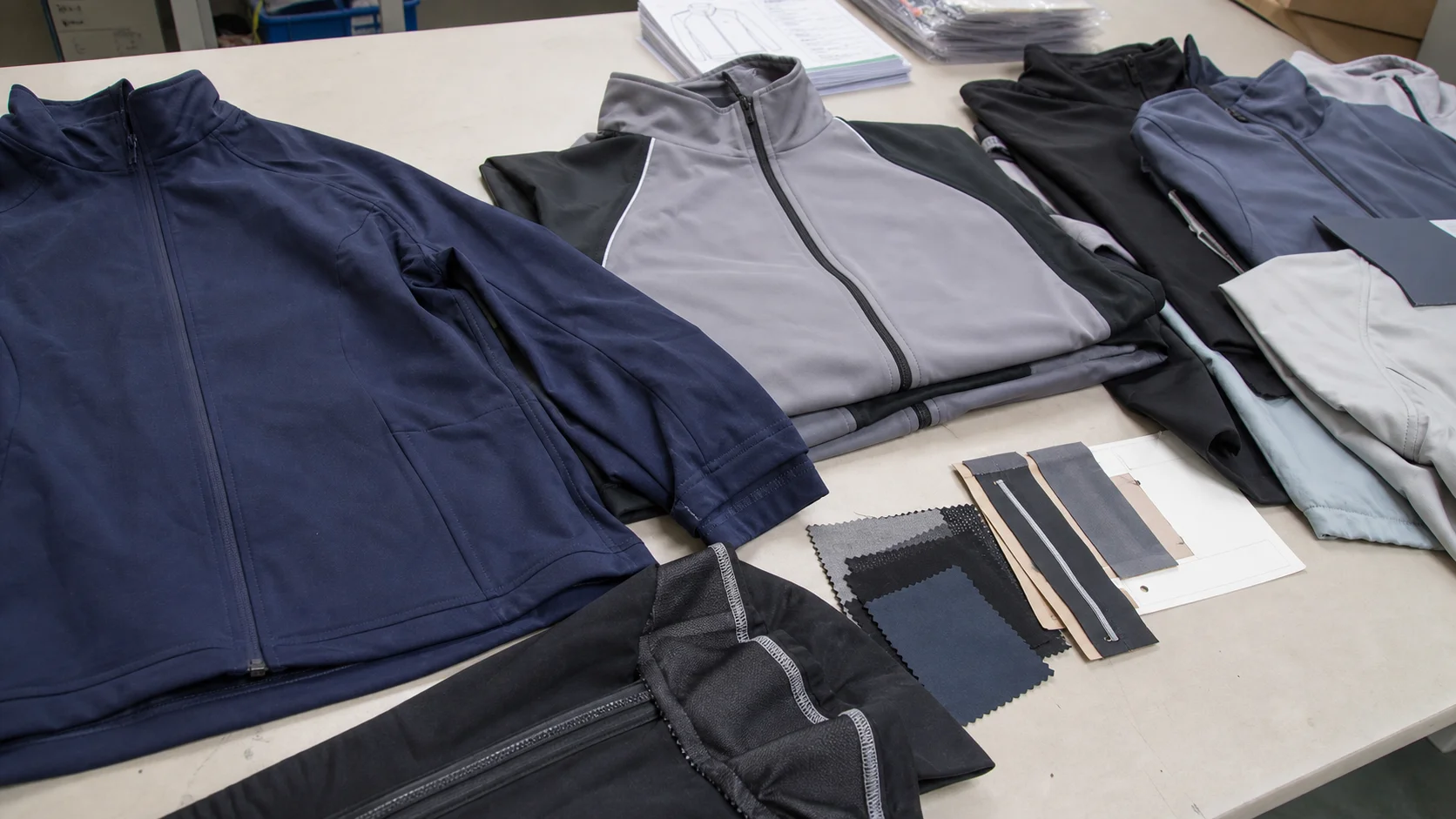
A product-specific vendor audit brief for corporate uniform buyers sourcing training jackets, covering fabric performance, decoration readiness, fit...
Training Jacket Vendor Audit Brief for Buyers - Fabrikn production reference
Category: Activewear & Teamwear
A training jacket manufacturer vendor audit brief helps corporate uniform buyers separate capable suppliers from factories that only look competitive on a quotation sheet. Training jackets sit between performance apparel and branded workwear. They need to look sharp in a team photo, survive repeated washing, move well during warm-ups or travel, and carry a logo cleanly across different sizes.
For corporate uniform programs, the risk is rarely one single defect. The bigger risk is inconsistency: one batch with poor zipper alignment, another with unstable dye lots, another with logos peeling after laundry, and another delayed because trims were not booked early. A structured vendor audit brief gives purchasing teams a practical way to check whether a factory can manage these details before a purchase order is placed.
This guide is written for buyers sourcing training jackets for employee uniforms, sports teams, field staff, event crews, hospitality groups, education programs, and branded corporate activewear. It focuses on audit questions, technical checkpoints, sampling requirements, MOQ expectations, and commercial tradeoffs that matter in real production.
Training jackets are often bought as part of a larger uniform package, but they behave differently from basic polos, T-shirts, or fleece hoodies. A jacket has more components, more sewing operations, more fit sensitivity, and more points where defects can appear. Zippers, pocket bags, elasticated hems, rib cuffs, lining, mesh ventilation, drawcords, seam tape, reflective trims, heat transfers, embroidery, and fabric coatings all create audit checkpoints.
Corporate buyers also face visibility pressure. A jacket is frequently worn outdoors, during travel, at trade events, in onboarding photos, and in customer-facing roles. If the fit is boxy, the branding is placed poorly, or the fabric pills quickly, the issue is public. A low-cost supplier can become expensive when replacement stock, complaints, and delayed rollouts are included.
A vendor audit brief should answer four buying questions:
For buyers building a broader sourcing plan, a service partner can also help structure vendor comparison, product development, and production follow-up. Fabrikn outlines relevant sourcing and manufacturing support on its services page.
A vendor audit is only useful when the buyer knows what kind of training jacket is being sourced. “Training jacket” can mean several different product types, and each has a different factory requirement.
A corporate buyer should not audit a supplier for a generic jacket category. The audit should match the intended product. A factory strong in fleece hoodies may not be strong in bonded softshell jackets. A teamwear sewing line may produce track jackets efficiently but struggle with sealed zippers, reflective tape standards, or complex panel blocking.
Performance expectations must be clear before the supplier is judged. A budget team jacket for a one-season event does not need the same testing package as an outdoor employee uniform used for 18 months. The audit should classify the program as basic, mid-range, or technical.
Program Level Typical Use Key Audit Focus Basic Events, short campaigns, light teamwear Workmanship, logo placement, color matching, delivery reliability Mid-range Corporate uniforms, school teams, travel kits Fabric durability, size consistency, wash performance, trim quality Technical Outdoor staff, sports programs, field teams Water resistance, breathability, seam performance, reflective trims, functional fitThe first part of the vendor audit should verify whether the supplier is commercially and operationally suited to corporate uniform buying. This is not only about factory size. A large factory may be too inflexible for mixed-size uniform orders, while a small workshop may not manage repeat programs or documentation well.
Buyers should be cautious with suppliers that claim they can make every apparel category equally well. Training jacket production benefits from pattern control, zipper handling, fabric relaxation knowledge, and panel matching. General cut-and-sew ability is not enough for a polished corporate uniform piece.
A practical audit question is: “Show the last three jacket styles you produced that are closest to this specification, and explain the main production issues encountered.” The answer often reveals more than a capability brochure.
MOQ and lead time are not fixed numbers. They depend on fabric availability, dyeing requirements, trim customization, logo method, size spread, order complexity, and whether the buyer needs stock service or made-to-order production.
Training jacket MOQs vary by material and customization level. The following ranges are common reference points, but buyers should confirm each project directly with the manufacturer.
Jacket Type Typical MOQ Range Notes for Buyers Stock fabric knit track jacket 100 to 300 pieces per color Lower MOQ possible if fabric and trims are readily available. Custom color woven training jacket 300 to 800 pieces per color Fabric dyeing and zipper matching can push MOQ higher. Softshell jacket 300 to 1,000 pieces per color Bonded fabric MOQ and testing requirements affect feasibility. Fully custom teamwear jacket with panel colors 200 to 600 pieces per style Small panel quantities can create cutting waste and color control issues. Replenishment order 50 to 200 pieces Only realistic when fabric, trims, and patterns are already approved and available.Low MOQ is attractive, but it can limit fabric options, color accuracy, and price. If the buyer needs exact brand colors, stable repeat production, or a full size range from XS to 5XL, pushing too hard on MOQ can create problems later. The better purchasing approach is to separate launch order MOQ from replenishment MOQ and agree on both before approval.
A realistic training jacket lead time usually has several stages. Sampling may take 7 to 21 days depending on complexity. Bulk fabric production may take 15 to 45 days. Sewing may take 10 to 30 days depending on order size and line capacity. Decoration and packing add more time, especially when logos require approval or placement checks.
For a standard corporate training jacket using available fabric, a typical production lead time may fall around 30 to 60 days after final sample approval and deposit. For custom-dyed fabric, bonded softshell, imported trims, or multiple decoration methods, 60 to 90 days is safer. Tight launches need a reverse calendar, not a verbal promise.
Fabric choice drives the jacket’s appearance, comfort, durability, and cost. A vendor audit should test whether the manufacturer can source and control the specified material, not just quote a generic polyester fabric.
The buyer’s tech pack should define fabric content, construction, weight, finish, stretch, and performance requirements. If those are missing, the supplier may substitute based on price rather than function.
For corporate uniform buyers, fabric consistency across repeat orders is a major issue. If the supplier cannot reserve fabric lots or maintain approved standards, the second order may look different from the first. This is especially important when jackets are issued alongside polos, pants, or caps in the same brand color family.
Trims are a common source of defects and delays. Zippers, drawcords, stoppers, elastic, snap buttons, reflective tape, labels, and packaging materials should be audited with the same seriousness as fabric.
Trim Audit Check Common Risk Zipper Brand, size, tape color, slider type, puller design, strength Wavy zipper, poor color match, slider failure, rough operation Elastic cuff or hem Width, recovery, tension, shrinkage Loose cuffs, twisting, uneven gathering Drawcord Material, diameter, end finish, safety compliance Fraying, color bleeding, non-compliant placement Reflective trim Reflectivity standard, wash durability, placement Cracking, peeling, insufficient visibility Labels Content, size, care instructions, country of origin Incorrect care label, missing fiber content, rough label edgeSampling is where the buyer learns whether the factory understands the product. A clean-looking salesman sample is not enough. The approval process should move from concept confirmation to production-ready control.
The pre-production sample is the most important approval point. It should be sealed with date, version number, buyer approval, and reference comments. Production should not start against an old sample, a photo, or an incomplete tech pack.
Training jackets need enough movement without looking oversized. Corporate buyers often prefer a cleaner silhouette than sports team buyers, but the garment still needs functional ease.
When the program includes both men’s and women’s fits, the supplier should not simply shrink one block. A women’s cut may require different chest shaping, waist shaping, sleeve length, and hip sweep. Extended sizes also need proper grading rather than proportional enlargement that distorts pocket placement and sleeve width.
A training jacket audit should include a practical sewing line review. The buyer or inspection team should look at how the factory controls cutting, bundling, sewing, pressing, trimming, and final measurement.
For knit track jackets, seam waviness is a common issue. The audit should check machine settings, operator handling, needle type, differential feed, and seam stabilization. For woven jackets, puckering around zippers and pocket openings is often the main visual defect. For softshell jackets, needle marks, delamination, and bulky seams deserve close inspection.
Corporate training jackets usually carry visible branding. Logo execution can make or break the program, even when the garment itself is acceptable. The audit should review whether the supplier controls decoration in-house or outsources it to a specialist.
Decoration should be tested on the actual bulk fabric, not a similar fabric. Coatings, stretch, texture, and heat sensitivity can change results. A heat transfer that works on a polyester knit may fail on a water-repellent woven surface. Embroidery that looks sharp on a heavyweight softshell may distort a lightweight windbreaker.
The vendor audit should confirm that the factory uses placement templates, not only operator judgment. A corporate program may include many sizes, and logo placement should be visually consistent across the size range. The buyer should define placement from fixed points, such as center front, shoulder seam, pocket edge, or high point shoulder.
Corporate uniform buyers should not rely only on visual inspection. Basic testing and documentation reduce avoidable disputes. The exact test package depends on target market, product claims, fabric type, and buyer policy.
If the jacket is marketed as water-resistant, breathable, recycled, flame resistant, high-visibility, or antimicrobial, the claim must be supported by documentation. Buyers should be especially careful with performance claims that appear in sales material but are not backed by test reports.
For broader supplier due diligence, buyers may want to review the sourcing company’s structure, background, and operating model. Fabrikn provides company information on its about us page.
Inspection planning should be agreed before production, not after problems appear. Training jackets have enough components that a final random inspection alone may miss early-stage issues. A stronger plan includes incoming material checks, inline inspection, and final inspection.
AQL levels vary by buyer policy, but many apparel inspections use general inspection levels with separate limits for critical, major, and minor defects. The key point is to define acceptance criteria before the order starts. If measurement tolerance, logo placement tolerance, and shade tolerance are not written, disputes become subjective.
A vendor audit is not complete without commercial review. The cheapest jacket may not be the best value if it requires looser fabric, weaker zippers, slow replenishment, or high rework risk. Corporate uniform buyers should compare landed cost, not only FOB unit price.
Buyers should ask suppliers to break down cost assumptions enough to compare alternatives. A lower quote may be based on lighter fabric, local unbranded zippers, simplified pockets, or excluded logo cost. This does not make the quote wrong, but it must be comparable.
Common payment terms for custom apparel may include a deposit before production and balance before shipment or against shipping documents. More favorable terms may be possible with established relationships, repeat programs, or credit arrangements. New buyers should be cautious about paying a large balance before inspection results are reviewed.
For corporate programs, the best purchasing judgment is often to pay slightly more for a supplier that can protect color consistency, documentation, and delivery. A jacket is a visible uniform item with many failure points. Saving a small percentage on unit price can be a poor trade if the supplier cannot control trims, measurements, or logo durability.
A scorecard turns audit observations into a decision. It does not need to be complicated, but it should separate must-pass requirements from negotiable preferences.
Audit Area Weight What to Check Product capability 20% Relevant jacket experience, samples, pattern control, fabric knowledge Quality system 20% QC checkpoints, defect records, measurement control, final inspection process Material and trim control 15% Fabric sourcing, shade control, zipper quality, trim approval process Sampling and development 15% Fit sample accuracy, PP sample discipline, strike-off handling Capacity and delivery 15% Production planning, realistic lead time, peak season risk, replenishment ability Compliance and documentation 10% Test reports, labels, restricted substance controls, claim support Commercial fit 5% MOQ, payment terms, price transparency, communication qualityA supplier with a strong total score but a failure in a must-pass area should not be approved without corrective action. For example, a factory may have good sewing capacity but no reliable way to test logo wash durability. If branded transfers are central to the program, that gap matters.
Many sourcing problems start because the buyer sends an incomplete brief and compares quotes that are not based on the same assumptions. Before requesting a price, corporate uniform buyers should prepare a clear package.
When the project is not fully specified, buyers can ask the manufacturer for two or three options. For example, one quote may use stock fabric for faster delivery, while another uses custom-dyed fabric for better brand color control. This makes the tradeoff clear instead of hiding it in a single price.
For buyers ready to discuss a program brief, Fabrikn provides a direct inquiry route through its contact page.
Vendor audits should identify risk early. Some issues can be corrected with better specifications or closer inspection. Others suggest the supplier is not suitable for the order.
One or two red flags may be manageable if the supplier responds with corrective action. A pattern of vague answers, missing documents, and unrealistic promises is a stronger reason to pause. In uniform sourcing, a delayed approval is usually cheaper than a failed rollout.
For most corporate uniform buyers, the safest path is to start with a jacket style that matches the supplier’s proven capability, then customize fabric, color, and branding within realistic limits. Highly engineered jackets can be worthwhile, but they require more development time, higher MOQ, and tighter testing.
If the priority is speed, use available fabric and standard trims, then focus on logo quality and fit. If the priority is brand consistency, allow time and budget for lab dips, custom trims, and approved bulk standards. If the priority is durability, invest in better zippers, stronger stitching, fabric testing, and wash-tested decoration.
A good training jacket manufacturer should be able to explain these tradeoffs clearly. Buyers should not expect every supplier to be the cheapest, fastest, most flexible, and most technical option at the same time. The audit brief exists to determine which supplier fits the program’s real priorities.
Get a free quote from Fabrikn — your trusted B2B clothing manufacturer with 10+ years of experience. MOQ as low as 200 pieces.
Get a Free Quote →A training jacket vendor audit should include supplier profile review, jacket production capability, fabric and trim control, sampling process, quality checkpoints, logo decoration controls, compliance documentation, production capacity, MOQ, lead time, and inspection planning. The audit should be specific to the jacket type, such as woven warm-up jacket, knit track jacket, or softshell jacket.
Typical MOQs range from 100 to 300 pieces per color for simple jackets using available fabric, 300 to 800 pieces for custom-colored woven jackets, and 300 to 1,000 pieces for softshell or bonded fabric styles. Very low MOQ may be possible for stock blanks or limited customization, but it can restrict color matching, trims, and replenishment consistency.
A common lead time is 30 to 60 days after final sample approval for standard styles using available materials. Custom fabric, softshell materials, special zippers, multiple logos, or added testing can extend production to 60 to 90 days. Sampling, lab dips, strike-offs, and inspection time should be included in the calendar.
The best fabric depends on use. Polyester interlock or double knit works well for track jackets and indoor teamwear. Lightweight polyester or nylon woven fabric works for warm-up jackets and event uniforms. Softshell fabric is better for outdoor staff who need wind resistance and light water resistance. Buyers should specify weight, stretch, finish, and wash performance rather than choosing only by fabric name.
Common risks include wavy zippers, uneven logo placement, poor color matching, seam puckering, unstable fabric shrinkage, weak pocket seams, pilling, peeling heat transfers, incorrect labels, and inconsistent measurements across sizes. These risks can be reduced through approved pre-production samples, material testing, inline inspection, and final AQL inspection.
Embroidery is durable and professional, but it may pucker lightweight or stretchy fabrics. Heat transfer gives a clean performance look and works well on many activewear fabrics, but adhesion and wash durability must be tested. The best method depends on fabric surface, logo size, stretch, brand appearance, and expected laundering.
Buyers should request fabric specifications, trim details, size charts, sample comments, test reports where applicable, care label information, production schedule, inspection plan, packing details, and compliance documentation for the target market. For branded programs, logo strike-off approvals and placement sheets should also be included.
Buyers should provide the same tech pack, fabric requirements, logo details, size range, order quantity, testing needs, and packing instructions to both suppliers. Quotes should be compared by fabric quality, trims, sampling accuracy, lead time, MOQ, inspection support, and landed cost. A lower unit price is not always better if it removes durability, documentation, or color consistency.