
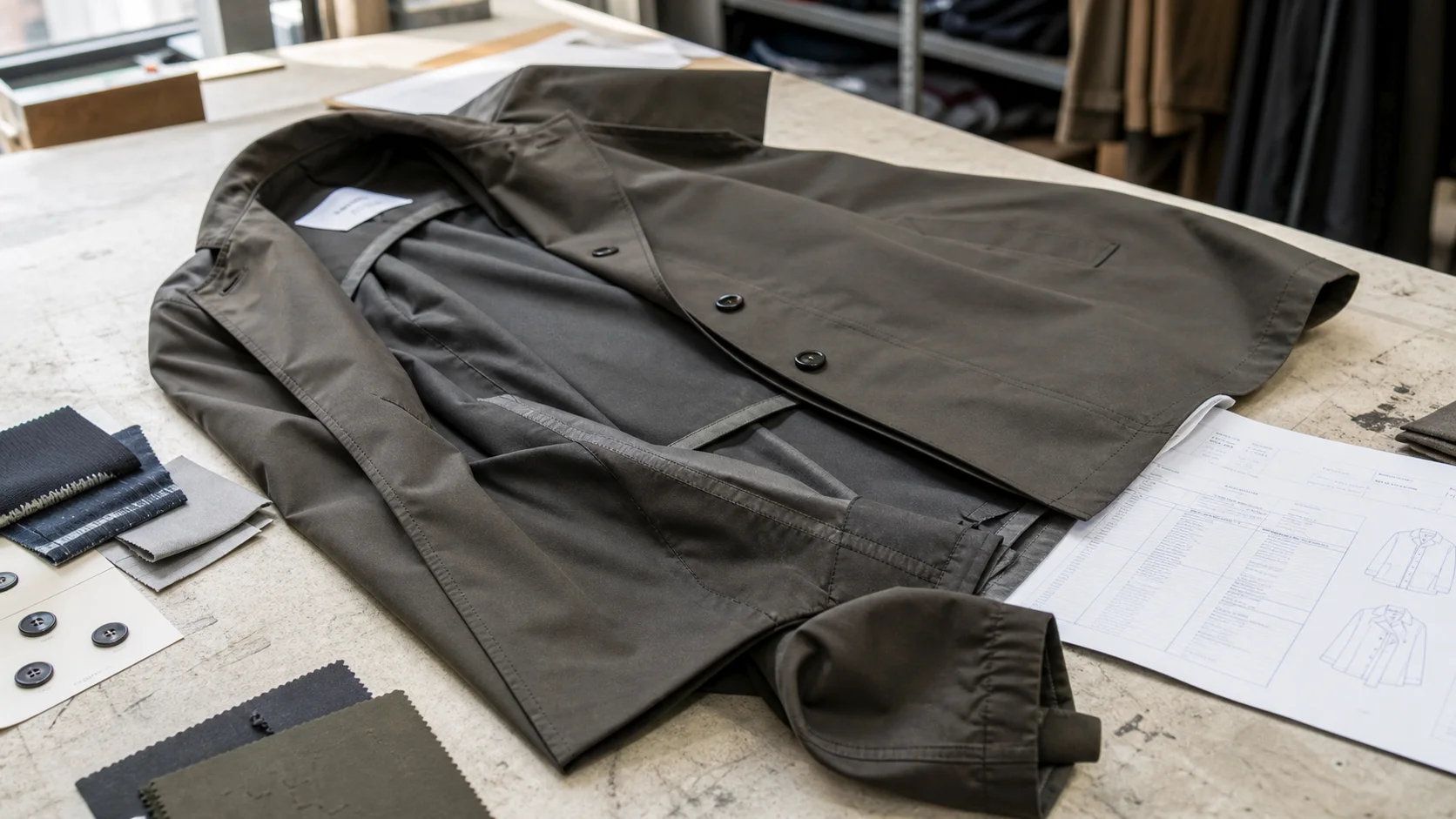
A distributor-focused outline for evaluating travel coat supplier fit blocks, grading rules, mobility, layering allowance, sample reviews, and production...
Travel Coat Fit Block Review for Distributor Buyers - Outerwear & Jackets manufacturing guide
For distributor buyers, a travel coat is not just another outerwear SKU. It sits between commuter wear, lightweight weather protection, business travel apparel, and packable outerwear. That makes the fit block more commercially important than many buyers expect. A coat that looks clean on a fit model but restricts movement over a blazer, wrinkles badly after packing, or pulls across the shoulder when reaching for luggage can produce high return rates.
A travel coat supplier fit block review should answer one practical question: can this base pattern support repeat wholesale orders across sizes, colors, seasons, and customer segments? Distributor buyers need more than a good-looking sample. They need a fit platform that can be graded consistently, manufactured repeatedly, and adjusted without rebuilding the entire style every season.
The best review process is direct and structured. It compares the supplier’s proposed block against target body measurements, intended layering, fabric behavior, size grading, trim placement, and inspection tolerances. It also checks whether the supplier understands distributor requirements: predictable MOQs, stable packaging, clear labeling, size consistency, and realistic lead times.
Travel coats are often sold to retailers, corporate uniform programs, hospitality buyers, online outerwear brands, and regional distributors. Each channel may expect a slightly different silhouette. Retail buyers may prefer a sharper shape. Corporate programs usually need conservative ease and a broader size range. E-commerce sellers need reliable measurements because customers cannot try the garment before purchase. One weak fit block can affect all these channels.
Purchasing judgment: do not approve a travel coat supplier based only on front-view sample appearance. Review the block in motion, with layering, after pressing, and after packability testing. A travel coat must perform when worn, folded, carried, and unpacked.
A fit block is the base pattern structure used to develop related styles. For a travel coat, the block controls shoulder slope, chest ease, armhole shape, sleeve pitch, body length, sweep, collar stand, hood compatibility, lining allowance, and movement room. It is the foundation behind the final garment measurements.
A supplier may present a “standard men’s travel coat block” or “women’s long commuter coat block,” but those labels are not enough. Distributor buyers should ask for the measurement chart, grading rules, intended body standard, and past style adaptations. A good supplier can explain whether the block is designed for woven shells, bonded fabrics, quilted linings, stretch fabrics, or waterproof laminated materials.
Travel coat fit blocks usually fall into four commercial shapes:
The right block depends on the buyer’s channel. A distributor selling into department stores may need a neater silhouette. A buyer supplying corporate travel uniforms may need a block that fits a larger range of body types with fewer complaints. A private label e-commerce buyer may need size charts that match customer expectations in each market.
If a supplier cannot explain the fit intention, treat the block as unproven. Pattern files alone are not enough. The supplier should show how the block behaves across base size, jump sizes, and extended sizes. For buyers building a long-term outerwear program, this is worth clarifying before placing bulk fabric orders.
Distributor buyers usually balance fit quality against price, MOQ, delivery timing, and risk. The fit block review should not become an isolated technical exercise. It should support purchasing decisions.
A distributor often buys multiple colors or fabrics under one style group. If the same block behaves differently across fabric lots, the sales team will face complaints. Lightweight polyester twill, nylon taslan, cotton-nylon blends, recycled polyester microfibers, and bonded softshell fabrics all respond differently to the same pattern.
A supplier should be able to advise which fabrics are compatible with the proposed block. If the block was developed for a soft woven fabric, it may become tight in laminated fabric with limited mechanical give. If it was built for a padded style, it may look oversized in an unlined shell.
Fit-related returns are expensive for distributor buyers, especially when selling to online retailers or regional stockists. Common return reasons include tight upper arms, narrow shoulders, long sleeves, bulky collar, tight hip, and poor length balance. A strong fit block reduces these problems before bulk production.
Many distributors reorder successful outerwear styles. The supplier should preserve approved patterns, grading rules, trims, labels, and measurement tolerances. Reorders should not drift because a different technician interpreted the block differently.
Travel coats are often required in wider size ranges than fashion jackets. Men’s ranges may run from S to 3XL or 4XL. Women’s ranges may run from XS to XXL, with plus-size extensions depending on the market. The block must grade sensibly. Large sizes need more than simple width increases; armhole depth, bicep, sleeve cap, back width, and sweep require careful balance.
Buyers working on a broader outerwear program can compare development support through a manufacturing partner’s service capabilities. For example, buyers reviewing supplier process depth may check outerwear manufacturing services before starting a new travel coat program.
A travel coat supplier fit block review should be done from the body outward. Do not start with pocket styling or button color. Those can be changed later. Shoulder, armhole, sleeve pitch, chest, hip, and length are harder to correct once the block moves into bulk production.
The shoulder controls the visual quality of the coat. If the shoulder is too narrow, the sleeve head pulls and the wearer feels restricted. If it is too wide, the coat looks cheap and oversized. Travel coats often need slightly more shoulder ease than fashion topcoats because the wearer may layer over shirts, knitwear, or a blazer.
Review shoulder slope on the fit model and on at least one alternate body type. A block with a steep shoulder may create diagonal drag lines near the armhole. A flat shoulder may produce fabric collapse near the neck point. Ask the supplier to provide photos from front, side, back, and arm-raised positions.
Chest ease should match the garment’s intended use. A lightweight travel shell may need moderate ease. A coat designed for business travel over a blazer needs more room. Typical finished chest ease for woven travel coats may range from 10 cm to 18 cm over body measurement, depending on gender, size, fabric, and styling. This is not a fixed rule. It is a starting range for buyer discussion.
Back ease is just as important. Buyers should check whether the wearer can reach forward, lift a bag, sit in a car, and walk naturally. A clean static fit can still fail in motion. Back vents, action pleats, stretch lining, or adjusted armhole shape may solve movement issues, but each adds cost or changes styling.
Armhole shape is one of the most common weak points in outerwear sourcing. Low armholes feel comfortable when standing but restrict movement when the arm lifts. Tight armholes look neat but may pinch over layers. Sleeve pitch must match natural arm position. A sleeve pitched too far forward or backward creates twisting and drag lines.
Distributor buyers should ask for bicep, elbow, cuff, armhole circumference, and sleeve cap height measurements. If the coat includes lining, quilting, or seam taping, allowances must be included in the block. Bulk production often tightens around the sleeve if allowances are ignored.
Travel coats are commonly mid-thigh, knee-length, or short commuter length. Longer coats offer better coverage but increase fabric consumption, shipping weight, and wrinkling risk. Shorter coats are easier to pack but may feel less protective in rain or wind.
Sweep measurement affects walking comfort and silhouette. A narrow sweep looks modern but can pull when sitting or walking. A wide sweep improves movement but may look shapeless. For women’s blocks, hip and sweep review is especially important. For men’s blocks, the hip area must still be checked over trousers, belts, and jacket layering.
The collar should sit cleanly without choking the wearer or collapsing away from the neck. Travel coats often use stand collars, convertible collars, detachable hoods, or hidden hoods. Each option changes the neck fit. A hood adds weight and may pull the back neckline if not balanced correctly.
Check collar height, collar stand curve, hood opening, drawcord position, and zipper garage placement. Poor collar engineering can make an otherwise acceptable coat uncomfortable during travel.
Travel coats typically include hand pockets, inner security pockets, phone pockets, ticket pockets, or zip chest pockets. Pocket placement must be reviewed on body, not only on a flat sample. Pockets placed too low are awkward. Pockets placed too close to the side seam may distort when filled.
Internal pockets need reinforcement. A passport pocket or phone pocket can sag if attached only to lightweight lining. If the supplier proposes multiple functional pockets, ask how they affect lining balance, production time, and inspection risk.
The fit block cannot be reviewed separately from fabric and trims. Fabric thickness, stretch, shrinkage, coating, lamination, and drape all influence fit. A travel coat block approved in one material may fail in another.
Unlined travel coats are lighter and easier to pack, but seam finishing must be clean. Half-lined coats can improve comfort without too much weight. Fully lined coats feel more premium but add bulk and may reduce breathability. If the coat is designed to be worn over business clothing, lining slipperiness matters.
Interlining affects collar, placket, cuffs, and pocket flaps. Too much fusing creates a stiff garment. Too little fusing makes the coat look weak after packing. Ask for fusing temperature, press time, compatibility testing, and peel-strength checks if the style uses fused components.
Many travel coats are marketed as water-resistant, not fully waterproof. Distributor buyers should be careful with claims. A DWR finish may repel light rain but does not make the coat waterproof. A laminated fabric with taped seams can improve weather protection, but it increases cost and production complexity.
If water performance is part of the sales promise, request test standards from the supplier. Common buyer discussions may include hydrostatic pressure, spray rating, seam leakage, colorfastness to water, and DWR durability after washing. Avoid vague claims like “rainproof” unless the testing and construction support it.
Trims can make or break a travel coat program. Zippers, snaps, drawcords, toggles, hook-and-loop closures, labels, and elastic components all affect user experience and inspection outcomes. Low-quality zippers are a high-risk area because they create immediate customer complaints.
Trim Area Buyer Checkpoint Common Risk Main zipper Slider smoothness, strength, color match, puller durability Jamming, waviness, broken pullers Snaps Pull strength, alignment, finish quality Loose snaps, cracked coating, misalignment Drawcords Compliance, stopper strength, placement Safety issues, uneven tension, slipping Labels Fiber content, care instructions, country of origin Incorrect compliance labeling Pocket zippers Opening size, seam reinforcement, zipper tape quality Distortion, weak pocket entry, broken slidersA disciplined sample process protects the buyer and the supplier. It also prevents late-stage arguments about whether a fit issue is a pattern problem, fabric problem, or sewing problem.
The buyer should provide a clear tech pack or at least a detailed brief. This should include target market, gender, size range, intended layering, garment length, fabric direction, lining preference, pocket functions, trims, labeling, packaging, and target price. The supplier should respond with a proposed block and measurement chart.
If the buyer does not have a complete tech pack, the supplier may help develop one, but responsibilities should be clear. A vague brief often leads to extra sample rounds and delayed approvals.
The proto sample checks the concept and base fit. It may be made in substitute fabric if the final fabric is not ready, but this limits accuracy. If substitute fabric is used, mark all fit comments as provisional. Do not approve a final block based only on a fabric with different weight, stretch, or drape.
The fit sample should be made as close as possible to final fabric and construction. Review it on the intended fit model and compare against the measurement chart. Record comments clearly: shoulder width, chest ease, sleeve pitch, bicep, body length, collar, pocket placement, and movement.
The size set verifies grading. This step is important for distributor buyers because bulk orders often span multiple sizes. Review base size plus small and large sizes. Extended sizes should not be approved only mathematically. They need body review or at least careful measurement validation.
The pre-production sample, often called PPS, should represent bulk production. It should use approved fabric, trims, labels, care instructions, packaging, and construction. The PPS becomes the reference for production and inspection. If the PPS is not correct, bulk should not start.
The sealed sample is the approved standard for the factory and inspection team. Keep one sample with the supplier and one with the buyer or inspection office where possible. It should include signed approval tags, date, style number, color, size, fabric lot reference, and any accepted deviations.
Purchasing judgment: if the supplier pushes to skip size set or PPS for a new travel coat block, treat it as a risk signal. Sampling cost is usually lower than the cost of correcting bulk fit failures.
Buyers who need structured development support can review supplier engagement options through Fabrikn’s services page or start a sourcing discussion through the contact page.
MOQ depends on fabric sourcing, trim availability, color count, construction complexity, and supplier capacity. Travel coats usually carry higher MOQs than simple fleece jackets because fabric finishing, lining, trims, and pattern work are more involved.
Order Type Typical MOQ Range Buyer Notes Basic unlined travel shell 300-800 pcs per color Possible when fabric is available from stock or shared greige goods Lined commuter coat 500-1,200 pcs per color MOQ rises with custom lining, custom trims, and multiple size ratios Water-resistant coat with custom finish 800-1,500 pcs per color Fabric mill MOQ may drive the final quantity Technical laminated travel coat 1,000-2,000 pcs per color Seam tape, special trims, and testing increase order complexity Private label multi-color program 1,500-5,000 pcs total Total quantity may be negotiated across colors if materials are sharedThese ranges are only practical reference points. Some suppliers may accept lower trial quantities at a higher unit price. Others may require higher MOQs because fabric mills, dye lots, or trim suppliers set minimums. Buyers should separate garment MOQ from fabric MOQ. A factory may say it can make 300 pieces, but the fabric mill may require enough cloth for 1,000 pieces.
For distributor buyers, the best approach is to plan size and color ratios early. Too many colors in low volume will weaken negotiating power and increase leftover fabric risk. A focused first order in two or three commercial colors often performs better than a scattered launch across six colors.
Size ratios should reflect the destination market and sales channel. A common men’s ratio may lean heavily into M, L, and XL, while women’s ratios may vary more by region and brand positioning. Corporate uniform programs may require broader coverage in larger sizes. Retail fashion programs may need more core sizes and fewer extremes.
Ask the supplier whether price changes for extended sizes. Larger sizes consume more fabric and may require special grading attention. Some buyers ignore this until costing, then face margin pressure.
Lead time for travel coats depends on development readiness, fabric availability, trim sourcing, testing, sample approval speed, and production capacity. A simple repeat order in available fabric may move quickly. A new waterproof travel coat with custom trims and testing will take longer.
Stage Typical Time Range Main Dependency Tech pack review and costing 3-10 days Completeness of specifications Proto sample 10-20 days Pattern readiness and sample room capacity Fit sample revision 7-18 days per round Comment clarity and fabric availability Size set 10-20 days Grading and size range complexity Bulk fabric and trims 20-45 days Mill MOQ, dyeing, finishing, testing Bulk production 30-60 days Order quantity, sewing complexity, line capacity Final inspection and packing 3-7 days Inspection result and carton readinessA realistic new development timeline may run 90 to 150 days from initial brief to shipment, especially if the buyer requires multiple sample rounds, lab testing, custom trims, or packaging approval. Repeat programs can be shorter, but only when the fit block, materials, and trims remain unchanged.
Late approvals are a common cause of delayed delivery. If the buyer takes two weeks to comment on each sample, the calendar expands quickly. Suppliers should also be transparent about fabric booking deadlines and production line slots. A good quote should identify assumptions, not just list a delivery date.
Travel coats create several inspection risks because they combine fit, function, weather performance, and appearance. Buyers should align inspection criteria before production starts. Waiting until final inspection to define acceptable quality levels invites conflict.
Outerwear measurements require realistic tolerances. Very tight tolerances may be impractical for padded, lined, or laminated garments. Common tolerances may range from +/- 1 cm for smaller points to +/- 2 cm for larger widths and lengths, depending on the measurement point and garment type. The buyer and supplier should agree before PPS approval.
Lightweight coated fabrics can pucker along seams, zippers, and hems. Bonded fabrics can twist if cutting direction is inconsistent. A supplier should control needle size, thread tension, pressing, and seam construction. Buyers should inspect side seams, sleeve seams, front placket, zipper tape, and hem.
Outerwear panels are large, so color shading is visible. Mixed dye lots or poor panel matching can create shade differences between sleeves, body panels, hood, and pocket flaps. Require fabric roll shade control and panel matching procedures for visible areas.
Long front zippers are prone to waviness, especially on lightweight shells. This can happen because of zipper tape shrinkage, sewing tension, fabric stretch, or pressing. Zipper waviness makes the coat look low quality even when measurements pass.
If a coat claims water resistance, inspection should include relevant checks. DWR inconsistency, seam leakage, or poor tape adhesion can undermine the product promise. Buyers should not rely only on hand feel. Test reports and in-line process controls matter.
Travel coats are often marketed as packable or easy-care. Check folding method, carton pressure, wrinkle recovery, and hang appearance after unpacking. A coat that needs heavy steaming after every shipment may create retail handling problems.
Outerwear labels must match destination market requirements. Fiber content, care instructions, size labels, country of origin, warning labels, and packaging marks should be checked before bulk packing. Incorrect labels can delay distribution even when garment quality is acceptable.
A scorecard helps distributor buyers compare suppliers without relying on impressions. It also creates a shared language between merchandising, technical design, sourcing, and quality teams.
Review Area Strong Supplier Evidence Risk Signal Fit block clarity Provides measurement chart, grading rules, intended body standard Only shares photos and general size labels Fabric compatibility Explains suitable shell fabrics and construction limits Claims one block works for all fabrics Sampling discipline Supports proto, fit, size set, PPS, sealed sample Pushes buyer to approve after one sample Grading quality Reviews jump sizes and extended sizes Grades mechanically without fit review Trim management Confirms zipper, snap, drawcord, label specifications Leaves trims open until late production Inspection readiness Agrees tolerances and quality checklist before bulk Defines quality only at final inspection Lead-time transparency Separates sample, fabric, trim, production, inspection timing Quotes a single optimistic shipment dateBuyers should rate each supplier before awarding a program. A low-cost supplier may still be useful for simple, low-risk travel shells if the buyer accepts more technical management. A higher-cost supplier may be better for lined, technical, or private label programs where fit stability matters more than the lowest FOB price.
Company background and operating approach can also support supplier evaluation. Buyers comparing potential manufacturing partners may review Fabrikn’s company background as part of a broader due diligence process.
A travel coat supplier fit block review should lead to a buying decision, not just a list of comments. The buyer needs to decide whether to approve, revise, trial, or reject the block.
Approve the block when the base size fits the target wearer, movement is acceptable, size grading is logical, fabric behavior matches the intended product, and the supplier can reproduce the approved standard. The sealed sample should be clear, and measurement tolerances should be agreed.
Approval does not mean the style is perfect for every channel. It means the block is commercially sound for the intended order. Buyers should record any accepted compromises, such as a slightly relaxed fit for broader customer coverage or a shorter length to meet price targets.
Revise the block when issues are correctable without changing the entire product concept. Examples include sleeve pitch adjustment, minor shoulder correction, pocket placement changes, collar balance improvement, or sweep adjustment. One or two revision rounds are normal for a new travel coat development.
Be specific in comments. “Make it better” is not useful. State the issue, location, desired change, and measurement impact where possible. Photos with marked drag lines or pressure points help reduce misunderstanding.
A trial order is sensible when the supplier looks capable but the buyer wants market confirmation. Trial orders are useful for new channels, new fabrics, new size ranges, or uncertain demand. Expect a higher unit cost if the quantity is below standard MOQ.
For trial orders, limit variables. Use fewer colors, standard trims, and a controlled size ratio. If the buyer changes too many elements at once, it becomes harder to identify what caused sales or quality issues.
Reject the block when the supplier cannot correct structural fit issues, cannot explain grading, ignores fabric compatibility, or resists basic sampling steps. A weak block will not become reliable simply because the price is attractive. Distributor buyers should be especially cautious when the coat will be sold under private label, because returns and brand damage fall back on the buyer.
There is no need to over-engineer every travel coat. A basic promotional travel shell can use a simpler fit block if the buyer accepts looser tolerances and limited styling. A premium commuter coat needs better shoulder shaping, trim quality, lining comfort, and finish control. The key is matching the block to the commercial promise.
Low price usually comes from simplified construction, available fabric, basic trims, fewer sample rounds, and larger production runs. Better fit usually requires more pattern work, more sampling, tighter process control, and sometimes better materials. The buyer’s job is to decide where the product sits.
A travel coat supplier fit block review is one of the most important technical buying steps for distributor buyers in the outerwear and jackets category. The fit block affects comfort, appearance, size consistency, return rates, reorder reliability, and margin protection. A good supplier should be able to explain the block, adapt it to the right fabric, support a disciplined sample process, and maintain quality through bulk production.
The strongest purchasing decisions come from combining technical review with commercial judgment. A lower-cost block may be suitable for a simple packable shell. A more developed block is usually justified for lined commuter coats, business travel outerwear, waterproof programs, or private label ranges. Buyers should not pay for unnecessary complexity, but they should not ignore fit engineering where it protects repeat sales.
For distributor buyers, the practical goal is clear: choose a travel coat supplier whose fit block is proven enough to scale, flexible enough to suit the channel, and controlled enough to survive bulk production. That is the difference between a sample that looks acceptable and an outerwear program that can be reordered with confidence.
Get a free quote from Fabrikn — your trusted B2B clothing manufacturer with 10+ years of experience. MOQ as low as 200 pieces.
Get a Free Quote →A travel coat fit block is the base pattern used to build the garment’s shape, measurements, grading, and movement. It controls areas such as shoulder, chest, sleeve, armhole, body length, sweep, collar, and layering ease.
Typical MOQs may range from 300 to 800 pieces per color for simple unlined shells, 500 to 1,200 pieces per color for lined commuter coats, and 1,000 to 2,000 pieces per color for technical laminated coats. Final MOQ depends on fabric mill minimums, trims, color count, and supplier capacity.
For a new travel coat block, buyers should usually expect a proto sample, fit sample, size set, pre-production sample, and sealed sample. Repeat styles may need fewer steps if fabric, trims, pattern, and grading remain unchanged.
Common issues include tight shoulders, restricted biceps, poor sleeve pitch, narrow hip, low armhole restriction, collar discomfort, pocket misplacement, and inconsistent grading across sizes.
One block can sometimes support related fabrics, but it should not be assumed. A block approved in soft polyester may not work in stiff laminated fabric or bonded softshell. Fabric weight, stretch, drape, lining, and construction must be reviewed.
A new development may take 90 to 150 days from brief to shipment when sampling, fabric sourcing, testing, production, and inspection are included. Repeat orders can be shorter if the approved block and materials are unchanged.
Buyers should inspect measurements, fit consistency, seam quality, zipper function, snap strength, color shading, lining attachment, label accuracy, water-resistance claims if applicable, packing method, and overall appearance after unpacking.
Reject the block when the supplier cannot correct structural fit issues, cannot explain grading rules, avoids size set approval, ignores fabric behavior, or pushes bulk production without a reliable pre-production sample.