
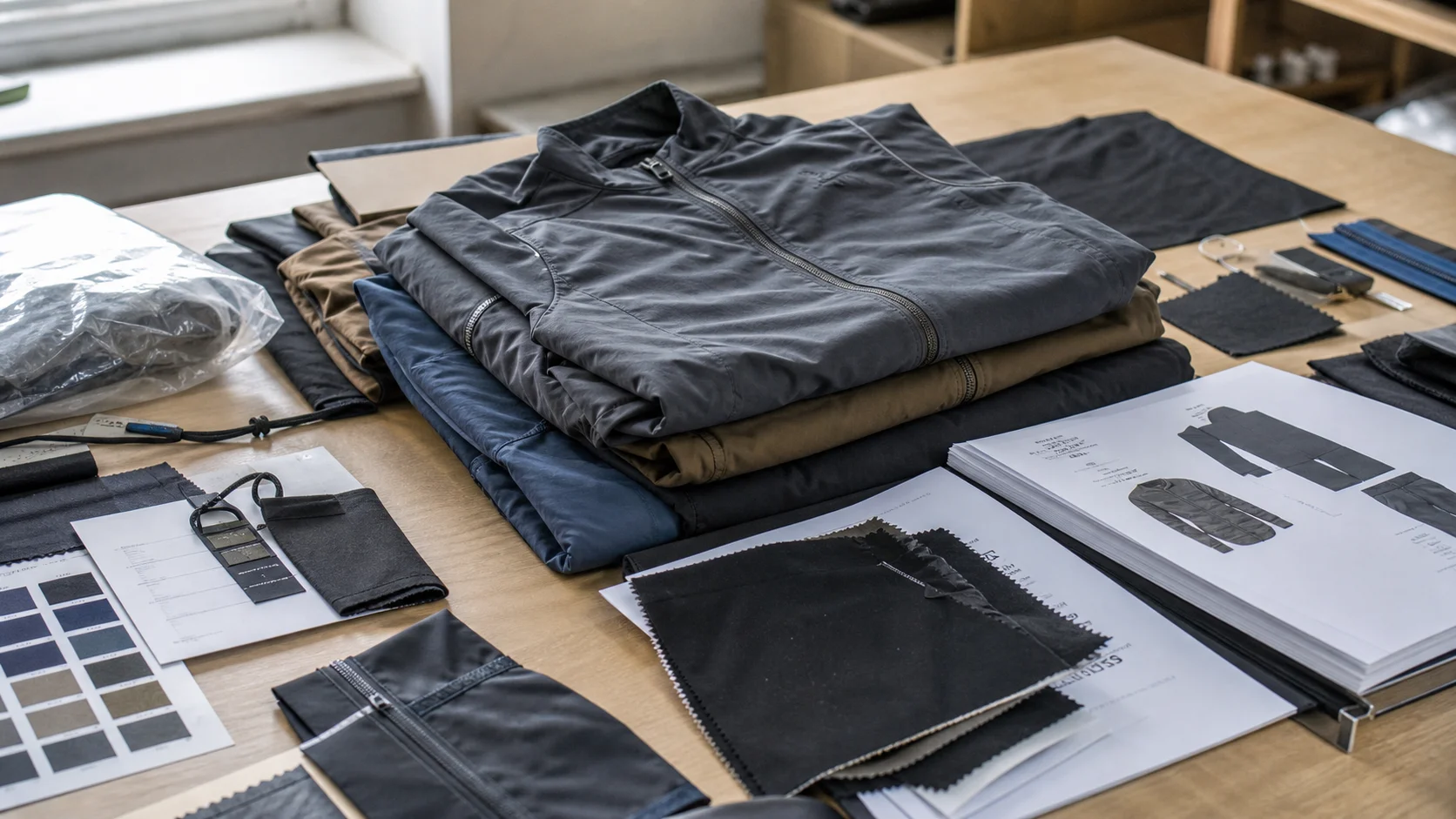
A practical SEO outline for distributor buyers managing travel coat orders, focused on factory release checkpoints, garment specs, trim approvals, packing...
Travel Coat Release Checklist for Distributor Orders - Fabrikn production reference
Distributor buyers do not need a poetic factory release process. They need a repeatable checkpoint system that catches the problems most likely to become chargebacks, late deliveries, margin loss, and retailer complaints. A travel coat order has more moving parts than a basic woven jacket: shell fabric performance, lining behavior, pocket construction, closures, packing method, hangtag claims, carton marking, and destination compliance all need to line up before goods leave the factory.
This travel coat order factory release checklist is written for distributor buyers, sourcing managers, import teams, and private-label outerwear programs that need practical control before shipment. It focuses on what should be confirmed after bulk production is complete but before the factory is allowed to release cartons to the forwarder.
The best release checklist is not a last-minute document created when the container is already booked. It should be built into the purchase order, tech pack, sample approval record, inspection protocol, and packing instructions from the beginning. That is especially true for distributor orders, where the buyer may be supplying multiple retailers, regional sales channels, or corporate customers from the same production run.
A travel coat is usually bought for practicality: lightweight warmth, weather resistance, packability, easy care, and enough polish for commuting or business travel. Distributor buyers often sell these coats across more than one account, which means a defect found late can affect several downstream customers at once.
Factory release is the final commercial gate. It is not the same as production monitoring, and it is not a replacement for sample approval. Its job is to answer one question clearly: are these goods acceptable to ship under the buyer’s order terms?
For outerwear, a weak release process often shows up in predictable ways. Water-repellent claims are not backed by testing. Zippers feel rough or fail under stress. Sleeve length varies across sizes. Cartons are mixed incorrectly. Care labels do not match the approved composition. Stuff sacks are missing. Coats arrive crushed because the packing method was chosen for factory convenience rather than channel requirements.
Distributor buyers should treat release approval as a controlled decision, not a courtesy confirmation. The factory may be under pressure to clear space, meet a vessel closing date, or close an invoice. The buyer’s priority is different: ship only what can be sold without avoidable disputes.
A good factory release checklist does not make production perfect. It makes risk visible before the goods move out of the buyer’s control.
Before reviewing measurements and packing lists, distributor buyers should step back and confirm whether the travel coat still matches the selling channel. A coat for corporate travel uniform programs may need different priorities than one for department-store resale or online marketplace fulfillment.
The same factory order can fail for different reasons depending on the destination. Retailers may be strict on hanger presentation, swing ticket placement, and carton ratios. Corporate distributors may care more about logo embroidery readiness, easy size identification, and replenishment consistency. E-commerce channels may need polybag warnings, scannable barcodes, individual pack dimensions, and return-resistant construction.
The tradeoff is straightforward. More channel-specific controls add administration and may increase packing cost. Fewer controls make the order easier for the factory but create more risk after shipment. Distributor buyers handling multiple accounts should not leave these details open to interpretation.
The release checklist should begin with document control. Many shipment disputes start with mismatched paperwork, not visible garment defects. A factory may produce against one version of a spec sheet while the buyer’s sales team expects another version. Small changes in lining color, zipper puller, or pack ratio can become expensive if they are not recorded properly.
At minimum, the factory release file should include the approved purchase order, final tech pack, approved sample comments, bulk fabric approvals, trim card, size specification, carton marking instructions, packing method, inspection standard, and any required test reports. If the order is being coordinated through a sourcing partner, service provider, or apparel production office, the buyer should confirm which party has authority to approve release. Fabrikn’s apparel manufacturing services page is a useful reference point for understanding how structured production support can be organized across development, manufacturing, and shipment preparation.
One practical rule works well: if a factory cannot show the approved document for a requirement, the buyer should not assume the requirement was followed. Verbal confirmations are weak evidence at release stage.
Factory release depends heavily on what was approved earlier. If development samples were vague, bulk release becomes a negotiation instead of a quality decision. Travel coats need structured sample approval because performance and fit issues may not be visible in flat photos.
Typical sample steps can vary by program, but distributor buyers should expect some combination of development sample, fit sample, size set sample, pre-production sample, shipment sample, and sometimes top-of-production sample. Not every order needs every sample, especially for repeat styles, but skipping all structured approval is risky for a new travel coat.
For low-risk repeat orders, the buyer may reduce sample stages. For a new supplier, new fabric, new size scale, or new waterproof/water-repellent claim, reducing sample review is usually a false saving. The factory may offer a faster path, but speed should not remove the buyer’s ability to verify the final product.
Sample approval should include written comments, not only “approved” or “ok.” Clear comments prevent disputes at release. If the buyer accepted a slightly noisy lining, a shorter packable pouch, or a revised zipper pull, that acceptance should be recorded. If the buyer rejected a weak snap or uneven quilting, the factory must show the correction before release.
Travel coats are often sold on fabric benefits. That makes material verification one of the most important release checks. Buyers should be careful with claims such as water-repellent, wind-resistant, breathable, recycled, wrinkle-resistant, stain-resistant, thermal, or packable. If those words appear on hangtags, online listings, or customer presentations, they should be supported by specification and testing where required.
The shell fabric should match the approved composition, construction, weight, color, hand feel, finish, and performance level. Typical travel coat shells may include polyester, nylon, cotton-nylon blends, polyester-spandex blends, or coated woven fabrics. Each option has tradeoffs.
Not every travel coat is insulated, but many include a lightweight lining for comfort and easier layering. Lining must be checked for colorfastness, seam strength, slippage, static, and compatibility with the shell. A lining that looks acceptable in a sample can cause returns if it tears at the armhole or pulls at the sleeve.
If the coat includes light padding or quilted lining, the buyer should verify fill weight, quilting pattern, needle damage, migration risk, and warmth claims. Distributor buyers should avoid broad thermal promises unless the product has been specified and tested accordingly.
Travel coats usually rely on trims for daily function. Zippers, snaps, drawcords, cord stoppers, Velcro-style closures, buttons, toggles, and elastic should all match the approved trim card. Zipper performance deserves special attention because it is one of the easiest failures for end users to notice.
A cheaper trim substitution may look harmless in photos but can damage the product’s commercial value. Distributor buyers should be strict on trims that affect wear, safety, or brand perception.
Construction quality must be evaluated garment by garment during inspection and summarized before release. The release decision should not rely on one beautiful sample pulled from the production line. Bulk goods need statistical inspection or an agreed alternative sampling plan.
Travel coats need enough ease for movement. A coat that measures correctly on a flat table can still feel tight when worn over a sweater or blazer. If the selling use case includes commuting or business travel, the buyer should check mobility through the shoulders, upper arms, and across the back.
Topstitching quality matters more than many factories assume. Outerwear has visible seam lines, and uneven topstitching can make the entire garment look cheap. Distributor buyers should identify which topstitching defects are minor and which are major before inspection begins.
Measurement control is one of the highest-risk areas for distributor orders. A small size variation may be manageable in a fashion boutique order, but distributor customers often expect repeatable fit across replenishment and regions. Inconsistent fit can lead to returns, markdowns, and customer service issues.
The buyer should measure selected garments from each size and color against the approved size specification. Tolerances should be realistic for outerwear. Very tight tolerances can create unnecessary failure rates, while loose tolerances can allow poor fit into shipment. Common tolerance ranges may be around 1/4 inch to 1/2 inch for smaller points of measure and around 1/2 inch to 1 inch for larger garment dimensions, depending on construction and buyer standard.
Sleeve length and body length need close attention on travel coats because customers notice them quickly. A coat can be wearable with slight variation in pocket depth, but a short sleeve or tight upper arm is more likely to trigger a return.
Distributors should also check grade logic. If size M is acceptable but XL and 2XL are too tight through the bicep, the issue may not be sewing inconsistency. It may be a grading problem that should have been caught during size set approval.
Labeling and packaging errors are common release-stage problems because they are often handled after sewing is complete. These errors can delay warehouse receiving even when garment quality is acceptable.
Care label accuracy must not be treated as a design detail. Incorrect fiber content or care instructions can create compliance and customer claim problems. If the shell is nylon but the label says polyester, the goods may require relabeling before they can be sold.
Travel coats may be shipped in individual polybags, folded cartons, hanger packs, compressed packs, or packable pouches. Each method affects appearance on arrival. A highly compressed pack may save freight cost but increase creasing, especially for coated fabrics or structured collars.
The lowest-cost packing method is not always the best choice. For distributor orders going to retailers, clean presentation may be worth the extra cost. For bulk corporate programs, efficient carton packing may be more important than perfect shelf appearance. The buyer should choose intentionally.
Inspection risk is not only about how many defects are found. It is also about whether the inspection method is strong enough to find the right defects. A travel coat inspection should be designed around the product’s risk profile.
Many buyers use AQL inspection for final random inspection. Typical general inspection levels and acceptable quality limits vary by buyer, product, and market. A common structure may classify defects as critical, major, or minor. The buyer should define these categories before inspection so the factory cannot argue later that a functional failure is only cosmetic.
Critical defects should have zero tolerance in most distributor programs. These may include safety hazards, sharp objects, mold, severe contamination, or legally non-compliant labeling. If a factory pushes to ship with unresolved critical defects, the buyer should hold release.
A photo report is useful, but photos do not replace physical inspection. Fabric hand feel, zipper smoothness, snap strength, lining noise, odor, and packability are difficult to judge from images alone. For higher-value outerwear orders, a third-party or buyer-appointed final inspection is often worth the cost.
Minimum order quantity and lead time affect how much control a distributor buyer can demand. A small trial order may have less leverage on custom trims or exclusive fabric. A large program should justify stronger checkpoints and clearer penalties for late correction.
MOQ varies by factory, fabric, trim customization, and whether the style is fully custom or adapted from an existing base. For travel coats, distributor buyers may see approximate MOQ ranges like these:
These are general sourcing ranges, not guarantees. The practical MOQ is often controlled by fabric dye lots, zipper minimums, lining availability, and factory line efficiency. Buyers should ask which component is setting the MOQ instead of accepting a single number without explanation.
Lead time for travel coat orders depends on development status and material readiness. A repeat order using available fabric can move faster than a new custom style. A new water-repellent shell, custom lining print, branded zipper puller, or lab-dip approval can extend the schedule.
As a cautious planning range, distributor buyers may allow around 60 to 120 days for many custom travel coat programs after approvals, with shorter timelines possible for repeat orders and longer timelines possible for new developments. The factory release date should include time for inspection, corrective action, and reinspection if needed. Booking shipment before inspection results are known can create pressure to accept defects.
Buyers who need structured production support or want to discuss project feasibility can use the Fabrikn contact page to start a conversation about sourcing requirements, timelines, and order scope.
The table below gives distributor buyers a practical release framework. It should be adapted to the order, product category, market, and customer requirements.
Release Area What to Check Buyer Judgment Release Risk if Missed Purchase Order Style, color, size range, quantities, delivery terms, and revision version. Release only when factory documents match buyer PO. Wrong shipment quantity, wrong SKU mix, invoice disputes. Approved Sample Pre-production sample, top sample, and shipment sample against comments. Hold if bulk goods differ from approved construction or materials. Customer rejection due to unexpected product changes. Shell Fabric Composition, weight, color, finish, hand feel, coating, and performance claims. Require proof for claimed benefits such as water repellency. Misleading claims, poor wear, color complaints. Lining and Insulation Lining color, seam strength, static, fill weight, quilting, and comfort. Check function, not only appearance. Tearing, discomfort, warmth complaints. Zippers and Trims Gauge, tape color, slider, puller, snaps, drawcords, toggles, and elastic. Reject substitutions that affect function or brand value. Returns from broken closures or poor usability. Measurements Key points across all sizes and colors against tolerance. Focus on chest, sleeve, body length, shoulder, sweep, and bicep. Fit complaints, high returns, retailer chargebacks. Workmanship Stitching, seam strength, topstitching, pocket bartacks, thread trimming, stains. Separate major functional defects from minor cosmetic issues. Reduced sell-through, repairs, rejected cartons. Labeling Main label, size label, care label, origin, hangtags, barcode, and warnings. Do not release legally or commercially incorrect labeling. Compliance issues, relabeling cost, warehouse delay. Packaging Fold method, polybag, hanger, pouch, carton ratio, carton marks, carton weight. Match packing to the receiving channel. Receiving failures, crushed goods, repacking cost. Inspection Result AQL result, defect classification, photos, measurement report, and corrective action. Release only after pass result or approved concession. Shipping unsellable goods or creating later dispute.A checklist is only useful if the buyer is willing to act on it. Some issues justify release with a written concession. Some require factory rework. Some should stop shipment completely.
Distributor buyers should be careful with concessions. A concession may be reasonable for a slight shade variation accepted by the customer, but it is usually poor judgment to concede incorrect labeling, weak zipper function, or serious measurement failures. The short-term benefit of shipping on time can be outweighed by downstream claims.
Release decisions should be recorded in writing. The record should identify the order, quantity released, inspection result, open issues, concessions, and next steps. If a partial release is approved, the buyer should define which cartons or lots are approved and which are held.
A clean release workflow reduces confusion between buyer, factory, inspection company, forwarder, and warehouse. The exact process can vary, but the sequence should be deliberate.
For distributor buyers managing several factories or styles, it helps to standardize release forms. The form should not be too complex. If it is difficult to complete, people will bypass it. A practical form should capture the decisions that matter: what was checked, what failed, what was corrected, and who approved release.
Every buyer wants quality, speed, and low cost. In practice, factory release control forces tradeoffs. Better inspection coverage costs more. Rework can protect quality but threaten delivery dates. Tighter tolerances reduce fit risk but may increase rejection rates. More customized trims improve brand value but can extend lead time.
The strongest buyers do not pretend these tradeoffs disappear. They decide which risks are worth taking and which are not. For travel coats, the non-negotiables should usually include correct fabric, functional closures, accurate labeling, acceptable fit, clean workmanship, and correct packing. Cosmetic preferences can be managed with judgment, but product function and compliance should not be treated casually.
Buyers should also consider supplier maturity. A proven factory making a repeat travel coat may need a lighter release process. A new factory, new material, or new performance claim deserves tighter control. If the program is important to a distributor’s seasonal launch, the buyer should not rely on factory self-inspection alone.
Companies evaluating production partners may want to review how a supplier presents its structure, product focus, and process capabilities. The Fabrikn about us page provides context on the type of manufacturing support and sourcing orientation buyers often look for when building apparel programs.
Before releasing a travel coat order, distributor buyers should confirm the following points in writing. This list can be copied into an internal approval form or sourcing system.
A travel coat order should not leave the factory just because production is finished. It should leave because the buyer has enough evidence that the goods match the order, meet the intended channel requirements, and can be received without avoidable disruption.
Get a free quote from Fabrikn — your trusted B2B clothing manufacturer with 10+ years of experience. MOQ as low as 200 pieces.
Get a Free Quote →A travel coat factory release checklist is a pre-shipment control document used to confirm that finished coats meet the purchase order, approved sample, material specifications, measurement tolerances, labeling rules, packing instructions, and inspection standard before the factory ships the goods.
Distributor buyers should use it after bulk production is complete and before goods are handed to the forwarder. The checklist should be prepared earlier, ideally when the purchase order and tech pack are issued, so the factory understands the release requirements from the start.
The most important checks usually include shell fabric verification, lining and trim accuracy, zipper and closure function, key measurements, workmanship quality, care label accuracy, barcode and hangtag accuracy, carton assortment, and final inspection results.
Typical MOQ ranges may start around 300 to 800 pieces for simpler styles using available materials, while custom colors, trims, or fabrics may require 800 to 3,000 pieces or more. Large private-label distributor programs can be much higher. The real MOQ often depends on fabric mill, trim supplier, and factory efficiency requirements.
Many custom travel coat programs may require around 60 to 120 days after key approvals, though repeat orders can be faster and new developments can take longer. Lead time depends on tech pack clarity, fabric sourcing, lab dips, trim development, sample rounds, factory capacity, inspection, rework, and shipping method.
In most cases, buyers should not release goods after a failed inspection without corrective action or a written commercial concession. Critical defects, incorrect labeling, wrong materials, and functional failures should normally stop shipment until resolved.
Factory self-inspection can help, but it should not automatically replace buyer-controlled inspection for important distributor orders. For new factories, new styles, performance fabrics, or large quantities, independent or buyer-appointed final inspection gives stronger protection.
High-risk defects include broken zippers, incorrect fabric or lining, wrong care labels, measurement failures, poor seam strength, missing packable pouches, incorrect carton ratios, unscannable barcodes, stains, odor, and unsupported performance claims.
The buyer should define release authority before production begins. Approval may come from the distributor’s sourcing manager, quality manager, production office, or authorized service partner. The factory should not assume release approval without written confirmation.
Buyers should compare the commercial risk of late delivery against the risk of shipping defective goods. Rework and reinspection are often better than releasing unsellable coats. If a concession is made, it should be documented clearly with affected quantities, accepted defects, and any agreed cost adjustment.