
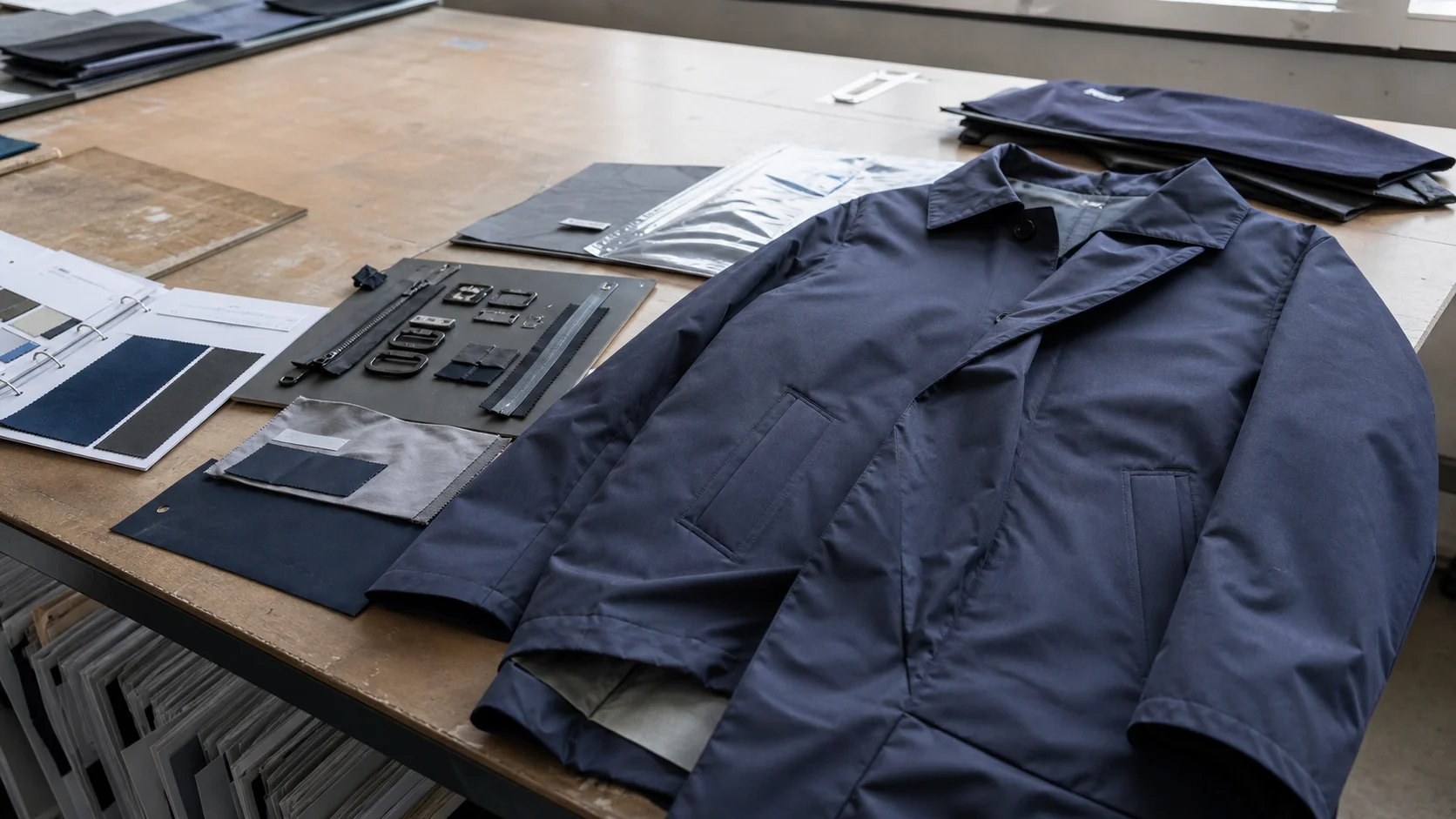
A distributor-focused outline for controlling travel coat orders, from spec packs and fabric approvals to inline inspections, packing checks, and shipment...
Travel Coat Production Brief for Buyer Orders - Outerwear & Jackets manufacturing guide
A travel coat order production control brief is not just a style sheet. For distributor buyers, it is the working document that protects margin, delivery dates, fit consistency, and inspection outcomes. Travel coats sit in a difficult part of outerwear: they are expected to look sharp, pack well, resist weather, hold multiple pockets, and still land at a sellable wholesale price.
That mix creates production risk. A coat that looks clean in a showroom sample may become expensive or unstable in bulk if the fabric shrinks, the seam taping fails, the pocket construction is slow, or the lining pulls after pressing. Distributor buyers need a brief that gives the manufacturer enough detail to quote accurately and produce repeatably, without leaving key decisions to interpretation.
This guide is written for B2B buyers placing travel coat orders under the Outerwear & Jackets category. It covers specification control, typical MOQ ranges, sample approval stages, fabric and trim requirements, lead-time dependencies, inspection risks, packing points, and commercial tradeoffs. It is not a substitute for technical product development, but it gives buyers a practical framework for controlling orders before production starts.
A strong travel coat brief should answer three questions before costing begins: what performance is required, what construction is acceptable, and what defects will cause rejection at inspection.
Travel coats are usually bought for customers who need lightweight protection, city-ready styling, and luggage-friendly function. Distributor buyers often supply retailers, corporate programs, promotional channels, online brands, uniform resellers, or regional apparel wholesalers. Each channel has different tolerance for price, finishing, and testing.
The first control point is defining the commercial use of the coat. A premium retail travel coat needs cleaner seam finishing, better handfeel, stronger lining compatibility, and more disciplined shade control. A corporate travel coat may prioritize logo placement, size availability, repeat ordering, and easy-care performance. A promotional travel coat may accept simpler fabric and fewer pockets if the price is strict.
Buyers should state the intended sales channel clearly in the brief. A vague “travel coat” request can produce quotes that are impossible to compare. One supplier may quote a water-repellent polyester shell with basic lining. Another may assume a laminated fabric, hidden zip pockets, back vent, packable hood, and branded trims. Both may be technically correct, but the prices will not be comparable.
Buying judgment matters here. A distributor serving broad retail accounts should avoid over-engineering a coat unless the price tier supports it. Every hidden pocket, waterproof zipper, snap cover, taped seam, and adjustable feature adds cost and production time. Functional details sell well, but only when the customer understands and pays for them.
A travel coat production brief should separate visual design from functional performance. Visual design includes silhouette, length, collar shape, pocket placement, closure style, lining appearance, color, and branding. Functional performance includes water repellency, wind resistance, breathability, packability, weight, wrinkle resistance, storage capacity, and ease of movement.
Buyers should not assume the factory will interpret these priorities correctly. If packability is the main sales point, fabric weight and construction bulk become critical. If weather protection is the main point, shell fabric, seam construction, closures, and hood design need tighter control. If business travel styling is the priority, pressing, drape, lapel shape, and lining behavior matter more than maximum pocket count.
Measurements must be supplied in a proper size chart, not only a reference sample. The most important points for travel coats usually include chest, waist, sweep, shoulder, sleeve length, sleeve opening, center-back length, hood opening, armhole, and bicep. If the coat is lined or lightly padded, the measurement tolerance must account for bulk.
Travel coats often fail in fit because the shell, lining, and interlining do not move together. A coat may measure correctly flat but feel tight across the back when the wearer reaches forward. Buyers should request movement checks during sample fitting, especially for commuter and business travel styles worn over shirts, knitwear, or lightweight blazers.
Fabric selection drives the cost, delivery schedule, performance, and inspection risk of a travel coat. Distributor buyers should define fabric by composition, weight, weave or knit type, finish, performance target, color, handfeel, and testing requirement. “Polyester with water repellent finish” is not enough for a serious production order.
Common shell fabrics include polyester pongee, polyester twill, nylon taslan, nylon taffeta, cotton-poly blends, bonded softshell, stretch woven fabric, and laminated waterproof fabric. Each fabric type has tradeoffs. Polyester is often cost-efficient and stable, but may look less premium. Nylon can feel lighter and stronger, but shade and price can be less predictable. Cotton blends look refined, but wrinkle resistance and drying time may be weaker.
Trims need the same discipline. Travel coats use more functional trims than basic jackets, and trims often delay bulk production. Zippers, snaps, drawcords, toggles, eyelets, stoppers, buckles, elastic, reflective details, labels, and packaging must be confirmed early.
A direct purchasing judgment: do not approve bulk fabric by photo alone. Digital color review is useful for speed, but shell fabric shade, sheen, texture, and coating appearance must be judged against a physical standard. Travel coats often use darker navy, black, khaki, stone, olive, and charcoal shades. These colors show shade variation differently under store lighting, daylight, and office lighting.
If a buyer needs support structuring specifications before supplier quotation, a sourcing and production support partner can help organize the brief and factory communication. Buyers can review service scope through Fabrikn services when they need order development, vendor coordination, or production follow-up support.
Sampling is where most travel coat risks should be found. The mistake is treating the first sample as a sales sample only. For distributor orders, samples should move through a controlled approval process: proto sample, fit sample, salesman sample if needed, pre-production sample, size set, and production reference sample.
Not every order needs every sample stage. A repeat order with existing patterns may only need fabric and trim approval plus a pre-production sample. A new travel coat style with functional pockets, lining, hood, and coating should not skip development checks. The cost of one extra sample is usually lower than the cost of a failed inspection or late delivery.
Buyers should require a sample comment sheet after each stage. Comments need to be specific: “increase chest by 2 cm in size M,” “raise pocket opening 1.5 cm,” “change zipper puller to matte black,” or “reduce sleeve length by 1 cm from size S to XL.” Vague comments such as “make fit better” or “improve quality” create delay and disagreement.
The pre-production sample is the most important control sample. It should use actual or approved bulk fabric, actual trims, correct labels, correct seam construction, correct logo placement, and near-final packing. If the PP sample uses substitute fabric or trims, the buyer should record every deviation and decide whether another PP sample is required.
MOQ for travel coats depends on fabric sourcing, trim customization, color count, size range, and factory production setup. Distributor buyers often want flexible quantities across many colors and sizes, while factories prefer fewer colors and larger quantities per style. The buyer’s job is to plan the order so it is commercially attractive without creating unsold inventory.
These are typical working ranges, not guarantees. A factory may accept lower MOQ if it has matching fabric in stock, a quiet production window, or an existing pattern close to the requested style. A factory may require higher MOQ if the order uses special coating, seam sealing, custom hardware, large size ranges, or many colorways.
Color planning is one of the easiest ways to control cost. Two strong colors with deeper quantities are usually easier to produce than six colors with thin size breakdowns. Buyers should avoid spreading a small order across too many SKUs. That approach increases cutting complexity, shade risk, leftover fabric, label errors, and packing mistakes.
Size breakdown also matters. Travel coats often include sizes from XS to 3XL or broader for distributor channels. Extended sizes affect grading, consumption, fit balance, and sometimes fabric yield. If plus sizes or tall sizes are required, buyers should state them at the quotation stage, not after price approval.
A travel coat cost is built from fabric, trims, labor, overhead, testing, packing, compliance, wastage, and margin. Fabric is often the largest cost component, especially for coated, laminated, stretch, or recycled materials. Labor increases when the coat includes many panels, lined construction, seam taping, hidden pockets, detachable parts, or complex topstitching.
Buyers should request a structured quotation that lists major assumptions. A simple unit price may be fast, but it hides risk. If the supplier quoted with standard zippers and the buyer later requests waterproof zippers, the price will change. If the quote assumes half lining and the buyer expects full lining, the price will change. If the quote assumes no testing and the retailer requires testing, the price will change.
A low quote is not automatically a good quote. It may exclude testing, use lighter fabric, simplify construction, or assume standard trims. Buyers should compare quotations against the same tech pack, bill of materials, color list, size breakdown, packing method, and inspection standard.
Negotiation should focus on smart simplification rather than only price pressure. Removing one low-value pocket, changing from custom metal hardware to stock matte plastic hardware, or reducing color count may save more than pushing the factory margin too low. Over-pressuring price can lead to shortcuts in fabric quality, sewing time, or inspection preparation.
Lead time for travel coat orders depends on sample approval speed, fabric availability, trim sourcing, testing requirements, factory capacity, and shipping method. A realistic production schedule should include time for fabric booking, lab dips, trim approval, sample making, pattern correction, bulk cutting, sewing, finishing, inspection, packing, and freight handover.
For many distributor travel coat orders, a practical total timeline from confirmed tech pack to shipment is around 60 to 100 days. Complex waterproof or laminated styles can take longer. Repeat orders with approved fabric and patterns can move faster, especially if trims are stocked.
Late buyer approvals are a major cause of missed delivery. Lab dips, artwork, care labels, zipper pulls, PP samples, and size sets all need fast decisions. A buyer who takes two weeks to approve each stage should not expect the original ship date to hold.
Freight method should be considered before production begins. Air freight can rescue late goods but may destroy margin, especially with bulky coats. Sea freight is cheaper but requires earlier production completion. Rail, truck, or consolidated freight may be useful in some routes, but packing volume and destination handling must be reviewed.
Buyers preparing a time-sensitive program should contact production partners early. For coordination, quotation preparation, or a discussion of order feasibility, buyers can use the Fabrikn contact page to start the conversation with clearer order inputs.
Travel coats carry more inspection risk than simple fleece jackets or basic windbreakers. They combine visible tailoring areas with functional outerwear components. AQL inspection can catch many defects, but buyers should not rely only on final inspection. In-line control is better because many defects are difficult to repair after the coat is finished.
Inspection standards should be agreed before production. The buyer should define critical, major, and minor defects. For example, broken zipper function, wrong fiber content label, incorrect size ratio, and severe shade mismatch are usually major or critical issues. A small loose thread may be minor if it is isolated and repairable.
Measurements require special attention. Coats should be measured after proper relaxation and finishing. Fabric shrinkage, pressing method, lining tension, and padding bulk can change final measurements. Buyers should confirm tolerance by point of measure. A common tolerance may be plus or minus 1 cm for smaller points and plus or minus 2 cm for larger body measurements, but each program should set its own rules based on style and customer expectations.
Performance claims must be supported by testing if they are used in sales materials. “Waterproof,” “water resistant,” “windproof,” “breathable,” “recycled,” or “quick dry” should not be used casually. If the distributor’s customer requires proof, the brief should list the test method, lab requirement, minimum standard, sample size, and timing.
A buyer should not approve care instructions without testing or at least a realistic fabric and trim review. Some travel coats may need machine wash cold, line dry, do not tumble dry, do not bleach, and cool iron instructions. Others with coating, padding, or special hardware may require more restrictive care. Incorrect care labels create customer returns and compliance exposure.
Travel coats are bulky compared with shirts, trousers, or lightweight knits. Packing method affects freight cost, wrinkle level, retail presentation, and carton efficiency. Buyers should define whether the coat is flat packed, hanger packed, folded into a pouch, individually polybagged, or packed by size and color ratio.
For travel coats sold as packable garments, the packed form must be tested during sampling. A coat that fits into a pouch once in the sample room may not be practical for consumers or factory packing teams in bulk. The pouch opening, zipper strength, folding guide, and final packed dimensions need review.
Wrinkle control is a practical issue. Lightweight coated fabrics can crease during compression. Cotton-blend travel coats may arrive with fold marks. Heavily packed cartons can deform collars, lapels, and shoulder areas. If the customer expects ready-to-sell presentation, the buyer may need hanger packing or reduced carton compression, which increases freight volume.
Shipping documents must match the order exactly. Distributor buyers should confirm purchase order number, style number, HS code support, fiber content, carton count, gross weight, net weight, packing list, commercial invoice, certificate requirements, and any retailer routing guide. Errors at this stage can delay customs clearance or warehouse receiving.
A complete travel coat order production control brief helps suppliers quote accurately and produce consistently. It also helps buyers compare offers fairly. The brief should be updated after every approval stage so the production team works from one current version, not scattered emails and old sample comments.
Buyers who are still qualifying production partners should also consider company background, sourcing model, communication process, and outerwear capability. General company information can be reviewed through Fabrikn about us when evaluating whether a support partner fits the buying process.
Distributor buyers often balance three pressures: customer deadline, target price, and product quality. It is rarely possible to maximize all three without compromise. The best production brief makes those compromises visible before the order is placed.
If the deadline is fixed, the buyer may need to use available fabric, standard trims, fewer colors, and a simplified sample process. If the target price is strict, the buyer may need to reduce pocket complexity, avoid custom hardware, use half lining, or choose a non-laminated fabric. If premium quality is the priority, the buyer should allow more development time, stronger testing, better fabric, and closer inspection.
One practical rule is to protect the feature that sells the coat. If the coat is sold as packable, protect fabric weight and folding function. If it is sold as weather-resistant, protect shell finish, closure coverage, and testing. If it is sold as business travel outerwear, protect fit, drape, and finishing. Cost reductions should come from secondary details, not the main promise of the product.
Buyers should also think about repeatability. A travel coat program that sells well may need replenishment. If the first order uses leftover fabric, clearance trims, or unrepeatable colors, the second order may not match. For distributor buyers building a stable product line, repeatable fabric and trim sourcing can be more valuable than saving a small amount on the first purchase.
Production control depends on communication discipline. Buyers should keep decisions centralized and documented. When sales teams, customers, designers, and suppliers all send separate comments, mistakes increase. One approved tech pack, one order sheet, one comment log, and one production calendar should control the order.
Every change after PP sample approval should be treated as a cost and schedule risk. Changing pocket placement after cutting, changing zipper color after trim delivery, or changing care labels after packing can create rework and delay. Some changes are necessary, but they should be approved with a clear impact on price, lead time, and inspection.
Photos and videos are useful for production updates, especially for fabric inspection, cutting, line setup, seam taping, logo application, packing trials, and carton marking. Still, photos do not replace physical sample approval or final inspection. They are a monitoring tool, not a full quality system.
A travel coat is a manageable product when the brief is specific. The problems start when buyers ask for outerwear performance with fashion costing, short lead time, and loose specifications. Distributor buyers can avoid many failures by locking fabric, trims, measurements, sample approvals, testing, and packing rules early.
The strongest buying approach is practical rather than complicated. Choose the right fabric for the sales promise. Keep color and size planning realistic. Approve samples carefully. Avoid unnecessary trims that add delay without improving sell-through. Set inspection standards before production. Confirm packing against the actual shipping and retail requirement.
A good travel coat production control brief does more than help a factory make a coat. It helps the buyer protect the order from misunderstandings, cost creep, late shipment, and quality disputes. In B2B apparel sourcing, that control is often the difference between a profitable outerwear program and a difficult one.
Get a free quote from Fabrikn — your trusted B2B clothing manufacturer with 10+ years of experience. MOQ as low as 200 pieces.
Get a Free Quote →It should include style details, target customer, fabric specifications, trim list, measurement chart, size breakdown, colorways, sample approval stages, testing requirements, inspection standard, packing method, delivery date, and commercial terms. For distributor buyers, the brief should also state the sales channel and price tier so the supplier quotes the right quality level.
Typical MOQ can range from 300 to 800 pieces for basic styles using available fabric. Custom colors, laminated fabrics, branded trims, or performance requirements may push MOQ to 1,000 to 3,000 pieces or more. Small trial orders around 100 to 300 pieces may be possible, but unit cost is usually higher and options are more limited.
A practical timeline is often 60 to 100 days from confirmed specifications to shipment. The schedule depends on sample approvals, fabric lead time, trim sourcing, testing, factory capacity, and shipping method. Repeat orders with approved patterns and stocked materials may be faster.
There is no single best fabric. Polyester twill or pongee can work for cost-efficient water-repellent coats. Nylon taslan or taffeta can support lightweight travel styles. Stretch woven fabric improves comfort. Laminated fabric supports stronger weather protection but adds cost and lead time. The best choice depends on price point, performance claim, handfeel, and order volume.
The pre-production sample is the most important because it should represent the approved production standard. Fit samples and size sets are also important for new styles. Proto samples help confirm design direction, while TOP samples help verify that bulk production matches the approved PP sample.
Common problems include shade variation, seam puckering, zipper defects, weak snaps, lining pulling, pocket misalignment, logo placement errors, coating marks, poor water repellency, incorrect measurements, and packing mistakes. Many of these issues should be checked during in-line inspection, not only final inspection.
Yes, if the coat is sold with performance claims such as water resistance, waterproofing, breathability, wind resistance, recycled content, or quick dry. The buyer should define the test method, minimum result, lab requirement, and timing before production starts.
Buyers can reduce cost by limiting color count, using standard trims, simplifying pocket construction, choosing half lining where suitable, avoiding unnecessary detachable parts, and planning deeper quantities per SKU. The main selling feature of the coat should not be weakened just to reduce price.
Travel coats are bulky and can wrinkle or deform if packed poorly. Packing affects freight cost, carton efficiency, retail presentation, and customer satisfaction. Buyers should define folding method, polybag size, carton ratio, barcode placement, carton markings, and hanger requirements if needed.
Buyers should involve a production partner before finalizing the order brief, especially for new styles, custom fabric, performance claims, tight delivery windows, or multi-color distributor programs. Early review helps identify MOQ, costing, sample, testing, and lead-time risks before the purchase order is committed.