
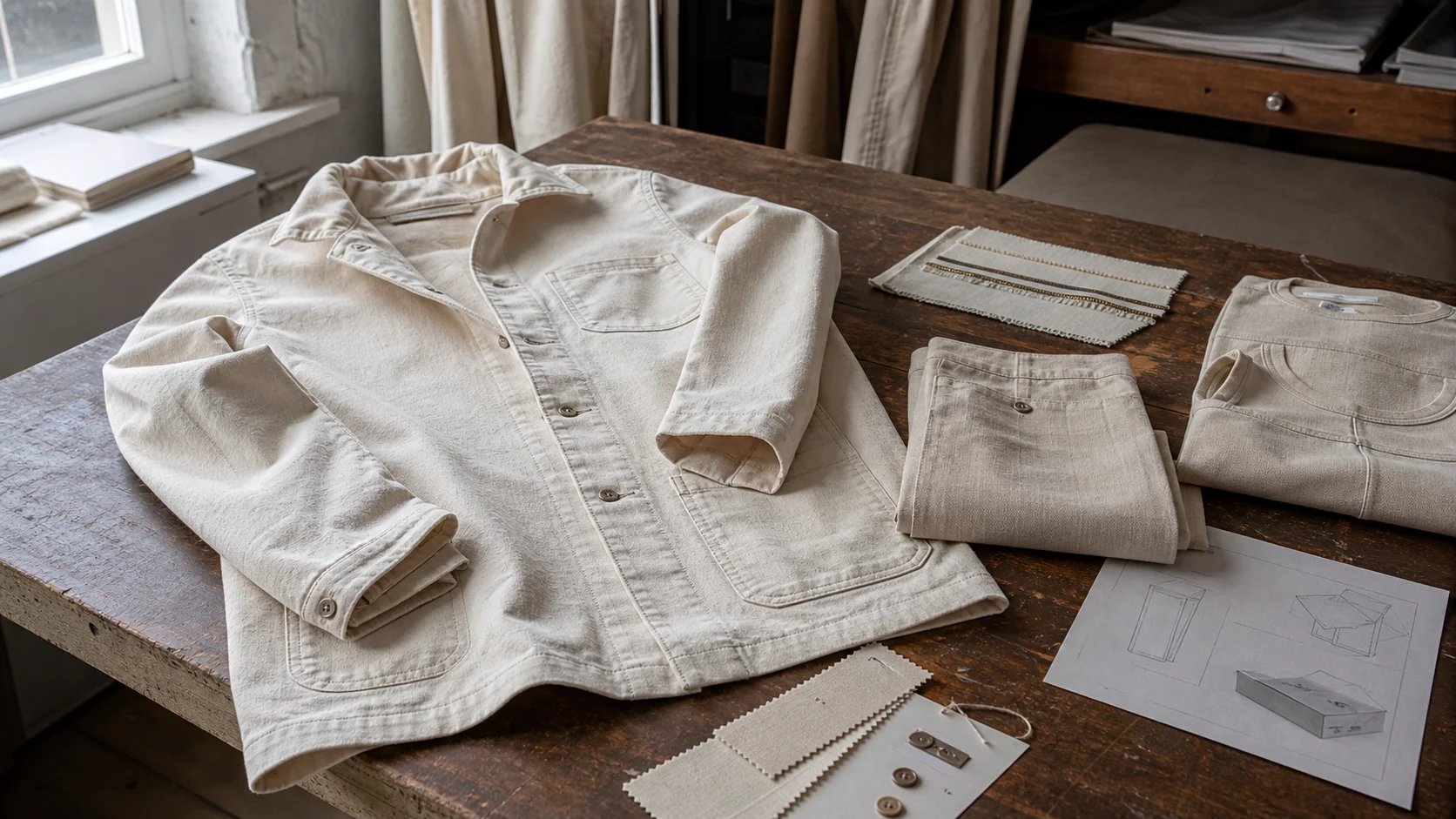
A production-focused outline for distributor buyers managing undyed twill coat programs, covering fabric controls, shrinkage, shade risk, construction...
Undyed Twill Coat Production Control for Buyers - Fabrikn production reference
Distributor buyers sourcing undyed twill coats need a production control brief that is tighter than a standard outerwear purchase order. The product may look simple: a coat made from uncolored twill fabric, often positioned under sustainable fashion, low-impact apparel, workwear-inspired outerwear, or minimalist uniform programs. In practice, undyed twill coat production carries specific risks around shade consistency, cotton contamination, fabric handfeel, shrinkage, seam appearance, and finishing discipline.
Because there is no garment dye or heavy coloration to hide fiber variation, every fabric lot, yarn imperfection, oil mark, seed speck, and sewing defect becomes more visible. That is not automatically a problem. Many buyers deliberately choose undyed twill for its natural color and lower processing impact. The issue is control: distributors must define what “natural,” “undyed,” and “acceptable variation” mean before bulk production starts.
This brief is written for distributor buyers, wholesale apparel teams, private-label importers, and sustainable fashion sourcing managers who need practical production controls for undyed twill coats. It covers specification planning, supplier alignment, fabric approvals, sample stages, MOQ expectations, lead-time factors, in-line controls, inspection risks, packing, and buyer-side decision points.
Undyed twill is often chosen for a reason: reduced dye processing, natural appearance, softer environmental messaging, and broad styling flexibility. In coat production, it can work well for chore coats, utility coats, trench-inspired silhouettes, shirt jackets, field coats, and relaxed overcoats. The fabric has structure, and the diagonal twill line gives the garment visual depth without printing or coloration.
The same qualities create sourcing risks. Undyed fabric does not behave like an off-the-shelf black, navy, or khaki dyed twill. Natural cotton tone can shift from creamy white to beige, oatmeal, greyish, or slightly yellow, depending on fiber source, yarn preparation, bleaching status, and finishing. Linen blends, recycled cotton blends, organic cotton, and cotton-hemp blends widen the variation further.
Distributor buyers usually have less tolerance for inconsistency than boutique brands. A distributor may supply multiple retailers, catalog accounts, uniform programs, or regional wholesale customers. If one shipment has three visibly different natural shades, the commercial problem lands with the buyer, not only the factory.
Production control is therefore not only about workmanship. It is about setting a visual and technical standard that can be repeated across purchase orders. That standard must be realistic. Natural undyed twill will rarely look as uniform as dyed polyester-cotton twill. The buyer’s task is to decide which variations are acceptable, document them, and stop uncontrolled changes before cutting begins.
Practical rule: do not approve undyed twill production from a small hand sample alone. Approve from a representative fabric lot, a lab test report, a pre-production garment, and a signed tolerance standard.
A distributor buyer brief for undyed twill coat production should combine design, commercial, technical, and quality expectations in one controlled document. A style sketch and size chart are not enough. The brief must tell the supplier what cannot change without written approval.
At minimum, the production control brief should include the following points:
Buyers who need structured development support can review manufacturing service scopes through Fabrikn’s services page. The important point is not the format of the brief; it is whether the supplier can convert the brief into repeatable bulk production without guessing.
Fabric is the main risk area in undyed twill coat production. A distributor buyer should define fabric in technical and visual terms. “Natural cotton twill” is too vague for production control.
Common fabric options include 100% cotton twill, organic cotton twill, cotton-linen twill, cotton-hemp twill, recycled cotton twill, and cotton-polyester twill. Each has tradeoffs.
Purchasing judgment matters here. If the distributor is selling to eco-focused boutiques, certified organic or traceable natural fiber may justify higher cost. If the coat is for uniform distribution, durability, repeatability, and shrinkage control may be more important than a niche fiber blend.
Coat twill usually sits in a heavier range than shirt fabric. Typical fabric weights may fall around 240 gsm to 420 gsm depending on design, season, and market positioning. A lightweight shirt-jacket coat may use 220 to 280 gsm twill. A chore coat or utility coat often sits around 280 to 360 gsm. A heavier structured coat can move above 380 gsm, especially when lined or reinforced.
Weight alone does not determine quality. A loosely woven 360 gsm fabric may bag out or distort, while a compact 300 gsm fabric may perform better. Buyers should request fabric weight, width, weave description, shrinkage data, tear strength, tensile strength, pilling performance if relevant, and finish description.
Undyed does not mean colorless. Natural cotton can be warm, creamy, sandy, greyish, or slightly speckled. The buyer should establish an approved shade band rather than a single unrealistic target.
A practical approach is to approve:
Panel mismatch is a major risk. A coat with one sleeve slightly yellower than the other will be difficult to sell even if the fabric is technically undyed and natural. Shade band approval should happen before spreading and cutting.
Undyed twill may be loomstate, desized, washed, enzyme-finished, sanforized, calendared, softened, or mechanically finished. Buyers must know which finish is used. A soft finish can improve handfeel but may affect strength or dimensional stability. A more natural, less processed finish may support sustainability messaging but can feel stiff.
Shrinkage is one of the most common problems in coat production. The buyer should request dimensional stability testing after wash or dry-cleaning according to the care label. If the final garment is intended to be machine washable, fabric shrinkage and garment shrinkage must be tested before size grading is locked.
Fabric Control Point Buyer Requirement Risk if Ignored Composition Confirm fiber content and certification scope if claimed Mislabeling, failed retailer compliance, weak sustainability claims Weight Approve gsm range and handfeel standard Coat feels too flimsy or too rigid Shade Approve natural shade band before cutting Panel mismatch and customer returns Shrinkage Test fabric and garment under care-label conditions Size claims fail after washing Contamination Inspect for dark fibers, oil stains, seed fragments, and weaving faults Defects remain highly visible on undyed fabricMOQ depends on fabric availability, mill minimums, trim ordering, factory line efficiency, and size-color breakdown. Undyed twill has one advantage: there is no dye color minimum if the mill already holds greige or natural twill. It can also have a disadvantage: if the buyer requires a special organic, recycled, hemp, linen, or certified fabric, the mill MOQ may be higher than expected.
Typical MOQ ranges for undyed twill coats may look like this:
MOQ should not be judged only by the garment factory’s willingness to accept the order. Buyers must check the weakest MOQ link. Fabric mill minimums, button minimums, zipper minimums, woven label minimums, packaging minimums, and testing costs can all affect the real order size.
For distributor buyers, a smaller first order may be commercially smart if the selling channel is untested. The tradeoff is higher unit cost and less leverage over fabric customization. A larger order can reduce cost but increases exposure if the natural shade, fit, or fabric handfeel misses the market.
Sampling is not a formality for undyed twill coats. It is the buyer’s main control system before financial risk increases. The sample process should move from concept validation to technical confirmation and then to bulk readiness.
The development sample checks silhouette, styling, pocket placement, collar shape, sleeve volume, and general fabric suitability. At this stage, the supplier may use substitute fabric if the correct undyed twill is not ready. That must be clearly marked. Buyers should not approve bulk from a development sample made in substitute fabric.
The fit sample should be made in the correct or very close fabric weight. Coats behave differently depending on fabric stiffness and thickness. Shoulder slope, armhole comfort, sleeve pitch, chest ease, body length, and closure alignment can change once the real twill is used.
Measurement tolerances must be realistic. For casual twill coats, common tolerances may include around 1 cm for smaller points and 1.5 cm to 2 cm for larger lengths, depending on design and buyer standard. A tailored coat may require tighter control, but tighter tolerances often increase rejection risk and production cost.
A size set validates grading across the full size range. Distributor buyers should pay special attention to sleeve length, across shoulder, chest, bottom opening, armhole, and body length. If the coat is sold as unisex, grading must be tested with more care. Unisex styles can sell well, but poor grading creates returns across both smaller and larger sizes.
The pre-production sample should be made from approved bulk fabric and approved bulk trims. This sample becomes the factory’s production reference. It should show final stitching, final labels, final buttons or snaps, final care label, final lining if any, final wash or finish, and final packaging method if practical.
Bulk cutting should not begin until the pre-production sample is approved in writing. A conditional approval may be acceptable only if the conditions are specific and verified before cutting. “Improve workmanship” is not a usable condition. “Increase topstitch SPI from 7 to 8 and align pocket flap edge within 3 mm tolerance” is usable.
The sealed sample should be retained by the buyer, supplier, and inspection team if possible. A signed sample tag should identify style number, size, fabric lot, trim lot, approval date, and any agreed deviations. Photos are helpful but not enough for undyed fabric because shade and handfeel are difficult to judge on screen.
Lead time for undyed twill coat production depends on fabric readiness, certification documentation, sample approval speed, trim availability, factory capacity, lab testing, inspection scheduling, and shipping mode.
A typical timeline may range from 60 to 120 days after final approval, with shorter timelines possible when fabric and trims are in stock. Custom woven, organic, recycled, hemp, or special-finish fabrics can push the timeline longer. Distributor buyers should avoid quoting delivery dates to wholesale customers before confirming fabric lead time and production line allocation.
Stage Typical Timing Buyer Control Point Tech pack and costing review 3 to 10 days Confirm construction, fabric, MOQ, and target price alignment Development and fit sampling 2 to 4 weeks Give clear comments within 24 to 72 hours where possible Bulk fabric sourcing or weaving 2 to 8 weeks Approve lab dips only if relevant; for undyed fabric approve shade band and finish Pre-production sample 1 to 3 weeks Approve only with final bulk fabric and trims Bulk cutting and sewing 3 to 6 weeks Require in-line reporting and defect tracking Final inspection and packing 3 to 7 days Hold shipment until inspection status is clearThe biggest avoidable delay is late decision-making. If the buyer takes two weeks to comment on every sample, the production calendar becomes unreliable. Fast approvals should not mean careless approvals. It means comments must be organized, measurable, and consolidated.
Undyed twill coats expose construction quality. Puckering, uneven topstitching, twisted seams, needle marks, dark thread contamination, and dirty handling show quickly on light natural fabric. The technical brief should include construction standards that match the coat’s price point and sales channel.
Thread color should be approved against the fabric shade band. Natural, ecru, off-white, beige, or tonal cotton-like thread may be used, but the thread must not look too yellow or too bright against the fabric. Polyester thread is common for strength. Cotton thread supports a natural story but may have different performance characteristics.
Stitch density should be specified for major seams and visible topstitching. For many twill coats, visible topstitching may fall around 7 to 10 stitches per inch, depending on fabric weight and desired look. Too few stitches can look cheap and reduce seam integrity. Too many stitches may cause puckering on dense twill.
Trim choice affects both aesthetics and compliance. Natural corozo buttons, recycled buttons, metal snaps, horn-look buttons, or matte metal zippers are common options. Buyers should confirm size, color, coating, strength, corrosion resistance, and attachment method.
Metal trims on undyed fabric need special care. Poorly finished metal can stain the fabric during humidity, washing, or storage. Dark antique finishes may rub off. Snaps can crack or pull through if reinforcement is weak. Zippers can create waviness if the front panel is not stabilized.
Care labels must reflect tested care performance, not marketing preference. If the fabric shrinks beyond acceptable limits under machine wash, the buyer must choose between changing the fabric finish, adjusting the pattern, or changing the care instruction. A care label that customers cannot follow will create returns.
Packaging also matters. Undyed coats can pick up dust and carton marks. Individual polybags may protect the garment, while plastic reduction targets may push the buyer toward recycled polybags, paper bands, or other lower-plastic options. The tradeoff should be explicit. Reduced packaging is attractive, but insufficient protection can cause visible soiling before delivery.
Final inspection for undyed twill coats should include workmanship, measurements, fabric defects, shade grouping, stains, trims, labeling, packing, and carton checks. A standard AQL approach may be used, often with general inspection levels and major/minor defect definitions agreed before production. The exact AQL level depends on buyer policy, product value, and retailer requirements.
The defect list should be stricter for visible contamination because undyed fabric shows marks that darker fabric may hide. Inspectors should review garments under suitable lighting and avoid dirty inspection tables or handling.
Buyers should be careful with natural fiber specks. If the selling point is undyed natural twill, some speckling may be expected. If the retailer expects a clean premium look, the tolerance must be tighter. The commercial promise and inspection standard must match.
Avoid approving a rustic fabric story in development and then rejecting every natural speck at final inspection. The standard must be commercially sensible and documented early.
Undyed twill is often placed under sustainable fashion because it may avoid conventional dyeing. That can be a legitimate advantage, but buyers should keep claims precise. “Undyed” does not automatically mean low-impact, organic, chemical-free, biodegradable, carbon-neutral, or fully sustainable.
A careful claim might say that the garment uses undyed twill fabric and avoids garment coloration. A stronger claim about organic cotton, recycled content, reduced water use, or certified processing needs supporting documentation. Distributor buyers selling to retailers should expect questions from compliance teams, especially in markets where green claims are under more scrutiny.
Documents to request may include:
Colorfastness may still be relevant even for undyed fabric. Natural fibers, finishes, contamination, trims, and labels can still bleed, stain, yellow, or change under washing, rubbing, perspiration, or light exposure. Buyers should not remove all color-related tests simply because the fabric is undyed.
Good supplier communication is direct, written, and measurable. Distributor buyers should avoid vague comments such as “make it better,” “premium finishing,” or “natural but clean.” These phrases create room for interpretation. The supplier needs target measurements, approved swatches, acceptable defect examples, trim standards, and approval deadlines.
For supplier qualification, buyers should ask whether the factory has experience with light-colored or undyed outerwear, whether cutting tables and sewing areas can be kept clean, how fabric lots are segregated, and how in-line quality is recorded. No unsupported claim should replace evidence. Photos of fabric storage, cutting, sewing, pressing, and packing areas can help, but they are not a substitute for inspection.
A practical production monitoring plan may include:
If the buyer is still defining supplier requirements, it can be useful to compare process support options or discuss project details through Fabrikn’s contact page. The buyer should come prepared with target quantity, fabric preference, delivery window, size range, and quality expectations.
Undyed twill coat production involves tradeoffs. The right decision depends on price point, customer expectation, distribution channel, and reorder strategy.
Some natural shade variation may be acceptable if the product is clearly sold as undyed natural twill. Small fiber specks may be acceptable if they are part of the approved fabric character. A slightly firmer handfeel may be acceptable if it improves durability and reduces chemical softening. A higher MOQ may be acceptable if it secures a more stable fabric source for repeat orders.
Buyers should also accept that certified or traceable fabric can cost more and take longer. If sustainability is a core selling point, the cost should be planned into the margin instead of negotiated out of the product until the claim becomes weak.
Do not accept uncontrolled fabric lot mixing on visible panels. Do not accept oil marks or machine dirt as “natural.” Do not accept a care label that has not been tested. Do not accept a lower fabric weight than approved without recalculating garment structure, fit, and cost. Do not accept vague certification claims without documents if those claims are used in selling materials.
Buyers should also reject rushed bulk cutting before pre-production approval. The cost of delaying cutting by two days is usually lower than the cost of receiving thousands of coats with shade mismatch or fit failure.
The cheapest quote may use stock natural twill, basic trims, loose tolerances, and limited testing. That can be suitable for a low-risk promotional or entry-level garment if the buyer accepts the limitations. A higher quote may include better fabric inspection, stronger trims, cleaner sewing, documented testing, and more stable repeatability. For distributors, consistency often matters more than the lowest first cost.
A practical way to compare quotes is to ask every supplier to price the same specification, including fabric weight, trim quality, testing requirements, packaging, inspection expectations, and shipment terms. If one quote is far below the others, check what has been omitted.
The following checklist can be used as a working control brief for distributor buyers sourcing undyed twill coats.
Control Area Action for Buyer Approval Timing Fabric composition Confirm fiber blend, certification, and test requirements Before costing is finalized Fabric weight and finish Approve gsm, handfeel, shrinkage, and finish description Before pre-production sample Natural shade Set master swatch and acceptable shade limits Before bulk cutting Fit and grading Approve fit sample and size set with measured comments Before bulk pattern release Trims Approve buttons, snaps, zippers, labels, thread, and packaging Before pre-production sample Testing Review shrinkage, strength, compliance, and care-label support Before production or before shipment, depending on risk In-line quality Monitor first output, measurements, stains, and seam quality During sewing Final inspection Check AQL result, defect list, packing, carton marks, and shipment release Before shipmentA buyer brief does not need to be complicated, but it must be complete. The structure below can be adapted for a purchase order package.
For buyers evaluating manufacturing partners and process transparency, company background can be reviewed through Fabrikn’s about page. The buyer should still base supplier selection on capability, documentation, sample quality, and commercial fit.
Undyed twill coats can be strong products for sustainable fashion assortments, distributor catalogs, and private-label outerwear programs. They offer a clean natural look and avoid some of the complications of dyed color matching. They also make production mistakes easier to see.
The best control strategy is simple: define the fabric, define the shade band, approve the real pre-production sample, control fabric lots before cutting, monitor cleanliness during sewing, and inspect with standards suited to light natural fabric. Buyers should be realistic about natural variation but firm about preventable defects.
A distributor buyer undyed twill coat production control brief should leave very little to assumption. The more natural the product looks, the more disciplined the production system needs to be.
Get a free quote from Fabrikn — your trusted B2B clothing manufacturer with 10+ years of experience. MOQ as low as 200 pieces.
Get a Free Quote →An undyed twill coat is made from twill fabric that has not been dyed to a conventional color. The fabric usually keeps a natural cotton, linen, hemp, recycled fiber, or blended fiber tone. It may still be washed, softened, sanforized, or otherwise finished, so buyers should confirm the exact processing.
No. Undyed twill may reduce or avoid dyeing, but sustainability depends on fiber source, processing, finishing, trims, packaging, transport, durability, and documentation. Claims such as organic, recycled, low-water, or chemical-reduced need evidence.
Typical MOQ may range from 300 to 500 pieces for stock fabric and simple trims, 500 to 1,000 pieces for small private-label runs, and 1,000 to 3,000 pieces or more for custom fabric, certified material, or distributor-scale programs. The real MOQ often depends on fabric and trim minimums, not only sewing capacity.
Natural fiber shade can vary by lot, fiber source, yarn, and finish. Without shade control, coat panels may not match. Buyers should approve a master swatch and acceptable shade limits before bulk cutting.
A sensible process includes a development sample, fit sample, size set sample, pre-production sample, and sealed reference sample. Bulk production should not start until the pre-production sample is approved using final fabric and trims.
The main risks are oil stains, dirt marks, panel shade mismatch, visible fabric contamination, shrinkage failure, seam puckering, uneven topstitching, poor trim attachment, and incorrect care labels. Light natural fabric makes these issues more visible.
Yes, but buyers should check strength, consistency, contamination, handfeel, and documentation. Recycled cotton can support sustainability goals, but it may show more neps, specks, and variation than virgin cotton.
That depends on the desired handfeel, shrinkage target, and appearance. Garment washing can soften the coat and reduce later shrinkage, but it may add cost, create shade variation, or increase handling marks if poorly controlled.
The brief should include fabric specs, shade standard, trim list, measurements, construction details, sample approvals, testing requirements, MOQ, lead time, inspection standard, packaging, and shipment instructions.
Buyers can reduce risk by approving representative bulk fabric, setting shade limits, testing shrinkage, checking trims, approving a true pre-production sample, using in-line inspection, and holding shipment until final inspection results are acceptable.