
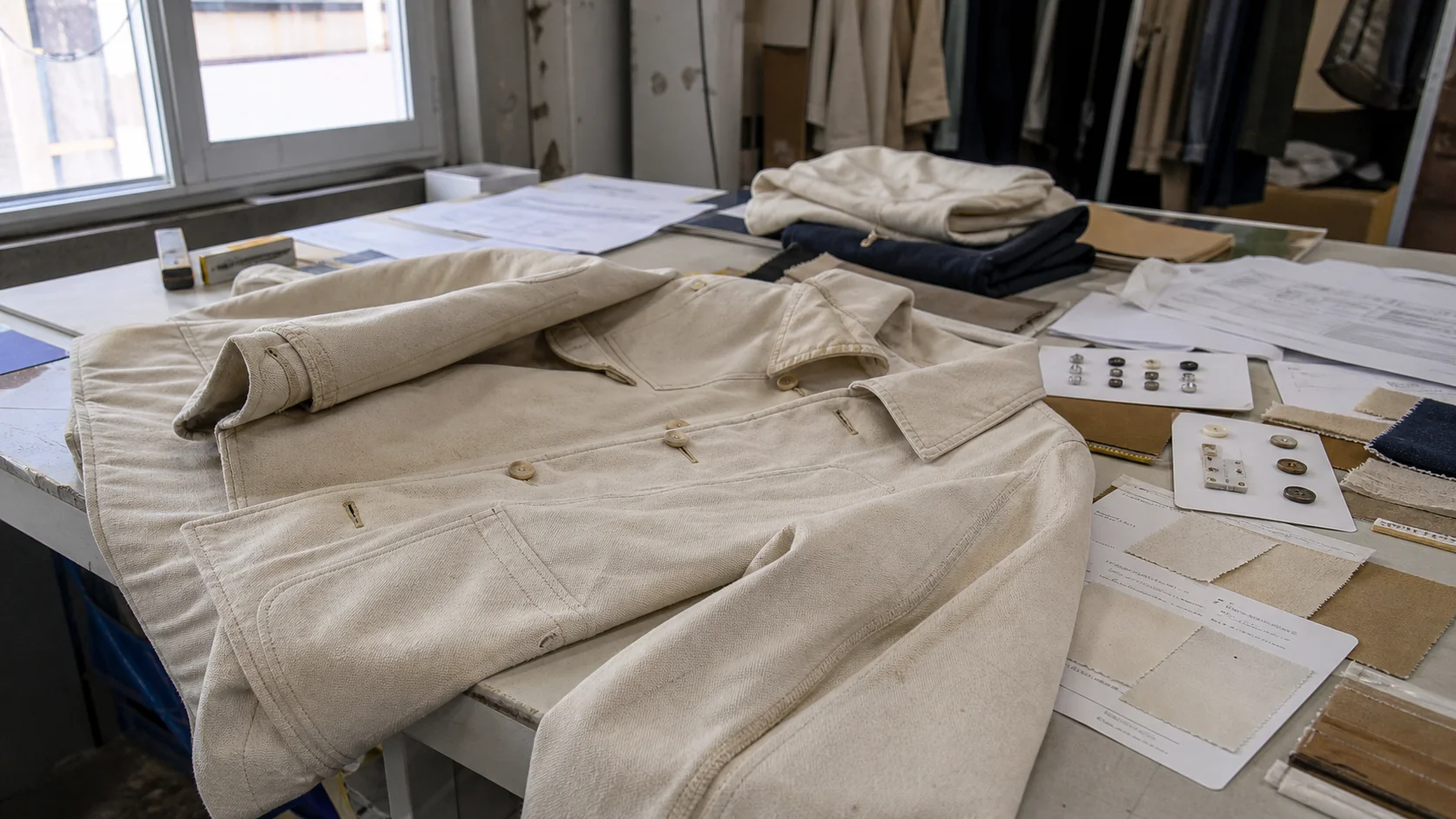
A distributor-focused SEO outline for evaluating undyed twill coat suppliers by fabric integrity, natural shade consistency, construction quality,...
Undyed Twill Coat Scorecard for Buyer Vetting - Sustainable Fashion manufacturing guide
Distributor buyers sourcing undyed twill coats need a stricter vetting method than they would use for a standard dyed outerwear program. The product looks simple on paper: a cotton or cotton-blend twill coat, left undyed, cut into a clean commercial silhouette. In production, the risks are specific and easy to underestimate. Shade variation, seed contamination, fabric skew, oil marks, inconsistent shrinkage, and weak trim discipline can all show clearly on undyed cloth.
An undyed twill coat supplier scorecard gives buyers a structured way to compare factories before committing to samples, deposits, or seasonal capacity. It also helps separate suppliers who understand natural-fiber outerwear from suppliers who simply quote a low price and hope the inspection team catches problems later.
This guide is written for distributor buyers, wholesale teams, private-label sourcing managers, and sustainable fashion brands that need a practical supplier evaluation framework. It covers the scorecard categories that matter, typical MOQ ranges, sampling steps, lead-time dependencies, fabric and trim specifications, and inspection risks that should be addressed before purchase order release.
Undyed twill sits in a sensitive part of sustainable fashion sourcing. It removes the dyeing stage, which can reduce chemical processing, water use, and color-related wastewater concerns depending on the full supply chain. That benefit does not automatically make the garment low-risk. In many cases, undyed fabric exposes more production defects because there is no dark dye or garment wash to mask contamination, yarn variation, or handling marks.
For distributor buyers, the commercial risk is larger because goods are often resold to boutiques, corporate uniform buyers, online retailers, or regional wholesale accounts. A small defect rate can turn into multiple claims across several customers. The supplier must be judged not only on sewing capability, but also on fabric control, packing discipline, documentation, and repeatability.
A useful scorecard turns subjective supplier impressions into measurable decision points. It helps buyers ask better questions: Can the supplier source consistent undyed twill from the same mill lot? Can they control shrinkage before bulk cutting? Do they understand natural flecks versus unacceptable stains? Can they keep ivory, ecru, beige, and raw cotton tones separated during production? Are they able to provide credible certificates without overstating sustainability claims?
For undyed outerwear, the lowest quote is rarely the safest quote. The better purchasing decision is usually the supplier that can control fabric cleanliness, shrinkage, trim matching, and inspection standards before bulk production begins.
Buyers building supplier lists for sustainable fashion programs can also review service capability and development support through pages such as Fabrikn services, especially when comparing cut-and-sew development, sourcing support, and production coordination options.
A strong undyed twill coat scorecard should not be too broad. If every category carries the same weight, the tool becomes administrative rather than useful. The highest-weight categories should reflect the most expensive failure points: fabric quality, construction consistency, compliance credibility, sampling discipline, and delivery reliability.
For most distributor buyers, a 100-point scorecard works well. The buyer can set a minimum pass score, such as 75 points for trial order approval and 85 points for preferred supplier status. Suppliers below the threshold may still be used for development samples, but they should not receive a bulk order without corrective actions.
Scorecard Category Suggested Weight Main Buyer Concern Fabric and material control 25 points Shade consistency, shrinkage, contamination, twill weight Construction and fit capability 20 points Seam strength, coat structure, grading, workmanship Sustainability and compliance 15 points Material claims, restricted substances, traceability, audits Sampling and development discipline 15 points Tech pack response, sample accuracy, revision control MOQ, price, and capacity 15 points Commercial fit, volume flexibility, cost transparency Quality inspection and packing 10 points AQL readiness, carton control, handling marks, labelingThe scorecard should include evidence columns, not only ratings. A supplier can claim experience with undyed twill, but the buyer needs proof: fabric test reports, photos of previous similar product categories, sample review notes, pre-shipment inspection records, and clear written answers to technical questions. Claims without evidence should receive a conservative score.
Fabric is the first and most important category in an undyed twill coat supplier scorecard. Twill coats require enough body to hold shape, but not so much stiffness that the garment becomes uncomfortable or difficult to sew cleanly. Common fabric compositions include 100% cotton twill, organic cotton twill, recycled cotton blends, cotton-linen blends, and cotton-polyester blends. Each has tradeoffs.
100% cotton twill gives a natural hand feel and aligns well with sustainable positioning when supported by credible fiber documentation. It can shrink more than blended fabric and may wrinkle heavily. Organic cotton can be a strong selling point, but the buyer should verify certification scope and chain-of-custody documentation. Recycled cotton blends may support circularity messaging, yet fiber strength and pilling should be checked carefully. Cotton-polyester blends can improve dimensional stability and durability, but they may weaken the “natural undyed” marketing story if the buyer is targeting a strict eco-conscious customer.
Fabric weight depends on the target coat style. Lightweight overshirts and chore coats may use twill around 220–280 GSM. Midweight coats often sit around 280–360 GSM. Heavier workwear-inspired coats can use 360–450 GSM or more, but sewing equipment, needle choice, seam bulk, and pressing capacity become more important as weight increases.
Undyed fabric should not be treated as a single color. Natural cotton can vary from creamy white to beige depending on fiber source, harvest conditions, storage, and finishing. That variation may be acceptable if it is controlled and communicated. It becomes a commercial problem when panels within the same garment show obvious mismatch or when reorder lots do not match the approved sample closely enough for wholesale customers.
The purchasing judgment is straightforward: if the supplier cannot define acceptable and unacceptable natural marks before sampling, bulk production is risky. Undyed twill needs a written shade and defect standard. Buyers should approve a physical fabric standard, not rely only on photos.
A twill coat requires more construction discipline than a basic shirt or tote bag. The buyer should evaluate whether the supplier can manage collar shape, sleeve pitch, pocket placement, placket alignment, topstitching, lining attachment if applicable, and hem balance. These details influence sell-through because outerwear is tried on, photographed, and compared at a higher price point.
Common undyed twill coat styles include chore coats, utility jackets, shirt jackets, trench-inspired coats, work coats, barn coats, and minimalist long coats. Each style has different production risks. A chore coat may look simple, but the large patch pockets can twist or sit unevenly. A long coat needs better pattern balance because hem sweep and front opening problems are more visible. A lined coat adds complexity in sleeve setting, lining ease, and pressing.
Fit approval should not be rushed. Distributor buyers often need size runs that work for multiple downstream customers. A coat that fits only the fit model used by the factory may create returns in broader wholesale distribution. The buyer should define base size measurements, grade rules, fit intent, tolerance, and how the coat will be worn. A workwear-inspired coat may need layering room. A cleaner fashion coat may need a slimmer shoulder and sleeve profile.
The supplier should be scored on measurement accuracy across samples, not only on the appearance of one prototype. If a supplier repeatedly misses sleeve length, shoulder width, or chest sweep, the issue may point to weak pattern control. A low sample price does not compensate for poor grading discipline.
Undyed does not automatically mean sustainable. It only means the fabric has not gone through a dyeing process. Buyers still need to check fiber origin, finishing chemicals, water-repellent treatments, resin finishes, anti-wrinkle treatments, trims, packaging, labor compliance, and restricted substance control. A coat can be undyed and still contain finishes or components that require careful review.
The scorecard should separate marketing claims from verifiable documents. If the supplier claims organic cotton, recycled content, biodegradable packaging, low-impact finishing, or responsible manufacturing, ask for documentation that matches the actual order scope. Certificates should be current and relevant to the material, facility, or transaction being discussed.
Some suppliers will have strong documentation. Others may be capable manufacturers but weak at paperwork. That does not always disqualify them, but it should affect order size and risk controls. For regulated markets or larger retail customers, weak compliance documentation can block shipment acceptance even if the garment quality is good.
Buyers who need broader sourcing guidance can compare development and production support through Fabrikn’s company background and related sourcing information. The key is to align supplier capability with the buyer’s market requirements before the purchase order is issued.
MOQ is one of the most common friction points in sustainable outerwear sourcing. Undyed twill coats often use custom fabric, heavier materials, and specific trims. The supplier’s MOQ depends on whether the fabric is in stock, whether the buyer requires certified material, whether custom trims are needed, and whether the order uses one style or multiple color-like natural tones.
Typical MOQ ranges vary widely. For stock undyed twill fabric and simple coat styles, some suppliers may consider 100–300 pieces per style, especially for sampling-based trial orders or emerging brands. For custom fabric, certified cotton, custom hardware, or dedicated fabric weaving, MOQs may move to 300–800 pieces per style. Larger factories or mill-linked programs may require 1,000 pieces or more, especially when the buyer needs stable pricing and reserved capacity.
Order Scenario Typical MOQ Range Buyer Tradeoff Stock undyed twill, simple chore coat 100–300 pieces Lower entry volume, less control over fabric lot continuity Certified cotton twill, private-label trims 300–800 pieces Better brand alignment, higher inventory exposure Custom-woven twill or special finish 800–1,500+ pieces Improved specification control, longer lead time and higher deposit risk Multi-style distributor program Negotiable by total volume Better leverage, more complicated allocation and inspection planningPrice comparison should be done against the same specification. A quote that excludes shrinkage testing, spare buttons, final pressing, hangtags, export cartons, or pre-shipment inspection support is not equal to a quote that includes those details. Buyers should request a cost breakdown or at least a clear inclusion list.
The right supplier is not always the one with the lowest MOQ. Very low MOQ can be attractive for market testing, but it may mean the supplier is using leftover fabric lots, manual processes, or non-dedicated production slots. For distributor buyers, consistency matters. A supplier that can scale from a 200-piece trial to a 1,000-piece reorder with the same quality discipline is usually more valuable than a supplier offering a one-time low minimum.
A disciplined sampling process protects both buyer and supplier. Undyed twill coat sampling should not move from first prototype directly to bulk production unless the style is extremely simple and the buyer accepts the risk. Most distributor programs need several approval points.
Not every order requires every sample stage, but skipping pre-production approval is a poor tradeoff for most undyed outerwear. The pre-production sample is where the buyer confirms that the factory is using the actual bulk fabric and trims, not a substitute. It should be sealed or clearly documented as the production standard.
Buyers should also control sample comments tightly. Vague feedback such as “make it better” or “improve finishing” leads to inconsistent interpretation. Comments should list measurement deviations, construction changes, trim updates, and visual defects. Each comment should show whether the supplier must correct the current sample, apply correction to the next sample, or apply correction only to bulk.
Lead time for undyed twill coats depends on fabric availability, certification requirements, trim sourcing, sample revisions, production capacity, inspection scheduling, and shipping method. A supplier may quote 30–45 days for production after sample approval, but that timeline usually starts after bulk fabric, trims, labels, and deposit are ready. Buyers should not confuse production lead time with full order lead time.
For stock fabric programs, a realistic timeline may be 2–4 weeks for sampling and approvals, then 30–60 days for bulk production depending on quantity and factory load. For custom fabric or certified cotton, fabric procurement alone may take 30–60 days or longer. Custom trims such as branded metal snaps, corozo buttons, recycled polyester labels, or custom woven labels can add 2–5 weeks if not prepared early.
Lead-Time Item Typical Range Main Risk Fabric swatch and sourcing 1–3 weeks Wrong weight, unacceptable tone, limited stock Prototype and fit sample 2–4 weeks Pattern corrections, unclear tech pack, trim substitutes Custom fabric booking 4–8+ weeks Mill MOQ, certification delay, shrinkage variation Bulk garment production 4–8 weeks Capacity congestion, rework, inspection failure Final inspection and packing 3–10 days Carton shortage, labeling errors, stain discoveryBuyers should ask suppliers to separate calendar estimates by stage. The most useful answer is not “45 days.” A better supplier response states the time needed for fabric booking, lab testing, sample revisions, bulk cutting, sewing, finishing, inspection, and shipment handover. That level of detail gives the buyer a chance to identify bottlenecks before seasonal delivery dates are threatened.
Inspection risk is higher for undyed twill because surface issues are visible. A minor oil mark on black dyed twill may be hard to see. The same mark on natural ecru twill can become a customer complaint. Distributor buyers should build product-specific inspection checkpoints into the supplier scorecard rather than relying only on generic AQL criteria.
The buyer should define whether natural flecks are acceptable. In sustainable fashion, some customers accept visible natural fiber character. Others expect a cleaner premium appearance. This must be decided before bulk production. A factory cannot inspect consistently if the buyer has not defined the standard.
AQL inspection can be used, but the defect classification should be customized. For an undyed coat, visible stains on the front body should usually be treated as major defects. Severe oil stains, holes, broken seams, wrong labels, incorrect fiber content labels, and unsafe trims may be critical depending on market requirements. Loose threads may be minor if easily trimmed, but repeated loose threads across many samples can indicate weak process control.
For buyers needing supplier coordination or production inquiry support, the Fabrikn contact page can be used to start a discussion around project requirements, target MOQ, and product category fit.
The following template can be adapted for distributor buying teams. It is intentionally practical rather than overly academic. Each section should be scored only after evidence is reviewed. A supplier interview alone is not enough.
Category Questions Evidence to Request Score Fabric Control Can the supplier control lot consistency, shrinkage, and surface defects? Fabric specs, test reports, roll inspection records, approved swatches 0–25 Construction Capability Can the supplier make the coat structure cleanly and consistently? Samples, measurement reports, seam strength results, construction photos 0–20 Compliance Can claims and legal requirements be supported? Certificates, RSL declarations, trim documents, care label review 0–15 Sampling Discipline Does the supplier respond accurately to comments and revisions? Sample timeline, comment sheet, revised samples, PP sample 0–15 Commercial Fit Do MOQ, price, payment terms, and capacity fit the buyer’s program? Quotation, MOQ policy, production schedule, cost inclusions 0–15 Inspection Readiness Can the supplier prevent and detect undyed fabric defects? QC checklist, AQL plan, packing photos, internal inspection report 0–10Weighting can be adjusted. If the buyer sells into premium boutiques, fabric surface and construction may deserve more points. If the buyer sells into corporate uniform distribution, compliance, repeatability, and delivery reliability may need stronger weighting. The scorecard should reflect the buyer’s actual sales channel, not a generic sustainability checklist.
A distributor buyer should approve an undyed twill coat supplier only when the supplier can show control across the full production chain. The decision should not rest on a clean showroom sample or an attractive quote. The best supplier is usually the one that asks detailed questions early, identifies specification gaps, explains fabric limitations, and accepts clear inspection standards.
There are tradeoffs. A low-MOQ supplier may help test demand but may have limited fabric continuity for reorders. A larger supplier may offer better process control but require higher volume commitments. Certified cotton may strengthen sustainability positioning but increase MOQ and documentation workload. Heavier twill may improve perceived value but create seam bulk, pressing, and shrinkage challenges. Natural flecks may support an authentic undyed look, yet some wholesale customers may reject them if the standard is not explained.
The safest approach is to start with a controlled trial order when working with a new supplier. Keep the first order focused: one or two styles, limited trims, clear fabric standards, and a full pre-production approval process. Build the scorecard during development and update it after inspection. A supplier that improves from sample to bulk and communicates clearly under pressure is worth serious consideration for reorder volume.
For sustainable fashion buyers, undyed twill coats can be a commercially strong category. They offer a natural aesthetic, align with reduced-processing narratives, and work across workwear, minimalist, uniform, and lifestyle assortments. The sourcing discipline must match the product promise. A scorecard gives buyers the structure to make that decision with fewer assumptions and better evidence.
Get a free quote from Fabrikn — your trusted B2B clothing manufacturer with 10+ years of experience. MOQ as low as 200 pieces.
Get a Free Quote →An undyed twill coat supplier scorecard is a buyer evaluation tool used to compare suppliers by fabric control, construction capability, compliance, sampling discipline, MOQ, price, capacity, and inspection readiness. It helps distributor buyers make sourcing decisions based on evidence rather than only price or sample appearance.
Typical MOQs may range from 100–300 pieces for stock fabric and simple styles, 300–800 pieces for certified cotton or private-label trims, and 800–1,500+ pieces for custom fabric or special finishing. Actual MOQ depends on fabric source, trim minimums, factory capacity, and size breakdown.
Undyed twill shows stains, dust, oil marks, shade variation, neps, and handling damage more clearly than many darker dyed fabrics. Buyers need stricter fabric inspection, cleaner handling, and a clear standard for acceptable natural fiber marks.
Light chore coats and overshirts may use around 220–280 GSM twill. Midweight coats often use 280–360 GSM. Heavier workwear coats may use 360–450 GSM or more. Heavier fabric can improve structure but may increase seam bulk, shrinkage risk, and sewing difficulty.
Fabric swatch approval, fit sample approval, pre-production sample approval, and size set review are the most important steps. The pre-production sample should use bulk fabric, bulk trims, final labels, and approved construction standards.
No. Undyed fabric removes the dyeing stage, but buyers still need to verify fiber origin, finishing chemicals, trims, packaging, restricted substances, and labor compliance. Sustainability claims should be supported with relevant documentation.
Visible front-body stains, panel shade mismatch, holes, broken seams, wrong labels, severe fabric skew, unsafe trims, and measurement deviations beyond tolerance should usually be treated as major defects. The buyer should define defect classification before final inspection.
Compare evidence, not just quotes. The stronger supplier is usually the one with better fabric testing, clearer sampling discipline, stronger inspection controls, realistic lead-time breakdowns, and more transparent MOQ and trim policies.