
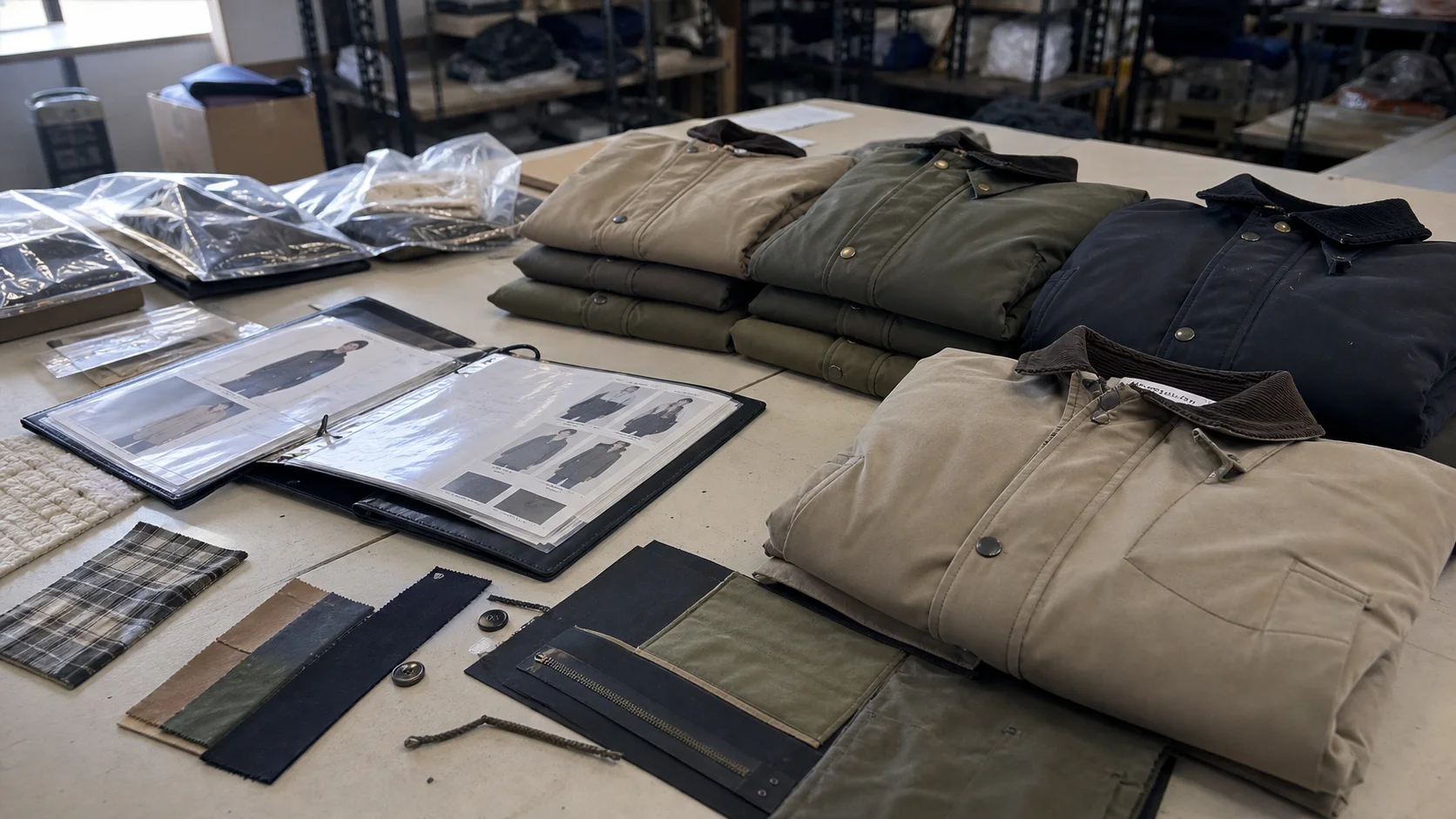
A practical SEO outline for fitness club buyers reviewing wholesale warehouse coat size grading, fit consistency, decoration planning, and order approval...
Warehouse Coat Size Grading for Club Buyers - Outerwear & Jackets manufacturing guide
Fitness club buyers face a very specific outerwear problem: the warehouse coat has to fit many body types, support staff movement, protect against cold handling areas, and still look consistent across front desk, facilities, coaching, and operations teams. A weak size grading plan creates avoidable returns, uneven uniforms, staff complaints, and reorders that do not match the first delivery.
This wholesale warehouse coat size grading review for fitness club buyers looks at the purchasing decisions behind fit, grading, sampling, MOQ planning, fabric choices, trim specifications, lead times, and inspection risks. The focus is not fashion theory. It is about buying coats in bulk that work across a real club workforce.
Size grading is the system used to increase or decrease garment measurements across a size range. For warehouse coats, this usually means controlling chest width, shoulder width, sleeve length, body length, armhole depth, hem width, bicep width, and sometimes hood or collar dimensions. Good grading keeps each size proportional. Poor grading makes small sizes too boxy, large sizes too tight in the armhole, or extended sizes too short in the body.
For fitness clubs, the issue is sharper than it may appear. A club uniform is worn by people who lift equipment, move supplies, clean facilities, manage cold entry areas, and sometimes step into public-facing roles. A coat that looks acceptable on a mannequin may fail when staff reach overhead, carry towels, unload cartons, or layer over hoodies and polos.
Club buyers also have to deal with mixed wear occasions. The same coat may be worn by a facilities team member in a back-of-house storage zone, a trainer walking between buildings, or a front desk employee at an entrance during winter. Size grading must support movement and a consistent brand image.
The buying mistake is treating a warehouse coat like a simple promotional jacket. It is a work garment first, and the grade rules need to reflect movement, layering, and repeated laundering.
In wholesale purchasing, fit problems become expensive quickly. If 15% of a staff uniform order fits poorly, the buyer may need urgent replacements in sizes that were not stocked deeply enough. That creates small reorder runs, higher unit cost, mismatched dye lots, and delayed rollout. A stronger grading review before bulk production reduces that risk.
The term “warehouse coat” can refer to different outerwear styles. In club sourcing, it often means a practical midweight or insulated work coat used for storage rooms, receiving areas, maintenance duties, back-of-house operations, and transitional outdoor use. It is usually more protective than a light windbreaker but less technical than a mountaineering jacket.
A typical fitness club warehouse coat may include a durable woven shell, light padding or fleece lining, full front zipper, storm flap, stand collar, elastic or adjustable cuffs, lower pockets, internal pocket, and embroidered or printed logo placement. Some buyers prefer a clean staff jacket silhouette so the coat can move from storage to member-facing areas without looking industrial.
Before approving size grading, buyers should define the actual use case. A coat worn over a T-shirt in a heated supply room can grade closer to a regular jacket. A coat worn over a polo, sweatshirt, and radio belt needs more ease through the chest, waist, bicep, and sweep. If staff wear gloves, the zipper pull and pocket openings also need attention.
The answers affect the base size and the grade increments. A warehouse coat that is shared by staff should usually have more forgiving ease and a slightly broader size distribution. A coat assigned to individual employees can be more precise, but it still needs enough room for daily movement.
Size grading starts with a base size. Many suppliers build the first pattern around size M or L for unisex coats. Women’s coats may be based on size S or M, depending on the market and fit standard. Once the base sample is approved, the factory applies grade rules to create smaller and larger sizes.
The main point for buyers is simple: not every measurement should increase at the same rate. Chest, hem, and waist may grow by larger increments than shoulder width. Sleeve length changes slowly. Body length may increase modestly, but it should not become excessive in larger sizes or too short in smaller sizes.
For a practical warehouse coat, common grade increments may look like this:
Measurement Point Typical Grade Per Size Buyer Note Chest Width 2.5 cm to 4 cm around the body Needs enough ease for layering and reach. Hem/Sweep 2 cm to 4 cm around the body Do not make the hem too tight over hips or tool belts. Shoulder Width 0.8 cm to 1.5 cm across Over-grading shoulders makes large sizes look sloppy. Sleeve Length 0.8 cm to 1.5 cm Must suit active movement without covering the hand. Body Length 1 cm to 2 cm Long enough for coverage, not so long it restricts bending. Bicep Width 1 cm to 2 cm around Critical for athletic staff and layered wear.These are typical reference ranges, not universal rules. The final grade should follow the fabric type, insulation thickness, target user, and brand fit direction. A heavy padded coat needs more space than an unlined shell. A stretch woven can tolerate a closer fit than a rigid polyester canvas.
One common issue in wholesale outerwear is proportional failure in extended sizes. The chest may be graded up, while the bicep, armhole, and across-back measurements do not grow enough. The coat can close at the front but still feel tight when the wearer reaches forward. For a fitness club workforce, that is a high-risk failure because staff are rarely standing still.
A fit block is the base shape used to build the garment. Club buyers often default to unisex sizing because it appears simpler and lowers SKU count. That can work for basic work coats, but it has tradeoffs. Unisex blocks usually fit straight through the body, with broader shoulders and longer sleeves. They may be practical for shared garments, but they can fit poorly on shorter staff or employees with narrower shoulders.
Men’s and women’s fit blocks improve size relevance, especially for public-facing uniforms. The downside is higher SKU complexity, more sample work, and more inventory planning. For smaller club groups, a strong unisex block with inclusive grading may be the better commercial choice. For larger multi-location chains, separate fits can reduce complaints and improve presentation.
A unisex block is usually the easiest for warehouse coat procurement. It works best when the coat is slightly relaxed, hip length, and adjustable at the cuff or hem. Buyers should watch sleeve length and shoulder width in sizes XS and S. If those measurements are too large, smaller staff may look like they are wearing borrowed stock.
A men’s block is useful when the buyer wants a more structured coat with defined shoulders and longer proportions. It can work well for facilities teams, receiving staff, and outdoor operations. The risk is that a men’s-only block may not serve the full workforce unless smaller sizes are carefully tested.
A women’s block can improve shoulder fit, sleeve length, and body shaping. For warehouse coats, shaping should be practical rather than tight. Too much waist suppression restricts movement and creates fit problems when worn over uniform layers. If a women’s block is used, buyers should confirm hip sweep and sitting comfort.
Fit Strategy Best Use Main Tradeoff Unisex Shared staff coats, smaller programs, simplified inventory Less precise fit across body types Men’s and Women’s Larger teams, public-facing uniform programs More SKUs, more sampling, higher planning burden Relaxed Unisex with Adjusters Operational coats with mixed layering needs Can look less tailored if overbuiltMost fitness club buyers should plan the size range before negotiating price. A supplier can quote a low unit cost for S to XL, then add surcharges or limitations for 2XL, 3XL, and above. Extended sizes are not a detail to solve later. They affect fabric consumption, pattern development, grading, cutting efficiency, and sometimes MOQ.
For a general unisex warehouse coat order, a practical size range may run from XS to 3XL. For larger staff populations, 4XL may be necessary. For women’s fit blocks, ranges may run XS to 2XL or XXS to 3XL, depending on the market. Buyers should avoid assuming that letter sizes are consistent across suppliers. One supplier’s L may be another supplier’s XL in chest or sleeve length.
Actual distribution should be based on staff data when available. If no reliable data exists, buyers can use a cautious starter curve and adjust after the first issue cycle.
Size Indicative Order Share Planning Note XS 5% to 8% Often underplanned, especially in unisex programs. S 12% to 18% Check sleeve and shoulder fit carefully. M 20% to 28% Common base or high-volume size. L 22% to 30% Usually a core replenishment size. XL 15% to 22% Needs enough bicep and across-back ease. 2XL 6% to 12% Plan at launch rather than treating as exception stock. 3XL and above 2% to 6% May require MOQ discussion and separate costing.This table is only a planning reference. A fitness club with many facilities staff may need deeper XL to 3XL coverage. A boutique studio with mostly front desk and coaching staff may skew differently. The better approach is to collect anonymized staff size requests before final bulk allocation.
Buyers should also consider spare stock. For uniform programs, holding 5% to 10% extra inventory is common, depending on staff turnover and seasonal needs. The spare stock should not be only M and L. It should reflect the real size curve, including smaller and extended sizes.
A warehouse coat size grading review should always include a measurement specification sheet. This is the buyer’s control document. It tells the supplier where to measure, what each size should measure, and what tolerance is acceptable in production.
For outerwear, tolerances are usually wider than for light knit tops because thicker fabrics, padding, and seam bulk can affect measurement. Still, tolerances must be controlled. A chest tolerance of plus or minus 1 cm may be reasonable for some woven coats. For padded styles, plus or minus 1.5 cm may be more realistic. Sleeve length, body length, and shoulder width should not drift too far because visual consistency suffers quickly.
Chest measurement gets too much attention compared with armhole and bicep. Many coats pass a flat chest check but fail in movement. For club use, across-back width and sleeve pitch are also important. If the sleeve is set too low or too narrow, staff will feel pulling when lifting or reaching.
Pocket placement should be graded carefully. If lower pockets sit too low on smaller sizes, they become awkward. If they sit too high on extended sizes, they can interfere with the natural hand position. Logo placement also needs grading review. A left chest embroidery that looks balanced on size M may sit too close to the armhole on XS or too high on 3XL if placement is not size-adjusted.
Fit is not controlled by measurements alone. Fabric and trims change how a coat feels and performs. A rigid shell with heavy padding needs more ease. A lightly padded coat with a brushed lining may feel warmer but also grab against fleece layers. A smooth taffeta lining improves easy-on wear but may be less warm than fleece.
Fitness club buyers should specify fabric details before approving size grading because the same pattern can fit differently in different materials. A prototype made in substitute fabric may not represent bulk fit. That is a frequent source of disappointment when the production coat arrives stiffer, thicker, or less flexible than the approved sample.
For a warehouse coat used by club staff, polyester oxford or a durable polyester woven can be practical if the buyer needs abrasion resistance. Softshell can look better in member-facing environments and allow easier movement, but it may not deliver the same insulation unless bonded with fleece or paired with a liner.
Padding weight should be specified in grams per square meter if insulation is used. Light padding may fall around 80 gsm to 120 gsm. Midweight padding may sit around 140 gsm to 180 gsm. These are broad references, not guaranteed warmth ratings. Climate, shell fabric, lining, wind exposure, and activity level all affect comfort.
Zippers are a common failure point in budget outerwear. A cheap zipper may pass a sample review and still fail after repeated use. Fitness club coats often get fast, rough handling during shift changes. Buyers should request zipper pull strength, smooth operation, and alignment checks during inspection.
If the coat will be laundered frequently, embroidery backing and thread quality matter. Poor backing can scratch, pucker, or distort the logo area. Heat transfer logos can look clean but may crack or peel if the wrong application temperature, fabric coating, or wash method is used. Embroidery is usually more durable, but it can create water penetration points on weather-resistant shells unless handled properly.
A disciplined sampling process is the best protection against grading mistakes. Buyers should not approve bulk production from a single attractive size M sample unless the order is small and risk tolerance is high. Warehouse coats need fit checks across the size range, especially if the program includes XS, 2XL, or 3XL.
A normal sample path may include design sample, fit sample, size set sample, pre-production sample, and shipment sample. Not every order needs every stage, but skipping size set review is risky for a new coat pattern.
Sample Stage Purpose Buyer Decision Design or Proto Sample Confirms style concept, fabric direction, trims, and branding position. Approve concept or revise construction. Fit Sample Checks base size measurements and movement comfort. Approve base pattern or request corrections. Size Set Sample Checks grading across selected sizes. Approve grade rules before bulk cutting. Pre-Production Sample Confirms final fabric, trims, labels, logo, and workmanship. Release bulk production if all details match. Shipment Sample Represents finished bulk output. Keep for record and compare with inspection findings.For a wholesale fitness club order, the size set does not always need every size, but it should include the base size, one small size, and one extended size. A practical review might include S, L, and 2XL for a unisex coat. If XS and 3XL are critical, include those too. The cost of extra samples is usually lower than the cost of correcting a bad bulk run.
Fit testing should include movement. Ask wearers to zip the coat, cross arms, reach forward, lift arms overhead, bend slightly, and place hands in pockets. If the coat will be worn while carrying boxes, towels, or supplies, simulate those movements. A coat that only feels good while standing straight is not ready for warehouse or club operations.
Buyers should document every comment clearly. “Make it bigger” is not a useful revision note. “Increase bicep by 1.5 cm, raise armhole slightly, keep chest unchanged, add 1 cm across back” gives the pattern team a better chance of correcting the actual problem.
For structured development support, buyers can review manufacturing service options at fabrikn.com/services/. The useful point is to align product development, sourcing, and production control before the coat reaches bulk cutting.
MOQ, or minimum order quantity, depends on fabric availability, dyeing requirements, trim customization, logo method, size range, and factory production setup. For wholesale warehouse coats, typical MOQ ranges may start around 100 to 300 pieces for stock fabric and standard trims. Custom fabric color, custom lining, branded zipper pullers, or extended size development can push MOQ to 500 pieces or more.
These figures are only typical market references. Supplier capability varies. Some manufacturers can support lower MOQs with higher unit prices if they use available fabric and standard components. Others need larger volumes to justify cutting, sewing line setup, quilting, or special procurement.
Small orders with too many sizes can become inefficient. A 150-piece order across eight sizes may leave very shallow quantities in each size. That sounds inclusive but creates higher operational risk if the size curve is wrong. A buyer may be better served by a tighter initial range plus planned replenishment, as long as extended sizes are not excluded from staff who need them.
For multi-location fitness clubs, allocation matters as much as total order quantity. If every site receives the same size pack, some locations will run out of key sizes while others hold dead stock. A better approach is to gather location-level staff counts and issue coats based on actual size requests, then hold central backup inventory.
Buyers should also ask whether reorder production will match the first bulk order. Fabric lot, lining shade, zipper tape color, and logo thread can shift. If the coat is part of a long-term uniform program, negotiate fabric continuity and keep approved standards on file.
Lead time for warehouse coats depends on how much is standard and how much is custom. A simple coat using available fabric and trims may be produced faster than a fully custom padded style. Sampling, size set approval, fabric procurement, cutting, sewing, decoration, finishing, inspection, and shipping all affect the calendar.
As a broad reference, sample development may take 2 to 6 weeks depending on complexity and revision rounds. Bulk production may take 4 to 10 weeks after approvals and material readiness. Shipping adds more time, especially for sea freight. Air freight can solve timing pressure but raises landed cost significantly.
Stage Typical Timing Risk Factor Tech Pack and Quotation 3 to 10 business days Incomplete specs cause vague pricing. Proto or Fit Sample 2 to 4 weeks Substitute fabric may distort fit review. Size Set Sample 1 to 3 weeks after fit approval Grade issues may require another round. Bulk Material Procurement 2 to 6 weeks Custom colors and trims extend timing. Bulk Production 4 to 10 weeks Padding, quilting, and decoration add steps. Inspection and Shipping 1 to 6 weeks Depends on inspection schedule and freight mode.The biggest timing mistake is approving design late and expecting production to absorb the delay. Factories cannot responsibly correct fit, order fabric, produce size sets, complete decoration, and ship a quality coat in an unrealistic window. If the rollout is tied to winter season, new club openings, or staff uniform refresh, start development early.
Lead time also depends on decision speed. Every sample revision requires clear comments and timely approval. If multiple departments review the coat, assign one decision owner. Conflicting feedback from operations, marketing, and finance can delay production and create a compromised product.
Buyers with upcoming club launches or uniform changes can use the contact route at fabrikn.com/contact-us/ to start a sourcing discussion with clearer timing, quantity, and specification details.
Inspection should check more than visible defects. For warehouse coats, measurement and functional testing are essential. A coat can look clean on a hanger but still fail in sleeve twist, zipper operation, pocket strength, logo placement, or size consistency.
Measurement inspection should be done by size and color. If the order includes multiple production lots, inspect each lot. Do not measure only the base size. Extended sizes can drift if patterns, markers, or sewing handling are not controlled carefully.
For padded coats, thickness can hide sewing defects. Inspect seams, pocket corners, cuffs, and zipper ends. These are stress points. A coat used in facilities or storage work will be pulled, grabbed, and washed more aggressively than a typical retail jacket.
Color consistency is another issue. Black, navy, charcoal, and grey are common club uniform colors, but different materials absorb dye differently. Shell fabric, rib, zipper tape, drawcord, and embroidery thread may not match perfectly. Buyers should define an acceptable shade range before production. Total perfection across different materials may be unrealistic, but visible mismatch looks cheap.
Bulk inspection usually relies on flat measurements rather than full wear testing. That makes the approved sample and measurement spec even more important. If the approved size L has the correct movement comfort, then inspection can compare production size L against that standard. If the approved sample was never truly tested, inspection cannot rescue the fit.
Buyers should retain sealed approved samples. One sample should stay with the supplier, and one should stay with the buyer or buying office. This prevents arguments over whether a production detail changed. The approved sample should include fabric, lining, trims, labels, logo, and packaging where possible.
The cheapest coat is not always the lowest-cost coat. If a warehouse coat fails fit or durability, the buyer pays through staff dissatisfaction, replacement orders, delayed uniform rollout, and brand inconsistency. That does not mean every club needs a premium technical jacket. It means the coat should match its actual use.
For back-of-house only use, spend money on durability, movement, and easy care before styling details. For member-facing use, allocate more attention to silhouette, logo execution, color consistency, and surface finish. For cold receiving zones or outdoor transitions, prioritize insulation, wind resistance, collar comfort, and pocket function.
A practical buying route is to start with a proven workwear-inspired outerwear block, adjust it for club branding and staff movement, then validate the size range through a size set. This is often safer than developing a highly original coat from scratch unless the buyer has enough time, budget, and volume to support proper development.
For clubs that want a cleaner brand presentation, a softshell or lightly padded staff jacket may be more appropriate than a traditional warehouse coat. The tradeoff is warmth and ruggedness. For clubs with heavy facilities use, a stronger shell and looser fit may be less stylish but more practical. The right answer depends on who wears the coat and how often.
Before asking for a final quotation, buyers should prepare a specification package. A clear spec reduces vague pricing and prevents suppliers from making assumptions that later become disputes.
Spec Area What to Define Why It Matters Style Coat length, collar, hood, cuff, pocket layout, closure Controls pattern and labor cost. Fit Unisex, men’s, women’s, relaxed, regular, layering requirement Controls size grading and comfort. Fabric Fiber, weight, weave, coating, color, performance claims Controls durability, hand feel, and cost. Lining Taffeta, fleece, quilted lining, padding weight Controls warmth and ease of wear. Trims Zipper, snaps, elastic, drawcord, labels, hangtags Controls function and reorder consistency. Branding Embroidery, print, patch, placement, size, colors Controls visual consistency. Size Range XS to 3XL, men’s/women’s split, extended sizes Controls MOQ, markers, and inventory. Packaging Individual bags, size stickers, carton packs, location sorting Controls distribution efficiency. Inspection AQL level, measurement tolerances, approved sample standard Controls acceptance criteria.Buyers should also confirm care instructions. A warehouse coat for club staff may be washed more frequently than a retail coat. If the shell coating, padding, or logo cannot tolerate normal laundering, staff will either damage the garment or avoid cleaning it properly. Neither outcome is acceptable for a uniform program.
Care labels should reflect tested performance, not assumptions. If tumble drying is not recommended, say so. If heat transfer logos require low-temperature washing, that should be clear. If the coat is water-resistant rather than waterproof, avoid overstating the claim in internal product descriptions.
Costing a warehouse coat is not just about unit price. The buyer should compare total landed cost, defect risk, reorder terms, and service reliability. A low quote may exclude sampling, custom labels, larger sizes, inspection corrections, or packaging by club location.
Ask suppliers to break out major cost drivers where possible. Fabric, padding, lining, zipper quality, logo method, and packaging all influence price. If the quote is too high, adjust the specification intelligently rather than forcing the supplier to cut quality invisibly.
Do not value engineer the bicep, armhole, zipper, or pocket reinforcement too aggressively. Those are functional areas. Cutting cost there can create the exact problems staff notice first.
If the buyer is comparing different manufacturing routes, it may help to review the company background and sourcing approach at fabrikn.com/about-us/. Supplier fit is not only about capability; it is also about communication discipline, documentation, and willingness to control production details.
A disciplined buying process keeps the project moving while protecting the club from fit and quality surprises. The exact workflow can vary, but the sequence below is a practical starting point.
The last step is often overlooked. Staff feedback after the first delivery is valuable. If many employees size up because of sleeve tightness, the issue may be the armhole, bicep, or across-back measurement rather than the chest. If smaller staff complain about oversized sleeves, the grade may be too aggressive in sleeve length or shoulder width. Use feedback to improve the next run, not just to process exchanges.
Warehouse coat size grading is a commercial decision as much as a technical one. The buyer is balancing fit coverage, MOQ, unit cost, inventory risk, staff comfort, and brand presentation. A strong coat program does not happen by ordering a generic jacket and hoping the size chart works.
For most fitness club buyers, the safest route is a practical relaxed fit, controlled grading, durable fabric, reliable trims, and a size set review before bulk production. Extended sizes should be built into the order plan from the beginning. Movement testing should be part of sample approval. Inspection should include measurements, logo placement, zipper function, pocket strength, and size labeling.
The best purchasing judgment is to spend where failure is expensive: fit, zippers, pockets, fabric durability, and sample control. Save money where it does not damage function: over-customized trims, unnecessary design complexity, and excessive packaging. A warehouse coat does not need to be overbuilt, but it must be fit for the way club staff actually work.
Get a free quote from Fabrikn — your trusted B2B clothing manufacturer with 10+ years of experience. MOQ as low as 200 pieces.
Get a Free Quote →Size grading is the process of increasing or decreasing garment measurements across a size range. For warehouse coats, it controls chest, shoulder, sleeve, body length, bicep, armhole, and hem measurements so each size fits proportionally.
Many unisex programs use XS to 3XL as a practical range. Larger organizations may need 4XL or separate men’s and women’s sizing. The best range should be based on staff size data, not only standard supplier availability.
Typical MOQs may start around 100 to 300 pieces when using stock fabric and standard trims. Custom colors, special linings, branded trims, or complex size ranges can push MOQ to 500 pieces or more. Supplier terms vary, so buyers should confirm early.
Unisex sizing is simpler and often better for shared operational coats. Separate men’s and women’s fits can improve presentation and comfort but increase SKU count, sampling work, and inventory complexity. The right choice depends on staff count, budget, and how public-facing the coat is.
Chest, bicep, armhole, across-back, sleeve length, shoulder width, body length, and hem sweep are all important. Buyers should not focus only on chest width because movement comfort often fails through the armhole, bicep, and back.
For a new coat style, buyers should review at least a base fit sample and a size set sample. A good size set includes a small size, base size, and extended size. A pre-production sample in final materials is strongly recommended before bulk cutting.
Sample development may take 2 to 6 weeks, while bulk production may take 4 to 10 weeks after approvals and material readiness. Shipping time depends on freight mode. Custom fabric, padding, decoration, and slow approvals can extend the timeline.
The most common risks are measurement drift, tight armholes, weak zippers, poor pocket reinforcement, inconsistent logo placement, color shading, incorrect labels, and size grading that does not match the approved sample.
Embroidery is usually durable and suitable for uniform coats, but it can add bulk and may affect water resistance at stitch points. Heat transfer can look clean and lightweight, but it must be compatible with the shell fabric and wash requirements. The better option depends on fabric, branding style, and care expectations.
Collect staff size data before ordering, approve a proper size set, test movement during fitting, include extended sizes in the first order, and hold spare stock based on the real size curve. Clear measurement specs and inspection standards also reduce surprises.