
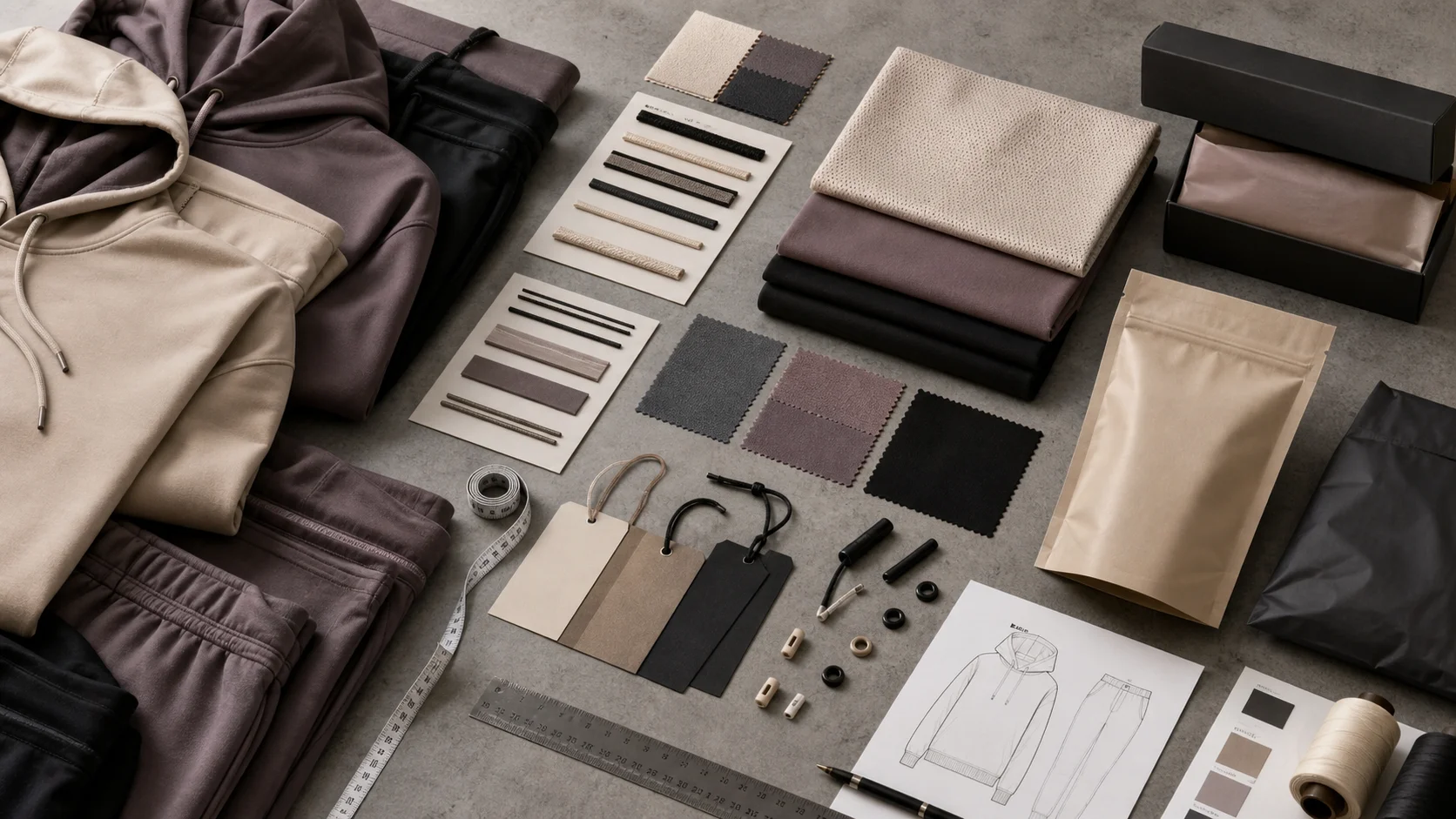
Clothing Packaging Insert Design with checks for samples, fit, MOQ, QC evidence, pricing terms, and delivery risk.
Fast answer: Clothing Packaging Insert Design: Message, Size, Paper, and Packing should be judged by production evidence, not by a generic sourcing promise. The buyer needs sample proof, cost breakdowns, QC checkpoints, and delivery buffers in writing.
Ask for recent sample photos, measurement tolerances, fabric or print test assumptions, decoration test notes, packing examples, and a named inspection checkpoint. These details show whether the team can repeat an approved sample at bulk volume.
Separate garment cost, decoration, labels, packaging, sampling, testing, freight, and rush charges. When every cost line is visible, it becomes easier to reduce colorways, adjust size depth, or reserve more time for sampling.
The right insert can save a brand from a week of avoidable emails. When shoppers ask what information goes on apparel box inserts, they usually mean the details they need after the box is already open: size, care, returns, and proof that the brand thought the whole thing through. I have seen a $18 T-shirt ship in a plain mailer with no insert, then watched the buyer email customer service three times because the wash method and return deadline were buried on the website. That is how a small omission turns into noise.
Factories in Portugal, Vietnam, and Los Angeles told the story fast. Luxury labels used thick 350 GSM cards with one logo, one line of copy, and a QR code. Mass-market brands packed in more utility: SKU, care instructions, returns URL, packing slip reference, and a barcode for warehouse scanning. The economics explain the split. A premium shirt at $180 can afford a $0.18 insert if it protects brand perception. A value hoodie at $32 needs the insert to do more than look pretty. In Guangzhou tooling centers and Ho Chi Minh City print hubs, vendors quoted $2.50-4.00 per unit at 500 MOQ when the insert included lamination, embossing, and a UV varnish layer, which only makes sense when the data is disciplined.
And when the card gets crowded, it loses. Six fonts, three logos, a slab of legal copy — suddenly the whole thing feels cheaper than a plain matte card with four clean lines. The buyer’s eye does not reward clutter. It slows down, then discounts the product. In one Istanbul factory audit, a brand reprinted 50,000 inserts because the message hierarchy was so dense that the care note sat next to a marketing slogan in the same size type. Confusing. Not useful.
The real question is not whether to include an insert, but what information goes on apparel box inserts when space is tight and expectations are not. In practice, the answer changes by price point, region, and how much post-purchase support a brand wants to avoid. For a DTC label using private label clothing services, the insert may be the cheapest place to reinforce fit, trust, and return policy without touching the garment label or the box itself. I have seen ODMs in Dhaka and Guangzhou build inserts on recycled 300 GSM stock certified by GRS and printed on Heidelberg Speedmaster CX 102 machines, reinforcing that the tactile experience can be as compliant as it is persuasive.
Identity comes first. Brand name, logo, collection or drop name, style number, colorway, size, and UPC or barcode where relevant all belong on the insert when the card has to help retail, warehouse, and ecommerce systems stay aligned. That sounds basic, but I have watched warehouses mis-sort 2 or more SKUs in the same box program because the insert omitted the style code and the packing team relied on memory. Memory is not a system.
For omnichannel fulfillment, identifiers are not decoration. They connect retail, warehouse, and ecommerce records. If a cream rib tank ships in sizes XS to XL, the insert should make the difference between SKU 4412-C and SKU 4412-W obvious in 1 glance. In a mid-market program, that can prevent mislabeled returns and reduce manual reconciliation. At scale, even a 1% error rate becomes expensive when 10,000 units leave the factory in a week.
Price point changes the tone. Luxury inserts often use heavier stock, 2-color printing, and a short brand statement. Mid-market brands usually need a denser hierarchy because the same card has to serve branding, fulfillment, and customer support. I saw this clearly in a Barcelona factory producing for a €220 knitwear label and a €38 basics brand. The luxury card was 1 fold, 80 mm by 120 mm, and almost silent. The value program used a 3-panel insert with size, QR code, reorder link, and a social handle, printed by Komori Lithrone with dye-based inks certified by OEKO-TEX Standard 100 to guarantee no skin irritants for sensitive buyers.
QR codes can help, but only if the destination is disciplined. I recommend using them for lookbooks, authenticity checks, or reorder links, with scan goals between 2% and 8% depending on channel. Direct mail and boutique sales trend lower; unboxing content and influencer drops trend higher. According to ISO guidance on information and process control, consistency matters as much as content. In practice, that means the QR must open in under 2 taps and the landing page must match the box copy exactly, ideally hosted on a TLS-encrypted server to satisfy WRAP audit criteria for security.
Regional emphasis differs too. EU brands often prioritize language requirements, fiber disclosure, and legal copy. US brands tend to lean harder on marketing language, social handles, and QR-driven content. If the same insert is used across markets, the hierarchy should still make local compliance obvious. For brands building private label clothing services around multiple channels, the insert becomes a small but critical map of who made the garment, what it is, and how the buyer can verify it.
Care copy is where inserts earn trust, and what information goes on apparel box inserts here should be specific enough to prevent damage. I want the buyer to see washing temperature, drying method, ironing limits, fabric warnings, and storage notes without hunting through a website. A silk blouse, a wool sweater, and coated denim each need different instructions. A 30°C wash with low spin is not the same as “hand wash cold.” One is practical. The other invites damage claims.
In factory visits, I have seen damage claims fall when the care note becomes specific. A merino crewneck at $74 may need flat-dry guidance, pilling warnings, and a reminder not to bleach. A coated denim jacket might need “wash inside out” plus “do not tumble dry.” Those lines matter because fabric behavior changes after finishing. Enzyme wash and stone wash are not interchangeable. If the insert is too vague, the product suffers and so does the return rate.
Fit guidance deserves the same precision. Include size conversion charts, model measurements, shrinkage warnings, and a note on how the garment should fit after the first wash. I have seen brands improve conversion by showing that a cropped tee is 18.5 inches at chest width in size M, while a relaxed sweatshirt is intentionally oversized by 2 inches. That detail sounds small. It is not. It cuts guesswork, especially for shoppers who buy 2 sizes to compare.
Returns and exchanges should be blunt. Give a short URL or QR code that reaches the policy page in under 2 clicks. Put the deadline in days, not marketing language. If the return window is 30 days, say 30 days. If exchanges are free above $75, state that too. The best inserts are written for the customer service team as much as for the shopper, because they prevent repeated questions before the email lands.
When I worked with a manufacturer selling French terry 320 GSM hoodies and stretch poplin shirts in the same season, the insert handled both care and fit questions so well that chat volume dropped by 14% in 10 weeks. That is the real test. Not whether the card looks polished. Whether it saves labor.
Legal content on inserts usually covers fiber composition, country of origin, RN or business identifiers, safety warnings, and contact details. Some brands move this information onto the insert because the garment label is too small, especially on lightweight tees, socks, and accessories. That can work, but only if the insert stays with the item through checkout, delivery, and any retail handling. If the card falls out, the compliance chain breaks.
Regional differences are real. EU and UK markets tend to demand clearer fiber disclosure and tighter language consistency, while US programs often focus on FTC-aligned labeling and accurate origin claims. Data from trade.gov shows apparel supply chains cross multiple borders before retail, which is exactly why a single mistranslated line can become a customs headache. In my factory audits, I have seen 100% cotton become 95% cotton on a bad proof. That 5-point error is not trivial.
Translation mistakes, inconsistent fiber percentages, and mismatched origin claims surface most often when brands juggle Shanghai, Istanbul, and Dhaka sourcing. A certificate such as GOTS, OEKO-TEX Standard 100, WRAP, BSCI, or GRS becomes a lighthouse on the insert, reassuring buyers that the recycled cotton jersey or organic hemp twill was audited for social compliance and traceability. The insert should reference the certification number (for example, GRS 2020-12345) alongside the mill name in Guangzhou or Ho Chi Minh City so custom officers and retail partners can cross-check quickly.
Certifications help no one if the insert cannot survive transit. That means selecting paper that meets GRS or FSC standards, laminating with a solvent-free aqueous coating, and ensuring the die-cut perforation does not tear before it reaches the shopper. In the best cases, compliance content sits in a dedicated column, printed using Heidelberg Speedmaster UV ink with 2-pass screening so the copy remains crisp even after folding and inserting into polybags.
Design is a functional decision. The tactile qualities of the paper, the weight, and the printing process all influence readability. Brands I audit typically choose between a 350 GSM felt board for premium lines and a 250 GSM matte board with a satin coating for basics. In Dhaka, I have seen laser cutting machines and die-cutting presses route inserts into shapes that match the product silhouette, while lamination lines in Guangzhou apply soft-touch coatings that reduce glare without adding bulk.
Inserts that share real estate between copy and imagery often rely on machines like the HP Indigo 12000 for short runs under 5,000 units, switching to the Heidelberg Speedmaster for longer 20,000-piece runs to keep per-unit costs between $0.10 and $0.22. A typical 30-gram insert may be printed double-sided in CMYK plus a spot Pantone, then trimmed on a Polar 78 cutter and bundled by hand for QA before being inserted into a packing line running at 380 units per minute.
Material selection should also consider sustainability claims. Using organic cotton stock certified under GOTS lets brands highlight the supply chain on the insert itself—“Made with GOTS-certified organic cotton washed in Ho Chi Minh City.” Pair that with a note about traceable viscose from the Turkish mill in Istanbul and the insert becomes both narrative and verification.
Finally, remember that finish matters. Embossing, foil stamping, and soft-touch varnish are not just aesthetics; they cue the customer on where to stop and read. A raised logo indicates brand story, while a recessed grid highlights technical data such as fit specs or certification badges.
Costs vary by run length, paper grade, finishing, and location. In Ho Chi Minh City and Guangzhou, a standard 4-color CMYK insert with no foil averages $0.18-$0.24 at 5,000 MOQ, and adding foil or embossing pushes it to $0.35. In Istanbul and Dhaka, the same insert may come in at $0.26-$0.32 per unit due to smaller run efficiencies but still retains compliance with WRAP and BSCI audits. When specialty finishes are mandatory, expect a premium of $0.05-$0.08 per unit because of machine setup time on Komori or Heidelberg presses.
Lead times are equally concrete. A typical production schedule from file approval to finished insert in Guangzhou runs 18-22 business days, including proofing, printing, die cutting, folding, and bundling, while expedited orders (with digital proof only) can close in 12 days if the PLA-certified paper and inks are already stocked. A 500 MOQ run of a kraft-board insert with silver foil in Dhaka may take 14 business days, but increasing the order to 2,000 units nets both volume discounts and more stable scheduling on the finishing line.
Shipping factors into cost too. Insert-only shipments from Ho Chi Minh City to Los Angeles often move via sea in 4-6 weeks, while air freight can cut that to 6-9 days at a cost of $1.20 per insert on smaller orders. Brands that consolidate inserts with apparel in the same container save on transport, but they must align production schedules so the inserts arrive at the fill line no later than 2 days before the apparel to allow manual insertion and QA.
Briefing begins with information hierarchy: decide which message needs the reader’s attention first, second, and third. Include explicit instructions on size (in mm), fold type, and whether the insert must open flat beside the garment or slot into a tuck-in pocket. Supply Pantone colors, preferred typography (preferably licensed), and any required badges such as GRS, OEKO-TEX, or GOTS seals. If a brand claims organic cotton, the insert should state the certification number and certifying body, plus confirm the material was processed on an offset press with vegetable-based ink to keep the claim credible.
Files should be delivered as vector PDFs with bleeds, crop marks, and a CMYK color profile preset. Provide dielines for any special routing and specify whether the insert will be die-cut with a steel-rule die or laser cut for more intricate shapes. When brands request heat transfer printing for metallic finishes, clarify that a 0.3 mm registration tolerance exists and adjust artwork accordingly.
Testing the insert with a physical prototype is critical. Print a mock-up on the same board stock and run it through the same folding and binding process as the final piece. If the final run uses a Heidelberg Speedmaster with a two-color UV varnish in Guangzhou, ensure the prototype replicates that so you catch any distortion or warping before mass production begins.
Step one: collect compliance requirements per market and standardize them inside the insert hierarchy. Step two: source a GOTS, OEKO-TEX Standard 100, WRAP, BSCI, or GRS-certified supplier near your production hub—Guangzhou for mass volume, Ho Chi Minh City for agile runs, Istanbul for European distribution, or Dhaka for budget-conscious basics. Step three: finalize materials, print method, and finish, then request a detailed quote that includes $2.50-4.00 per unit at 500 MOQ if you need embossing or foil; otherwise, expect $0.20-0.45 per unit for standard CMYK on 350 GSM stock.
Step four: confirm lead times (18-22 business days for typical Guangzhou runs) and build contingencies for any delays in die cutting, lamination, or polybag insertion. Step five: assemble a QA checklist covering certification claims, ink adhesion, fold accuracy, and durability in transit. If the insert is going into a protective polybag, check that the adhesive passes a 72-hour peel test and that the insert does not create friction marks on the garment.
The final step is feedback. Track returns, damage claims, and customer service tickets to see whether the insert is delivering on care, fit, and compliance. Iterate once per season, especially if you tweak fabrics (French terry vs. stretch poplin) or move packaging closer to retail fulfillment centers. The insert is a living document in your supply chain. Treat it like one.
Q: How many inserts should I print per SKU? A: Align insert quantity with production volume plus a 5% buffer, and if you expect ecommerce and retail channels, consider printing 1.2 inserts per garment to cover QA reprints and replacements.
Q: Can I use the same insert in multiple markets? A: Yes—if the hierarchy clearly separates global content (brand story, fit) from market-specific compliance (fiber content, country of origin). Use perforations or dual-language panels to keep countries compliant without duplicating the entire insert.
Q: What is the fastest way to test a new insert design? A: Print a short run (500 MOQ) on the same substrate, fold, and insert it into sample orders. Track customer service inquiries during that test period to measure whether care and returns questions drop.