
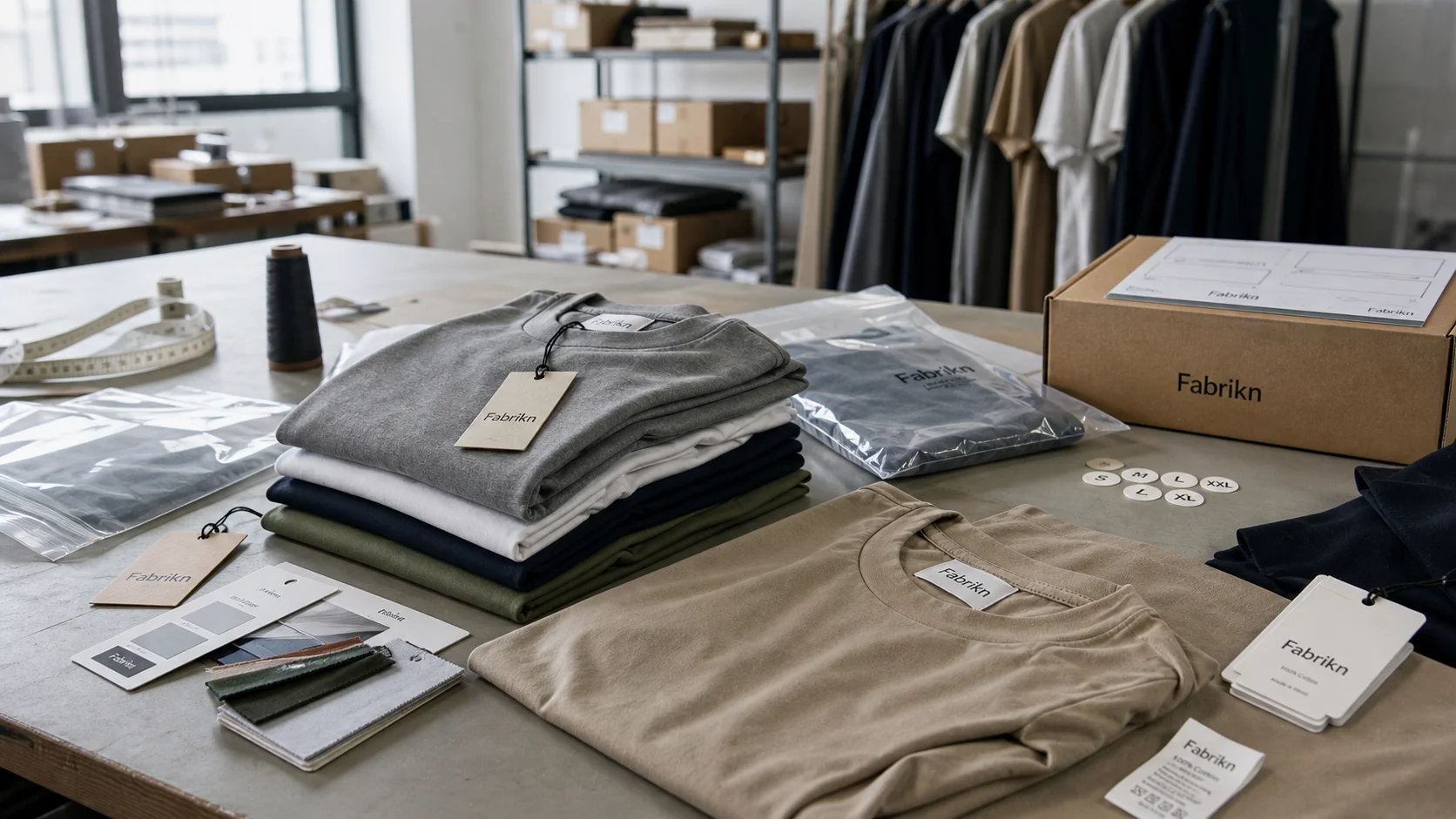
Clothing Packaging Box Information with checks for samples, fit, MOQ, QC evidence, pricing terms, and delivery risk.
Fast answer: Clothing Packaging Box Information: Required Fields, Layout, and Proof should be judged by production evidence, not by a generic sourcing promise. The buyer needs sample proof, cost breakdowns, QC checkpoints, and delivery buffers in writing.
Ask for recent sample photos, measurement tolerances, fabric or print test assumptions, decoration test notes, packing examples, and a named inspection checkpoint. These details show whether the team can repeat an approved sample at bulk volume.
Separate garment cost, decoration, labels, packaging, sampling, testing, freight, and rush charges. When every cost line is visible, it becomes easier to reduce colorways, adjust size depth, or reserve more time for sampling.
I have watched premium shirts worth $68 sit in a warehouse because the box carried only a logo and a smile. No SKU. No size break. No fiber reference. No handling mark. The carton looked polished on a photo table, then failed the first real test: getting received, counted, and shipped without human intervention. That is the first answer to what information should be on clothing packaging box. It is not decoration. It is proof the goods can move.
Across more than 200 factory visits in eight countries, I saw the same pattern repeat. In Vietnam and Bangladesh, export cartons for export-led brands often included style code, carton count, and origin, while smaller labels in the same buildings stripped everything down to a logo to save $0.03 to $0.08 a box. In Italy and Portugal, higher-end brands printed cleaner carton data because they were serving boutiques, distribution centers, and cross-dock teams at once. In the US, I saw plenty of budget cartons with a retail-ready look but weak compliance details. The result was predictable: intake delays, relabeling, and chargebacks that wiped out the few cents saved on printing.
Missing box information creates friction at every handoff. A warehouse associate can scan a legible barcode in 1-2 seconds. A confusing carton can take 15-30 seconds to open, verify, and reconcile. Multiply that by 5,000 units and the labor cost becomes real money, not theory. A carton rejection at retail can cost $50 to $250 per case in admin time and rework, before freight is counted. If the wrong carton is shipped into the wrong door, returns and transfers start compounding. The box becomes an expense line that keeps charging you after production is over.
I have seen premium brands make one kind of mistake and value brands make another. Premium labels often over-design the outer box, then hide the useful data under glossy ink and decorative panels. Budget brands do the opposite. They strip out compliance text, assume the carton will never be seen by a buyer, and discover too late that the buyer is a sorter, a customs officer, or a store receiver. The box is a communication tool. It has to serve logistics, compliance, and branding in the same 40 cm by 60 cm rectangle. Ignore that, and the repeat order gets harder to win.
The minimum package data is not mysterious. Buyers expect brand name, product name, style number, SKU, size, color, and barcode. Those seven items turn a carton from a visual object into a traceable unit. They also reduce receiving errors fast. In a distribution center handling 20,000 pieces a day, saving even 3 seconds per unit means more than 16 labor hours recovered over 20,000 scans. That is why I treat item-level identifiers as non-negotiable, especially for clothing packaging solutions that need to work across warehouse and retail channels.
Country of origin belongs on the box in most export flows, even when it also appears on a sewn label or hangtag. Fiber content reference matters too, especially if the box is used for direct-to-consumer shipment and the buyer opens it before the inner packaging. I also want a visible pointer to care instructions, either a short care line or a clear “see garment label” note. For apparel sold in mixed assortments, a carton that lists “100% cotton, 320 GSM French terry” or “95% cotton, 5% elastane” prevents a lot of sorting mistakes. When brands ask what information should be on clothing packaging box, this is the layer that keeps the receiving team from guessing.
There is a practical split between consumer-facing boxes and B2B master cartons. Consumer boxes may need product name, color, size, and a polished identity line. Master cartons need shipping marks, carton count, carton dimensions, weight, destination code, and perhaps PO number or batch number. A retailer may never see the outer master carton in the store, but the distribution center will. That is where a clean barcode and clear carton count save time and avoid receiving disputes.
I have seen brands use the same carton for T-shirts, hoodies, and infant bodysuits, then wonder why intake slows down. A box for custom hat manufacturing may need size and crown height notes. A box for infantwear needs more careful size and age markers, plus a clearer fiber statement. The box must match the product category, not just the logo.
Compliance changes by market, and the box has to follow. In the EU, buyers usually expect clearer product identification, origin statements, fiber disclosure, and language that matches the destination market. In the US, carton standards are often retailer-specific, but import records, origin marks, and traceability still matter. According to Trade.gov guidance on exporting goods, consistent documentation helps reduce customs friction and delays across markets. That matters when one missing digit can stall a shipment for 3 days.
Recycling symbols, material identifiers, and disposal notes can be useful, but only if they are true and documented. I have seen too many boxes claim “recyclable” with no backing file and no explanation of the laminate, adhesive, or finish. That is how brands end up with retailer pushback or greenwashing complaints. If the box uses FSC paper, recycled content, or low-VOC ink, keep the certificates on hand and match the claim language exactly to the documents. A sustainability claim that cannot survive a buyer audit is not a claim. It is a liability.
Language requirements can also change the physical layout. A Canadian shipment may need English and French. A Gulf market may require Arabic on the outer carton or a compliant insert. Customs teams care about marks that connect cartons to purchase orders, HS classifications, and destination points. I always ask for traceability codes, lot numbers, and carton IDs because they help during recalls, short shipments, and port inspections. If a retailer asks for a specific carton mark format, follow it exactly. One extra character can force a relabel job across 4,000 pieces.
On larger programs, I have seen factories use carton-level QR codes tied to packing lists and inspection records. That is not overkill. It cuts back-and-forth when a buyer wants to verify a 12-carton lot or confirm that a production run used the approved 220 GSM fleece rather than the lighter 180 GSM version. Brands working on custom baby clothing manufacturing should be especially careful here, because age grading, fiber disclosure, and destination labeling mistakes travel faster through compliance channels than they do in fashion storytelling.
For sustainability-driven programs, buyers may also ask about certified materials or responsible production. If that is part of the brief, reference trusted standards from Textile Exchange or OEKO-TEX only when the program has supporting documentation. That keeps the box honest, audit-ready, and aligned with the manufacturer, factory, and supplier records behind the shipment. When teams debate what information should be on clothing packaging box, lean on the certificates you actually have: GOTS for organic cotton yarn spun in Dhaka, OEKO-TEX Standard 100 for the dyes printed in Ho Chi Minh City, WRAP compliance for the Istanbul finishing facility, BSCI audits from the Guangzhou folding line, or GRS-backed recycled board made in Turkey. Make the box part of the same quality system that the fabric, trims, and final inspection live in. Otherwise the carton becomes the weak link in a supply chain that prides itself on traceability.
Cheap cartons can be acceptable if the receiving party is forgiving, but even budget programs need the basics. For fast-fashion runs out of Guangzhou or Dhaka operating on $2.50-4.00 per unit at 500 MOQ, the outer sleeve still needs SKU, size, and PO number plus a barcode for handheld scanners. That same $2.50-4.00 spend still buys you a die-cut window, a printed care line, and a handling flag when sourced through a Guangzhou carton plant using Heidelberg Speedmaster presses. Spend another $0.15 per unit to add a tamper evidence label that matches the PO. If the buyer is a value retailer, add the exact fiber blend (e.g., “65% polyester, 35% organic cotton”) so cross-docking lines can sort automatically instead of manually handling each bundle.
In higher-tier channels where the box double-tasks as a shelf display, you need more design detail without losing legibility. An Istanbul fashion brand shipping to boutiques in Europe may specify a two-panel matte-laminated box with foil stamping done on a Komori Lithrone machine, but it still needs the same logistics text on a secondary panel: weight, carton count, and traceability code. Without that, the boutique receives a premium-looking package that can’t be scanned on receipt and ends up in the back room for days. The channel dictates the finish, but the compliance data stays constant.
Direct-to-consumer programs, especially for subscription or limited editions, should call out everything the customer sees when they open the box. Mention the materials (“100% GOTS-certified organic cotton, brushed 320 GSM French terry”) on the sleeve, include care instructions inside or reference a QR code that links to a WRAP-approved laundry guide, and note the handling orientation so the courier knows the shipment is fragile. Even if the box takes 18-22 business days to ship from a Ho Chi Minh City production line to a west coast fulfillment center, the customer should still feel confident that the carton is auditable and the data is clean.
Good design is not about removing information. It is about prioritizing it. Place transaction-critical data—style, SKU, carton count—in a visible zone that is contrasted with white space. Reserve the top-left quadrant for barcodes and QR codes, because most warehouse scanners approach from that direction. Use the right-hand edge for handling marks, pallet codes, or country of origin statements, and keep the “branding zone” in the center if the buyer needs a premium reveal.
Use materials and machines that align with the data layout. A 450 GSM SBS board with matte lamination and hot foil stamping is a great canvas, but don’t overprint the compliance block. Use an inline flexo printer attached to the Heidelberg XL 106 to add traceability dots after the artwork run, keeping the registry crisp. When you have multiple language requirements, stack them vertically to save horizontal real estate rather than jamming them into the same line. If you need to repeat the fiber content in two languages, do it beneath the barcode instead of around the logo.
Remember, the box will be handled ten times between the factory and the consumer. Use protective coatings that match the intended channel (e.g., aqueous coating for export cartons, UV for boutique showrooms) and verify that adhesives are suitable for automated labeling machines in the destination warehouse. An adhesive failure on the Guangzhou folding line when applying a BSCI-required barcode label can ruin the work of a dozen handlers before the carton even leaves the dock.
Before signing off on the box, verify the following:
Start with the buyer’s receiving team. Ask for their receiving SOP, translation requirements, and barcode format before you run a new carton. Match that with your factory data—traceability codes from the GSM-controlled spinning mill in Dhaka, fiber declarations from the lab in Istanbul, and the actual box spec from the Guangzhou printer. Run a small pilot (100 cartons) down the integration line in the warehouse to confirm scanners, scales, and fulfillment robots all read the same data. If you still have doubts, ask for a quick photo of the box in the port of destination receiving area, because a visual proof point beats a spreadsheet when the buyer is chasing a compliance specialist.
Finally, invest in documentation. A PDF that shows where each data point lives on the dieline, tied back to compliance references (GOTS, OEKO-TEX Standard 100, WRAP, BSCI, GRS), is what keeps the next production run from repeating the same packaging mistake.
Q: What information should appear on a clothing carton for US retailers?
A: Include brand, style, SKU, size, color, barcode, PO number, carton count, weight, and country of origin. Use the same barcode format that the warehouse scanners have tested—typically GS1-128—and add traceability QR codes if the retailer requests it.
Q: Do I need fiber content on the box?
A: Yes, especially for assortments that mix fibers. Note the precise blend (“65% polyester, 35% cotton”) and reference the certification (e.g., GOTS for organic cotton) so the receiving team knows the fiber claim is audited.
Q: How much does it cost to add full compliance information to a premium box?
A: The additional cost is minimal—approximately $2.50-4.00 per unit at a 500 MOQ for a reinforced cardboard box with lamination—and that includes printing barcodes, care info, and certifications. The savings come from avoiding chargebacks and manual handling later.
Q: What if the box ships from Ho Chi Minh City but goes to a European boutique?
A: Coordinate with both the manufacturing hub (where the Komori or Heidelberg line is located) and the destination (e.g., a Paris DC). Include language requirements, customs marks, and logistics data on the box, and confirm the box will survive the transit time—often 18-22 business days when consolidated by ocean freight through the port of Ho Chi Minh City.
Q: How do certifications play into the box information?
A: Certifications like GOTS, OEKO-TEX Standard 100, WRAP, BSCI, and GRS must be linked to the actual lot numbers, dyes, and orders on the box. State them explicitly if you reference them, and keep the supporting documents ready for final inspection and customs.