
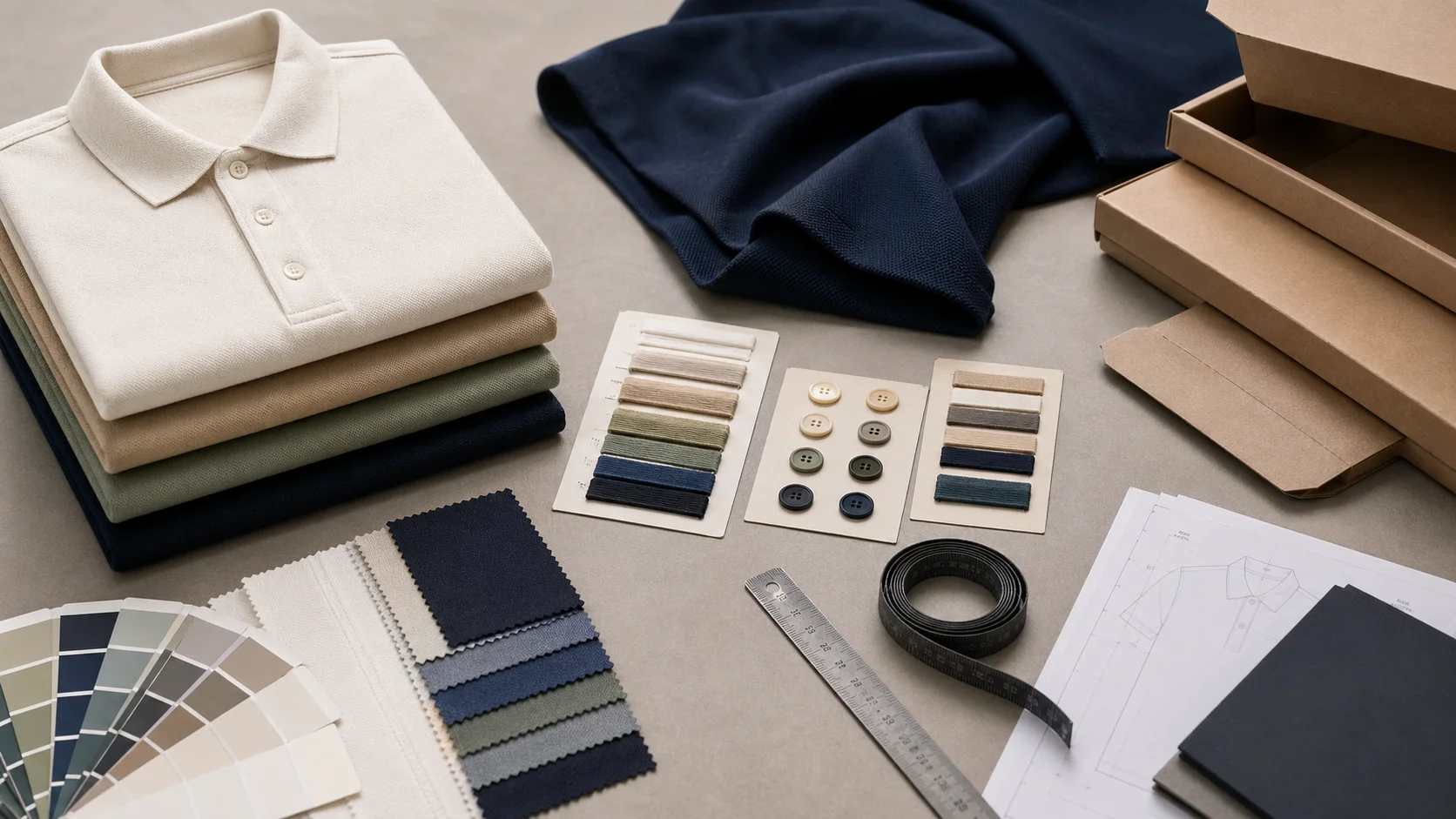
A Composition Label on Clothing compared by sample evidence, fabric or trim specs, MOQ, AQL terms, cost lines, delivery timing, and rework responsibility.
Fast answer: A Composition Label on Clothing: Material, Print, MOQ, and QC Terms should be judged by production evidence, not by a generic sourcing promise. The buyer needs sample proof, cost breakdowns, QC checkpoints, and delivery buffers in writing.
Ask for recent sample photos, measurement tolerances, fabric or print test assumptions, decoration test notes, packing examples, and a named inspection checkpoint. These details show whether the team can repeat an approved sample at bulk volume.
Separate garment cost, decoration, labels, packaging, sampling, testing, freight, and rush charges. Clear cost lines make it easier to reduce colorways, adjust size depth, or reserve more time for sampling.
A mislabeled garment can sit in a warehouse for 12 weeks, trigger a 100% inspection, and still fail because one tiny line says 92% cotton instead of 95%. Before I look at the silhouette, the wash, or the hanger sample, I check what is a composition label on clothing. That fiber-content statement usually lists percentages like 95% cotton and 5% elastane. Sounds dull. It isn’t. In Guangzhou, a label house running an OMET XJet digital press and ultrasonic die cutter can rerun that line with GOTS-certified ink, but the buyer will often wait 18-22 business days for a new woven roll if the customer demands OEKO-TEX Standard 100 and WRAP inspection approval.
Across factory visits in Vietnam, Bangladesh, Portugal, Turkey, India, and China, I’ve watched buyers, customs officers, and retail compliance teams read that label in the first five seconds. They use it to verify claims, compare products, and decide whether a shipment can enter the market. In Dhaka, Ho Chi Minh City, and Istanbul I see local compliance teams cross-check the label against OEKO-TEX Standard 100 certificates, GRS lot numbers, and BSCI audit scores before releasing containers. At packing stage, not design stage, the label becomes real. One typo can mean relabeling 20,000 pieces, a chargeback of $0.30-$1.50 per unit, or a freight hold that turns a 7-day move into 21 days.
The label sits at the intersection of law, trust, and pricing. If a tee costs $3.20 FOB and the label is wrong, the sticker problem can cost more than the shirt margin. I once watched a brand spend $1,800 on emergency reprints for a 6,000-piece run, then another $900 on labor to remove and resew them. Basic jersey program. Fabric fine. Paperwork not. When a Guangzhou hangtag supplier quotes $2.50-4.00 per unit at a 500 MOQ run, most of that is the labor to tear up the original, print a GRS-certified insert, and sew it back in. No compliance team ever forgets that number.
Retailers use the composition label to compare claims across price points, too. A $28 rib tank and a $120 one may both say 95% cotton, 5% elastane. Usually, the difference lives in yarn quality, fabric weight, stitch density, and finishing. Not the percentage line. Small component. Big compliance shadow. They also expect to see if the yarn is GOTS-certified organic cotton, whether the recycled polyester arrives with a GRS chain-of-custody number, and whether the RF-welded heat-transfer label was cured on a Schoberer pad with silicone adhesive to pass OEKO-TEX Standard 100.
A composition label usually contains fiber names, percentage amounts, and sometimes market-specific wording that must be translated or localized. In the EU, the Fiber Composition Regulation requires clear fiber naming and accurate percentages. In the US, FTC rules focus on truthful fiber disclosure and origin marking where relevant. UK practice runs close to EU rules, though retailers may add house requirements on top. A label can be stitched in, heat-applied, or printed directly onto the fabric; the legal meaning stays the same. Most are woven tapes made from ring-spun organic cotton or GRS-certified recycled polyester, printed with reactive dyes in a Guangzhou dye house, and cut on a Heidelberg rotary micro cutter so the edges don’t fray in the wash.
First line: fiber content. It may read 100% cotton, 80% polyester, 20% recycled polyester, or 72% viscose, 23% nylon, 5% elastane. Percentages should add up to 100, with some markets allowing rounding tolerance. I’ve seen brands get burned when the math looks neat but the test report says otherwise. If the fabric uses regenerated fibers such as lyocell or modal produced on a Lenzing TENCEL line, the naming has to follow accepted terminology. Recycled claims should be specific, not vague, and the thermal transfer paste is usually cured with a servo-driven ultrasonic bonding machine to keep the text legible after 25 cycles. The industry guidance on reusable fiber names comes from OEKO-TEX Standard 100 and GOTS, so it’s worth quoting the certificate numbers.
The label is not the same as a brand tag or care label, even when all three sit together in one seam. A brand may place logo, size, care symbols, and fiber content on one folded label, but those are legally distinct functions. Care symbols often sit on a separate care label or on a multi-language panel. In children’s wear and sleepwear, the layout can be stricter, especially where flammability and traceability rules apply. A double-faced label printed on a Zimmer inspection table may combine those functions, but the compliance staff will still want to see the composition line alone.
Premium brands often run longer compliance review cycles, sometimes two to four weeks for artwork sign-off, yet their final label layout is simpler than fast fashion. A luxury tee may carry fewer lines, fewer translations, and fewer claims than a mass-market style with recycled content, QR codes, and country-specific wording across three regions. Complexity rises faster in lower-priced programs because the compliance stack is heavier, and teams rely on automated proofing tools such as Gerber AccuMark to update label files in real time. Simpler is easier to proof, especially when the manufacturing site switches from a circular knitting machine in Ho Chi Minh City to a cut-and-sew floor in Dhaka and the label tape must still match the ASTM test report.
So what is a composition label on clothing really telling you? Structure, not decoration. The lines show what the garment is made of, where the legal weight sits, and how many teams touched the file before production. In practice, the best labels are precise, boring, and impossible to argue with, because they are printed on certified satin, cut with ultrasonic blades, and sewn with a 3-thread overlock that matches the fabric weight.
In major markets, the composition label has to do three jobs at once: identify the fibers, state them accurately, and survive normal wear and care. The EU tends to be strict on fiber naming and percentage disclosure. The US FTC expects truthful fiber content and clear origin marking where applicable. The UK usually mirrors EU expectations, but retailer compliance teams may add format rules that go beyond law. For multi-market brands, one style can require three label versions, sometimes five if Canada, Japan, or the Gulf are in play. When a brand sources fabric from a Dhaka mill that carries both WRAP and BSCI approvals, the label story must reflect each authority’s language in a single document.
The biggest gaps I see in factory audits aren’t dramatic. They’re small, expensive, and avoidable. Blend rounding comes up constantly: a fabric tested at 97.6% cotton gets labeled as 98% cotton in one market and 97% in another. Missing translations show up all the time, especially when a German or French retail customer wants local language on-pack. Then there are recycled claims, which can be misdeclared if the brand has a supplier certificate but no lot-level traceability. According to Textile Exchange, recycled and preferred fiber claims depend on chain-of-custody discipline, not marketing language. In Istanbul I once saw a label with a recycled polyester claim pulled because the GRS reporting form from the Turkish mill didn’t match the percentage line.
Product type changes the rules. Underwear and sleepwear often need more careful handling because the consumer has direct skin contact and the products may fall into restricted categories in some jurisdictions. Children’s wear gets extra scrutiny on safety and traceability. A cotton romper for a 6-month-old may need tighter placement rules than an adult jersey tee. I’ve seen brands assume one universal composition line would work across all age groups. It rarely does. A label printed on a satin backing with silicone adhesive may peel in a baby romper wash test, so we switch to a GOTS-certified organic cotton tape that tolerates the extra abrasion.
The cost of getting it wrong is rarely just the label. A reprint of 10,000 woven labels might cost $250-$600, but the real hit comes from rework labor, repacking, and delayed freight. I watched a supplier in Bangladesh hold a 20,000-piece order for nine days while compliance confirmed wording, which added storage fees, extra QC labor, and a missed ship window. The label itself was less than one cent per piece. The error wasn’t. Throw in the extra 1.2% margin loss when a customer in Portugal refuses the shipment because the fiber bill failed the EU test, and you see how a tiny line generates a big cost.
Regulatory consistency matters even more for recycled content or blends. If a style is 60% recycled polyester and 40% organic cotton, the supporting documents should match the claim language, the test report, and the final label artwork. Data from ASTM standards helps many mills and buyers align testing language with product specs, especially when claims are tied to performance or fiber identification. The label is only one piece of evidence, but it’s the one consumers can read.
The process starts long before sewing. A tech pack or spec sheet lists fabric content, size range, country rules, and any required claim language. That data moves to artwork, where the label layout is built and checked against the order form, barcode system, and packing list. Then comes sampling. A three-piece or five-piece label approval run is common before bulk. If the garment uses a printed neck label, the printer will usually test wash resistance and color registration before sign-off, often with a Schoberer dry-heat press and a simulated 60°C wash cycle.
Most mistakes happen at the edges. A sourcing team changes fabric from 95/5 cotton-elastane to 92/8 after a mill strike. Nobody updates the label file. Or the factory maps the wrong SKU to the wrong label language because the style code changed from 2147A to 2147B after the buyer requested a new color. A small edit in week six can derail a 20,000-piece order by three to ten days. I’ve seen that happen in tiny plants and large ones.
Regional capability varies less by country than by system. Some mills in Vietnam and Bangladesh can turn label changes faster than small-unit factories in Europe because they handle larger batches and have dedicated compliance staff. But a bigger factory is not automatically better; the key is whether the label line has a dedicated Gerber AccuMark workflow, a Zimmer inspection table, and a dedicated compliance planner who talks to the lab in Istanbul. When the line switches from Guangzhou to Ho Chi Minh City, the new crew must calibrate the rotary screen press and the servo-driven ultrasonic cutter so the label tape still meets GRS text contrast requirements.
Sampling is where the real checks happen. A Guangzhou supplier may print a five-piece test run on a Koenig & Bauer CorruSpeed, send it to the brand for approval, and then run the same data through a Pantone viewer for color accuracy. Sample labels spend at least 48 hours under infrared dryers and a tensile test by the ink vendor before being signed off, because once the sewing team in Dhaka starts stitching them into a run, it’s costly to stop the line.
Label production involves specific materials and machines. Woven tapes often come from a shuttle loom or a circular knitting machine with rayon warp yarn, while printed labels use a digital textile printer with eco-solvent inks and a silicone adhesive cured on a Schoberer pad. Heat-transfer labels might be created on a Dah Luen automatic coating line that applies a GRS-approved thermoplastic adhesive, followed by heat-pressing with a servo-controlled hot stamping machine.
The packing line only sees labels once they pass inspection. A factory in Istanbul that runs BSCI-certified sewing lines will pull a random label off every 1,000 garments, send it to the lab for an FTIR scan, then tuck that report into the QC checklist. A mistake on the composition line triggers a hold in the ERP system, a request for new graphics, and often a 18-22 business day run from the approved supplier before the container departs, which is much cheaper than a full rework after the ocean freight is locked.
Start with the label artwork compared to the spec sheet and lab report. Pull the sample that the logistics team used for the buyer’s approval and check the fiber list. If the sample shows “60% recycled polyester (GRS)” but the order form only lists “recycled polyester,” the audit stops there. Confirm the supplier attached the GOTS or OEKO-TEX Standard 100 certificate that matches the label mill, especially for organic cotton tape in neck labels.
Next, verify the physical label. Use a lightbox to read the woven yarn and check for color matching, then run a tensile stretch test if the label is heat-applied. Several factories in Dhaka and Guangzhou now invest in automatic label inspection equipment from Instrument Systems that scans each label for missing characters and rejects any batch that doesn’t score 95% or higher. If the label contains recycled content, request the GRS report or WRAP statement from the yarn supplier to close the loop.
Document compliance with machinery and process records. For example, the label house in Istanbul should have the Schoberer heat press service log, an ultrasonic cutter calibration report, and a record of the silicone adhesive cure cycle. If the label is printed using a Koenig & Bauer digital press, ask for the ink batch number and the OEKO-TEX Standard 100 dye house certificate. That kind of documentation proves the facility runs its process in a repeatable way.
Finally, do a wear test. Pull a randomized composition label from the packing line in Ho Chi Minh City, subject it to a 30-cycle home wash simulation, and confirm the text is still legible and the adhesive is intact. Brands that market durability rely on these audits to ensure the composition label tells the truth, and they often insist on a third-party inspection from a lab partner like SGS in Istanbul or Intertek in Guangzhou.
A composition label is a cheap way to signal a lot of things. A brand that slaps 100% GOTS-certified organic cotton on its label is telling the market it cares about traceability, even if the price point is only $28. A label that lists a mix of recycled polyester and TENCEL modal is hinting at technical finishes, like a moisture-wicking grid knit that uses a Jet-Air circular knitting machine. The simplest line saying “100% cotton” on a 120-gram jersey may cost more to produce when it’s printed on a satin label with OEKO-TEX Standard 100 dyes and stitched with a 3-step coverstitch because the buyer wants zero bleeding in the wash.
Price also lives in the label. Cheaper programs tend to use heat-applied polyester labels, which are printed on a Dah Luen automatic coating line and pressed with a servo heat press. Higher-end programs invest in woven labels, satin backings, and split docking that keep the label flush and soft. Those details feed into the brand’s story: more costly label architecture signals a focus on quality, even if the fiber content line stays the same.
Quality is not just what the label says; it’s how it behaves. A label that peels after the second wash tells the buyer the quality control is weak. A label that still reads cleanly after 50 washes on a Schoberer heat cycle shows the fabric, the adhesives, and the printing process are all aligned. Brands that rely on composition labels to prove their sustainability claims often include certification logos such as GOTS, OEKO-TEX Standard 100, WRAP, BSCI, or GRS on the label if the market allows it.
Positioning comes through clarity. If the composition label lists every fiber plus a QR code linking to a traceability report, the brand is telling the customer it is transparent. If the label only reads “Cotton” with no percentages, the product may be positioned at a lower margin or a discount channel. Read that tiny line with care; it tells you whether the price reflects raw materials, machine cost, compliance hoops, or just marketing hype.
If you find the label is wrong, stop the line. Reprinting an entire batch of neck labels might only take a day, but the rewiring of the workflow—repurposing the servo-driven ultrasonic cutter, reprogramming the Koenig & Bauer file, and scheduling the layout on a Schoberer press—can easily take 18-22 business days when the supplier also has to wait for a new GRS-certified yarn shipment. Prioritize the major markets first, then layer in secondary languages and claims.
Order a small reprint at 500 MOQ if the buyer will accept it, because a 500-run priced at $2.50-4.00 per unit is cheaper than a full relabeling of the entire production run. Use that run to test the process: run the label through the same tensile and wash tests you plan to apply to the bulk version, and keep records of the machines used, the adhesive cure cycle, and the thread color. That documentation becomes part of the compliance folder you hand to the retailer.
Communicate with your suppliers in Guangzhou, Dhaka, Ho Chi Minh City, or Istanbul and ask for a photographic sign-off before the next shipment. Highlight any new certifications—such as WRAP, BSCI, or GOTS—that were added, and make sure those logos match the certificates. Once the new label is approved, sequence the packing so the updated tag is sewn into roll-by-roll batches, then lock the ERP entry to prevent the old label from slipping back into production.