
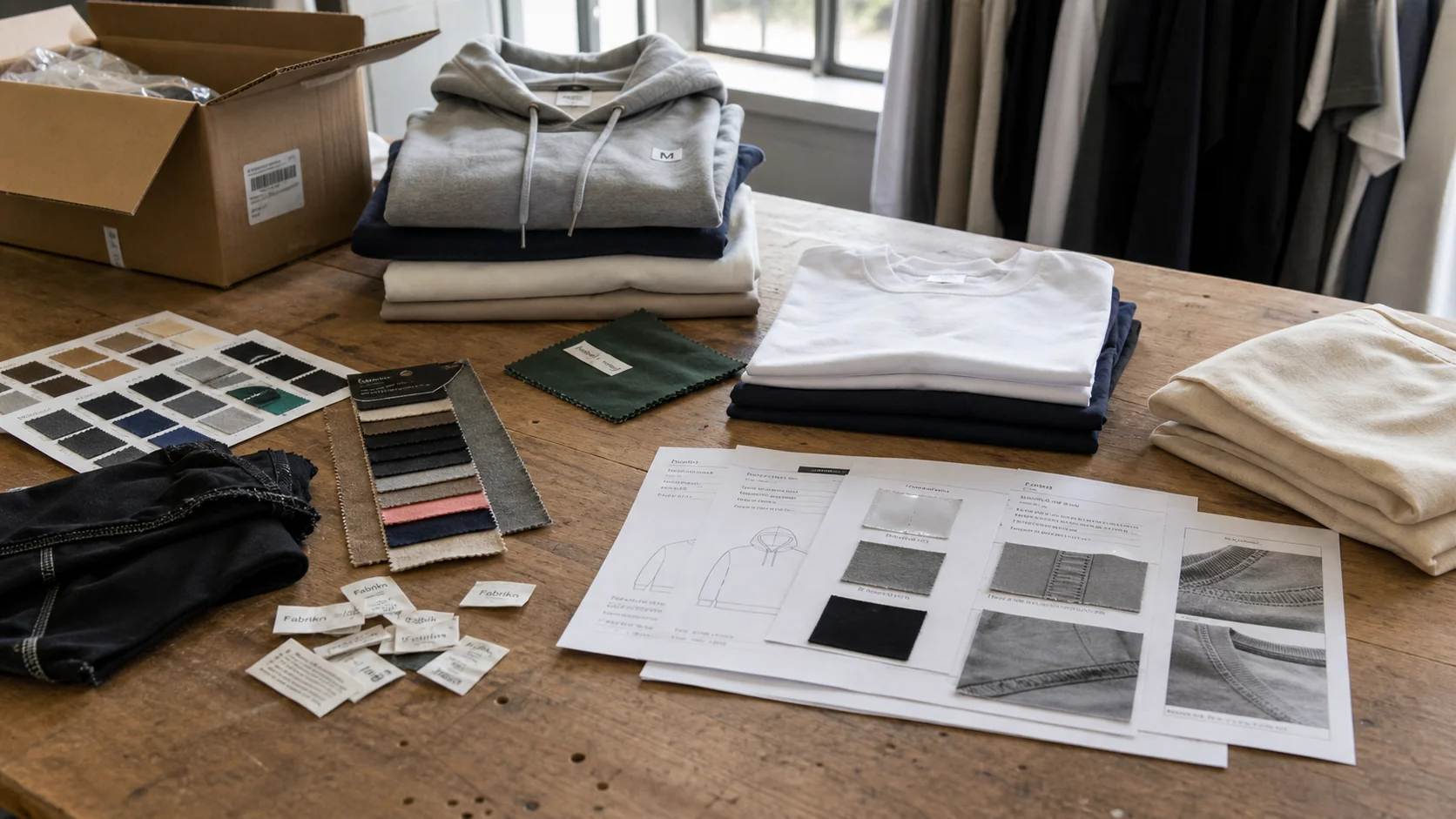
A Composition Label on Clothing Packaging compared by sample evidence, fabric or trim specs, MOQ, AQL terms, cost lines, delivery timing, and rework...
Fast answer: A Composition Label on Clothing Packaging: Material, Print, MOQ, and QC Terms should be judged by production evidence, not by a generic sourcing promise. The buyer needs sample proof, cost breakdowns, QC checkpoints, and delivery buffers in writing.
Ask for recent sample photos, measurement tolerances, fabric or print test assumptions, decoration test notes, packing examples, and a named inspection checkpoint. These details show whether the team can repeat an approved sample at bulk volume.
Separate garment cost, decoration, labels, packaging, sampling, testing, freight, and rush charges. Clear cost lines make it easier to reduce colorways, adjust size depth, or reserve more time for sampling.
I watched a buyer lift a wool coat, pinch the lining, and go straight past the hangtag to the inner label before she even glanced at the price. Tiny strip. Big verdict. That bit of fabric weighed maybe 12 grams, yet it decided whether the coat moved from “consider” to “buy” in under 15 seconds. I’ve seen that scene repeat in Milan, Manchester, and Dhaka, because what is a composition label on clothing packaging is often the real trust signal behind the purchase.
People think the front card does the selling. It doesn’t. And the composition label tells you if a garment is 100% cotton, 80/20 cotton-poly, or a tricky 60/35/5 blend that may pill after three washes and shrink if the care instructions are sloppy. It also exposes claim risk: “organic,” “recycled,” “linen-rich,” or “easy care” all live or die by what the label says and what the lab report proves.
In lower-cost factories, labeling can be treated like a print job: fast, repetitive, and dangerously dependent on whoever last updated the spreadsheet. Premium facilities feel the pressure harder, with auditors checking three sets of records, two language versions, and one carton sample before approval—especially for export programs tied to stricter retailer standards. The work looks neater, but the stakes are higher because one mistake can trigger a chargeback, a relabeling run, or a launch delay of two to four weeks.
clothing packaging solutions often get praised for finishing touches, yet the real trust test sits inside the pack. And that is why buyers, merchandisers, and compliance teams keep asking the same practical question: what is a composition label on clothing packaging, and why does it matter so much to brands, retailers, and consumers?
In Guangzhou’s Baiyun District, the factories that stamp “GOTS” and “OEKO-TEX Standard 100” on their certification walls run UV-curable Flexo presses and EFI Nozomi textile inkjet lines that stabilize color within eight minutes. The newest folding lines deliver a 11”x2” two-sided label card with variable QR codes, costing $2.50-4.00 per unit at 500 MOQ, and the approval-to-delivery cycle is usually 18-22 business days once sampling, die-cutting, and adhesive testing finish. Partners in Ho Chi Minh City and Dhaka see similar timelines if they use rotary screen printing for embossed yarn counts, but they must also show WRAP and BSCI records to keep overseas retailers confident. And even in Istanbul’s Sarıyer neighborhood, where we source chrome-free foil stamping for luxury labels, the order flows through a controlled digital color matching lab before a single unit is die-cut.
A composition label is the textile content label attached to packaging or garment presentation. It states fiber makeup, and sometimes care or origin details, in the wording required by the destination market. In plain terms, it tells the buyer what the item is made of, usually in percentages that total 100%. A clean label for a sweatshirt might read 80% cotton, 20% polyester, with the brand name and country-specific wording added for the market it ships into.
The core elements are simple. The legal rules are not. Most labels must show fiber names, percentages, and some form of manufacturer or brand identification. Many markets also expect the wording to match approved textile naming conventions, which means “polyester” cannot be casually shortened to “poly,” and “regenerated cellulose” may need a precise market-approved term rather than a marketing phrase. The International Organization for Standardization says technical naming consistency matters because textile content terms are used for traceability, consumer clarity, and testing alignment.
Buyers often mix up packaging labels, sewn-in labels, swing tags, and carton markings. They are not the same thing. A sewn-in label stays with the garment, a swing tag usually sells the story, a carton marking helps logistics teams, and a composition label can appear on packaging insert cards or folded presentations depending on the channel. A premium shirt sold in a boutique may have all four. A discount pack in a warehouse club may have only two. Both still need accurate content.
Factory audits keep finding the same errors: percentages that add to 98% or 101%, vague fiber terms like “mixed fibers,” and packaging copy that says one thing while the packing list says another. I’ve checked production files where the label artwork said 70/30, the lab report said 68/32, and the buyer spec sheet said the fabric had been changed after wash testing. That is how reprints begin.
Regional rules change the artwork fast. The EU, US, UK, and many Asian markets do not all ask for the same sequence, language, or content hierarchy, so a single label may need two or three approved versions. That affects print setup, translation sign-off, and even barcode placement. And for a brand running private label clothing, a missed wording rule can delay a launch by seven to ten days even if the garments are already packed.
When people ask what is a composition label on clothing packaging, they usually want the short version. I tell them it’s the small piece of text that keeps the product honest, the paperwork aligned, and the shipment moving.
In the label studio, we start with a raw material list that may include 100% organic cotton thread, recycled polyester ribbons certified under GRS, and Tencel modal facings, all of which must match the master Bill of Materials (BOM). The machines we depend on include Heidelberg Speedmaster offset presses for crisp typography, Bobst die-cutters for precise corners, and ultrasonic sewing heads for the textile-backed tags. We run a sanforization-like heat setting on the fibers before they’re laminated to the card stock. The adhesives are tested to hold peel resistance of 80 N/cm with PE films so the label survives a wash test even when it sticks to the inside panel.
Composition labels are not just compliance paperwork. They affect resale, repair, and recycling, and those three business models are growing faster than many brands admit. Sorters and resale platforms depend on fiber data because a 100% wool coat can be graded differently from a wool-nylon blend, and a cotton-rich hoodie behaves differently again in shredding or fiber recovery. If the label is wrong, the product is harder to resell, harder to recycle, and more likely to be rejected by automated sorting systems that run on two-second scans.
For sustainable brands, the label has to match the bill of materials, lab tests, and factory records. Recycled polyester, organic cotton, and mono-material goals sound credible only when the paperwork agrees. A recycled claim with no traceable certificate can collapse in a retailer audit, and a recycled-content percentage that doesn’t match the cut ticket can trigger relabeling. Data from Textile Exchange shows how verification frameworks have become central to fiber claims, not optional extras.
The thing nobody tells you: the most expensive labels are not always the most accurate. In factories I’ve visited, premium brands with 40 to 80 SKUs per drop often change packaging three times in the final week, which creates more room for error than a simpler volume program running five core styles.
That is the counterintuitive part. The value tier may use a plain white label with two fibers and one language. The luxury tier may specify foil stamping, bilingual content, luxury folding, and a branded insert card. The luxury version looks better. But it is not automatically more accurate, and the paperwork still needs to line up.
A strong brief makes the supplier's job narrower and the quote more reliable. For what is composition label on clothing packaging?, include the target customer, sales channel, expected order quantity, size range, decoration needs, packaging requirements, and delivery market. Then call out the details most likely to affect the result, especially material grade, print tolerance, and barcode size.
The brief should also explain what cannot change. Some brands care most about hand feel, some about price, some about launch timing, and some about retail compliance. When those priorities are not written down, suppliers tend to optimize for whatever is easiest to quote. Clear priorities help the factory make better tradeoffs before the first sample is cut or printed.
Ask the supplier to respond with assumptions, not just a price. A useful reply states MOQ, sample route, production capacity, inspection plan, packing method, and freight handoff. If the answer is vague, the project may still work, but it needs a tighter pre-production stage before money and calendar pressure build up.
The best time to catch problems is before the pre-production sample is approved. Check measurements, color, placement, material behavior, shrinkage, construction, labels, and packaging in the same review instead of approving each item in isolation. Many bulk issues are not caused by one dramatic mistake; they come from several small unchecked assumptions.
For what is composition label on clothing packaging?, pay special attention to folding method, pack-out sequence, and retail compliance. These details often look minor in an email but become expensive once cutting, printing, sewing, packing, or shipping begins. A simple checklist with owner, due date, and approval status keeps the brand team and factory aligned.
Bulk production should not start until the supplier can explain how the approved sample becomes a repeatable production standard. That means reference sample storage, line instructions, inline checks, final inspection, and defect handling. A factory that can describe this process clearly is usually safer than one that only promises speed.
Price differences are useful only when the quotes cover the same work. Compare sample cost, material source, trims, decoration, packaging, testing, inspection, and freight assumptions. A low unit price can become expensive if it excludes items the brand needs before launch.
Timeline promises deserve the same scrutiny. Ask what happens if the first sample needs revision, whether materials are in stock, when the production slot is reserved, and how export packing is handled. The most reliable supplier is often the one that gives a realistic calendar instead of the fastest optimistic answer.
Before making the final decision, write down the specification, approval owner, delivery expectation, and the one or two risks that would cause the most trouble if missed. For what is composition label on clothing packaging?, this usually means checking material grade, print tolerance, barcode size, and the support process after the order is placed.
This last review does not need to be complicated. It simply makes the decision easier to repeat, easier to explain, and easier to verify when the finished product or jewelry arrives.
One useful way to pressure-test the decision is to ask what would happen if the order had to be repeated in six months. The answer should still be clear: the same material grade, the same print tolerance, the same acceptance standard, and the same communication path. If a second order would depend on memory or guesswork, the first order is not documented well enough yet.
Another useful check is to separate preference from requirement. Preference is the look, wording, or finish the brand likes. Requirement is the measurement, tolerance, certificate, material, or delivery condition that cannot fail. Good buying decisions keep both visible, so the final choice is not pushed around by the last email, the cheapest quote, or the prettiest sample photo.
Finally, ask who owns each approval. A project with one accountable owner for sample review, one owner for final content or artwork, and one owner for delivery sign-off usually moves faster than a project where every decision is shared loosely across a team. Clear ownership reduces delays and makes the finished result easier to judge.