
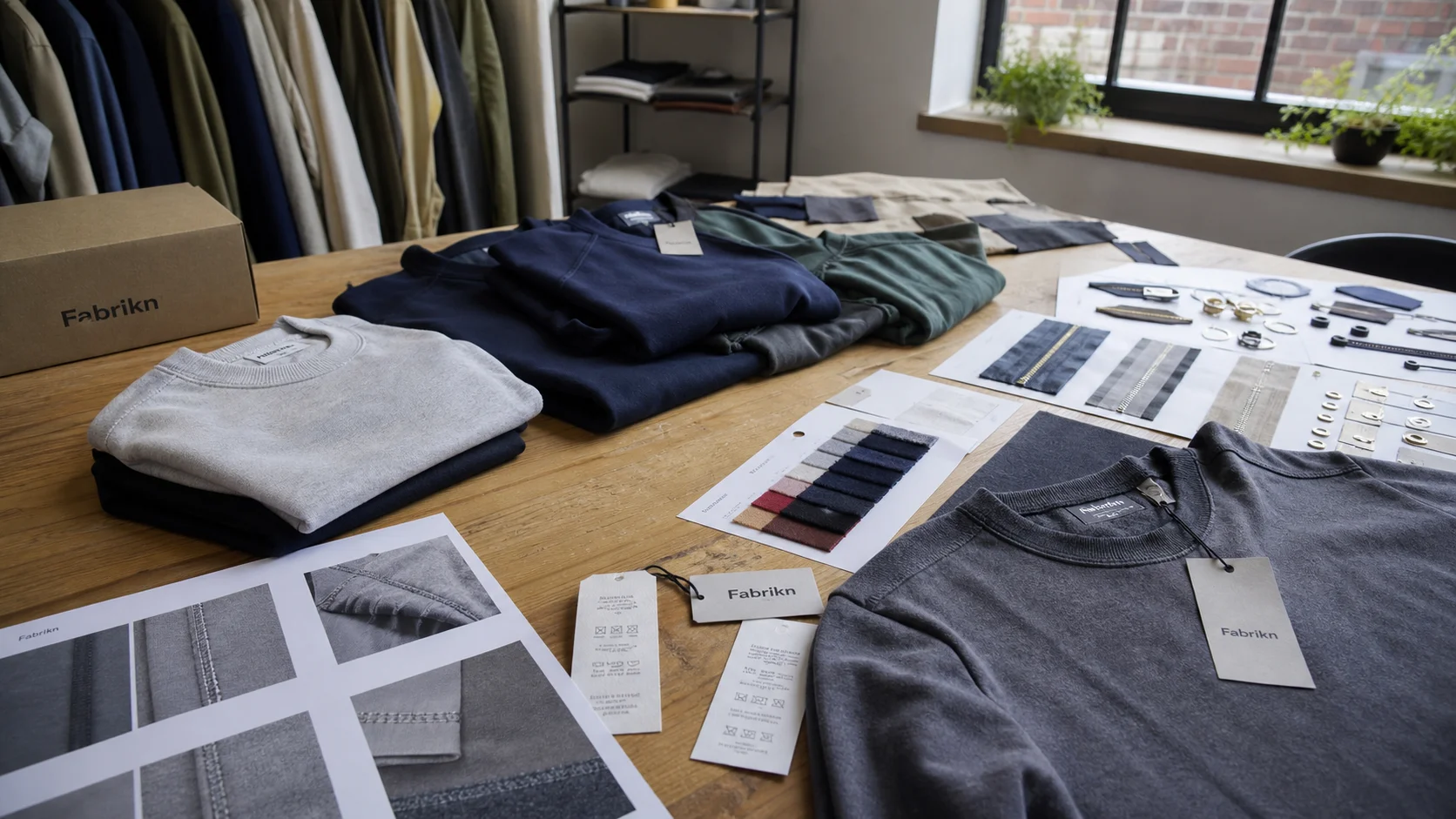
Clothing Manufacturer MOQ with checks for samples, fit, MOQ, QC evidence, pricing terms, and delivery risk.
Fast answer: Clothing Manufacturer MOQ: Samples, MOQ, QC, and Lead Time should be judged by production evidence, not by a generic sourcing promise. The buyer needs sample proof, cost breakdowns, QC checkpoints, and delivery buffers in writing.
Ask for recent sample photos, measurement tolerances, fabric or print test assumptions, decoration test notes, packing examples, and a named inspection checkpoint. These details show whether the team can repeat an approved sample at bulk volume.
Separate garment cost, decoration, labels, packaging, sampling, testing, freight, and rush charges. When every cost line is visible, it becomes easier to reduce colorways, adjust size depth, or reserve more time for sampling.
If you are launching a fashion label or scaling an existing apparel business, one of the first manufacturing terms you will encounter is MOQ. Understanding what clothing manufacturer MOQ means can save you time, money, and costly production mistakes. It also helps you choose the right factory partner, plan your inventory more effectively, and build a more sustainable production strategy for your brand.
In this guide, we will explain what MOQ means in clothing manufacturing, why it exists, how factories set minimum order quantities, and what fashion brands can do to negotiate the right number. We will also cover the benefits and challenges of different MOQ levels, practical tips for new brands, and how Fabrikn supports apparel businesses with flexible manufacturing solutions. If you are comparing suppliers or preparing for your first production run, this article will help you make informed decisions.
MOQ stands for Minimum Order Quantity. In clothing manufacturing, it is the smallest number of units a factory is willing to produce for a specific style, color, fabric, or order type. For example, a factory may require 300 t-shirts per color or 500 sweatshirts per design before it will begin production.
MOQ is not just a random rule. It is a business threshold that helps manufacturers cover the cost of setup, raw materials, labor, printing, cutting, sewing, and quality control. Since producing garments involves many fixed steps before the first item is made, factories usually need a minimum volume to make the order financially viable.
For fashion brands, MOQ is one of the most important factors to understand when sourcing a clothing manufacturer. It affects your startup budget, product assortment, inventory risk, and ability to test the market. If your order quantity is below the factory’s MOQ, the manufacturer may decline the project or charge a higher unit price.
MOQ exists because clothing production has setup costs that do not change much whether a factory makes 50 pieces or 5,000 pieces. These costs must be spread across the total order to keep the business profitable.
Here are the main reasons manufacturers use MOQ requirements:
In short, MOQ helps factories operate efficiently while ensuring the order is worthwhile. For brands, understanding this logic makes negotiation much easier because you can identify where flexibility may be possible and where the manufacturer has real constraints.
MOQ in clothing manufacturing is typically based on several variables. The exact number depends on the product type, complexity, material availability, and factory capabilities.
A basic cotton t-shirt usually has a lower MOQ than a technical jacket or fully lined dress. The more pieces, seams, components, and finishing details involved, the higher the setup effort and the higher the MOQ may be.
Some fabrics are easy to source in small quantities, while others require bulk purchasing. Custom-dyed or specially woven fabrics often come with minimums from mills, which then affect the garment manufacturer’s MOQ.
Factories often set MOQ by color. A style may have a total production minimum of 500 units, but each color might require at least 100 units. This is because dyeing and color consistency processes are more efficient in larger lots.
Screen printing, embroidery, washes, labeling, packaging, and private label details can all increase setup costs. The more customization you request, the higher the MOQ is likely to be.
Larger factories may accept higher minimums because they are built for scale. Smaller or niche manufacturers may offer lower MOQs to serve startups, sample orders, or limited-edition collections.
Manufacturing location also plays a role. Labor costs, material sourcing infrastructure, and logistics all affect how much volume a factory needs to accept an order efficiently.
MOQ can vary widely, but here are some common examples to give you a practical idea of what to expect:
Keep in mind that these are only general benchmarks. A factory may quote a lower MOQ if it already has the right fabric in stock or if the order is simple. On the other hand, highly customized products may require far more than the numbers above.
Some manufacturers also set separate MOQs for different elements of the same product. For example, you may need 300 units for the garment overall, but only 100 units per print design or colorway. This makes it important to clarify details early when requesting a quote.
MOQ affects more than production volume. It influences almost every part of a fashion brand’s launch and growth strategy.
Higher MOQ means a larger upfront investment. Brands must pay for sampling, deposits, raw materials, and production before any revenue comes in. If your order quantity is too high, cash flow pressure can become serious.
If your products do not sell as expected, high MOQ can leave you with too much inventory. This can lead to discounting, storage costs, and slower future product development.
Lower MOQ makes it easier to test new silhouettes, colors, or categories without overcommitting. This is especially useful for startup brands and seasonal collections.
Unit cost usually drops as order quantity increases. That means MOQ directly affects your margin, retail pricing, and wholesale competitiveness.
MOQ also shapes how you scale. A brand with strong demand may benefit from higher MOQs because the unit economics improve. A brand in early-stage testing may need flexibility to avoid overproduction.
Negotiating MOQ is possible, but it requires preparation. Manufacturers are more likely to offer flexibility when they see that your brand is organized, realistic, and ready to grow.
Provide detailed tech packs, size breakdowns, fabric preferences, and reference images. When the manufacturer understands your product clearly, they can assess whether a lower MOQ is realistic.
If the factory already stocks the fabric, trims, or blanks you need, it may be able to reduce MOQ. In-stock materials often lower setup barriers.
Fewer colors, fewer trims, and simpler construction can reduce production complexity. Brands that streamline their first collection often get better MOQ terms.
Factories may accept a smaller first order if they believe repeat orders are likely. Showing your growth plan can help build trust.
Some manufacturers allow MOQ to be met across multiple colors or styles. For example, instead of ordering 300 units of one color, you may be able to split the total across three colorways.
If you need a lower order quantity, the factory may increase the unit price to offset setup costs. This can still be worthwhile if it helps you reduce inventory risk.
Not every brand can meet a factory’s standard MOQ. If you are working with a limited budget or testing a new product line, there are still several ways to move forward.
These strategies can help brands avoid overproduction while still maintaining a professional, market-ready product launch.
There is no universal answer. The best MOQ depends on your business stage, product type, and sales strategy.
For many emerging brands, low MOQ is the smarter starting point. For established fashion companies with proven demand, high MOQ can unlock better pricing and long-term production efficiency.
Fashion brands often make a few predictable mistakes when dealing with MOQ. Avoiding these can save you significant time and money.
Some brands focus only on unit price and ignore the total order value. A low unit price with a very high MOQ may still be too expensive for your budget.
You may meet the total MOQ but still fail to meet per-color or per-size minimums. Always confirm how the factory calculates its minimums.
It is tempting to place a large order to reduce unit cost, but if demand is uncertain, this can create serious inventory problems.
MOQ is not standardized across the industry. Different factories will have different requirements, so always request multiple quotes when possible.
Do not place a large order before approving samples. Sampling is essential to verify fit, fabric quality, construction, and branding details.
At Fabrikn, we understand that MOQ is one of the biggest decision points for fashion brands. Whether you are building your first collection or expanding into new product categories, the right manufacturing partner should help you balance flexibility, quality, and commercial feasibility.
Our team works with brands to assess product requirements, production goals, and order quantities in a practical way. We help clients identify the best manufacturing path for their needs, whether that means smaller test runs, streamlined product development, or larger production plans.
If you are exploring apparel production options, you can learn more about our capabilities on our services page. If you want to discuss your project directly, visit our contact page. You can also find out more about our company and approach on our about us page.
Choosing the right partner matters because MOQ is not only about numbers. It is about aligning your brand strategy with a manufacturer’s processes, timelines, and production structure. The right conversation can turn MOQ from a barrier into a planning tool.
The ideal MOQ depends on what stage your business is in and how much demand you can reasonably forecast. Ask yourself the following questions:
If you are still testing the market, a lower MOQ is usually the safer choice. If you already know demand is strong, a higher MOQ may improve your margins and support growth. The best decision is one that fits your business model rather than simply chasing the lowest unit price.
So, what is clothing manufacturer MOQ? It is the minimum number of garments a factory requires to produce an order. MOQ exists because apparel manufacturing includes fixed setup costs, material minimums, labor planning, and efficiency considerations. For fashion brands, understanding MOQ is essential for budgeting, inventory planning, and supplier selection.
Whether you are a startup brand looking for small-batch production or an established label ready to scale, MOQ should be evaluated strategically. The right manufacturer will help you find a production structure that supports your goals while keeping risk manageable. By asking the right questions, simplifying your product where possible, and working with an experienced partner, you can turn MOQ into an advantage rather than a limitation.
Get a free quote from Fabrikn — your trusted B2B clothing manufacturer with 10+ years of experience. MOQ as low as 200 pieces.
Get a Free Quote →MOQ stands for Minimum Order Quantity. It is the smallest number of units a clothing manufacturer will produce for a style, fabric, or colorway.
Factories use MOQ to cover setup costs, material sourcing, labor efficiency, and overhead expenses. Small orders are often less efficient to produce.
Yes, sometimes. You may be able to negotiate by simplifying your design, using stock materials, ordering fewer colors, or committing to future orders.
In many cases, yes. Low MOQ reduces upfront cost and inventory risk, which makes it easier for new brands to test products and refine their market fit.
Yes. Lower order quantities usually result in higher unit prices, while higher quantities often reduce the cost per piece.
Not always. Some factories set MOQ by color, size, fabric, or style. Always confirm how the minimum is calculated before placing an order.
Fabrikn helps brands evaluate production options, understand minimums, and find a manufacturing approach that supports both budget and growth goals. You can reach out through our contact page.