
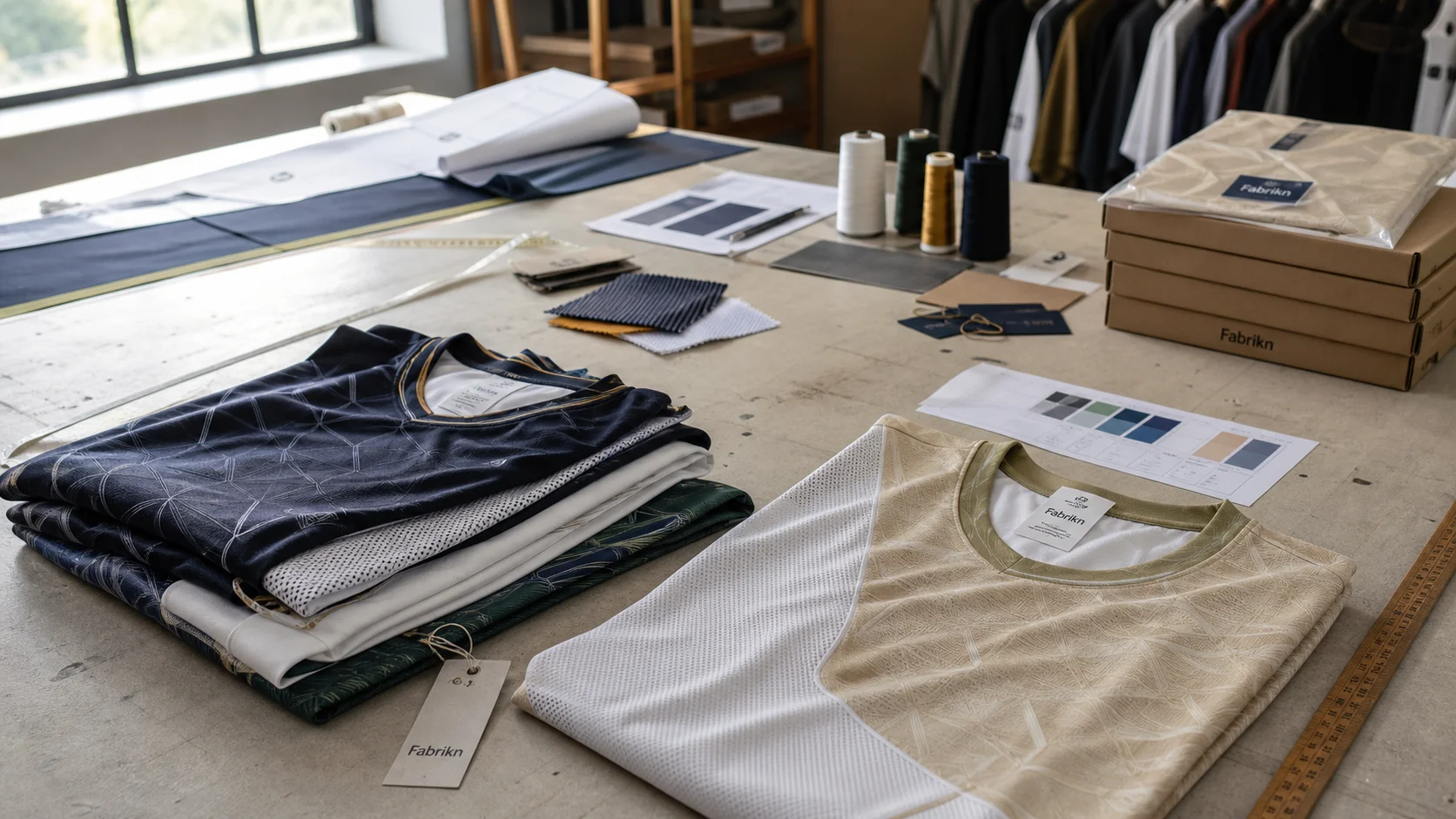
Minimum Order Quantity for Custom T-shirts compared by sample evidence, fabric or trim specs, MOQ, AQL terms, cost lines, delivery timing, and rework...
Fast answer: Minimum Order Quantity for Custom T-shirts: Tech Pack, Sample Gate, MOQ, and QC Terms should be judged by production evidence, not by a generic sourcing promise. The buyer needs sample proof, cost breakdowns, QC checkpoints, and delivery buffers in writing.
Ask for recent sample photos, measurement tolerances, fabric or print test assumptions, decoration test notes, packing examples, and a named inspection checkpoint. These details show whether the team can repeat an approved sample at bulk volume.
Separate garment cost, decoration, labels, packaging, sampling, testing, freight, and rush charges. Clear cost lines make it easier to reduce colorways, adjust size depth, or reserve more time for sampling.
If you are planning to launch a clothing line, organize a corporate event, sell branded merchandise, or create custom apparel for a team, one of the first questions you will likely ask is: what is minimum order quantity for custom t shirts? The answer matters. It affects your budget, production method, design flexibility, and overall business strategy, and it can quietly determine whether a project feels manageable or suddenly expensive. Honestly, this is one of those questions that sounds simple until you start getting real quotes back.
In the custom apparel industry, minimum order quantity, often called MOQ, is the smallest number of units a manufacturer is willing to produce in a single order. For custom t-shirts, that number can vary widely depending on the supplier, printing method, fabric type, design complexity, and whether the manufacturer is working with a small business or a large brand. A low-MOQ screen-print order in Guangzhou might start around $2.50-4.00 per unit at 500 MOQ for a single-color print on 180-200 GSM cotton, while a DTG order in Ho Chi Minh City or Dhaka can be priced differently depending on garment blank quality and artwork coverage. Why does the same shirt carry such different rules from one factory to the next?
Understanding MOQ is important for anyone looking to work with a clothing manufacturer. It helps you plan inventory, control costs, reduce waste, and choose the right production partner. In my experience, people usually underestimate how much MOQ shapes the whole project, right down to cash flow. In this article, we will explain what minimum order quantity means, why it exists, how it affects custom t-shirt production, and how to choose the best MOQ for your brand.
Minimum order quantity is the smallest number of products a manufacturer will make for one order. In the case of custom t-shirts, it is the minimum number of shirts you must order to start production. For example, if a factory has an MOQ of 100 pieces, you must order at least 100 custom t-shirts before production begins. I have seen factories where that number is treated almost like a hard gate, and others where there is a little more wiggle room if the project is straightforward. In practical terms, a supplier in Istanbul may quote 300 MOQ for a combed cotton tee with neck print and woven label, while a factory in Dhaka might accept 100-150 pieces if you are using existing fabric stock and a standard rib collar.
MOQs are common in clothing manufacturing because producing custom apparel requires setup work, materials, labor, and equipment preparation. Even if you only need a few shirts, the manufacturer still has to complete the same design, pattern, printing, cutting, sewing, and quality control steps. On a typical line, that means CAD pattern files, automatic fabric spreading, a Gerber or Lectra cutting machine, flatlock or overlock stitching, collar attachment on a coverstitch machine, and final inspection before packing.
That means a lower quantity order is usually more expensive per shirt than a larger bulk order. The smaller the order, the harder it is for the manufacturer to spread production costs across many units. In other words, the math rarely favors tiny runs.
Manufacturers set MOQs for several practical reasons. These requirements help them operate efficiently and maintain quality while keeping costs manageable.
Custom t-shirt production involves multiple setup steps, such as preparing screens, creating digital files, sourcing fabric, cutting patterns, and calibrating machines. These costs remain similar whether the order is small or large. For screen printing, a 6-color design may require 6 separate screens, flash curing between layers, and a conveyor dryer run; for embroidery, the factory may need to digitize the logo into a DST file and test it on a single-head or multi-head Tajima-style machine.
Factories often buy fabric, trims, labels, and packaging in bulk. Suppliers may also have their own MOQs, which means the manufacturer must purchase a certain volume of raw materials to begin production. For example, GOTS-certified organic cotton jersey or GRS-certified recycled polyester usually comes with stricter fabric mill minimums than standard ring-spun cotton.
Workers need time to prepare and complete each custom project. Larger orders allow the factory to work more efficiently because the same setup can be used across more garments. A production floor in Guangzhou or Ho Chi Minh City may run dozens of identical tees through the same cutting marker, sewing bundle, and final pressing line to keep labor minutes per piece low.
Ensuring consistent quality takes time and attention. Manufacturers prefer orders that justify the resources needed for inspection and finishing. Many export factories inspect against AQL standards, checking measurements, stitch density, color consistency, and seam strength before carton packing.
Very small orders may not generate enough revenue for the manufacturer to cover labor and overhead. MOQ protects the business from producing items at a loss.
The MOQ for custom t-shirts can range from as low as 10 pieces to 500 pieces or more, depending on the supplier. Some manufacturers specialize in low MOQ production for startups and small businesses, while others focus on large-scale bulk orders. In Guangzhou, a basic blank-plus-print program may be offered at 50-100 pieces, while in Dhaka or Istanbul a cut-and-sew private label program often starts closer to 300-500 pieces. For premium programs, the unit price might sit around $2.50-4.00 per unit at 500 MOQ for a standard 160-200 GSM tee, and rise with heavier fabric, garment-dyeing, or packaging upgrades.
Here are some common examples:
The best MOQ depends on your needs. A startup testing a new design may prefer a lower MOQ, while a company ordering uniforms for employees may need a higher volume at a lower unit price. Honestly, that tradeoff is where a lot of first-time buyers get caught out. Lead times also matter: a simple screen-printed order can often move in 18-22 business days after artwork approval and deposit, while cut-and-sew programs using custom fabric development can take 30-45 business days or more.
Several factors influence the minimum order quantity for custom t-shirts. Knowing these can help you negotiate with manufacturers and choose a production plan that fits your goals.
Some fabrics are easy to source in small quantities, while others require bulk purchasing. Premium cotton, organic materials, heavyweight jersey, and specialty blends may have higher MOQs because suppliers prefer larger runs. Common options include 100% combed cotton, ring-spun cotton, cotton-poly blends, CVC jersey, bamboo viscose blends, and recycled polyester. If you need OEKO-TEX Standard 100-certified fabric, GOTS organic cotton, or GRS recycled content, the mill and dyehouse usually need tighter batch control.
The printing technique plays a major role in MOQ. Screen printing usually requires more setup, so it often has a higher MOQ. Digital printing methods may allow smaller runs because they do not require screens. For example, discharge printing, plastisol screen printing, water-based inks, DTG, and DTF all behave differently on the production floor; a 1-color chest print can be economical at 50-100 pieces, while an all-over print or puff ink design can push the MOQ higher.
Simple one-color logos are easier and cheaper to produce than multi-color graphics, all-over prints, embroidery, or special finishes. More complex designs may come with higher minimums. A left-chest embroidery on a commercial embroidery machine is far simpler than a full-size back print with halftones, foil transfer, or applique patches.
A basic crew neck t-shirt is easier to manufacture than a custom-cut, oversized, cropped, or fashion-forward silhouette. Special styles may require pattern development and extra sampling, which can increase MOQ. For example, a standard tubular tee with a rib collar and shoulder-to-shoulder taping is simpler than a drop-shoulder boxy fit with side slits and custom woven neck labels.
Features like woven labels, printed neck tags, custom packaging, and specialty trims can also affect MOQ because they require additional supplier coordination. Heat-transfer size labels, recycled poly mailers, hangtags, barcode stickers, and custom cartons add more steps to sourcing and assembly.
Different manufacturers have different business models. A local print shop may accept tiny orders, while a full-scale factory usually needs a larger minimum to make the numbers work. And that is often the real dividing line.
Not every production method behaves the same way. Some are built for flexibility, others for volume, and the MOQ usually follows that pattern.
Screen printing is one of the most common methods for custom t-shirts. It is durable, cost-effective for larger runs, and great for bold graphics. But the setup work can be time-consuming, so screen printing often has a higher MOQ. A 1-color logo on a standard blank can work at 50 pieces, while multi-color artwork may need 100, 200, or more.
DTG printing is ideal for small orders and detailed artwork. Because it prints directly onto the fabric, it does not require screens. That makes it a popular choice for low MOQ orders, sample runs, and one-off designs.
DTF printing offers flexibility and can work for both small and medium runs. It is often used when a supplier wants to keep MOQ lower without sacrificing print quality. It also handles a wide range of fabrics pretty well.
Embroidery gives a premium look, but it usually comes with its own setup needs. The design must be digitized, stitched out, and approved before production starts. Depending on the size and detail of the logo, the MOQ may be moderate rather than very low.
Cut-and-sew projects usually have the highest MOQ because they involve custom pattern making, fabric development, grading, and full garment construction. If you want a fully private label t-shirt with custom fit and branding, expect a higher minimum than you would for print-on-demand style work.
Low MOQ production can be a smart choice in the right situation. It gives brands room to move without tying up too much money in stock.
And for a lot of new brands, that is the difference between launching now and waiting six more months.
Low MOQ is not perfect. The convenience usually comes with tradeoffs.
So yes, low MOQ helps, but it is rarely the cheapest path in the long run.
Choosing the right MOQ starts with your business model. If you are launching a new brand, a smaller order may be the safer move. If you already know your product sells, a larger order might make more sense because it lowers your unit cost.
Ask yourself a few simple questions: How much stock can you afford to hold? How quickly can you sell through inventory? Are you testing a design, or are you scaling a proven product? Does the shirt need custom labels, special fabric, or just a clean print?
It also helps to speak directly with the manufacturer. Some factories can adjust their MOQ depending on the fabric, print method, or color choices. A supplier in Istanbul might reduce the minimum if you use stock fabric and a standard rib collar; a factory in Dhaka may offer a lower entry point if you keep the garment simple and skip custom packaging. In other words, there is usually more room to negotiate than the first quote suggests.
At Fabrikn, we help businesses source custom t-shirts with production options that make sense for their stage of growth. Whether you need a small test order or a larger wholesale run, we work with manufacturers that can balance quality, flexibility, and reasonable MOQs.
We also help you compare printing methods, fabric choices, and customization details so you can avoid paying for features you do not need. If you are not sure whether DTG, screen printing, or cut-and-sew is the right fit, we can walk you through the tradeoffs without turning it into a lecture.
The goal is simple: get the right product made without overcommitting to inventory too early.
Use these adjacent sourcing guides to compare supplier capability, costing, and production planning before you brief a factory.
For production planning, review Fabrikn services or contact the team through the sourcing brief form.
It depends on the manufacturer and production method. Some suppliers accept as few as 10 to 50 shirts, while others require 100, 300, or more.
MOQs help cover setup costs, material sourcing, labor, quality control, and overhead. Small orders are often less efficient to produce.
Not always. A lower MOQ reduces risk, but the cost per shirt is usually higher. A larger order may offer better pricing if you are confident in demand.
Sometimes, yes. If you keep the design simple, use stock fabric, or order multiple styles together, some manufacturers may lower the minimum.
There is no single answer. Many new brands start with a small-batch order so they can test the market before placing a larger run.
Minimum order quantity is one of the biggest factors in custom t-shirt production. It affects price, planning, risk, and the kind of factory you can work with. Start too small and the unit cost climbs fast. Go too big too early and you may end up sitting on boxes of shirts you are not ready to sell. That balance is the whole game.
If you understand how MOQ works, you can make smarter decisions about your apparel line and avoid costly surprises. And if you are still figuring out the right production path, it usually helps to compare a few suppliers before you commit. The first quote is rarely the whole story.