
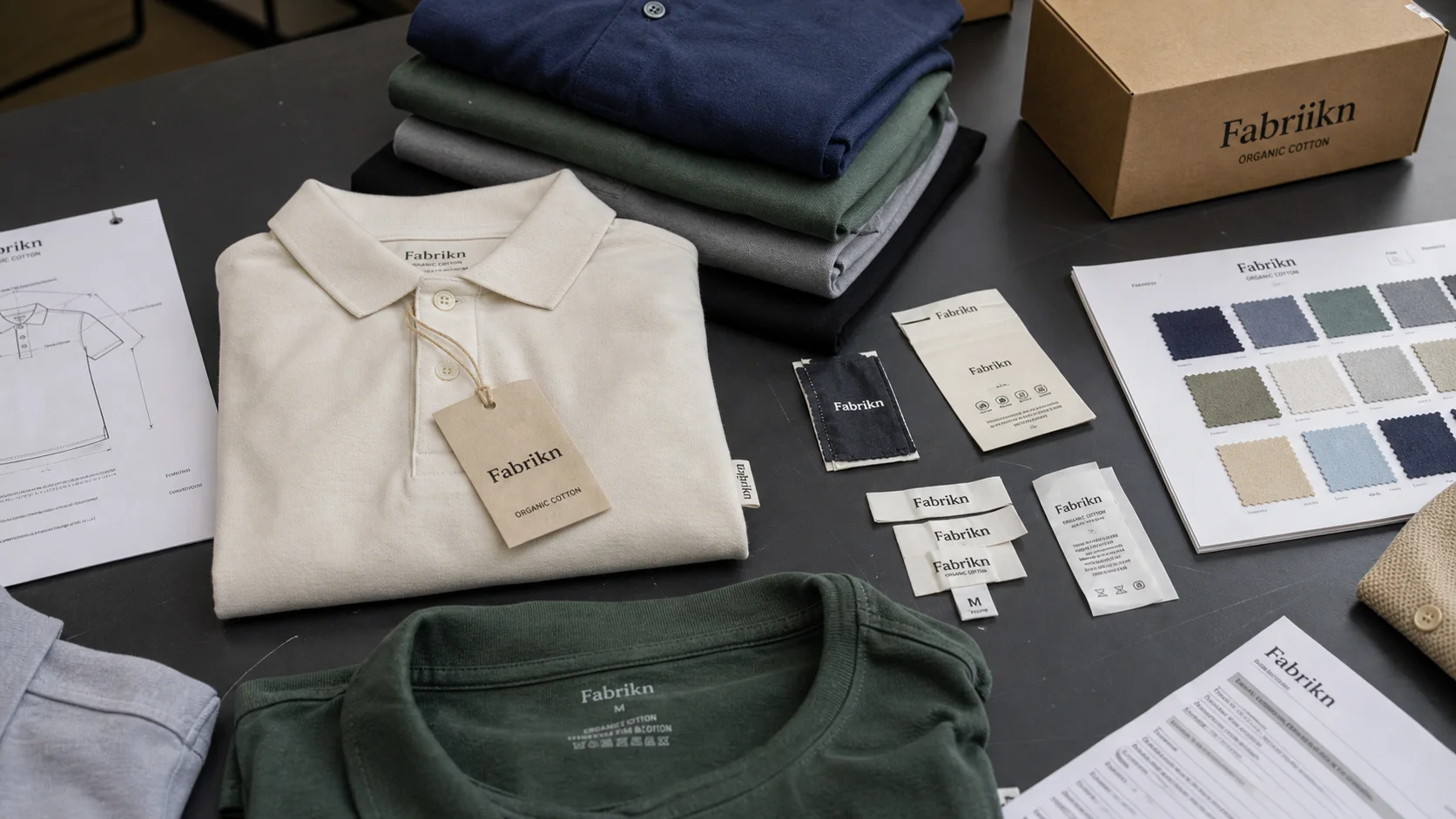
Minimum Order Quantity in Apparel compared by sample evidence, fabric or trim specs, MOQ, AQL terms, cost lines, delivery timing, and rework responsibility.
Fast answer: Minimum Order Quantity in Apparel: Tech Pack, Sample Gate, MOQ, and QC Terms should be judged by production evidence, not by a generic sourcing promise. The buyer needs sample proof, cost breakdowns, QC checkpoints, and delivery buffers in writing.
Ask for recent sample photos, measurement tolerances, fabric or print test assumptions, decoration test notes, packing examples, and a named inspection checkpoint. These details show whether the team can repeat an approved sample at bulk volume.
Separate garment cost, decoration, labels, packaging, sampling, testing, freight, and rush charges. Clear cost lines make it easier to reduce colorways, adjust size depth, or reserve more time for sampling.
Minimum Order Quantity, or MOQ, is the smallest number of units a clothing manufacturer is willing to produce in a single order. In apparel manufacturing, MOQ is a key term that affects product development, pricing, production efficiency, and inventory planning. If you are asking “what is minimum order quantity in apparel,” the simplest answer is this: it is the minimum quantity required by a factory before it will accept and produce your clothing order.
MOQ exists because apparel production involves fixed setup costs. Before a manufacturer can make even one garment, they may need to source fabric, create patterns, cut materials, prepare printing or embroidery equipment, and organize labor. When production volume is too small, these costs become difficult to spread across each item, which makes the order expensive and inefficient.
For clothing brands, especially startups and growing labels, understanding MOQ is essential. It helps you choose the right supplier, plan your budget, and avoid production delays. MOQ can vary widely depending on the garment type, design complexity, fabric availability, and factory capabilities.
MOQ directly impacts how a brand launches and scales products. If your order is below a factory’s minimum, the manufacturer may decline the project or charge a premium. That means understanding MOQ early helps you avoid surprise costs and production setbacks.
Here are some reasons MOQ matters so much in apparel:
For example, a fashion startup may want to test a new hoodie style with only 50 pieces. However, a factory might require 300 pieces per color and size range. In that case, the brand must either meet the MOQ, negotiate terms, or search for a manufacturer that specializes in smaller production runs.
If you are still exploring production support, you can learn more about Fabrikn’s manufacturing capabilities on our Services page or get in touch through our Contact Us page.
MOQ in apparel is not always a single number. It may be based on one of several production dimensions:
For instance, a factory may accept a total order of 500 t-shirts, but require that each color have at least 100 pieces. Another factory may allow a lower total quantity but require that all garments use the same fabric and trim package to keep production simple.
MOQ is also closely linked to the production method. Screen printing, embroidery, dyeing, cut-and-sew, knitwear, and sublimation printing each have different setup requirements. A design that uses multiple colors, custom labels, woven patches, special washes, or unique trims may require a higher MOQ because the production workflow is more complex.
Some manufacturers offer flexible MOQ programs for new brands. These are usually designed to help startups validate demand before placing larger bulk orders. In other cases, a manufacturer may set a strict MOQ to preserve factory efficiency and maintain profitable production lines.
There are many reasons why MOQ changes from one product to another. Understanding these factors will help you estimate your own production needs more accurately.
If the fabric must be specially dyed, knitted, or woven, the factory may require a larger order to justify sourcing or producing that material. Standard in-stock fabrics usually allow lower MOQs because they are easier to access quickly.
A basic t-shirt usually has a lower MOQ than a technical jacket or a structured blazer. Complex garments require more labor, more pattern development, and more quality control, which increases setup effort.
Branding details like screen prints, embroidery, patches, heat transfers, woven labels, care labels, and hangtags can increase MOQ depending on how each item is applied and sourced.
Each additional color can increase cost and production complexity. A factory may prefer one colorway at a higher quantity rather than several small color runs.
More sizes can mean more cutting requirements, more pattern grading, and more inventory management. Some factories set MOQs per size ratio to keep production balanced.
Manufacturers in different regions have different cost structures. A local factory may offer lower communication barriers and faster turnaround, while an overseas factory may offer lower unit costs but higher MOQs.
If the product requires specialized machinery or a trained operator, the factory may set a higher MOQ to cover setup and changeover time.
Every factory has its own business model. Some focus on mass production, while others specialize in boutique or small-batch manufacturing. MOQ often reflects that focus.
MOQ can vary dramatically by garment type. While there is no universal standard, the examples below can help you understand what manufacturers often request.
These are only general ranges. A premium manufacturer may require more, while a small-batch supplier may accept fewer. The more customized the product, the more likely the MOQ will increase.
For a deeper understanding of our company and approach to apparel production, visit our About Us page.
Neither low MOQ nor high MOQ is automatically better. The right option depends on your business stage, budget, and sales strategy.
Brands often begin with a low MOQ when launching new products and gradually move to higher MOQs as sales become more predictable. This approach helps reduce risk while building confidence in the product-market fit.
If a factory’s MOQ is higher than your budget or launch plan, negotiation may be possible. While not every manufacturer will adjust their minimums, many are willing to discuss options if you present your project professionally.
Reduce the number of fabrics, trims, prints, and colors. Simpler products are easier and cheaper to produce, which can help lower MOQ.
Ask whether the factory has in-stock fabrics or pre-approved trims. Using available materials can significantly reduce setup requirements.
Producing one color instead of three can lower complexity and improve your chances of getting a smaller order accepted.
Some manufacturers may agree to smaller batches if you are flexible on delivery timing and can fit into their production schedule.
If your brand has several similar products, ask whether they can be grouped into one production run with shared components.
Factories are more likely to support brands that communicate clearly, pay on time, and show potential for repeat business.
A small test run may help establish trust and prove the product’s viability before moving to larger volumes.
When discussing quantities, be honest about your business stage. Many factories appreciate transparency and may suggest alternative production solutions. If you need guidance, reach out through our Contact Us page to discuss your project.
Although MOQ can feel like a barrier, it actually serves an important purpose for both manufacturers and clothing brands.
For manufacturers, MOQ helps:
For brands, MOQ helps:
In many cases, MOQ creates a healthier business relationship between the factory and the brand. It clarifies expectations and helps both sides understand the scale of the project.
When new brands start sourcing manufacturers, they often make avoidable mistakes around MOQ. Here are some of the most common ones:
To avoid these issues, ask detailed questions at the beginning of the sourcing process. Provide complete tech packs, size breakdowns, fabric preferences, and branding details. The more information a manufacturer has, the more accurate their MOQ guidance will be.
Preparation is key if you want to manage MOQ successfully. Before approaching a clothing manufacturer, make sure you have a clear product vision and business plan.
When you are organized, manufacturers can quote more accurately and may be more willing to work with you. Clear communication also reduces sampling errors and keeps production moving smoothly.
Choosing the right manufacturer is one of the most important decisions a clothing brand can make. A good partner does more than produce garments. They help guide your brand through sampling, sourcing, cost planning, and production timelines.
The right clothing manufacturer will be transparent about MOQ, explain why certain minimums exist, and help you find the best production path for your goals. Whether your brand needs a small pilot run or a larger wholesale order, a reliable supplier can make a major difference in product quality and long-term growth.
At Fabrikn, we work with apparel brands that need dependable production support and clear communication. If you are researching manufacturing options, our team can help you evaluate your order requirements and determine the best next step.
So, what is minimum order quantity in apparel? It is the smallest quantity of garments a manufacturer will produce in a single order, and it plays a major role in pricing, production planning, and inventory strategy. MOQ is influenced by fabric, design complexity, customization, production method, and factory policy.
For clothing brands, understanding MOQ is essential for building a successful product launch and scaling responsibly. A lower MOQ can help reduce risk and support testing, while a higher MOQ may deliver better pricing and production efficiency. The key is to find the balance that fits your brand’s stage and goals.
If you are ready to discuss your apparel manufacturing needs, explore our Services page, learn more about our team on the About Us page, or contact us directly through our Contact Us page.
Get a free quote from Fabrikn — your trusted B2B clothing manufacturer with 10+ years of experience. MOQ as low as 200 pieces.
Get a Free Quote →MOQ stands for Minimum Order Quantity. In clothing manufacturing, it is the smallest number of pieces a factory will produce for a specific product, style, or colorway.
Factories use MOQs to cover setup costs, labor, sourcing, and production efficiency. Small orders can be expensive to produce because the fixed costs are spread across fewer units.
Sometimes. Some manufacturers offer sample runs, pilot production, or flexible small-batch programs. However, ordering below MOQ may result in higher unit prices or limited customization options.
Not always. Low MOQ reduces risk, but it usually comes with a higher per-unit cost. The best option depends on your budget, sales expectations, and launch strategy.
A good MOQ depends on the product type and the manufacturer. For many startups, 50 to 300 pieces per style is a common target range, but this can vary significantly based on design complexity and material requirements.
You can often reduce MOQ by simplifying your design, using stock fabrics, limiting colorways, and working with a factory that specializes in small-batch production.
Yes. Lower MOQs usually mean higher unit costs, while larger orders often reduce the cost per piece because production becomes more efficient.