
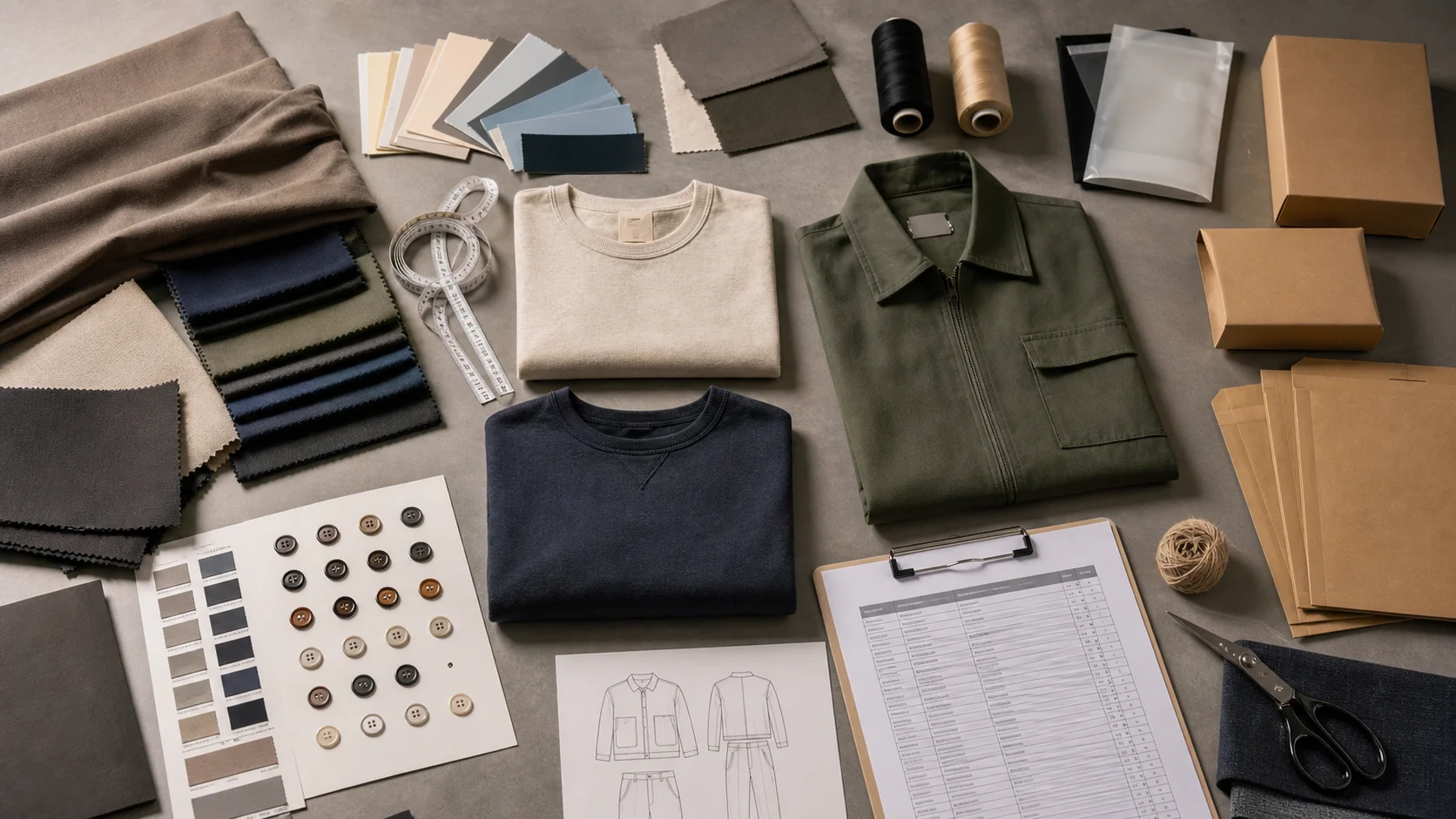
OEM in Clothing Manufacturing compared by sample evidence, fabric or trim specs, MOQ, AQL terms, cost lines, delivery timing, and rework responsibility.
Fast answer: OEM in Clothing Manufacturing: Tech Pack, Sample Gate, MOQ, and QC Terms should be judged by production evidence, not by a generic sourcing promise. The buyer needs sample proof, cost breakdowns, QC checkpoints, and delivery buffers in writing.
Ask for recent sample photos, measurement tolerances, fabric or print test assumptions, decoration test notes, packing examples, and a named inspection checkpoint. These details show whether the team can repeat an approved sample at bulk volume.
Separate garment cost, decoration, labels, packaging, sampling, testing, freight, and rush charges. Clear cost lines make it easier to reduce colorways, adjust size depth, or reserve more time for sampling.
If you are building a fashion brand, launching a private label, or scaling an apparel line, you will likely come across the term OEM. Understanding what is OEM in clothing manufacturing is essential because it affects how your products are designed, produced, branded, and brought to market. For many fashion businesses, OEM is the model that makes it possible to create unique products without owning a factory.
In this guide, we will explain what OEM means, how it works in clothing manufacturing, how it compares with ODM and private label, and why it matters for fashion brands. We will also cover the benefits, challenges, production process, and how to choose the right OEM clothing manufacturer for your business.
OEM stands for Original Equipment Manufacturer. In clothing manufacturing, OEM refers to a production model where a factory manufactures garments based on the buyer’s design, specifications, and branding requirements. In simple terms, the fashion brand owns the idea, and the manufacturer turns that idea into a finished product.
When people ask what is OEM in clothing manufacturing, the answer is usually this: the manufacturer does not create the design concept for the brand. Instead, it produces garments according to the brand’s instructions. Those instructions may include technical sketches, patterns, fabric choices, trims, sizing, colors, labels, packaging, and quality standards.
OEM is widely used by fashion startups, established apparel labels, sportswear brands, streetwear companies, and corporate uniform businesses. It is especially valuable for brands that want a custom product rather than an off-the-shelf design.
The OEM model in clothing manufacturing is straightforward: the brand develops the concept, and the manufacturer brings it to life. The manufacturer may support the process with sampling, fabric sourcing, pattern development, cutting, sewing, printing, embroidery, finishing, and packaging.
A typical OEM workflow in fashion includes:
This model is popular because it allows brands to create differentiated products while relying on an experienced factory for production expertise. In many cases, an OEM partner becomes an extension of the brand’s supply chain.
Many fashion brands confuse OEM with ODM and private label. While these models can overlap, they are not the same.
With OEM, the brand owns the product concept and specifications. The factory manufactures the custom garment based on the brand’s design brief.
ODM stands for Original Design Manufacturer. In ODM, the factory already has existing product designs or templates. The brand may customize colors, branding, labels, or minor details, but the core design comes from the manufacturer.
Private label usually means the brand selects a pre-designed product from a manufacturer and adds its own logo or branding. It is often faster and cheaper than OEM, but less unique.
The main difference is control. OEM gives the fashion brand the highest level of control over product design and development. ODM and private label are more limited but can reduce development time and startup risk.
OEM offers several advantages for clothing brands that want to build a distinct market presence.
OEM allows brands to choose every important detail, from silhouette and fit to stitching, fabric weight, and branding elements. This is ideal for brands that want a signature look and feel.
Because the garments are made to your specifications, your products can reflect your brand DNA more accurately. This helps create consistency across collections and improves customer recognition.
In crowded clothing markets, differentiation matters. OEM makes it easier to offer a unique product rather than competing on the same generic design sold by many other businesses.
Once a product is approved and production is organized, OEM manufacturing can support small runs, repeat orders, and large-scale production as your brand grows.
When the process is managed properly, OEM can deliver consistent quality across batches. This is especially important for premium fashion, activewear, workwear, and uniforms.
OEM can be used for t-shirts, hoodies, leggings, jackets, dresses, children’s wear, loungewear, and more. It is adaptable to many categories.
To understand what is OEM in clothing manufacturing in practical terms, it helps to look at the process step by step.
The brand begins with an idea. This may come from market research, trend analysis, or a product gap the brand wants to fill. The concept should include style direction, target customer, and intended price point.
To turn an idea into a factory-ready garment, brands often prepare a tech pack. A tech pack may include sketches, measurements, construction details, fabric specifications, color references, size grading, and labeling instructions.
The manufacturer reviews the design and estimates production cost, lead time, minimum order quantity, and material availability. At this stage, the factory may suggest adjustments to improve manufacturability or cost efficiency.
A sample is produced so the brand can check fit, appearance, construction, and fabric performance. Sampling is one of the most important parts of OEM production because it reduces the risk of expensive mistakes in bulk manufacturing.
Most products require one or more rounds of revisions. The brand provides feedback on fit, details, and finishing, and the manufacturer updates the sample until it meets expectations.
After approval, the factory begins mass production. This includes fabric cutting, sewing, printing, embroidery, washing, pressing, and assembly.
Quality control is conducted during and after production to check measurements, stitching, color consistency, and packaging accuracy. Reliable inspection helps protect the brand’s reputation.
The finished garments are packed according to the brand’s specifications and shipped to the destination market. Some factories also support barcode labeling, hangtags, and retail-ready packaging.
If you want to work with an OEM clothing manufacturer, it helps to prepare the right information before reaching out. The clearer your instructions, the smoother the process will be.
If you do not have a complete tech pack yet, a good manufacturer can still help guide the development process. You can learn more about support options on our services page.
OEM manufacturing is used across many apparel categories. Some of the most common include:
Because OEM supports customization, brands can create products for seasonal collections, niche audiences, or performance-focused apparel categories.
Although OEM has many advantages, it also comes with some challenges that brands should understand before starting.
OEM usually takes longer than private label because the product is developed from scratch. Sampling and revisions can extend the timeline.
Since the brand must define the product in detail, OEM requires more preparation. Brands without product development experience may need extra support.
Some factories require a minimum order quantity, which may be difficult for very small startups. However, many manufacturers offer flexible MOQs depending on the product type.
If specifications are unclear, the final product may not match expectations. Clear communication and documentation are essential.
Custom production can cost more than buying pre-made products, especially for small batches. Still, many brands find the investment worthwhile because of the better fit, quality, and brand value.
Choosing the right partner is one of the most important decisions a fashion brand will make. Not every factory is suitable for every product, and not every OEM manufacturer offers the same capabilities.
Choose a manufacturer that has experience producing the type of clothing you want to make. A supplier with strong expertise in knitwear may not be the best fit for structured outerwear, for example.
Good OEM manufacturers should be able to create accurate, high-quality samples and revise them efficiently.
A reliable factory should have access to quality fabrics, trims, and finishing options that align with your brand goals.
Quality control standards matter. Ask how the manufacturer checks measurements, stitching, shrinkage, color fastness, and packaging accuracy.
Fast and clear communication helps avoid delays and errors. You want a manufacturer that responds professionally and keeps you updated through each stage.
Make sure the production minimums and delivery timelines match your business model and inventory strategy.
A trustworthy manufacturer should explain pricing, production steps, and potential risks clearly. Transparency builds long-term partnerships.
If you are comparing clothing manufacturers, you can also learn more about our company on the about us page or reach out through our contact us page.
At Fabrikn, we support fashion brands that need dependable clothing manufacturing with a strong focus on customization, quality, and production efficiency. Whether you are developing a new apparel line or scaling an existing one, OEM can help you turn your concept into a market-ready product.
We work with brands that value product development support, reliable communication, and manufacturing solutions tailored to their goals. Our team understands the challenges fashion businesses face when moving from idea to finished garment, and we aim to make the process smoother from start to finish.
To explore how we can support your next project, visit our services page or send us a message through the contact page.
So, what is OEM in clothing manufacturing? It is a production model where a factory manufactures garments based on the brand’s own design, specifications, and branding. OEM gives fashion brands the ability to create unique products, strengthen brand identity, and control product quality while relying on an experienced manufacturing partner.
For brands that want originality and flexibility, OEM is one of the most powerful models in the apparel industry. It requires planning, clear communication, and the right factory partner, but the payoff can be significant. If your goal is to create clothing that truly represents your brand, OEM may be the right path forward.
Get a free quote from Fabrikn — your trusted B2B clothing manufacturer with 10+ years of experience. MOQ as low as 200 pieces.
Get a Free Quote →OEM in clothing manufacturing means a factory produces garments based on the brand’s own design, specifications, and branding instructions.
OEM uses the brand’s design and concept, while ODM uses the manufacturer’s existing design with limited customization.
OEM offers more customization and uniqueness, while private label is faster and usually simpler. The best option depends on your brand goals, budget, and timeline.
A tech pack is highly recommended because it helps the manufacturer understand your exact product requirements. However, some factories can help you develop one if you do not have it ready.
Yes. OEM is suitable for startups that want custom products, but it may require more planning and development time than private label production.
OEM can be used for many apparel categories, including t-shirts, hoodies, activewear, dresses, jackets, uniforms, and more.
Start by preparing your product idea, design references, target quantity, and branding requirements, then contact an experienced OEM clothing manufacturer for a quote and sample development.