
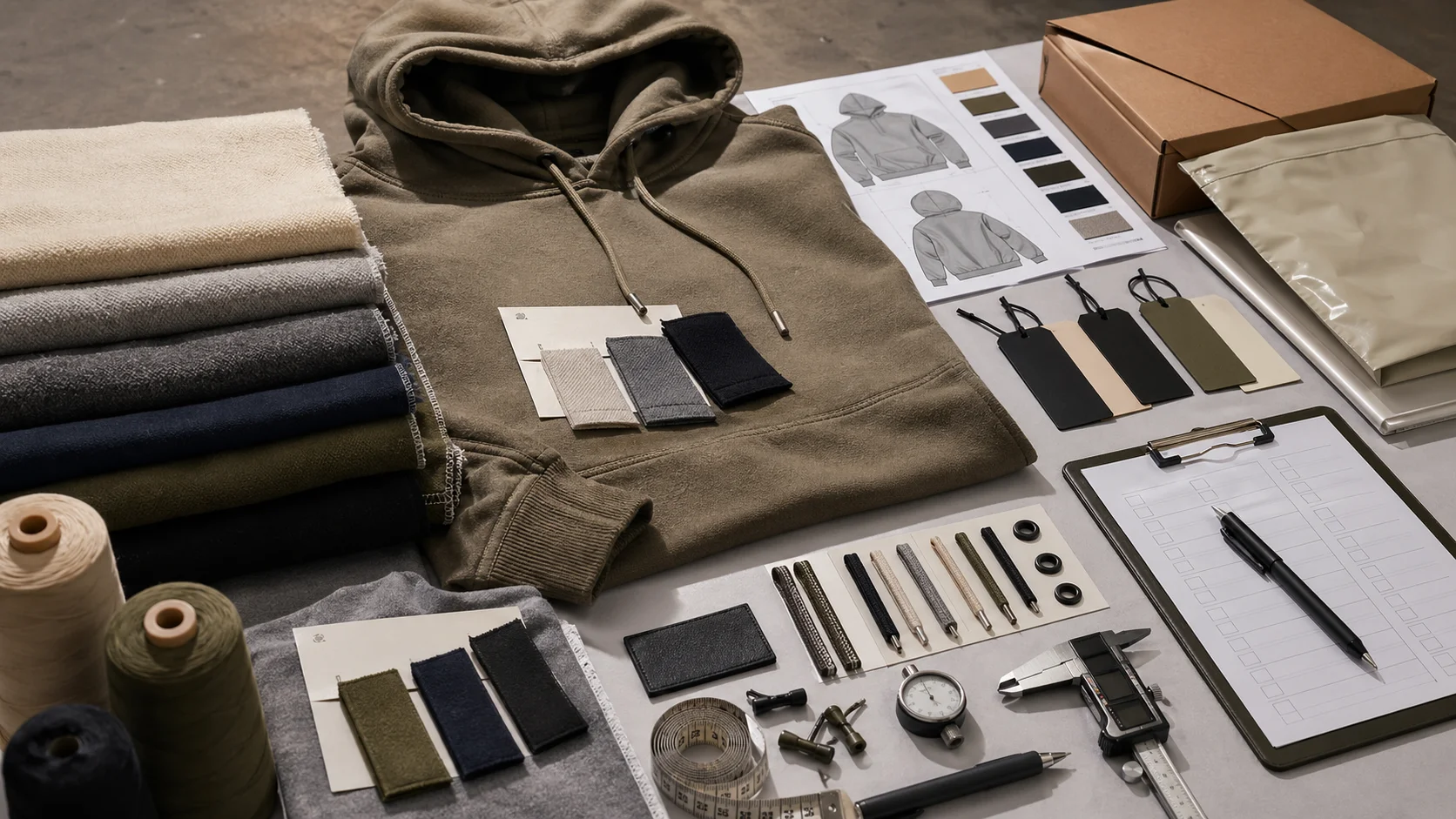
Europe Clothing Care Label Rules with checks for samples, fit, MOQ, QC evidence, pricing terms, and delivery risk.
Fast answer: Europe Clothing Care Label Rules: Symbols, Fiber, Language, and Placement should be judged by production evidence, not by a generic sourcing promise. The buyer needs sample proof, cost breakdowns, QC checkpoints, and delivery buffers in writing.
Ask for recent sample photos, measurement tolerances, fabric or print test assumptions, decoration test notes, packing examples, and a named inspection checkpoint. These details show whether the team can repeat an approved sample at bulk volume.
Separate garment cost, decoration, labels, packaging, sampling, testing, freight, and rush charges. When every cost line is visible, it becomes easier to reduce colorways, adjust size depth, or reserve more time for sampling.
A missing care label once turned a routine Milan shipment into a warehouse headache no one wanted. If you are asking what is required on clothing care labels in Europe, the answer starts with more than a tidy template. The fiber content was on the hangtag, but the sewn-in label was incomplete. Cartons were already palletized, the factory had cut 9,600 units, and customs did not care. Missing fiber data and weak care symbols turned a 3-day release into an 11-day delay, plus relabeling at €0.18-0.32 per piece.
That is the first trap in what is required on clothing care labels in Europe: there is no single, fully harmonized care-label law that wipes away national practice, retailer specs, and product liability exposure. Brands love to assume one EU template will work from Lisbon to Helsinki. It does not. Germany tends to push harder on consumer clarity, France can be stricter on language presentation, and many Nordics expect clean, minimal labels that still survive repeated washing.
The core label burden looks simple on paper. In practice, it touches fiber composition, care instructions, size, country of origin where the channel asks for it, and durable attachment that survives 20-30 wash cycles. A €6 jersey tee can carry the same compliance burden as a €260 cashmere sweater. Price changes margin. Not responsibility.
Low-cost basics fail more often than premium goods. Backward, yes. Still true across 8 countries and more than 200 factory visits. A budget tee may be rushed through sample rounds in 7-10 days, while a luxury knit gets 3-4 approval cycles and a bilingual pack check. The cheapest program is often the messiest.
Some of the best-run mills have the fewest label errors because they standardize artwork at source. One Bangladeshi supplier I visited kept a master label library for 140 styles, with fiber data locked before cutting. Their error rate was under 1.5 percent. A less organized factory in Southern Europe was retyping copy for every order and hit 9 percent relabeling on a 12-piece assortment. Process beats panic.
The practical checklist starts with four things buyers should never treat casually: fiber content, care instructions, responsible entity or brand details, and any required warnings. If the item is made from 80 percent cotton and 20 percent polyester, that mix should match lab data, not a marketing estimate. Blend percentages should be ordered from highest to lowest and verified against testing before bulk approval.
Fiber naming must use generic fiber names, not showroom language. “Merino” is not enough by itself. “Wool” is the regulated fiber term, with merino as a descriptive qualifier if the brand wants it. The same rule applies to “recycled polyester,” which still needs the generic fiber name and truthful content backing. According to ISO, care communication depends on consistent symbol use and unambiguous technical meaning, which is why sloppy abbreviations create avoidable disputes.
Care symbols help, but symbols alone are not always enough. Across EU markets, adding short text alongside symbols reduces retailer objections and customer misuse, especially on performance pieces, babywear, and multi-fabric garments. A “Do not tumble dry” symbol may be read correctly by one buyer in Berlin and ignored by a wholesaler in Madrid unless the translation is present on packaging or the insert.
Labels must also be truthful and not misleading. If the hangtag says “machine washable at 40°C” but the sewn-in label says “cool hand wash only,” the sewn-in label wins in a dispute, and the retailer will usually side with the stricter instruction. I have seen brands lose 2 weeks and pay €400-800 in sample-room rework because the sales team promised a softer message than the technical file allowed.
Traceability is not always printed on the garment label, but some retailers and customs teams expect it in the background. Batch number, SKU, PO reference, and style code reduce arguments when a 5,000-piece program has one bad dye lot. In private-label programs, I ask suppliers to keep the label artwork file, test report, and final cut approval together. That paperwork saved one brand I worked with from a 100% relabel claim on a 1,200-unit order. For private label clothing, that discipline is worth more than clever packaging.
Europe is not one uniform checklist in practice. Germany tends to reward precision and readable care data. France often expects clear language handling and disciplined consumer communication. Italy is sensitive to textile origin and presentation quality. Spain commonly pushes for plain-language clarity. The Nordics prefer restrained graphics, but they still expect labels that survive repeated laundering and remain readable after 5-8 wash cycles.
Channel matters as much as geography. A department store buyer in Paris or Stockholm may demand a stricter label specification than a DTC brand shipping from its own webshop, because the retailer is absorbing part of the customer complaint risk. A private-label program with 4 market versions can face different insert sheets, barcode placements, and hangtag copy even when the garment itself is identical.
Product type adds another layer. Wool, silk, leather trims, babywear, and performance garments need extra caution because consumers mishandle them most often. A wool-blend sweater may require more conservative wash guidance. Silk can demand “dry clean only” language. Leather trim can restrict a full machine-wash promise. For custom baby clothing manufacturing, I insist on softer label finishes and clearer warning language because infant skin complaints spike when label edges scratch after 2-3 washes.
Lower prices do not reduce risk. Cheapest items often have the highest error rates because the timeline is tighter. A €9.90 tee might be approved in 48 hours, while a €110 blouse gets a week of review. Compression creates mistakes. I have seen 6-day programs swap language at the last minute and trigger reprint costs of €0.12-0.25 per garment.
The same shirt may need different packaging insert strategies depending on retailer language and destination country. A French department store may want a bilingual insert, while a German online marketplace may accept sewn-in symbols plus a QR code to the care page. The garment is unchanged. The compliance pathway is not. That is why multi-market programs fail when sourcing, legal, and packaging teams work in separate silos.
ISO 3758 care symbols are the common language, but internal symbol libraries matter because the same icon can be misread by different teams. I have reviewed labels where a triangle was used for bleach when the brand’s artwork file showed a different local convention, and the error was caught only during pre-shipment QC. According to OEKO-TEX, clear textile communication and tested material safety go hand in hand, especially on products worn close to skin.
Language placement is practical, not decorative. Symbols can carry more weight in some channels, yet many brands still need text in the market language for clarity and liability control. Multilingual labels are common on export programs: one line for symbols, one line for English, and a second line for French or German. On a 12-country rollout, that can mean 2 label versions or 4, depending on retailer policy and packaging space.
Durability is where good intentions die. Labels must survive normal wear and laundering without falling off, curling, cracking, or fading after a few washes. I have seen printed labels crack after 6 wash cycles, heat-transfer labels peel at the collar seam, and care ink bleed during a 40°C wash test. A stitched label that itches can send a premium return rate from 4 percent to 9 percent in babywear, where parents notice everything.
Factory failure modes are remarkably consistent. One mill in Portugal had perfect content data but used a stiff woven label with a rough edge. The product passed paperwork review and failed in customer wear testing. Another factory in Vietnam had soft labels but the ink bled after a stone wash simulation. For a brand using enzyme wash on a 320 GSM French terry sweatshirt, that is the difference between a clean launch and 800 angry reviews.
For technical garments, I often prefer a conservative label system with a sewn-in care tab plus a hangtag summary, especially when a style has multiple trims or coatings. That extra redundancy costs €0.05-0.14 per unit, but it protects sell-through. In my experience, the label that survives the laundry bag is the one customers keep trusting.
Costs vary fast. A woven sew-in label may run €0.03-0.10 per piece at volume, a printed label €0.02-0.06, a heat-transfer label €0.05-0.18, and a hangtag with care copy €0.04-0.12 before assembly. Add artwork adaptation, translation, compliance review, and sample approval, and a simple style can land at €120-300 in setup costs before one unit ships. Complex multi-market programs can reach €700-1,500.
The money is not only in the label itself. It is also in design artwork, fiber testing, translation, sample rounds, and production setup. A lab test for fiber composition may cost €60-180 per fabric, while a full wash-and-durability check can add €90-250. If the garment has 3 colorways and 2 market versions, the testing and proofing bill multiplies quickly. Compliance scales with complexity, not retail price.
Turnaround depends on factory size and discipline. A simple cotton tee with one label version can be approved in 7-10 days, then bulk produced in 2-3 weeks. A multi-fiber jacket with German, French, and Nordic pack variants may need 3-4 weeks for sampling and another 2-3 weeks for label procurement. For brands doing cut and sew manufacturing, the label file should be frozen before cutting begins, not after the first sample comes back.
The cheapest label option can become the most expensive one. I have seen a brand save €0.04 per unit by choosing the wrong printed label, then spend €3,600 on relabeling, €1,200 on airfreight, and another €900 in retailer chargebacks when 24,000 units missed the buyer’s spec. Cheap labels are only cheap until the first mistake.
My supplier audit starts with documents, not promises. I ask for the tech pack, fiber test reports, label artwork, translation file, and approval signoff before production starts. If a manufacturer, factory, or supplier cannot produce those in 24 hours, I worry. If they can produce them in one folder with version numbers, I relax a little. The gap between the two is usually where label mistakes hide.
At the factory, I inspect label roll storage, version control, needle damage, and whether the sewn sample matches the approved spec. A label roll left on a dusty mezzanine floor for 6 weeks is already a warning. Handwritten changes are another. So is a style sheet that says 92/8 cotton-elastane while the packaging insert says 95/5. One wrong digit can create 2 separate complaints from customs and the retailer.
Red flags are easy to spot once you have seen enough of them. Last-minute market swaps. Inconsistent fiber percentages across documents. A sales manager editing care copy after approval. A new buyer “simplifying” language by removing the warning line. The pre-shipment QC gate should check label placement, readability, and attachment strength on at least 5-10 random units per color.
Supplier accountability needs to be written into the PO. If labels must be reworked because the factory used the wrong artwork version, the factory should pay for reprint and relabeling. If the buyer changed the approved copy late, the buyer should absorb that cost. Clear ownership keeps a €0.07 label from becoming a €7,000 dispute.
For wholesale and bulk programs, I also look at MOQ planning, production calendars, and whether the supplier uses a controlled custom label library instead of ad hoc retyping. Brands sourcing from China often need tighter artwork signoff because faster sampling can hide rushed proofreading. A good supplier will show how label quality checks sit inside the production flow, not beside it.
I tell buyers to treat label compliance as a production step, not a legal afterthought. Before bulk approval, request the fiber composition sheet, the care symbol library, the translation file, the final label artwork, the test report, and the signed sample approval. If any file is missing, stop and fix it. A 1-hour delay now can prevent a 10-day hold later.
Use a pre-production checklist that verifies fiber percentages, brand/entity details, size notation, warnings, and country-specific wording. If you are launching into 3 or more markets, confirm which language goes on the sewn-in label and which can sit on the hangtag or carton insert. Packaging teams should loop in legal, merchandising, and sourcing before the first bulk cut so the spec is locked at the same moment the fabric is.
Before shipment, check the final cartons for label placement, symbol accuracy, attachment quality, and readability after a quick abrasion rub. I also ask for 3 reference samples from the end of the line: one perfect unit, one stress-tested unit, and one pulled from the outer carton. If all 3 match, your risk is low. If not, re-open the file.
Buyers who work in hats and accessories often miss that label discipline crosses categories. The same process that protects custom hat manufacturing can protect apparel, too: approved artwork, traceable versions, and clean handoff between sourcing and production. Compliance is cheaper than relabeling, chargebacks, blocked inventory, or a warehouse full of product nobody can sell.
The most common mistakes are mismatched fiber percentages, unclear care symbols, missing translations, and labels that fail durability testing. Another frequent issue is when the hangtag, insert, and sewn-in label say different things. In that case, the most conservative instruction usually wins with retailers and consumers.
Yes. The manufacturer, factory, or supplier should maintain the approved artwork, test reports, and version control before production starts. If you are ordering custom or wholesale programs in bulk, this becomes even more important because one error can affect thousands of units. Strong production discipline is the easiest way to protect quality and MOQ planning.
Not always. A label set that works in Europe may not meet the expectations of a China program, especially when language, formatting, or retailer requirements differ. If you source from China, ask the factory to prepare separate label files for each market and verify them during sample approval.
For industry references, start with trade.gov, Textile Exchange, and the EU-facing resources from recognized testing and standards bodies. These sources help buyers compare label expectations, sustainable fiber claims, and testing practices before bulk production.
Most garments need fiber composition, care instructions, and a durable label attached to the product. Many buyers also include brand or responsible entity details, plus warnings where relevant. The exact presentation can vary by country and channel, but the content must be truthful and readable.
At volume, sew-in labels often cost €0.03-0.10 each, while heat-transfer labels can run €0.05-0.18. Setup costs for artwork, translation, testing, and approvals commonly add €120-1,500 depending on complexity. A multi-market jacket costs more to manage than a basic tee.
A simple style can be approved in 7-10 days if the file is clean and the fabric data is already tested. Multi-market or multi-fiber styles often take 3-4 weeks. Add another 2-3 weeks if samples need relabeling.
Yes. EU buyers face a common baseline, but Germany, France, Italy, Spain, and the Nordics often enforce different language and presentation expectations. Retailers can also impose stricter specs than the local market requires. That is why one label file rarely works everywhere.
Wrong labels can trigger customs holds, chargebacks, relabeling, and customer returns. I have seen delays of 7-14 days and rework costs of €0.12-0.32 per piece. If the error is caught late, airfreight and warehouse fees can dwarf the original label budget.