
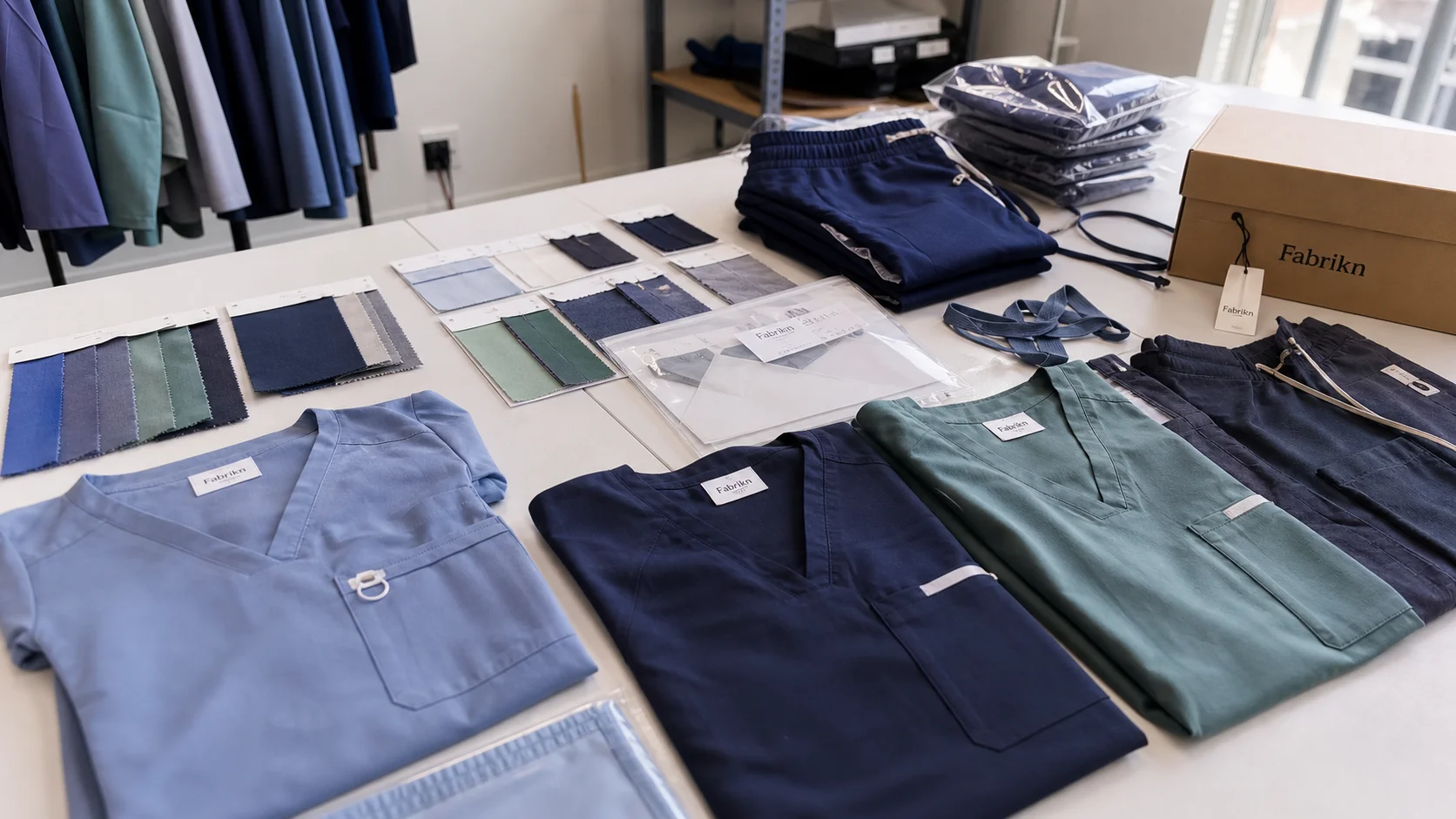
Custom Folded Care Cards China with checks for samples, fit, MOQ, QC evidence, pricing terms, and delivery risk.
Fast answer: Custom Folded Care Cards China: Paper, Print, Folding, and MOQ should be judged by production evidence, not by a generic sourcing promise. The buyer needs sample proof, cost breakdowns, QC checkpoints, and delivery buffers in writing.
Ask for recent sample photos, measurement tolerances, fabric or print test assumptions, decoration test notes, packing examples, and a named inspection checkpoint. These details show whether the team can repeat an approved sample at bulk volume.
Separate garment cost, decoration, labels, packaging, sampling, testing, freight, and rush charges. When every cost line is visible, it becomes easier to reduce colorways, adjust size depth, or reserve more time for sampling.
A care card can make a $12 tee feel like a $5 one the moment it lands in the box. I have watched it happen on pack lines where everything else was dialed in: tissue paper, rigid mailer, neat polybag, branded sticker, the whole polished routine. One bent insert changed the story. That is why custom folded care cards for clothing packaging China deserve more attention than most brands give them.
Across China-based apparel packaging teams, folded cards keep showing up for a simple reason: more room without a dramatic jump in cost. A folded insert usually adds 2-4 printed panels, while a flat card can leave 40-60% less copy space once care symbols, fiber content, multilingual text, and brand notes are squeezed in. For export programs shipping from Guangzhou to the EU, US, and Middle East in the same carton, that extra space matters in both compliance and storytelling.
When I visited factories in Guangzhou, Zhejiang, and Fujian, the difference between card quality and print quality became obvious. A sharp logo on flimsy stock still looks weak. A plain logo on a well-scored, dense card looks deliberate. Better card stock, cleaner fold accuracy, tighter finishing — all of it cuts spoilage, reduces rework, and keeps batches consistent across 5,000 or 50,000 units. Even the way floor supervisors align the Herzog & Heymann folding machine with a Bobst folder-gluer can change the percentage of cracked edges.
The cheapest card often becomes the most expensive once you count reprints, misfolds, and manual insertion errors. I watched one plant in Guangzhou scrap 1,200 cards from a 10,000-piece run because the score line was off by 1.5 mm and the folded edge cracked. The quote looked attractive at $0.04 per piece. The real cost was closer to $0.09 after labor, freight, and replacement time. That is not savings. That is a hidden bill caused by skipping a proper die-cut trial on the X-cut die board.
For brands already managing clothing packaging solutions, the care card is not a side note. It is part of the selling system. On the pack line, every insert has to move fast, stay flat, and communicate clearly in 3-4 seconds. If it fails there, the customer notices it before they touch the garment. I saw this in a Guangzhou-operated fulfillment hub where a single misaligned tri-fold holding textile care icons led to five extra seconds per bundle and a frustrated team on a tight 2,000-piece per shift quota.
The build starts with stock choice. Most factories I audited offered 200-350 gsm art paper, FSC paperboard, recycled uncoated stock, specialty textured papers, and occasional TCF (totally chlorine free) cotton-blend stock for sustainable collections. Each behaves differently on the press and the folding table. A 250 gsm uncoated sheet feels honest and practical. A 300 gsm coated sheet holds ink better and survives handling. Specialty paper can look premium, but it also exposes every scoring mistake when the board passes through the Heaven-sent Komori GL printing press.
Fold structure comes next, and buyers usually land on half-fold, tri-fold, gate-fold, accordion fold, or booklet-style inserts. Half-fold is simple and fast. Tri-fold gives a useful balance of space and compact size. Gate-fold feels more premium but can be tricky if the stock is thick. Accordion fold works well when you want 6-8 content zones. Booklet-style inserts suit multi-language compliance copy and QR code panels. The supplier often nests the boards on Heidelberg Speedmaster 74 cylinders, then feeds them to a dedicated BOBST+HUHTAMAKI folding line with registered creasing and laser-guided scores.
Print method matters just as much. Digital printing suits low minimums and rapid sampling, often 500-1,000 pcs. Offset printing is the workhorse for larger runs because the per-unit economics improve fast once setup is absorbed across volume. Screen printing or spot embellishment is useful for select brand effects, especially with foil, raised varnish, or a single Pantone hit on a minimal layout. When brands require tactile effects, suppliers in Guangzhou or nearby Shenzhen often add soft-touch lamination via a Goss M-600 laminator or run aqueous coating through a Heidelberg UV line.
Finishing changes feel and function. Matte lamination suppresses glare. Soft-touch adds a tactile finish that can lift perception on premium basics. Aqueous coating protects against scuffing without the heavier plastic feel of lamination. Foil and embossing create a sharper shelf impression. Perforation is practical when a return coupon, warranty strip, or compliance tear-off needs to be detachable. In Istanbul and Ho Chi Minh City, I saw similar finishing lines with die-cutting handled by Zünd digital cutters for custom shapes, while smaller Dhaka shops used manual steel-rule dies paired with pneumatic press tables.
Thicker stock can crack on sharp folds unless it is scored correctly. I also saw yield losses when plants ran multiple fold styles on one line without resetting guides. That is why a supplier quoting a neat price needs to prove the folding table, not just the print sample. If the crease is wrong, the whole insert looks wrong. Some suppliers even combine a dedicated scoring unit with a hot-foil stamper to stabilize panels before the folder.
Brands working across garments often pair care inserts with custom baby clothing manufacturing or other high-compliance categories, where text accuracy and softness matter even more. In those runs, suppliers map a quality checklist that includes tactile ink swatches, fiber verification labs, and production audits in factories in Guangzhou, Dhaka, and Istanbul to keep consistent execution.
The right spec depends on the garment, the brand tier, and how much information must sit on one piece of paper. Basics and denim can tolerate a simpler layout. Activewear needs room for wash instructions, fabric performance notes, and sometimes heat warning symbols. Knitwear often benefits from a softer stock and a cleaner design. Children’s apparel needs clear language, safer finishes, and fewer visual distractions. Premium collections can justify specialty paper and a more tactile closing feel, especially when the care card’s textures echo the garment’s tactile story from Ho Chi Minh City manufacturing partners or Istanbul ateliers.
Size drives readability and packing efficiency. I have seen finished inserts as small as 55 x 90 mm and as large as 120 x 180 mm, with 6-8 content areas on the larger versions. Bigger is not automatically better. A card that takes up too much pocket space can slow manual insertion by 15-20 seconds per bundle. That sounds tiny until you multiply it by 8,000 units. Most vendors I track run 18-22 business days from artwork approval to port-ready pallets when using standard paper and offset runs of 25,000 pcs, though expedited digital orders from Guangzhou can be shipped in 12-14 days with air freight if necessary.
Information hierarchy should be ruthless. Care symbols come first. Fiber content and country of origin usually follow. Then QR code, barcode, brand story, return details, and social handles, in that order if space allows. Brands that try to lead with marketing copy end up crowding the legally useful content. I have seen that mistake more than once, and it always creates a second round of edits. A cleaner layout also helps maintain compliance with GOTS, OEKO-TEX Standard 100, WRAP, BSCI, and GRS certified fiber claims when the garments themselves carry those certifications.
Stock and finish should match price point. Value brands often use 250 gsm uncoated stock because it reads plainly and costs less. Mid-market labels usually move to 300 gsm coated paper for a cleaner print surface and better color hold. Premium labels may choose textured paper, soft-touch lamination, or a small foil accent. The choice should reflect the garment’s retail value, not the founder’s mood board.
There is a trade-off nobody can dodge. More folds give more room, but each fold adds risk of cracking, misalignment, and slower packing when automation is limited. On a line handling 2,000 pieces per shift, even a 5% slowdown becomes visible in labor cost. That is why a smart spec is often the one that removes complexity, not adds it.
For brands that manage private collections, the same logic applies to private label clothing services. The care card should feel like the same product family, not an afterthought stapled onto the order.
Pricing is shaped by paper choice, number of colors, number of folds, finishing, die-cutting, packaging method, and shipping terms. I have watched buyers obsess over a $0.01 difference in print cost while ignoring the $180 sample fee, the $60 artwork revision, and the freight charge from an inland factory to the port. Those smaller charges add up faster than people expect. When you stack a soft-touch lamination, a registered foil stamp, and a scoring die, the per-unit can climb to $2.50-4.00 per unit at 500 MOQ before even factoring in the weekly inspection fee.
Order size changes the math. Sample and test drops usually sit at 500-1,000 pcs. Small brands often place 3,000-10,000 pcs. Scaled apparel programs may run 50,000+ pcs, where setup costs are diluted and unit pricing drops sharply after the first production tier. A quote that seems expensive at 1,000 pcs can look ordinary at 10,000 pcs because the press setup no longer hurts as much. Of course, shipping from Guangzhou via FOB or EXW to Ho Chi Minh City distribution hubs adds a predictable $0.03-0.05 per card for logistics if air freight is needed.
A plain folded care card can cost a fraction of a laminated, foil-stamped, multi-panel version. Honestly, this approach works better because you avoid the extra headaches—less time chasing foil registration, fewer trips to the QA table, and a happier product team. When brands factor in the true insertion labor (roughly $0.08 per bundle for automated cartoners) and potential rework from misfolds, the laminated tri-fold becomes a better investment if it keeps return rates low.
Factory standards have matured. The best suppliers run under WRAP auditing, carry BSCI certificates, and are happy to show the OEM-specific GRS files and OEKO-TEX Standard 100 dye lab reports when you request them. On-site QA typically includes handheld spectrophotometers checking Pantone values after each run on the Heidelberg press, and a full dimensional check before the finishing line. Some factories in Guangzhou even map thermal contrast on the soft-touch lamination to ensure consistent tactile feedback for a customer-facing finish.
Quality control is a multi-step process. Incoming stock is measured for gsm using a digital gram/area tool and verified against the GOTS certificate provided by the fiber supplier. After printing, teams run a 100% visual inspection across the first 50 cards, followed by electronic die-cut accuracy checks using a Keyence laser micrometer on the die-cutting station. Folding accuracy is checked via a sample feeder on the folder-gluer, comparing every score to the CAD layout.
On the compliance front, ensure your factory keeps certificate copies current. GOTS, OEKO-TEX Standard 100, and GRS have expiry dates; a factory overseas might still claim compliance even after a certificate lapses. Request a live scan or video during your factory visits and note the registration number with the board. Keep WRAP and BSCI audit summaries in your file so you can share them with retail partners or customs if needed.
When comparing suppliers, don't just look at price. In Guangzhou and Ho Chi Minh City, I have seen small shops with top-tier finishing equipment, while in Dhaka and Istanbul, some factories “catch up” by outsourcing their lamination and scoring to third-party shops with GRS-certified facilities. Compare their machining capacity (Heidelberg Speedmaster vs. smaller Ryobi digital units), scoring equipment (pneumatic vs. servo-controlled), and finishing lines (inline vs. offline). Ask for a run sheet showing how often they calibrate the folder-gluer and whether they use air-bearing tables to avoid dust.
Lead time is another comparison point. The standard for offset production is 18-22 business days from artwork approval to port-ready pallet with pallets strapped and labeled. Shorter lead times often mean lighter QC. Some Guangzhou suppliers charge for rush jobs, while Istanbul and Dhaka factories may offer 5-7 day sampling if they can schedule print time. Always ask who is responsible for shipping documentation and whether the supplier bundles artwork revisions with free proofing.
Check their sustainability claims. Do they actually separate pulp waste and recycle varnish? Do they test inks for heavy metals? Ask for the latest sustainability audit, cross-reference it with the certifications, and determine whether they use FSC or recycled fiber. A supplier that can’t provide the last two WRAP or BSCI audit reports probably doesn’t have a robust compliance program.
Before you place an order, finalize your artwork, then perform a physical mock-up. Use the exact stock you plan to order, print a registration sample in-house, and fold it using the same angles the supplier will. Make sure participants on the pack line in Guangzhou, Dhaka, or Istanbul see how the card fits into a polybag. Verify that the thickness won’t interfere with automated inserting machines running at 40-45 units per minute.
Request a detailed sample pack from the supplier that includes a scoring test, a gloss meter reading if you’re using aqueous coating, and a laminated feel sample. Have the packaging engineer sign off on the dimensions and folds. Confirm the production schedule and ask for a digital copy of the palletization plan to ensure there’s no last-minute port congestion.
Finally, align on payment terms, whether it’s 30% deposit and the balance upon delivery or letter of credit via Guangzhou bank branches. Clarify the freight forwarder, the incoterms, and who will handle customs clearance. If you plan to ship to the EU, mention the EU’s packaging waste directives and ensure the supplier can provide proof of recyclability for the lamination and adhesives.
Q: What certifications should I request for care cards made in China?
A: Ask for the GOTS, OEKO-TEX Standard 100, WRAP, BSCI, and GRS certificates relevant to the fiber, finish, and the facility. Have the supplier show you the latest audit date and the registration number.
Q: How long does a typical production run take?
A: Most runs from Guangzhou to the port take 18-22 business days after artwork approval. Rush jobs or smaller Dhaka/Istanbul productions can sometimes be ready in 12-14 days, but expect an expedited surcharge.
Q: What’s a realistic minimum order quantity?
A: Samples and tests generally start at 500 pcs. A balanced MOQ for production is usually 1,000-3,000 pcs for a mid-sized brand, while large programs may work with 10,000+ pcs to lower per-unit pricing to closer to $0.30 after finishes.
Q: Which machines should I ask about during a factory visit?
A: Check if they run Heidelberg Speedmaster or Komori offset presses, Zünd or Bobst die cutters, servo-controlled folder-gluers, and inline laminators. These machines signal higher reliability when aligning metallic foils, soft-touch laminates, and precision folds.
Q: How can I ensure consistent color?
A: Require a Pantone master proof, and ensure they use color management software tied to an X-Rite spectrophotometer on the press. Request a monthly accreditations log, especially if your brand demands spot varnish or metallic inks.