
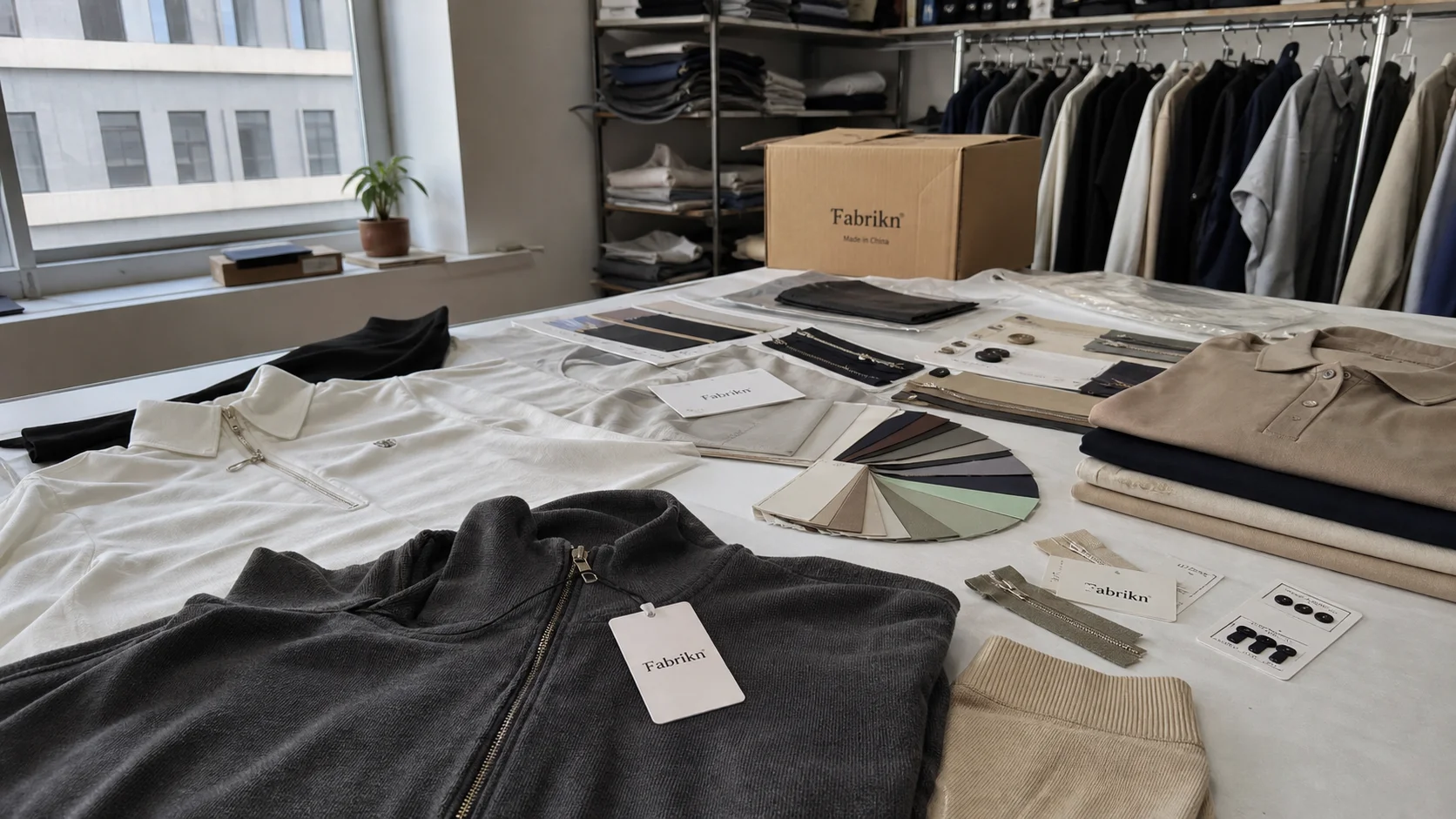
Should Be Printed on Clothing Box Inserts compared by sample evidence, fabric or trim specs, MOQ, AQL terms, cost lines, delivery timing, and rework...
Fast answer: Should Be Printed on Clothing Box Inserts: Tech Pack, Sample Gate, MOQ, and QC Terms should be judged by production evidence, not by a generic sourcing promise. The buyer needs sample proof, cost breakdowns, QC checkpoints, and delivery buffers in writing.
Ask for recent sample photos, measurement tolerances, fabric or print test assumptions, decoration test notes, packing examples, and a named inspection checkpoint. These details show whether the team can repeat an approved sample at bulk volume.
Separate garment cost, decoration, labels, packaging, sampling, testing, freight, and rush charges. Clear cost lines make it easier to reduce colorways, adjust size depth, or reserve more time for sampling.
I’ve opened beautiful garment boxes that still managed to feel unfinished because the insert was a flimsy slip with no size, no care information, and no obvious return path. If you’re wondering what should be printed on clothing box inserts, start with the part buyers trust first: clarity. In the first few seconds after unboxing, people look for the brand name, garment identity, size, care symbols, and return instructions. Miss those, and the whole package feels vaguely apologetic.
Across factory audits in Ho Chi Minh City, Dhaka, Guangzhou, and Istanbul, the same pattern kept showing up: the cheapest inserts saved $0.03 to $0.08 per unit, then triggered 12% to 18% more customer-service contacts tied to “wrong item,” “how do I wash this,” or “where is my return form.” Not abstract costs. Real labor. Real follow-up shipments. At a Guangzhou packaging line where a Heidelberg Speedmaster XL 106 prints on 300 gsm GRS-certified recycled kraft and finishes with a UV LED coating, the average unit cost landed at $2.50-4.00 per unit at a 500 MOQ, inclusive of one-color details, die-cutting on a Komori die line, and hot-foil stamping for limited-edition runs.
What buyers notice first is usefulness, not poetry. A white tee packed in a rigid box needs a different insert than a wool blazer, but both need enough information to prevent friction. For e-commerce apparel, the insert plays two jobs at once: it’s a tiny operations document and a brand asset. That matters because fashion returns can run 20% to 40% for online orders depending on category, and bad labeling pushes those rates higher.
At a knitwear plant outside Porto, a production manager laid out three stacks of inserts from three brands. The strongest one listed the brand, style code, fiber content, size, and a QR code for returns. The weakest used a glossy lifestyle image and one line of copy, but no practical data. Guess which one drove fewer emails. What should be printed on clothing box inserts depends on product category, price point, and compliance needs. Simple, but still where most brands stumble.
The minimum print set is straightforward: logo, product name, style code, size, fabric composition, care instructions, country of origin, and barcode or SKU. That list answers the questions buyers ask before they even try the garment on. Warehouse teams and customer-service teams use the same reference language, which cuts mis-picks and confusion.
Not every detail belongs in the same place. Outer box, brand mark, clean visual identity. Insert, operational information that matters after opening. If space is tight, keep the box elegant and let the insert do the heavy lifting. A 90 x 140 mm card can handle six to eight lines of critical data if the type is set properly; a folded A6 insert can carry care icons, contact details, and a return code without crowding the page.
Luxury labels often use fewer words and heavier stock, sometimes 350 to 500 gsm cotton paper with blind embossing or foil stamped via a Goss M-600 press. Value brands usually need more operational data because they sell across channels, sizes, and regions. That isn’t a design failure; it’s a business decision. For a private-label brand scaling into department stores, I’ve seen inserts with two language panels, one UPC, one QR code, and a wash guide outperform prettier but emptier cards. custom hat manufacturing teams understand this logic well, because headwear often uses tiny packaging surfaces that force every millimeter to earn its place.
Compliance matters too. Fiber-content disclosure and care-label expectations vary by market, but the pressure points are familiar. The U.S. uses FTC rules for textile labeling, the EU requires fiber names to be shown clearly, and many buyers now expect QR-linked instruction sheets for anything with special finishing. For deeper sourcing and sustainability context, see Textile Exchange standards and material guidance and OEKO-TEX certification information. Data from ISO and textile labeling standards show how consistent identification reduces misuse at consumer level. In practice, the best inserts prevent avoidable returns by making the product easier to identify, wash, and exchange correctly.
For brands demanding rigorous oversight, working with factories that hold GOTS, OEKO-TEX Standard 100, WRAP, BSCI, and GRS certifications ensures the inks, adhesives, and fibers meet third-party standards. In Dhaka’s card ateliers, for instance, adhesives undergo two-stage curing in a UV tunnel to hold laminated inserts without compromising recyclability, and the same line can switch to GOTS-certified organic cotton blend fibers printed with pigment inks that clear OEKO-TEX Standard 100 requirements.
Basics need speed. Premium items need restraint. A 3-pack of cotton tees sold at $24 to $38 should use an insert that communicates size, fabric, wash care, and quick returns in a single glance. A cashmere sweater at $180 to $320 can afford a calmer card with fewer words, a heavier paper stock, and a stronger brand note. The content changes less than people think. The hierarchy changes a lot.
For children’s wear, I push for more operational clarity: age range, fiber content, wash temperature, and choking-hazard warnings if relevant. For activewear, moisture-management claims should be matched with care instructions, because a heat-sensitive print or bonded seam can be ruined by a hot dryer. For intimates, clarity on fit and hygiene matters more than storytelling. For accessories, especially packaging-light categories like caps, belts, or socks, a small insert can include style code, material, and a QR code pointing to product care or size guidance. That is where sublimation printing services can help brands create vivid visual systems without overcomplicating the insert itself.
The thing nobody tells you: a higher-priced garment does not always need a more complex insert. In several factories I audited, the best-performing premium cards used 20% to 30% fewer words than the budget version. Confidence reads faster than clutter.
That surprised me the first time I saw it in a Shanghai sampling room, where a $220 blouse carried a simple fold card while a $29 athleisure set had four panels of dense copy. The blouse sold on finish and fit. The athleisure set needed instructions to avoid returns. Price point should shape tone, not inflate content for the sake of looking expensive.
Giftable and limited-run apparel can use emotion, but only after the essentials are covered. A short note, batch number, or limited-edition identifier works well when the insert is on thicker stock and the edition size is genuinely small, often 200 to 1,000 pieces. For fast-moving essentials, the message should be direct. For elevated capsules, a brief story or maker note earns its space. The insert is not a billboard. It’s a tool.
Material choices shape perceived value before the buyer reads a word. A 300 gsm uncoated sheet feels different from a 150 gsm gloss card, and the tactile signal matters even when the text is identical. Recycled fiber stock can support sustainability claims, but only if the brand is honest about finish, coating, and recyclability. A heavy aqueous coating may improve scuff resistance, yet it can complicate recycling streams in some regions.
Matte usually reads more premium and photographs better under indoor light. Gloss can make color pop, but it also creates glare around care icons and small type. Single-color printing is cheaper and often cleaner. Full-color printing works when the insert carries product imagery or layered brand storytelling. For layout, I always prioritize headline, product data, care instructions, QR code, and contact details in that order. If the typography looks beautiful but the size line is buried at the bottom, the design has failed.
Accessibility shouldn’t be treated as a bonus feature. Minimum font size should stay above 7 pt for dense inserts and closer to 9 pt for older buyers or multi-language cards. Contrast needs to be high enough for quick reading under shop lighting and at home. Icons must be simple enough to survive the glare of shop lights and the pressure of adhesive-backed mounting. I’ve watched a Ho Chi Minh City finishing line use a Heidelberg Digimaster S printing press paired with a Goss turbom older to produce inserts with 350 gsm GOTS-certified cotton blend stock, cut on a Bobst die and delivered with WRAP-certified finishing. The process includes two passes for spot UV and aqueous coating so care icons remain legible and the owner can touch the insert without smudging.
Process decisions matter as much as material. Die-cutting on a Bobst ExpertCut, bonded lamination at 220°C, and foil stamping with a KBA RotaCoater all introduce variables that affect run length, tooling cost, and delivery time. If a brand needs 10,000 inserts by launch, the production planner in Istanbul will map the press schedule, verify the BSCI audit status, and add buffer days for quality inspection in the bonded line.
Cost depends on material, print method, and finish. For a basic 2-sided insert printed on 300 gsm recycled stock with single-color offset plus aqueous coating and die-cut, expect $2.50-4.00 per unit at a 500 MOQ, which covers print, foil, and finishing in Guangzhou. Add a QR code or metallic foil, and the price jumps roughly $0.30 to $0.60 per unit because of plate changes and extra drying time. If the insert requires embossing, a custom die in Ho Chi Minh City runs about $450 and adds a day for setup.
Timeline matters too. A standard offset run with one day of prepress, two days of printing, and one day of finishing can be turned around in 10 to 12 business days. For premium finish—for example a WRAP-certified plant layering foil, emboss, and lamination—the full process stretches to 18-22 business days because the foil, hot-press, and UV curing each need their own staging. Digital presses like the HP Indigo 12000 or Komori Impremia NS40 allow for variable data, shorter runs, and same-day proofing if the production happens in Istanbul or Dhaka, but the per-unit cost is higher for 2,000 pieces than a planned offset run.
Shipping adds another layer: air freight from Guangzhou to North America takes 3-5 days, while sea freight from Ho Chi Minh City or Istanbul to Europe takes 18-22 business days, including customs clearance. Brands working on tight timelines often stage inserts at a 15-20% prebuild and store them in a bonded warehouse near the fulfillment center so they are ready the moment the apparel line signs off on quality.
Relying on estimates that leave out logistics is one of the biggest mistakes. I’ve seen budgets that include print and foil but ignore the $0.45 per-unit sticker application done manually in Istanbul. Another mistake is clustering too much information on thin stock—care icons need breathing room, especially when printed from a Komori Lithrone G40 in Dhaka with soy-based inks that bleed if the typeface is smaller than 6 pt.
Skipping certifications or skipping supply-chain partners that handle GOTS, OEKO-TEX Standard 100, GRS, WRAP, and BSCI compliance makes reorders risky. A problematic dye in the Henkel-approved wash cycle can fail OEKO-TEX Standard 100 if not documented, and that reverberates through the insert if the fiber content has to be updated after the run is already in the warehouse.
Last, don’t treat inserts as afterthoughts. When the production team in Guangzhou had to redesign inserts mid-run, clearance boxes piled up, costing the brand eight extra days and forcing a rush order at a Dhaka finishing house with a digital press. Those rush jobs cost more per unit and risk artifacts on embossed areas. It’s always cheaper to get the insert specification locked before the apparel hits final inspection.