
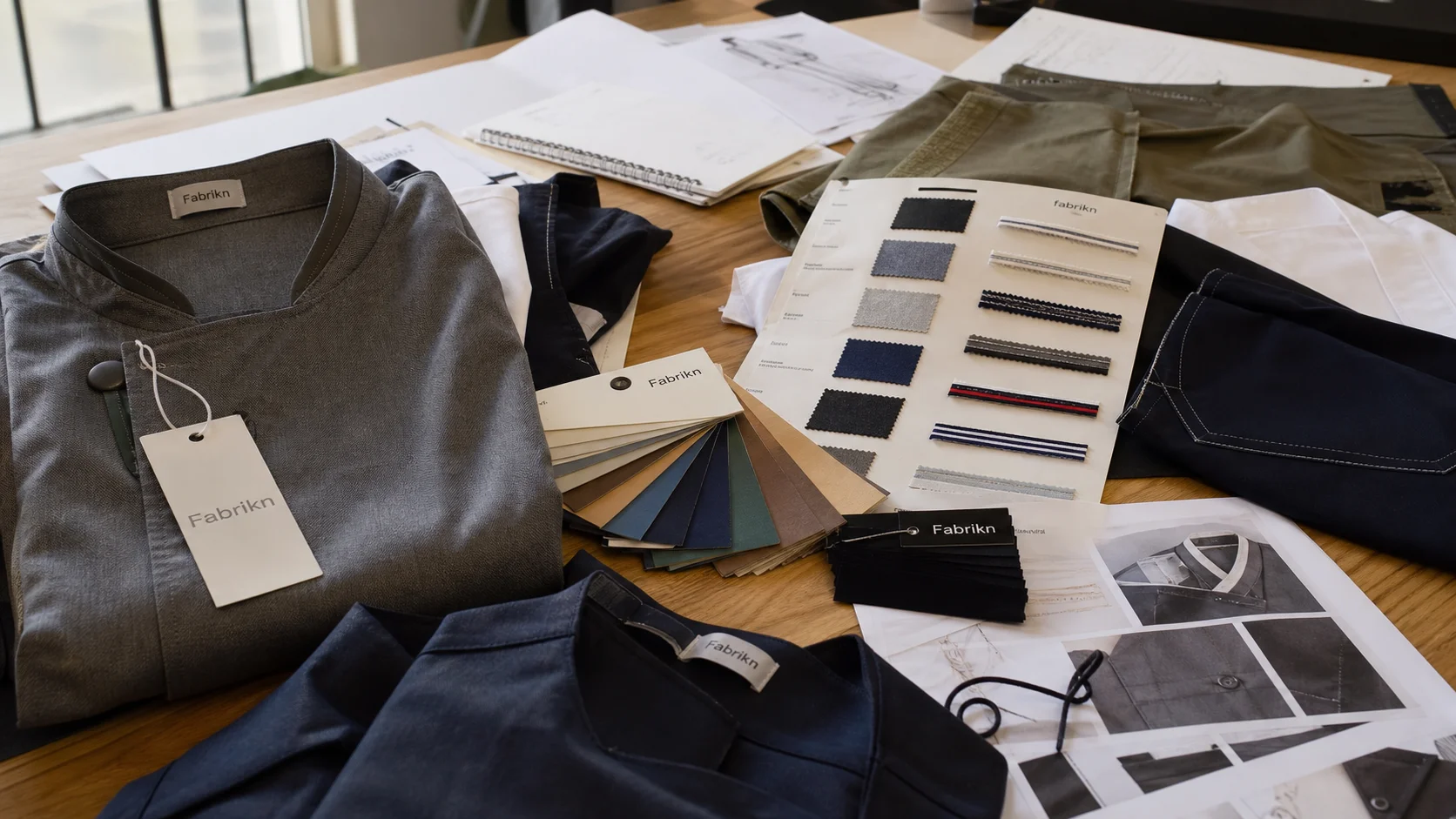
Should Be Printed on Clothing Hang Tags compared by sample evidence, fabric or trim specs, MOQ, AQL terms, cost lines, delivery timing, and rework...
Fast answer: Should Be Printed on Clothing Hang Tags: Material, Print, MOQ, and QC Terms should be judged by production evidence, not by a generic sourcing promise. The buyer needs sample proof, cost breakdowns, QC checkpoints, and delivery buffers in writing.
Ask for recent sample photos, measurement tolerances, fabric or print test assumptions, decoration test notes, packing examples, and a named inspection checkpoint. These details show whether the team can repeat an approved sample at bulk volume.
Separate garment cost, decoration, labels, packaging, sampling, testing, freight, and rush charges. Clear cost lines make it easier to reduce colorways, adjust size depth, or reserve more time for sampling.
A shopper lifts a shirt, reads the tag for seven seconds, and decides whether the garment is worth a second glance. That tiny pause is where sales are won or lost. Vague copy kills momentum. So does clutter. That's the retail reality behind what should be printed on clothing hang tags. The first two or three lines have to earn their place, because almost nobody studies a tag the way a buyer studies a spec sheet. A lean lead-in keeps shoppers from zoning out before they even hit the price tag.
Across 200-plus factory visits in eight countries, I keep seeing the same mismatch. Design teams spend weeks perfecting silhouettes, trims, and wash effects, then leave tag copy until the last 48 hours. In export factories in Vietnam and Bangladesh, the default tag is often compliance-heavy: fiber content, origin, care marks, barcode. In boutique production in Portugal or Turkey, the hang tag gets treated like a miniature sales page, with a short story, fabric callout, and a QR code. I have seen factories where the hang tag is slapped on the garment at the final inspection line, which makes you wonder whether the tag or the garment gets the actual design review (no offense to the invoicing clerk).
The economics are blunt. But a $14 basic tee needs speed and clarity. And a $120 merino sweater needs justification. At mass-market price points, a crisp tag can cut confusion at shelf and reduce avoidable returns caused by missing details on size, fabric, or care. In premium ranges, the tag supports perceived value. And perceived value is not fluff. It affects conversion. In my experience, that kind of clarity also keeps the customer service inbox from overflowing with the same questions.
In Guangzhou's Pearl River Delta cluster, where hang tags are printed alongside swimwear and knitwear, assembly lines run rotary screen presses for water-based OEKO-TEX Standard 100 inks, digital UV LED printers, and automatic eyelet setters that keep 30,000 tags per day aligned with the cut-and-sew schedule. And Dhaka and Ho Chi Minh City facilities that supply DTC and wholesale labels maintain WRAP and BSCI audits while using 300 gsm GOTS-certified organic cotton stock or GRS-certified recycled polyester board, routed on a laser die cutter and finished with inline matte aqueous coating or foil stamping machines. Istanbul's wool workshops tie the tag back to the garment by referencing the Shima Seiki gauge, heat-set collar process, and bespoke bullion button treatment, and the same card that carries that story also lists the QR code linking to the mill's quality dossier.
I have seen this play out in factories serving both DTC labels and wholesale chains. The DTC brand wanted emotion; the wholesaler wanted scannability. Both were right, just for different reasons. What gets printed on the hang tag sits at the intersection of branding, legal data, and sales psychology. That is why what should be printed on clothing hang tags is never just a design question. It is about what a customer needs to know in under 10 seconds, and what a store associate needs to verify in 10 more. Sometimes I joke that the hang tag gets more scrutiny than the CFO's forecast, but it does the job just as well.
Every useful tag starts with the same core elements: brand name, logo, product name, size, and a short value proposition. I have seen production floors where they treat the tag as a contract with the shopper, and the difference in error rates is night and day. If space allows, I want a website URL or QR code on the front or back, because buyers now verify brands online before they commit. This focus keeps the message targeted on what shoppers actually need. And a clean tag with 8 to 15 words of brand message often does more work than a crowded block of text (yes, even the creative director grudgingly agrees).
Product-specific details matter more than most teams admit. Style name, color, fabric content, and fit description help store staff answer quick questions without guessing. If a garment is 100% organic cotton, or 72% recycled polyester and 28% elastane, that should be stated clearly, but only if it is documented. A single measurable claim travels farther than three vague adjectives. Country of origin works too, especially for brands that want to signal traceability or local production. That wording lets shoppers make the right choice without guessing.
For premium lines, I prefer a tighter voice and one proof point. And for DTC, the tag can carry a little more story, because the customer is often engaging without a sales associate. For wholesale, speed wins. Buyers and floor staff scan tags, not essays. A wholesale hang tag that reads clearly from one arm’s length is doing its job. In my experience, the stores that keep it this simple avoid the “Where is the size?” call.
Last year I worked with a brand that split its tag strategy by channel. The wholesale version used a two-sided card with SKU, size, barcode, and one line on fabric. The DTC version added a short origin note and a QR code that linked to a product page with wash care and fit notes. Their internal team saw fewer customer service emails within 30 days, and the store staff reported fewer “what is this made from?” interruptions. Sometimes the debate around a hang tag reads like a treaty negotiation, which is maddening until you see the return rate drop.
What should be printed on clothing hang tags varies by channel, but the rule is consistent: use the tag to remove uncertainty. In my experience, a tag that answers three questions fast is stronger than one that tries to tell the whole brand story.
The physical tag deserves the same attention as the garment. When I specify tags for a Guangzhou-based supplier, I ask for 350 gsm GRS-certified Kraft board, rounded corners cut on a laser die cutter, and a matte aqueous coat cured by a UV LED tunnel. The adhesive stripe gets applied with an automatic hot-melt dispenser calibrated to 180°F so that it can hold through a 12-hour warehousing cycle without marking fabrics. And those kinds of choices — from card stock to process steps on the Ho Chi Minh City finishing floor — support the copy and keep the tag from feeling like an afterthought.
Legal content belongs on the tag only if your market permits it there, and if you have no better place for it. The non-negotiables are fiber content, country of origin, manufacturer identity or RN where required, and care guidance if it is printed on the hang tag rather than sewn in. Teams that cross-check the hang tag with the sewn label avoid those nasty reprints (and yes, it takes one extra meeting). According to FTC clothing labeling guidance, U.S. apparel labels must make fiber content and origin clear, and that clarity starts long before the goods arrive on shelf.
One universal tag can trigger reprint costs. The U.S., EU, and UK do not read garment labeling the same way, and factory teams often discover that only after artwork is approved. I have seen brands pay for 5,000 reprinted tags because the original version used one compliance line for all three regions. That mistake can wipe out a margin gain on a $24 sweatshirt. It still drives me nuts when a brand insists on a fancy script for the compliance line (seriously, readability matters).
Hang tags are not sewn-in labels, and they should not be treated as a dumping ground for every mandatory statement. If you already have a neck label, the hang tag can stay cleaner and focus on buyer-facing details. That separation keeps both compliance and storytelling readable.
A strong brief makes the supplier's job narrower and the quote more reliable. For what should be printed on clothing hang tags, include the target customer, sales channel, expected order quantity, size range, decoration needs, packaging requirements, and delivery market. Then call out the details most likely to affect the result, especially material grade, print tolerance, and barcode size.
The brief should also explain what cannot change. Some brands care most about hand feel, some about price, some about launch timing, and some about retail compliance. When those priorities are not written down, suppliers tend to optimize for whatever is easiest to quote. Clear priorities help the factory make better tradeoffs before the first sample is cut or printed.
Ask the supplier to respond with assumptions, not just a price. A useful reply states MOQ, sample route, production capacity, inspection plan, packing method, and freight handoff. If the answer is vague, the project may still work, but it needs a tighter pre-production stage before money and calendar pressure build up.
The best time to catch problems is before the pre-production sample is approved. Check measurements, color, placement, material behavior, shrinkage, construction, labels, and packaging in the same review instead of approving each item in isolation. Many bulk issues are not caused by one dramatic mistake; they come from several small unchecked assumptions.
For what should be printed on clothing hang tags, pay special attention to folding method, pack-out sequence, and retail compliance. These details often look minor in an email but become expensive once cutting, printing, sewing, packing, or shipping begins. A simple checklist with owner, due date, and approval status keeps the brand team and factory aligned.
Bulk production should not start until the supplier can explain how the approved sample becomes a repeatable production standard. That means reference sample storage, line instructions, inline checks, final inspection, and defect handling. A factory that can describe this process clearly is usually safer than one that only promises speed.
Price differences are useful only when the quotes cover the same work. Compare sample cost, material source, trims, decoration, packaging, testing, inspection, and freight assumptions. A low unit price can become expensive if it excludes items the brand needs before launch.
Timeline promises deserve the same scrutiny. Ask what happens if the first sample needs revision, whether materials are in stock, when the production slot is reserved, and how export packing is handled. The most reliable supplier is often the one that gives a realistic calendar instead of the fastest optimistic answer.
Before making the final decision, write down the specification, approval owner, delivery expectation, and the one or two risks that would cause the most trouble if missed. For what should be printed on clothing hang tags, this usually means checking material grade, print tolerance, barcode size, and the support process after the order is placed.
This last review does not need to be complicated. It simply makes the decision easier to repeat, easier to explain, and easier to verify when the finished product or jewelry arrives.
One useful way to pressure-test the decision is to ask what would happen if the order had to be repeated in six months. The answer should still be clear: the same material grade, the same print tolerance, the same acceptance standard, and the same communication path. If a second order would depend on memory or guesswork, the first order is not documented well enough yet.
Another useful check is to separate preference from requirement. Preference is the look, wording, or finish the brand likes. Requirement is the measurement, tolerance, certificate, material, or delivery condition that cannot fail. Good buying decisions keep both visible, so the final choice is not pushed around by the last email, the cheapest quote, or the prettiest sample photo.
Finally, ask who owns each approval. A project with one accountable owner for sample review, one owner for final content or artwork, and one owner for delivery sign-off usually moves faster than a project where every decision is shared loosely across a team. Clear ownership reduces delays and makes the finished result easier to judge.