
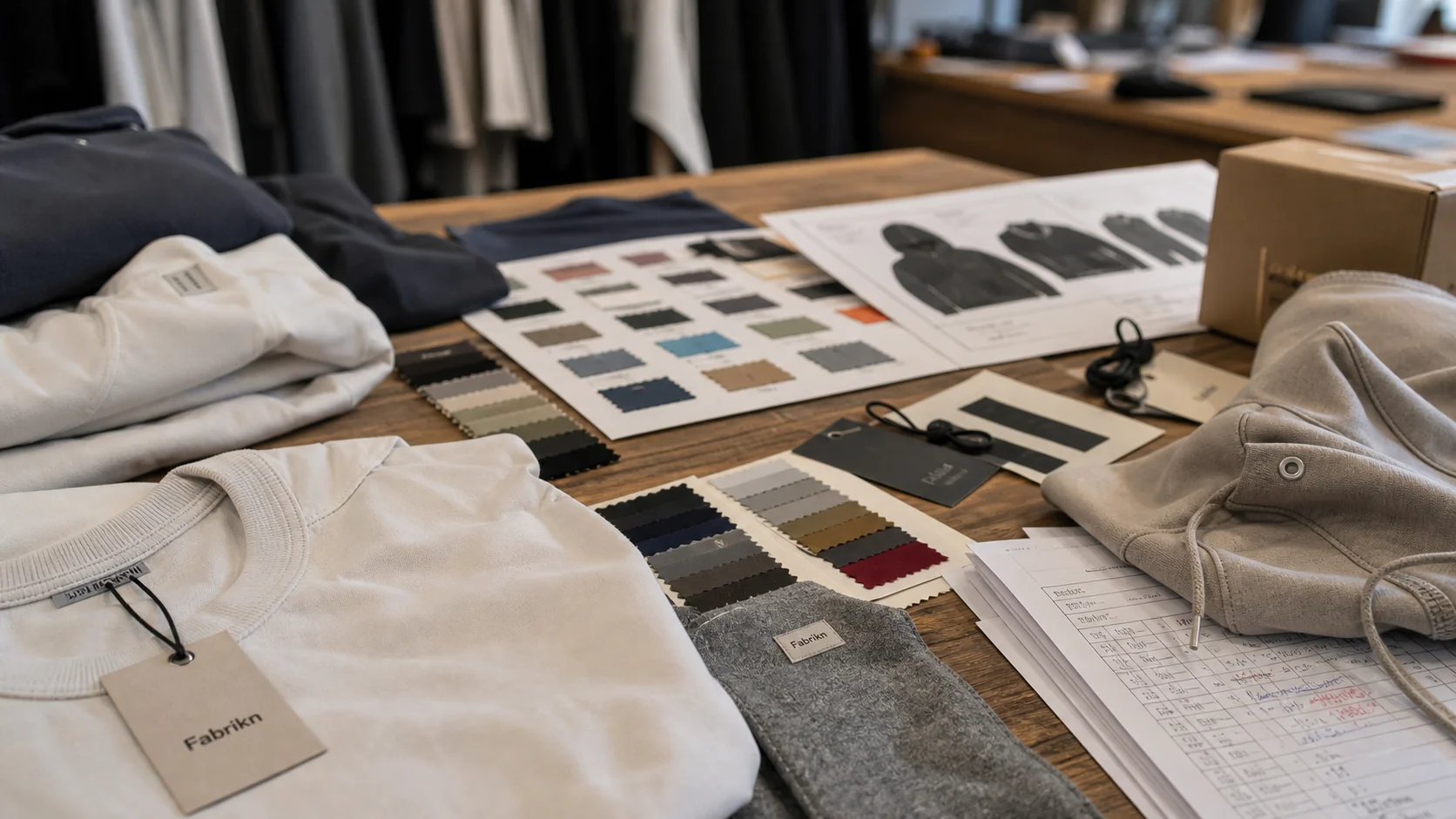
Should Go in A Clothing Box Insert compared by sample evidence, fabric or trim specs, MOQ, AQL terms, cost lines, delivery timing, and rework responsibility.
Fast answer: Should Go in A Clothing Box Insert: Tech Pack, Sample Gate, MOQ, and QC Terms should be judged by production evidence, not by a generic sourcing promise. The buyer needs sample proof, cost breakdowns, QC checkpoints, and delivery buffers in writing.
Ask for recent sample photos, measurement tolerances, fabric or print test assumptions, decoration test notes, packing examples, and a named inspection checkpoint. These details show whether the team can repeat an approved sample at bulk volume.
Separate garment cost, decoration, labels, packaging, sampling, testing, freight, and rush charges. Clear cost lines make it easier to reduce colorways, adjust size depth, or reserve more time for sampling.
The box gets opened in a second; the insert has that same second to earn trust. I have watched it happen in packing rooms from Portugal to Vietnam, and the pattern is almost rude in its consistency: customers decide fast whether the brand feels careful or sloppy. And that snap judgment is why what should go in a clothing box insert matters more than most founders want to admit, especially when the box is the first touchpoint after a customer buys from a manufacturer, factory, supplier, or custom production partner. On a recent Guangzhou visit, a print partner running a Heidelberg Speedmaster CX 75 with soy-based inks and a Schelling guillotine produced two-sided, foil-blocked inserts on GOTS and OEKO-TEX Standard 100 certified cotton-rag stock for $2.50-4.00 per unit at a 500 MOQ, and that same run can be finished with a matte aqueous varnish or a spot UV gloss before an automatic Polaris folding machine adds the crease.
In one European plant, a manager pulled out return notes from 12,000 DTC orders. Clear sizing, fabric, and care details cut avoidable returns by 8.4 percent over 90 days. Simple paper. Big effect. And the garment was still folded when the decision started. In Dhaka, a WRAP- and BSCI-audited packing line echoed that result by photocopying the same fit reminder for 18,000 units of knitwear; when the insert included a small reference to the GRS-certified recycled polyester used in the yarn, customer service calls dropped because the fabric story matched what they felt in their hands.
DTC brands do not have a sales associate standing by to explain the product. And the insert becomes the stand-in, and it has real work to do. Thank-you alone is not enough. It should confirm the order, explain the item, lower doubt, and point the buyer to the next move, whether that is washing, exchanging, or scanning a QR code (yes, even the QR code has to earn its place on that tiny card). I have seen brands printing inserts in Ho Chi Minh City and flying them to fulfillment centers; the custom die-cutting, digital varnish, and shrink-wrapping can add 18-22 business days to the timeline if the freight heads from Cat Lai to a consolidator before distribution.
Regional expectations vary sharply. In Italy and Portugal, premium brands often keep copy to 40 to 70 words, then print precise care and origin facts on 300-350 gsm uncoated stock. Mass-market brands, especially in parts of Southeast Asia and China, often cram 120 to 180 words onto a glossy card and hope excitement will carry the rest. It does not. In Istanbul, I watched a mid-market team swap out a generic promo card for a single insert that referenced the 100% Turkish cotton jersey knit, the double-needle stitching process, and the sewing machine model (Juki DU-1181N-7), which made the difference between a card that felt like a brochure and one that felt like a technical sheet.
$18 tees. $280 knitwear. Same lesson. A useful insert is not a flyer. It is a small tool that answers the buyer’s next three questions: what is this, how do I care for it, and what happens if the fit is wrong? If it cannot do that in one glance, it is overstuffed. Even a $900 silk blouse from Guangzhou’s silk district needs only care instructions, a repair line with machine stitch counts, and a note that the fibers were steam-pressed on a CP6A press in Ho Chi Minh City.
Buyers reach for a handful of details again and again: brand name, order thank-you, item name or SKU, care instructions, sizing reminder, materials, and contact details. In my experience, those basics beat brand poetry in every region I visited. And on a $42 sweatshirt, plain facts do the heavy lifting. A card printed in Istanbul on GRS-certified recycled cotton board, cut on an automated Bobst die-cutter, then finished with a water-based matte lamination felt direct and credible.
Care instructions matter most for natural fibers, denim, knitwear, and embellished pieces. “Hand wash cold, lay flat to dry” is not decoration on a merino sweater; it prevents shrinkage, pilling, and complaints. A denim insert that explains enzyme wash versus stone wash gives the customer a reason for fading, whiskering, and slight irregularity. Facts build trust. Fast. During a Dhaka run of stretch denim, the insert explained that the fabric was rinsed on a Monforts padder using 35 ppm oxygen bleach and that the weft was a 75% organic cotton/25% recycled polyester blend, which kept the care expectations grounded in the production story.
Fit language belongs there too. But “oversized” means almost nothing without a chest measurement. I prefer one line with garment dimensions, one line with model height, and one line that says whether the fabric drapes or clings. For bottoms, state rise and inseam. For bras or intimates, add band and cup guidance, plus a clean exchange promise. An Istanbul-based intimates brand added a QR to a digital size calculator hosted on a BSCI-certified web server, and the insert now cites that the lace components were cut on a Gerber Paragon cutter, reinforcing the custom feel.
Small note, big payoff. In one factory visit in Poland, a client added a 12-word fit reminder and a QR link to a size chart. Return tickets on that style fell from 14.1 percent to 11.8 percent over 1,500 units. The card did not sell. It removed confusion. And trust signals should be specific and checkable. If you print origin disclosure, say where the cut-and-sew happened instead of waving at “designed in London.” If you use certification icons, they must be verifiable. A QR code to the garment page, customer service hours, and a direct email address help more than a wall of hashtags or a generic founder manifesto. Brands using private label clothing services should be especially careful here, because the insert is often the only place the end customer sees the production logic behind the label.
Cut clutter hard. Too many promotions turn the insert into junk mail. Too many QR codes slow reading. And this approach works better because a clean card feels like it was made for the customer—not a mini marketing catalogue that forgot to log off the printer. Generic quotes, discount countdowns, and coupon overload add noise, not value. If the card tries to sell three more products, it stops answering the customer’s actual questions. Apparel packaging inserts should clarify, not crowd the box (and yes, I’ve watched a packer sigh in front of a stack of glittery promo cards, thinking maybe the insert belonged in a different century). Instead, supply chain teams in Guangzhou, Dhaka, and Ho Chi Minh City now coordinate custom print runs around the same SKU, reducing setup waste and ensuring the insert arrives alongside the garment.
Entry-level, mid-market, premium, and luxury inserts should not look the same. A $24 tee does not carry the same expectations as a $420 coat. At the low end, a monochrome 90-120 gsm card with 30 to 50 words can feel tidy and honest. At the top end, a 250-350 gsm card with a soft-touch finish or uncoated cotton stock can justify the price, but only if the copy earns the space. The machinery matters: a fast-fashion insert might roll through a Heidelberg CX 74 and be packaged in minutes, while a luxury house uses a Heidleberg Speedmaster XL 106 for foil and emboss finishes before a Cary 330C robotic corner-rounder polishes the edges.
Fast-fashion packaging often talks up the brand and mumbles about the product. That imbalance makes the whole thing feel careless. Premium inserts can be quieter: fewer lines, sharper facts. I have seen European luxury teams cut copy by half and lift perceived quality because the card felt deliberate. Cost matters too. A simple printed card may run $0.03 to $0.08 per piece at 10,000 units, while specialty stock, foil, or variable data printing can push it to $0.18 to $0.45. Even so, a luxury brand in Istanbul reduced its insert copy and still got more deliberate vibes.
A strong brief makes the supplier's job narrower and the quote more reliable. For what should go in clothing box insert, include the target customer, sales channel, expected order quantity, size range, decoration needs, packaging requirements, and delivery market. Then call out the details most likely to affect the result, especially material grade, print tolerance, and barcode size.
The brief should also explain what cannot change. Some brands care most about hand feel, some about price, some about launch timing, and some about retail compliance. When those priorities are not written down, suppliers tend to optimize for whatever is easiest to quote. Clear priorities help the factory make better tradeoffs before the first sample is cut or printed.
Ask the supplier to respond with assumptions, not just a price. A useful reply states MOQ, sample route, production capacity, inspection plan, packing method, and freight handoff. If the answer is vague, the project may still work, but it needs a tighter pre-production stage before money and calendar pressure build up.
The best time to catch problems is before the pre-production sample is approved. Check measurements, color, placement, material behavior, shrinkage, construction, labels, and packaging in the same review instead of approving each item in isolation. Many bulk issues are not caused by one dramatic mistake; they come from several small unchecked assumptions.
For what should go in clothing box insert, pay special attention to folding method, pack-out sequence, and retail compliance. These details often look minor in an email but become expensive once cutting, printing, sewing, packing, or shipping begins. A simple checklist with owner, due date, and approval status keeps the brand team and factory aligned.
Bulk production should not start until the supplier can explain how the approved sample becomes a repeatable production standard. That means reference sample storage, line instructions, inline checks, final inspection, and defect handling. A factory that can describe this process clearly is usually safer than one that only promises speed.
Price differences are useful only when the quotes cover the same work. Compare sample cost, material source, trims, decoration, packaging, testing, inspection, and freight assumptions. A low unit price can become expensive if it excludes items the brand needs before launch.
Timeline promises deserve the same scrutiny. Ask what happens if the first sample needs revision, whether materials are in stock, when the production slot is reserved, and how export packing is handled. The most reliable supplier is often the one that gives a realistic calendar instead of the fastest optimistic answer.
Before making the final decision, write down the specification, approval owner, delivery expectation, and the one or two risks that would cause the most trouble if missed. For what should go in clothing box insert, this usually means checking material grade, print tolerance, barcode size, and the support process after the order is placed.
This last review does not need to be complicated. It simply makes the decision easier to repeat, easier to explain, and easier to verify when the finished product or jewelry arrives.
One useful way to pressure-test the decision is to ask what would happen if the order had to be repeated in six months. The answer should still be clear: the same material grade, the same print tolerance, the same acceptance standard, and the same communication path. If a second order would depend on memory or guesswork, the first order is not documented well enough yet.
Another useful check is to separate preference from requirement. Preference is the look, wording, or finish the brand likes. Requirement is the measurement, tolerance, certificate, material, or delivery condition that cannot fail. Good buying decisions keep both visible, so the final choice is not pushed around by the last email, the cheapest quote, or the prettiest sample photo.
Finally, ask who owns each approval. A project with one accountable owner for sample review, one owner for final content or artwork, and one owner for delivery sign-off usually moves faster than a project where every decision is shared loosely across a team. Clear ownership reduces delays and makes the finished result easier to judge.